BPC-157 Research Peptide
A high-purity research peptide studied in tissue repair and gut research.
In stock
Supplied for laboratory research purposes only — not for human consumption or for medical, veterinary or diagnostic use.
Product Overview
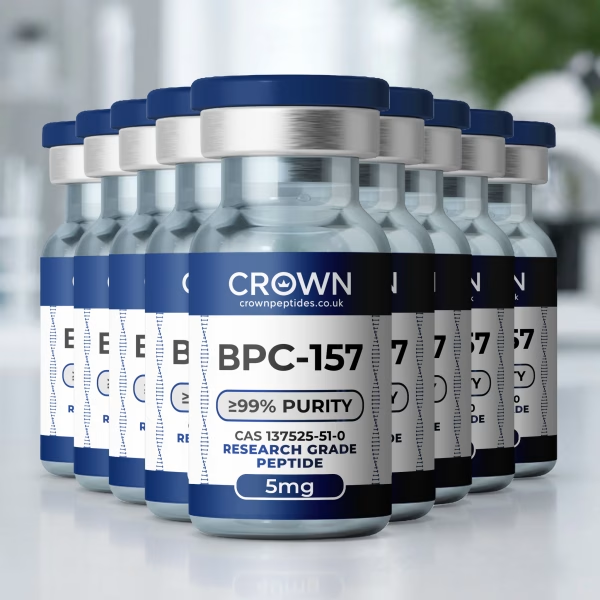
BPC-157 peptide UK is Crown Peptides' synthetic pentadecapeptide composed of 15 amino acids, available in 5mg and 10mg strengths for laboratory research.
- Studied in research involving tissue repair and regeneration
- Studied in research involving wound-healing and tissue-injury models
- Studied in research involving gastrointestinal and gut-related processes
- Studied in research involving inflammatory signalling
- Batch-specific quality documentation available
About BPC-157 Peptide UK
BPC-157 is a synthetic pentadecapeptide consisting of a defined 15-amino-acid sequence. It has become widely studied in laboratory and preclinical research because of scientific interest in tissue-response pathways, cellular signalling and its behaviour across a range of experimental injury and gastrointestinal models.
Also known as: BPC 157, BPC157, Body Protection Compound-157, PL 14736, PL-10, bepecin.
BPC-157 has the sequence GEPPPGKPADDAGLV. It was first described as a partial sequence of a larger protein, known as Body Protection Compound, that researchers isolated from human gastric juice. The 15-amino-acid fragment is the part that has attracted the most laboratory interest, and it is the form supplied by Crown Peptides in 5mg and 10mg vials.
One reason BPC-157 is so widely used in research is its stability. Many short peptides break down quickly in solution, while BPC-157 has been reported to remain stable in gastric juice and across a range of experimental conditions. That makes it a practical research tool for laboratories studying how tissues respond to injury, how new blood vessels form, and how the gut lining is maintained in experimental models.
Over the past three decades, BPC-157 has been investigated in a large body of preclinical work, mostly in cell cultures and animal models. Researchers have used it to explore tissue-response pathways, cellular signalling and vascular biology, which is why it is often studied alongside TB-500 and in combination as the Wolverine Stack. For a full, plain-English walk through the research, see the BPC-157 research guide.
Every Crown Peptides batch of BPC-157 is independently tested by HPLC for purity and by mass spectrometry for identity, and the Certificate of Analysis for the batch you receive is published on this page and linked from the QR code on the vial.
BPC-157 Research
Published research has explored BPC-157’s role in tissue repair and nociception (pain-signalling) research (Learn more), wound healing, tissue-injury models, gastrointestinal and gut-related processes, inflammatory signalling, angiogenesis and connective-tissue biology. Researchers have also examined molecular pathways associated with cellular migration and vascular response, contributing to continued interest in BPC-157 as a mechanistic peptide research tool alongside compounds such as TB-500.
Most of this research is preclinical, carried out in cell cultures and animal models. For the study-by-study detail and references, see the BPC-157 research guide and BPC-157 vs TB-500: What Is the Difference?
Gastric origins and gut-lining research
BPC-157 began life in the stomach. In the early 1990s, Predrag Sikirić’s team in the Department of Pharmacology at the University of Zagreb described a larger protective protein in human gastric juice, which they called Body Protection Compound, and the 15-residue stretch now sold as BPC-157 is a partial sequence of it. Unusually for so short a chain, the fragment was reported to stay intact in human gastric juice.
That origin shaped the first experiments. Rat models of damage to the stomach and intestinal lining came first, including mucosal lesions provoked by alcohol and by non-steroidal anti-inflammatory drugs, and the work later widened to fistula, oesophageal and bowel models. By the early 2000s the Croatian company Pliva was testing the peptide in clinical studies for inflammatory bowel disease under the code PL 14736. The Gastrointestinal Research Bundle groups it with KPV and VIP for laboratories working in this area.
Tendon, ligament and muscle: the rat injury models
Musculoskeletal studies make up a large share of the BPC-157 literature. A much-cited example cut through the rat Achilles tendon a few millimetres above the heel bone, leaving a wide gap between the two ends, and then followed recovery for two weeks. Against controls, treated animals showed a higher load at failure and a higher Young’s modulus, better Achilles functional index scores, and more fibroblasts, reticulin and collagen in the healing gap under the microscope (Learn more).
The same style of experiment has since been applied to transected muscle, ligament injuries and the myotendinous junction where muscle meets tendon, largely by the Zagreb group. Newer studies have begun to put BPC-157, TB-500 and the pair together in one rat Achilles repair model, which is the thinking behind the Wolverine Stack.
Inside the tendon fibroblast: outgrowth, spreading and survival
A team at Chang Gung University in Taiwan studied what happens inside fibroblasts taken from rat Achilles tendon. In their experiments BPC-157 did not make the cells divide any faster, yet it sped up the outgrowth of cells from small tendon explants, improved survival when cultures were stressed with hydrogen peroxide, and increased migration through a transwell filter as the concentration rose.
Treated fibroblasts also flattened out across the dish more quickly and assembled more filamentous actin, the cable-like network a cell uses to crawl. Western blotting tied this to greater activation of focal adhesion kinase and paxillin, the proteins that anchor that network to the spots where a cell grips its surface. A follow-up from the same laboratory found the growth hormone receptor among the genes most strongly switched on in these cells.
VEGFR2, nitric oxide and new blood vessels
Healing tissue needs a blood supply, so angiogenesis is one of the busiest BPC-157 research themes. One 2017 study ran it through several angiogenesis tests at once: vessel density increased in the chick chorioallantoic membrane assay and in endothelial tube-formation tests, and laser Doppler scanning showed faster return of blood flow in an ischaemic rat hind-limb model (Learn more).
In human vascular endothelial cells, BPC-157 raised levels of the receptor VEGFR2 while leaving its usual partner VEGF-A unchanged, and it pushed the receptor to be taken up into the cell. Blocking that uptake with dynasore also blunted the downstream VEGFR2–Akt–eNOS signalling. Since eNOS is the enzyme that makes nitric oxide in blood-vessel linings, the finding sits neatly beside the Zagreb group’s long-running interest in how BPC-157 interacts with the nitric oxide system.
Inflammatory signalling and the open questions
Reviews of the animal literature regularly report lower inflammatory cytokine activity in BPC-157 studies, and critical reviews published recently have pulled together its rodent ischaemia–reperfusion work, where oxidative stress, inflammation and nitric oxide responses are measured side by side. Laboratories building inflammation models often compare it with smaller signalling peptides such as KPV.
Good research also means being clear about the gaps. Formal preclinical pharmacokinetic work reports a plasma half-life of under 30 minutes, which sits awkwardly beside effects lasting hours or days in animal studies. Review titles such as “Regeneration or Risk?” show how actively the field is debating what the animal data mean, and settling those questions is a big part of why BPC-157 stays so widely studied.
Specifications
- Product
- BPC-157
- Classification
- Synthetic pentadecapeptide composed of 15 amino acids
- Available strengths
- 5mg and 10mg
- Form
- Research material supplied according to product label
- Purity / assay
- 99% (HPLC), batch-specific; refer to Certificate of Analysis
- Verification
- HPLC and Mass Spectrometry where analytically appropriate
- Also known as
- BPC 157, BPC157, Body Protection Compound-157, PL 14736, PL-10, bepecin
- Sequence (three-letter code)
- Gly-Glu-Pro-Pro-Pro-Gly-Lys-Pro-Ala-Asp-Asp-Ala-Gly-Leu-Val
- Appearance
- White lyophilised (freeze-dried) powder in a sealed glass vial
- Pack sizes
- 1, 5 or 10 vials, in 5mg or 10mg, with savings on 5 and 10
- Product Name
- BPC-157
- CAS Number
- 137525-51-0
- Molecular Formula
- C62H98N16O22
- Molecular Weight
- approximately 1419.5 g/mol
- Amino-acid sequence
- GEPPPGKPADDAGLV
Purity and Testing
Crown Peptides BPC-157 is supplied for controlled laboratory research with batch-specific analytical documentation. High-Performance Liquid Chromatography (HPLC) can assess chromatographic purity, while Mass Spectrometry provides molecular information used to support identity verification.
The batch-specific Certificate of Analysis is the definitive source for the exact purity result, identity data and analytical specification of the material supplied.
Storage Conditions
- Store unreconstituted material at -20°C ± 5°C in a cool, dry environment
- Prepared research solutions should use validated storage conditions appropriate to the compound and study design
- Protect from unnecessary heat, direct light and repeated temperature fluctuations
BPC-157 Frequently Asked Questions
About BPC-1576 questions
What is BPC-157?
BPC-157 is a 15-residue peptide, Gly-Glu-Pro-Pro-Pro-Gly-Lys-Pro-Ala-Asp-Asp-Ala-Gly-Leu-Val (GEPPPGKPADDAGLV in one-letter code), with a molecular weight of about 1,419.5 g/mol. It copies part of a larger protein found in human gastric juice and comes as a lyophilised white powder, in 5mg and 10mg vials. It is also written BPC 157 or BPC157, and older papers use PL 14736, PL-10 or bepecin.
Which laboratory is behind most BPC-157 research?
It came out of Predrag Sikirić’s pharmacology group at the University of Zagreb School of Medicine in Croatia, which published the first papers in the early 1990s and has produced a large share of the literature ever since. Independent teams, notably at Chang Gung University in Taiwan, later added their own cell-culture and angiogenesis studies, a useful second line of evidence.
What are the CAS number and molecular formula of BPC-157?
The commonly referenced CAS number is 137525-51-0, and the molecular formula is C62H98N16O22. Both describe the 15-residue chain itself, with its free amino and carboxyl ends.
Why is BPC-157 called a “stable gastric pentadecapeptide”?
Every word in that phrase earns its place. “Pentadeca” means fifteen, matching its 15 residues. “Gastric” points to its source in human gastric juice. “Stable” reflects reports that, unlike most short peptides, it is not rapidly broken down in gastric juice, a feature the Zagreb group puts front and centre in its paper titles.
What was PL 14736?
PL 14736 was the development code used when the Zagreb-based pharmaceutical company Pliva took BPC-157 into early clinical studies for inflammatory bowel disease in the early 2000s. The programme never produced a licensed product, and a 2026 pharmaceutics review notes that there is still no approved formulation of BPC-157 anywhere and no completed phase II trial. That unlicensed status is also why the World Anti-Doping Agency has listed BPC-157 since 1 January 2022 under S0, its category for pharmacological substances without current approval for human therapeutic use.
How much human data exists for BPC-157?
Only to a very limited extent. A systematic review of the orthopaedic literature up to mid-2024 included 35 preclinical studies and a single clinical one, a small retrospective case series. A later review counted fewer than 30 participants in total across three uncontrolled pilot studies, so nearly everything known about BPC-157 still comes from cells and animals.
Research context & related products3 questions
How do BPC-157 and TB-500 differ in origin and focus?
They come from entirely unrelated proteins. BPC-157 is a stomach-derived 15-mer, whereas TB-500 is built on the actin-binding stretch of thymosin beta-4. In cell work BPC-157 is mostly linked with growth-factor receptors and vascular signalling, while TB-500 research centres on how cells handle actin as they move. Our article BPC-157 vs TB-500 puts them side by side, and TB-500 is available on its own.
What is the Wolverine Stack?
Wolverine Stack is the nickname researchers use for BPC-157 and TB-500 combined. Crown Peptides supplies it as one pre-blended vial, the Wolverine Stack, in 5mg + 5mg and 10mg + 10mg, for studies that want the two peptides at an equal ratio from the start.
Why does growth hormone come up in BPC-157 tendon research?
The connection runs through a receptor rather than the hormone itself. In a 2014 microarray study of rat tendon fibroblasts, the growth hormone receptor was one of the most strongly increased genes after BPC-157 exposure. When growth hormone was then added, those primed cells proliferated more, with JAK2 signalling switched on, which suggests BPC-157 made the cells more responsive rather than acting as a growth-hormone releaser.
Identity, strengths & handling3 questions
How do BPC-157’s four prolines help confirm its identity?
The intact peptide has a monoisotopic mass of about 1,418.7 Da, so it typically appears as singly and doubly protonated ions near m/z 1,419.7 and 710.4. The more telling fingerprint comes when that ion is broken apart. Bonds on the N-terminal side of proline tend to cleave readily, so the Pro-Pro-Pro run at positions 3 to 5, plus a fourth proline at position 8, leaves a recognisable fragment pattern that helps distinguish true BPC-157 from a scrambled or shortened sequence of the same mass.
How do the 5mg and 10mg strengths and multi-vial packs fit different BPC-157 projects?
Think about how long the project runs and how many experimental groups it needs. The 5mg vial is a neat size for pilot work and cell-culture assays, where working concentrations are low and one vial goes a long way. The 10mg vial halves the number of reconstitutions over a longer animal series. Buying five or ten vials together lowers the price of each and makes it easier to keep a whole study on one batch covered by a single Certificate of Analysis.
Does BPC-157’s reputation for stability mean it can be stored casually?
No. The gastric-juice findings describe how the peptide behaved in a particular experiment, not how it copes with months on a warm shelf. As a freeze-dried powder it keeps best at -20°C, dry and out of the light. Laboratories commonly dissolve it in bacteriostatic water and then hold the solution under validated conditions; the storage guide has more detail.
Read the batch certificate before you order
Every batch is published openly — identity, purity and batch number, with no account needed.
View lab reports- Laboratory research only
- Not for human or clinical use
- Not for human or veterinary consumption
Supplied for laboratory research purposes only — not for human consumption or for medical, veterinary or diagnostic use.
Other Research Peptides
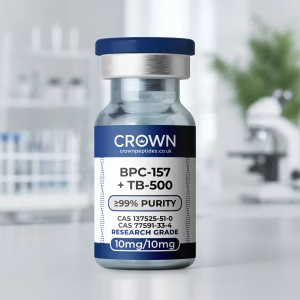 Musculoskeletal researchBPC-157 + TB-500 Blend (Wolverine Stack)5mg / 5mg · 2 strengths ›