Register today and get 10% off your first orderRegister for 10% off your first orderRegister now
Crown Peptides

Research Peptides

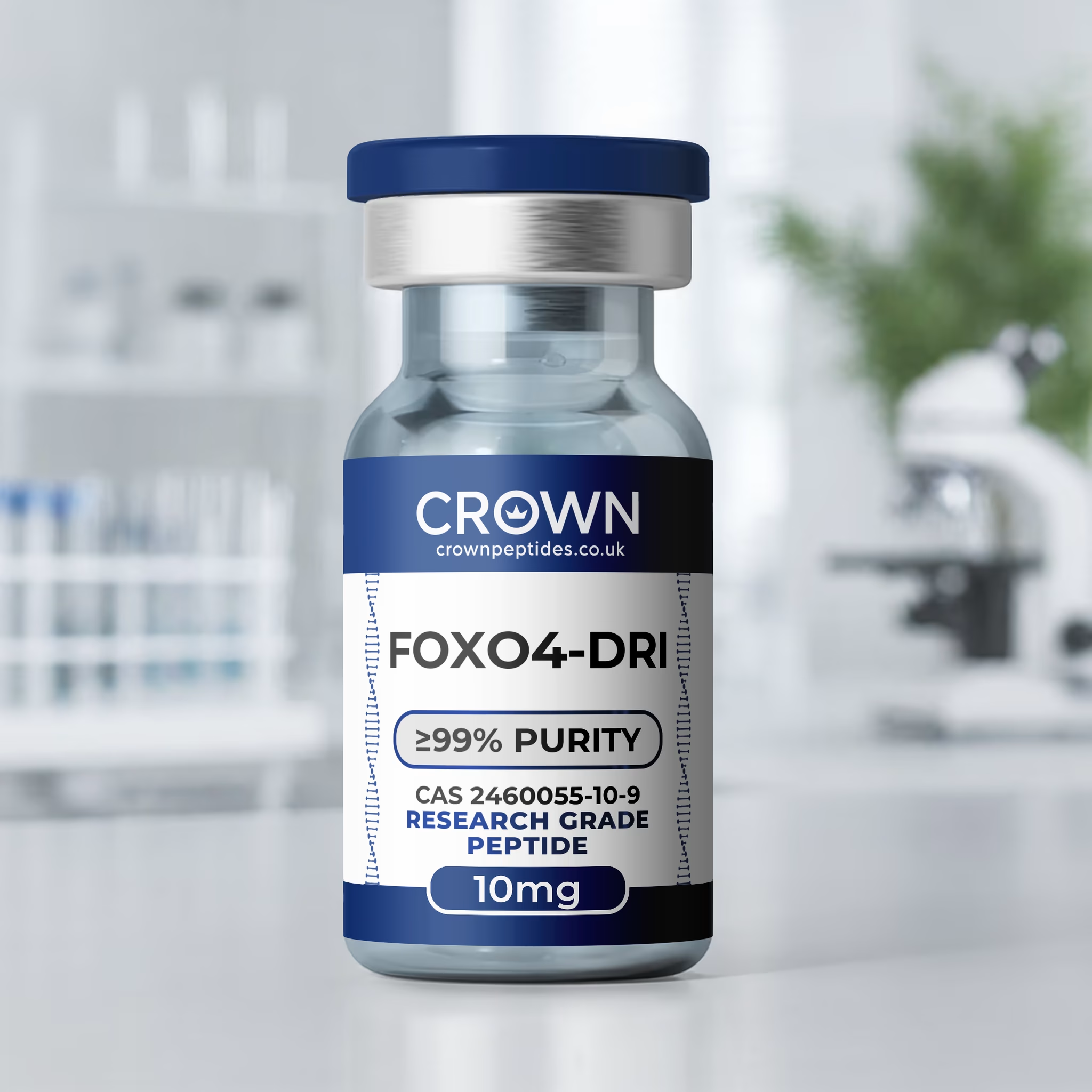
FOXO4-DRI Research Peptide

A high-purity research peptide studied in cellular senescence and FOXO4-p53 research. Coming soon in 10mg, with every batch independently tested and dispatched from the UK.

£89.99or from £67.49 per vial in packs of 10
Save up to 25%
From: £89.99
Your selection:
All Batches TestedEvery batch, no exceptions
HPLC & MS VerifiedFull certificate published
Same Day PostageOrder before 2pm
UK Based CompanyDispatched from the UK
Product Overview

A high-purity research peptide studied in cellular senescence and FOXO4-p53 research. Coming soon in 10mg, with every batch independently tested and dispatched from the UK.

Full Product Specification
Overview

Product Overview

FOXO4-DRI peptide UK is Crown Peptides’ synthetic D-retro-inverso FOXO4 research peptide, coming soon in 10mg for laboratory research.

10mg (coming soon)Available strengthHPLC testedChromatographic purityMS verifiedIdentity confirmedBatch CoADocumentation supplied

Supplied for laboratory research purposes only — not for human consumption or for medical, veterinary or diagnostic use.

Key features

Key Features

  • Studied in research involving cellular senescence and senescent-cell clearance
  • Studied in research involving the FOXO4–p53 protein interaction
  • Studied in research involving rodent models of chemotoxicity, ageing and fibrosis
  • Studied in research involving the structural biology of the p53 transactivation domain
  • Batch-specific quality documentation available
Background

About FOXO4-DRI Peptide UK

FOXO4-DRI is a synthetic peptide designed to interfere with the binding between two proteins, FOXO4 and p53, inside senescent cells. Senescent cells are cells that have permanently stopped dividing but have not died, and they build up in tissues with age and after certain kinds of damage. The peptide is built from D-amino acids in reversed order, a “retro-inverso” design that mimics the shape of a natural FOXO4 segment while resisting the enzymes that normally break peptides down. It sits in the ageing and cellular research area alongside Epitalon and SS-31.

The compound was introduced in 2017 by a Dutch research group studying how senescent cells avoid dying. Since then it has become one of the most widely discussed tools in senolytic research, the field that studies whether selectively removing senescent cells changes how tissues behave. The published results are genuinely mixed: some models report improvements, others report no benefit or harm. A fair reading of FOXO4-DRI needs both sides, and this page sets them out.

Also known as: FOXO4-D-Retro-Inverso, FOXO4 DRI, FOXO4 peptide

Research

FOXO4-DRI Research

FOXO4-DRI was first described in a 2017 study showing that, in senescent cells, the transcription factor FOXO4 holds p53 inside the nucleus and keeps the cell alive, and that a peptide disrupting this interaction pushes senescent cells into programmed cell death while largely sparing normal cells. (Learn more) Related ageing and cellular research compounds include NAD+ and MOTS-c.

  • FOXO4–p53 interaction in senescent cells
  • Senescent-cell clearance in rodent and cell models
  • Models with mixed or negative outcomes
  • Structural studies of how the peptide binds
Where the story starts: why senescent cells survive

Senescent cells have switched on the p53 pathway, which normally triggers cell death after severe damage, yet many of them persist for long periods. The 2017 study found that FOXO4 levels rise in senescent cells and that FOXO4 binds p53 in the nucleus, holding it in a state that stops the cell from dying. The researchers designed FOXO4-DRI to compete for that binding. In their experiments the peptide caused p53 to leave the nucleus and triggered cell-intrinsic apoptosis in senescent cells. In mice it counteracted the tissue damage caused by the chemotherapy drug doxorubicin, and in fast-ageing XpdTTD/TTD mice and naturally aged mice it was reported to restore fur density, fitness and kidney function measures. (Learn more)

Leydig cells and the testis

Two later studies applied the peptide to senescent Leydig cells, the testosterone-producing cells of the testis. In 2020, FOXO4-DRI selectively removed hydrogen-peroxide-induced senescent TM3 Leydig cells in culture and improved the testicular microenvironment in naturally aged mice. (Learn more) A 2024 study in aged mice reported improved spermatogenesis, linked to reduced secretion of the inflammatory signals that senescent Leydig cells release, collectively called the senescence-associated secretory phenotype. (Learn more)

A result that removed cells but not the problem

In 2021, researchers tested FOXO4-DRI on human chondrocytes, the cartilage-forming cells, that had become senescent through repeated growth in culture. The peptide removed more than half of the cells at the later stage of expansion and lowered the senescence level of the remaining population. However, it did not improve the cells’ ability to form cartilage, the outcome the work was aiming for, and the authors concluded that its usefulness for cartilage formation needed further investigation. (Learn more)

Lung fibrosis

A 2022 study in mice with bleomycin-induced pulmonary fibrosis reported that the FOXO4 peptide targeted myofibroblasts, the scar-forming cells in fibrotic lung, and reduced fibrosis through pathways linked to the extracellular matrix. Researchers reading this paper should note that a correction was published in 2024. (Learn more)

A model where clearance made things worse

A 2023 study on pulmonary hypertension found the opposite of a benefit. In mouse models, senolytic interventions, including FOXO4-DRI, led to adverse changes in lung blood-vessel pressure measurements and loss of pulmonary endothelial cells, the cells lining the lung’s blood vessels. The authors concluded that eliminating senescent endothelial cells in the lung may worsen pulmonary haemodynamics. (Learn more)

How the peptide actually binds

A 2025 structural study used nuclear magnetic resonance to map the interaction at atomic level. It found that both FOXO4 and FOXO4-DRI target the disordered transactivation domain of p53, and that both the FOXO4-derived section and the positively charged cell-penetrating section of the peptide contribute to binding. The authors declared commercial interests in this area, which readers should take into account. (Learn more)

Taken together, FOXO4-DRI is a well-known but still contested tool for laboratory research on senescence: its mechanism has been mapped in detail, it has produced striking results in some rodent models, and it has produced neutral or harmful results in others, which is why the evidence has to be read model by model rather than as a single conclusion.

Specifications

Specifications

Product
FOXO4-DRI
Classification
Synthetic D-retro-inverso FOXO4 research peptide
Available strength
10mg (coming soon)
CAS number
2460055-10-9
Molecular weight
≈ 5,358 g/mol
Molecular formula
C228H388N86O64
Form
Research material supplied according to product label
Purity and assay
≥99% (HPLC), batch-specific — refer to Certificate of Analysis
Verification
HPLC and Mass Spectrometry where analytically appropriate

Compound-level reference data. Batch-specific results appear on the Certificate of Analysis.

Work out concentration with the peptide calculator
Testing

Purity and Testing

Crown Peptides FOXO4-DRI will be supplied with batch-specific quality documentation appropriate to the material. FOXO4-DRI is a long peptide of roughly 5,358 daltons, built from D-amino acids and carrying a cell-penetrating section rich in charged residues, so it is more demanding to make and check than a short peptide. Shorter chains left over from synthesis can sit close to the main peak on HPLC, which is why mass spectrometry is used to confirm that the full-length molecule is present. The Certificate of Analysis should be used as the definitive source for identity, assay, purity and relevant impurity information.

Storage

Storage Conditions

  • Store unreconstituted material at -20°C ± 5°C in a cool, dry environment
  • Prepared research solutions should use validated storage conditions appropriate to the compound and study design
  • Protect from unnecessary heat, direct light and repeated temperature fluctuations
Full storage guide
Related

Related Compounds

Researchers working with FOXO4-DRI may also be interested in Epitalon, SS-31, NAD+, MOTS-c, 5-Amino-1MQ and GHK-Cu — other compounds studied in ageing, cellular and mitochondrial research.

Compliance

Research Use Only

  • Laboratory research only
  • Not for human or clinical use
  • Not for human or veterinary consumption
  • Qualified personnel only
Questions

FOXO4-DRI Frequently Asked Questions

About FOXO4-DRI7 questions
What is FOXO4-DRI?

FOXO4-DRI is a synthetic research peptide designed to block the interaction between the proteins FOXO4 and p53 inside senescent cells. It was first described in 2017 and is used in laboratory research on cellular senescence, in cell culture and in rodent models of chemotherapy damage, ageing and fibrosis.

What does “DRI” stand for?

DRI stands for D-retro-inverso. The peptide uses D-amino acids, the mirror-image forms of the amino acids found in natural proteins, and lists them in reverse order. The result has side chains arranged much like the natural FOXO4 segment, but a backbone that protein-digesting enzymes recognise poorly, so it lasts longer in biological systems.

What is a senescent cell?

A senescent cell has permanently stopped dividing, usually after damage to its DNA, shortened telomeres or other stress, but stays alive and metabolically active. Senescent cells release a mix of inflammatory and tissue-remodelling signals, and they build up with age and after treatments such as chemotherapy, which is why researchers study ways to remove them.

Why does FOXO4 matter to p53?

p53 is a protein that decides whether a damaged cell repairs itself, stops dividing or dies. The 2017 study found that in senescent cells, FOXO4 binds p53 in the nucleus and keeps it from triggering cell death. Breaking that bond with FOXO4-DRI released p53 and allowed senescent cells to undergo apoptosis, the cell’s built-in self-destruct process.

Why is the peptide so much larger than most research peptides?

At around 5,358 daltons, FOXO4-DRI is several times heavier than short peptides such as Epitalon. It needs a long enough FOXO4-like section to compete for p53 binding, plus a positively charged cell-penetrating section that carries it across cell membranes. The 2025 structural study found that both parts contribute to how it binds.

How is FOXO4-DRI different from small-molecule senolytics?

Most early senolytic compounds were small drug-like molecules that act on survival pathways such as BCL-2 family proteins. FOXO4-DRI is instead a peptide aimed at one protein–protein interaction, FOXO4 with p53. That gives researchers a different tool for asking which survival mechanism senescent cells depend on in a particular tissue or model.

Is FOXO4-DRI the same as Thymalin or other ageing-research peptides?

No. Thymalin is a thymus-derived bioregulator studied in immune research, and peptides such as SS-31 target mitochondria. FOXO4-DRI is unusual in being designed to make one specific type of cell, the senescent cell, die, rather than to support or protect cells.

Findings in research models4 questions
What did the original 2017 study report?

The study reported that FOXO4-DRI caused selective apoptosis of senescent cells in culture, counteracted doxorubicin-induced damage in mice, and improved fur density, fitness and kidney function measures in fast-ageing and naturally aged mice. These are rodent findings from a single research group and have not been tested as such in people.

Have any studies found FOXO4-DRI unhelpful or harmful?

Yes. A 2021 study on human chondrocytes found that it removed senescent cells but did not improve cartilage formation. A 2023 study in mouse models of pulmonary hypertension found that senolytic interventions including FOXO4-DRI worsened lung blood-vessel pressure measurements and caused loss of endothelial cells. Results clearly depend on the tissue and model.

What has FOXO4-DRI shown in Leydig cell research?

Leydig cells produce testosterone in the testis. In a 2020 study, FOXO4-DRI selectively cleared senescent Leydig cells in culture and improved the testicular environment in aged mice, and a 2024 study reported improved spermatogenesis in aged mice, linked to reduced inflammatory secretion from senescent Leydig cells.

What has structural research revealed about the peptide?

A 2025 study using nuclear magnetic resonance showed that FOXO4 and FOXO4-DRI both bind the disordered transactivation domain of p53, a flexible region rather than a fixed pocket. It also found that the cell-penetrating section is not just a carrier but takes part in binding, which matters for anyone designing modified versions.

Buying, testing & storage4 questions
Is FOXO4-DRI legal to buy in the UK?

FOXO4-DRI is not a controlled drug under the Misuse of Drugs Act 1971, and it is not a licensed medicine in the UK. It is sold in the UK as a research compound for laboratory use only, which is how Crown Peptides supplies it. This is general information, not legal advice.

Where can I buy FOXO4-DRI in the UK?

FOXO4-DRI is coming soon to Crown Peptides in 10mg vials, available singly or in packs of 3, 5 or 10 with a saving on every vial. Orders ship from the UK, and every batch is independently tested, with its Certificate of Analysis published on this page once stock arrives.

How far does a 10mg vial go?

Because FOXO4-DRI is a large peptide of about 5,358 daltons, 10mg is roughly 1.9 micromoles, far fewer molecules per milligram than a short peptide gives. Cell studies typically work in the micromolar range, so one vial covers a moderate amount of in vitro work, and the 5 and 10-vial packs keep a longer project on a single batch.

How should FOXO4-DRI be stored once it arrives?

Keep the unreconstituted powder at -20°C ± 5°C, dry and away from light. Long, highly charged peptides can stick to surfaces and absorb moisture, so vials are best kept sealed until use and brought to room temperature before opening. Prepared solutions should follow storage conditions validated for your study design, and each batch’s Certificate of Analysis documents the material as dispatched.

Read the batch certificate before you order

Every batch is published openly — identity, purity and batch number, with no account needed.

View lab reports

Supplied for laboratory research purposes only — not for human consumption or for medical, veterinary or diagnostic use.

All Batches TestedEvery batch, no exceptions

Each batch undergoes internal analytical verification using chromatographic and spectrometric methods prior to lyophilisation.

• HPLC Analysis
• Mass Spectrometry Confirmation
• Batch Traceability

For Research Use Only

By purchasing this product you confirm that you are a qualified researcher and that this compound will be used exclusively for laboratory research purposes.

Not for Human Consumption

This product is not intended for diagnostic or therapeutic use.

Any human or medical use is strictly prohibited.

Store Safely at All Times

Store in a cool, dry, secure and sterile environment away from any unauthorised persons or children.

Other Research Peptides

2 strengths5-Amino-1MQ 10mg research compound vial, Crown Peptides UKAgeing research

5-Amino-1MQ Research Compound


From£24.99Strength10mg
Add to basket
Adamax 10mg research peptide vial, Crown Peptides UKNeurocognitive research

Adamax Research Peptide


From£44.99Strength10mg
Add to basket
AHK-Cu 100mg copper peptide vial, Crown Peptides UKAgeing research

AHK-Cu Research Peptide


From£29.99Strength100mg
Add to basket
AICAR 50mg research compound vial, Crown Peptides UKAgeing research

AICAR Research Compound


From£34.99Strength50mg
Add to basket

Further reading

UK research peptides. Every batch HPLC and MS verified, certificate published in full.
SUPPORT Mon to Fri, 9am to 5pmDISPATCH Cut-off 2pmEMAIL Email usWHATSAPP +44 7301 802654

Disclaimer: All products are sold strictly for laboratory research purposes only. Not for human or veterinary use, consumption, therapeutic, or diagnostic application. None of our products are medicines, and none are presented as such. By purchasing, you confirm you are a qualified professional and legally permitted to handle these materials in compliance with all applicable laws and regulations. Misuse, resale for unauthorised purposes, or unlawful application is strictly prohibited. Crown Peptides UK disclaims all liability for improper use, handling, or regulatory non-compliance.

© 2026 Crown Peptides UK, a trading name of Crown Peptides Ltd (company no. 17068950), Suite Ra01, 195-197 Wood Street, London E17 3NU . All Rights Reserved.