Register today and get 10% off your first orderRegister for 10% off your first orderRegister now
Crown Peptides
SAVE20%

Research Peptides

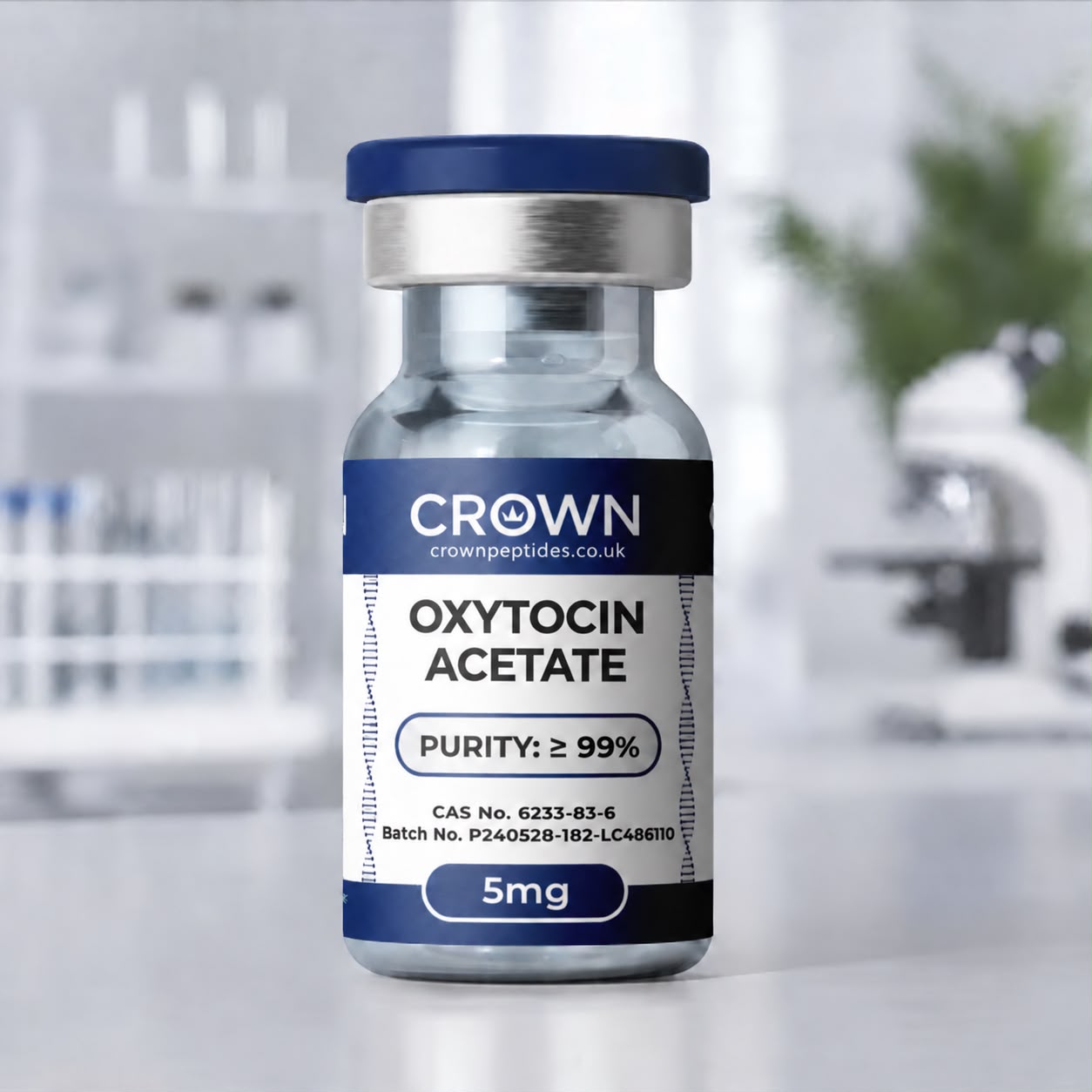
Oxytocin Acetate Research Peptide

A high-purity research peptide studied in social-bonding and hormone research. Available in 5mg, with every batch independently tested and dispatched from the UK.

£24.99or from £19.99 per vial in packs of 10
Save up to 20%
From: £24.99
Your selection:
Batch level verified
All Batches TestedEvery batch, no exceptions
HPLC & MS VerifiedFull certificate published
Same Day PostageOrder before 2pm
UK Based CompanyDispatched from the UK
Product Overview

A high-purity research peptide studied in social-bonding and hormone research. Available in 5mg, with every batch independently tested and dispatched from the UK.

Full Product Specification
Overview

Product Overview

Oxytocin Acetate is a synthetic nonapeptide consisting of 9 amino acids, widely used in laboratory research investigating oxytocin-receptor signalling, neuroendocrine pathways and behavioural biology.

Supplied by Crown Peptides as a high-purity lyophilised research peptide, Oxytocin Acetate is verified using HPLC and Mass Spectrometry, with a batch-specific Certificate of Analysis available for quality verification.

5mgAvailable strengthHPLC testedChromatographic purityMS verifiedIdentity confirmedBatch CoADocumentation supplied

Supplied for laboratory research purposes only — not for human consumption or for medical, veterinary or diagnostic use.

Key features

Key Features

  • Studied in research involving oxytocin-receptor (OXTR) signalling
  • Studied in research involving neuroendocrine and behavioural biology
  • Studied in research involving social-recognition and stress-response models
  • Studied in research involving reproductive and smooth-muscle signalling
  • Batch-specific quality documentation available
Background

About Oxytocin Acetate Peptide UK

Oxytocin Acetate is a synthetic cyclic nonapeptide supplied as the acetate salt of oxytocin, a hormone produced naturally in the hypothalamus. It has become widely studied in laboratory and preclinical research because of scientific interest in oxytocin-receptor signalling, cellular behaviour and its role across a range of experimental neuroendocrine and behavioural models.

Also known as: oxytocin, OXT, oxytocin acetate salt.

Research

Oxytocin Acetate Research

Published research has explored Oxytocin Acetate’s role in oxytocin-receptor signalling and astrocytic mechanisms underlying anxiolytic effects (Learn more), social-recognition and bonding models, stress-response pathways, neuroendocrine signalling, reproductive physiology and smooth-muscle biology. Researchers have also examined molecular pathways associated with autonomic regulation and cellular signalling, contributing to continued interest in Oxytocin Acetate as a mechanistic peptide research tool alongside compounds such as Selank.

  • Oxytocin-receptor (OXTR) signalling
  • Social-recognition and bonding models
  • Stress-response and neuroendocrine pathways
  • Reproductive and smooth-muscle signalling
  • Autonomic regulation and cellular signalling
Nine residues and a ring: the first hormone built in a flask

In 1906 the British pharmacologist Henry Dale found that extracts of the posterior pituitary made uterine muscle contract,, and within a few years the same extracts were linked to milk let-down. The name comes from Greek words meaning “swift birth”. In the early 1950s Vincent du Vigneaud’s laboratory worked out its sequence and then, in 1953, assembled it from individual amino acids. It was the first chemical synthesis of a peptide hormone, and in 1955 du Vigneaud received the Nobel Prize in Chemistry for his work on biochemically important sulphur compounds, especially that first synthesis of a polypeptide hormone.

The sulphur explains the shape. The cysteines at positions 1 and 6 are joined by a disulphide bridge, closing the first six residues into a ring, while proline, leucine and a C-terminal glycinamide hang off it as a short tail.

Oxytocin and vasopressin: a family two swaps apart

Oxytocin has a close sibling in arginine vasopressin, the hormone best known for its role in water balance. Both are cyclic nonapeptides built on the same disulphide ring, and they differ at only two positions: isoleucine at position 3 of oxytocin is phenylalanine in vasopressin, and leucine at position 8 is arginine. Their genes sit side by side on human chromosome 20, the legacy of an ancient gene duplication.

That near-identical chemistry matters at the bench. Four receptors respond to this peptide family: the oxytocin receptor plus the vasopressin V1a, V1b and V2 receptors. At high concentrations oxytocin can activate V1a receptors, so well-designed studies lean on selective antagonists or receptor-knockout tissue to show which receptor is responsible for an effect.

OXTR: one receptor from uterine muscle to brain

The human oxytocin receptor was cloned in 1992 by Kimura and colleagues, who described a 388-amino-acid protein with seven membrane-spanning segments, the signature of a G protein-coupled receptor. Its main signalling route runs through Gq proteins and phospholipase C to a rise in intracellular calcium, which is why uterine smooth muscle and the milk-ejecting myoepithelial cells of the mammary gland respond so strongly. Receptor messenger RNA in uterine muscle was found to rise sharply near term.

This uterine biology explains oxytocin’s long clinical record. Oxytocin is a licensed hospital medicine, marketed under names such as Syntocinon in the UK and Pitocin in the US, used to induce or strengthen labour and to control bleeding after delivery. The receptor is targeted in the opposite direction too: atosiban, an oxytocin-receptor antagonist, has been authorised in the EU since 2000 as Tractocile for delaying threatened preterm birth.

Prairie voles, knockout mice and the biology of bonds

Few animals have shaped oxytocin research like the prairie vole, a small North American rodent that forms lasting pair bonds. In 1994 Williams, Insel and colleagues reported that delivering oxytocin into the brains of female prairie voles helped them form a partner preference after a short period of cohabitation, and that a selective oxytocin-receptor antagonist blocked the effect. Compared with the montane vole, which does not pair-bond, prairie voles carry higher densities of oxytocin receptors in the nucleus accumbens, a reward-related brain region.

Mouse genetics added further layers. Mice lacking the oxytocin gene mated and gave birth normally, yet their pups could not obtain milk, establishing the hormone as essential for milk ejection. Male knockouts also failed to recognise mice they had already met, despite a normal sense of smell, a “social amnesia” that oxytocin reversed. Then a study published in Neuron complicated the story: prairie voles with the receptor gene knocked out still formed pair bonds and cared for their young, suggesting the underlying circuitry is more robust and redundant than the drug studies had implied.

Intranasal studies in people and the replication debate

Human oxytocin research accelerated after a 2005 paper in Nature reported that volunteers given intranasal oxytocin entrusted more money to a stranger in an economic “trust game”. It helped launch a large literature of nasal-spray studies on social perception and cooperation. A critical review by Nave, Camerer and McCullough pooled seven trust-game studies with 481 participants and found a combined effect that was small and not reliably different from zero. A large pre-registered replication led by Declerck and Fehr, published in Nature Human Behaviour, then found no effect of oxytocin on trusting behaviour in the original design.

Debate also continues over how much nasally applied peptide reaches the brain, so headline behavioural claims are best weighed against well-powered, pre-registered and independently replicated work.

Specifications

Specifications

Product
Oxytocin Acetate
Classification
Synthetic cyclic nonapeptide composed of 9 amino acids
Available strength
5mg
CAS number
6233-83-6
Molecular weight
≈ 1067.24 g/mol
Molecular formula
C45H70N12O14S2
Sequence
CYIQNCPLG-NH₂ (disulfide bridge Cys1-Cys6)
Form
Lyophilised peptide powder
Purity and assay
≥99% — batch-specific, refer to Certificate of Analysis
Verification
HPLC and Mass Spectrometry where analytically appropriate

Compound-level reference data. Batch-specific results appear on the Certificate of Analysis.

Work out concentration with the peptide calculator
Storage

Storage Conditions

  • Store unreconstituted material at -20°C ± 5°C in a cool, dry environment
  • Prepared research solutions should use validated storage conditions appropriate to the compound and study design
  • Protect from unnecessary heat, direct light and repeated temperature fluctuations
Full storage guide
Related

Related Compounds

Researchers working with Oxytocin Acetate may also be interested in Selank, Semax, Kisspeptin-10, PT-141 and DSIP — other compounds studied in neuroendocrine, behavioural and cellular research.

Compliance

Research Use Only

  • Laboratory research only
  • Not for human or clinical use
  • Not for human or veterinary consumption
  • Qualified personnel only
Questions

Oxytocin Acetate Frequently Asked Questions

About Oxytocin Acetate6 questions
What is Oxytocin Acetate?

It is oxytocin, the nine-residue hypothalamic hormone CYIQNCPLG-NH₂ with a Cys1–Cys6 disulphide ring, supplied as its acetate salt in freeze-dried form. Crown Peptides makes it available as a high-purity research peptide for work on OXTR signalling, neuroendocrine pathways and behavioural models. In papers and catalogues it also appears simply as oxytocin, OXT or oxytocin acetate salt.

Why was making oxytocin in the lab worth a Nobel Prize?

Before 1953 no one had built a working peptide hormone from scratch. Du Vigneaud’s synthetic oxytocin behaved like the natural hormone, which proved that its activity came entirely from a defined chemical structure and showed that biologically active peptides could be made to order. That opened the door to the synthetic peptide field, analogues included, and the Nobel committee recognised it in 1955.

Why did the original synthesis paper call oxytocin an octapeptide?

Du Vigneaud’s 1953 report described “an octapeptide amide with the hormonal activity of oxytocin”. At the time, the two cysteines bridged by sulphur were counted as one cystine unit, giving eight building blocks. Counting each cysteine separately gives the nine residues used today, which is why oxytocin is now called a nonapeptide.

How closely related are oxytocin and vasopressin?

Extremely closely. They share a ring structure and seven of nine residues, differing only at position 3 (isoleucine versus phenylalanine) and position 8 (leucine versus arginine). Those two changes are enough to steer each peptide towards its own receptors, though some cross-activation occurs at high concentrations.

Does the “acetate” change the oxytocin molecule?

The peptide itself is unchanged; acetate is the counter-ion left from purification. It does change the paperwork. Free oxytocin (C43H66N12O12S2) weighs about 1007 g/mol and carries CAS number 50-56-6, while the acetate salt listed in our Additional Information, C45H70N12O14S2, comes to roughly 1067 g/mol under CAS 6233-83-6. The roughly 60-unit gap is one molecule of acetic acid.

Is this the same as Syntocinon or Pitocin?

Those are licensed medicines: sterile, ready-to-use hospital preparations of oxytocin made under pharmaceutical manufacturing rules and approved by regulators for use in labour and after delivery. Crown Peptides Oxytocin Acetate shares the peptide sequence, but it is a lyophilised laboratory reagent, not a medicinal product, and carries no marketing authorisation.

Receptors & behaviour models4 questions
What kind of receptor does oxytocin act on?

OXTR is a G protein-coupled receptor with seven transmembrane segments, 388 amino acids long in humans. It signals mainly through Gq and phospholipase C, lifting calcium inside the cell. Humans have a single oxytocin receptor type, so experiments that need to rule out vasopressin receptors usually add selective antagonists rather than relying on the agonist alone.

Why do prairie voles keep appearing in oxytocin papers?

They are one of the few laboratory rodents that form lasting pair bonds, and they have a close relative, the montane vole, that does not. That contrast lets researchers compare receptor maps, block receptors in specific brain regions and test partner-preference behaviour.

What did mice without the oxytocin gene reveal?

Two surprises. Females mated and delivered pups normally, so oxytocin turned out not to be required for birth in mice, yet their young failed to feed because milk was never ejected. Males, meanwhile, could smell normally but could not remember individuals they had met, a deficit that oxytocin, and not vasopressin, restored.

Has the “trust hormone” idea held up in human studies?

Not convincingly. The original intranasal trust-game finding has been hard to reproduce: a pooled analysis of seven studies found no reliable effect, and a large pre-registered replication found none in the original setting. The field now puts far more weight on sample size and pre-registration.

Identity, stability & supply3 questions
Why does the sulphur bridge matter when confirming oxytocin’s identity?

Oxytocin is only correct with its ring closed. Mass spectrometry shows the intact peptide near m/z 1007 for the singly protonated ion, while a reduced, ring-opened form sits about two units higher because each cysteine regains a hydrogen. A clean, single peak at the expected mass, alongside the HPLC purity result, is good evidence that the disulphide is in place. Vasopressin, with a molecular weight near 1084, is easily told apart from its sibling.

Why has heat stability been such a big topic for oxytocin?

In accelerated degradation work at 40–80°C, Hawe and colleagues found oxytocin most stable around pH 4.5, with breakdown elsewhere producing deamidated forms in acid and tri- and tetrasulphide species, dimers and aggregates at neutral to alkaline pH. That sensitivity is why the WHO recommends keeping medicinal oxytocin at 2–8°C, and why a heat-stable carbetocin was trialled against it in roughly 30,000 women in the CHAMPION study.

What vial options are there for Oxytocin Acetate?

There is one fill, 5mg of freeze-dried peptide per vial, sold individually or as a box of five at a lower price per vial. A single vial covers pilot or receptor-assay work, while the box of five suits longer behavioural series.

Read the batch certificate before you order

Every batch is published openly — identity, purity and batch number, with no account needed.

View lab reports

Supplied for laboratory research purposes only — not for human consumption or for medical, veterinary or diagnostic use.

All Batches Purity Tested

Each batch undergoes internal analytical verification using chromatographic and spectrometric methods prior to lyophilisation.

• HPLC Analysis
• Mass Spectrometry Confirmation
• Batch Traceability

For Research Use Only

By purchasing this product you confirm that you are a qualified researcher and that this compound will be used exclusively for laboratory research purposes.

Not for Human Consumption

This product is not intended for diagnostic or therapeutic use.

Any human or medical use is strictly prohibited.

Store Safely at All Times

Store in a cool, dry, secure and sterile environment away from any unauthorised persons or children.

Other Research Peptides

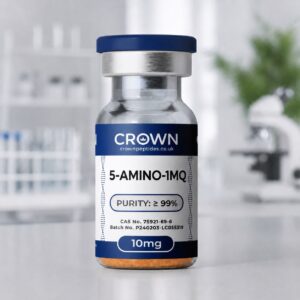
5-Amino-1MQ research compound UK 10mg and 50mg vial - Crown Peptides
≥99% PURITY
HPLC & MS TESTED
5-Amino-1MQ Research Compound
From: £24.99

Buy Now

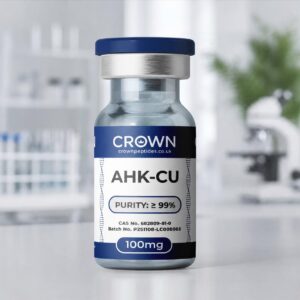
AHK-Cu 100mg research peptide vial – Crown Peptides UK
≥99% PURITY
HPLC & MS TESTED
AHK-Cu Research Peptide
From: £29.99

Buy Now

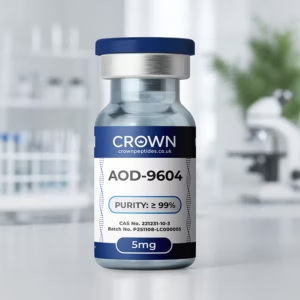
AOD-9604 5mg research peptide vial - Crown Peptides
≥99% PURITY
HPLC & MS TESTED
AOD-9604 Research Peptide
From: £34.99

Buy Now

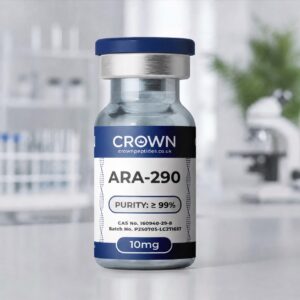
ARA-290 research peptide UK 10mg vial - Crown Peptides
≥99% PURITY
HPLC & MS TESTED
ARA-290 Research Peptide
From: £39.99

Buy Now

Further reading

SUPPORT Mon to Fri, 9am to 5pmDISPATCH Cut-off 2pmEMAIL info@crownpeptides.co.ukWHATSAPP +44 7301 802654

Disclaimer: All products are sold strictly for laboratory research purposes only. Not for human or veterinary use, consumption, therapeutic, or diagnostic application. None of our products are medicines, and none are presented as such. By purchasing, you confirm you are a qualified professional and legally permitted to handle these materials in compliance with all applicable laws and regulations. Misuse, resale for unauthorised purposes, or unlawful application is strictly prohibited. Crown Peptides UK disclaims all liability for improper use, handling, or regulatory non-compliance.

© 2026 Crown Peptides UK, a trading name of Crown Peptides Ltd (company no. 17068950), Suite Ra01, 195-197 Wood Street, London E17 3NU . All Rights Reserved.