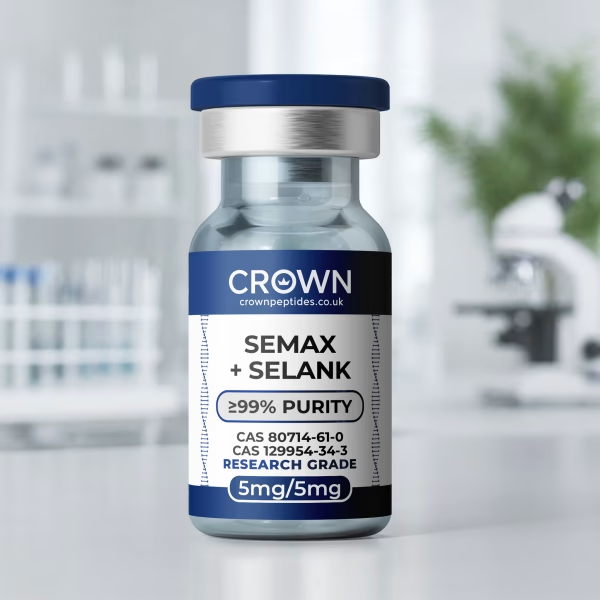
Semax + Selank (Blend)
A high-purity research blend studied in cognitive and stress research.
In stock
Supplied for laboratory research purposes only — not for human consumption or for medical, veterinary or diagnostic use.
Product Overview
Semax Selank blend UK is Crown Peptides' dual-peptide research formulation combining Semax and Selank, supplied in 5mg/5mg and 10mg/10mg vials for laboratory research into neurotrophic, GABAergic and stress-related signalling.
- Studied in research involving Semax-associated neurotrophic research
- Studied in research involving Selank-associated neurotransmitter and stress research
- Studied in research involving cognition and learning models
- Studied in research involving neuronal plasticity and neuroimmune pathways
- Batch-specific quality documentation available
About Semax + Selank Blend UK
The Semax + Selank blend combines two synthetic peptides used in neurobiological research. Semax is associated with ACTH-fragment-derived neurotrophic and neuronal-plasticity research, while Selank is a tuftsin-related peptide studied in neurotransmitter, stress-response and neuroimmune models.
Also known as: Semax Selank blend, Semax/Selank.
Semax + Selank Blend Research
The scientific interest in this combination comes from the different research pathways represented by the two components, with dedicated functional-connectomic work examining both peptides’ effects side by side (Learn more). Semax literature frequently examines BDNF, neuronal plasticity, learning and oxidative-stress responses; Selank literature includes GABAergic signalling, stress-related models and neuroimmune regulation, alongside related nootropic-research peptides such as Semax and Selank individually.
- Semax-associated neurotrophic research
- Selank-associated neurotransmitter and stress research
- Cognition and learning models
- Neuronal plasticity and neuroimmune pathways
Semax: four residues borrowed from ACTH
Semax begins as a piece of adrenocorticotropic hormone. Its opening residues, Met-Glu-His-Phe, match positions 4 to 7 of ACTH, part of a region that animal studies linked to attention and learning decades ago, separate from the hormone's job of signalling to the adrenal glands. Chemists at the Institute of Molecular Genetics of the Russian Academy of Sciences added Pro-Gly-Pro to that fragment, giving the heptapeptide Met-Glu-His-Phe-Pro-Gly-Pro (C37H51N9O10S, about 813.9). Papers usually describe it as a non-hormonal analogue of ACTH(4-10).
Its best-known mechanistic result comes from the rat hippocampus. After a single application, Semax raised BDNF protein by up to 1.4-fold and phosphorylation of the BDNF receptor TrkB by 1.6-fold, while messenger RNA for BDNF exon III rose threefold (Learn more). The same rats produced more conditioned avoidance responses in a learning task, tying the molecular change to behaviour in that model. BDNF (brain-derived neurotrophic factor) is a key growth signal for synaptic plasticity, so this result anchors much Semax work.
Selank: tuftsin rebuilt for neuroscience research
Tuftsin is a natural four-residue fragment, Thr-Lys-Pro-Arg, released from the heavy chain of immunoglobulin G and first characterised as a stimulant of phagocytic immune cells. On its own it is short-lived, so the Institute of Molecular Genetics, working with the V.V. Zakusov Research Institute of Pharmacology, lengthened it with Pro-Gly-Pro to improve its metabolic stability. The result, Selank (Thr-Lys-Pro-Arg-Pro-Gly-Pro, C33H57N11O9, about 751.9), keeps a foot in immunology while being studied mainly in the brain.
Its link with GABA, the brain's main inhibitory transmitter, is the area most researchers come to it for. In rats, Selank shifted the expression of 45 out of 84 neurotransmission genes in the frontal cortex one hour after administration and 22 after three hours, and those changes correlated with the pattern produced by GABA itself (Learn more). A follow-up in IMR-32 human neuroblastoma cells found no direct effect on the same genes, leading the authors to favour an indirect, allosteric influence on GABA-A receptor signalling rather than straightforward gene switching.
Pro-Gly-Pro: the tail both peptides share
Set the two sequences next to each other and the common ending jumps out. Pro-Gly-Pro belongs to a family of short proline- and glycine-rich fragments known as glyprolines, which the Moscow group also studies as regulatory peptides in their own right. Proline-rich sequences resist many of the peptidases that rapidly trim short peptides in blood and tissue, so capping each core sequence with this tripeptide was a deliberate design decision to keep both molecules intact long enough to study.
The shared tail also explains why the two are so often discussed as a pair. They come from the same institute and the same design approach, yet their front halves trace back to entirely different parents: one to a pituitary hormone, the other to an antibody fragment. A combined vial therefore gives researchers a neat way to compare a melanocortin-derived and an immune-derived peptide built on an identical chemical chassis, within one experiment.
Stroke, stress and the transcriptome studies
Both peptides have been examined with genome-wide expression tools. In rats that underwent temporary blockage of the middle cerebral artery, RNA sequencing of the frontal cortex 24 hours later found ischaemia altering 3,774 genes; Semax and a sister peptide, ACTH(6-9)PGP, reduced those disturbances for 1,171 genes associated with immune and nerve-signalling pathways (Learn more). In an acute restraint-stress model, Semax changed the activity of more than 1,500 genes in the rat hippocampus, many of them in the opposite direction to the stress.
Selank's stress research has been mainly behavioural. In rats kept under unpredictable chronic mild stress, the elevated plus maze was used to compare Selank, the benzodiazepine diazepam and the two given together; anxiety measures in the combination group did not differ from pre-stress values. The contrast is instructive: Semax data lean towards injury and plasticity readouts, Selank data towards stress behaviour and inhibitory signalling.
Russian medicines and research material: the distinction
Semax and Selank are unusual among research peptides in holding medicine status in one country. In Russia, Semax is registered as a prescription nasal-drop nootropic and has been included on the national List of Vital and Essential Drugs, while Selank is registered as a 0.15% nasal-drop anxiolytic, with its original registration dating from 2009. Both registrations are held by the Russian company Peptogen.
Neither peptide is authorised as a medicine by the UK's MHRA, the European Medicines Agency or the US FDA, and most of the clinical literature is Russian-language. The Crown Peptides blend is research material produced by peptide synthesis; it is not the registered Russian product and is not formulated as nasal drops.
Specifications
- Product
- Semax + Selank (Blend)
- Classification
- Research blend combining Semax and Selank
- Available strengths
- 5mg + 5mg and 10mg + 10mg
- Purity / assay
- 99% (HPLC), batch-specific; refer to Certificate of Analysis
- Verification
- HPLC and Mass Spectrometry where analytically appropriate
- Also known as
- Semax Selank blend, Semax/Selank
- Product Name
- Semax + Selank (Blend)
- Available form
- 5mg/5mg and 10mg/10mg vials
Purity and Testing
Crown Peptides Semax + Selank (Blend) is supplied for controlled laboratory research with batch-specific analytical documentation. High-Performance Liquid Chromatography (HPLC) can assess chromatographic purity, while Mass Spectrometry provides molecular information used to support identity verification. The batch-specific Certificate of Analysis is the definitive source for the exact purity result, identity data and analytical specification of the material supplied.
Storage Conditions
- Store unreconstituted material at -20°C ± 5°C in a cool, dry environment
- Prepared research solutions should use validated storage conditions appropriate to the compound and study design
- Protect from unnecessary heat, direct light and repeated temperature fluctuations
Semax + Selank Blend Frequently Asked Questions
About the Semax + Selank blend6 questions
What is the Semax + Selank blend?
Each vial combines equal amounts of Semax, the ACTH-derived heptapeptide, and Selank, the tuftsin-derived heptapeptide: 5mg of each (10mg of peptide in total) or 10mg of each (20mg in total). One preparation therefore spans both the neurotrophic side of this research field and its stress- and GABA-related side. Supplier listings spell it in several ways, so it also turns up as Semax/Selank or Semax Selank blend.
What are the sequences of Semax and Selank?
Semax reads Met-Glu-His-Phe-Pro-Gly-Pro (MEHFPGP) and Selank reads Thr-Lys-Pro-Arg-Pro-Gly-Pro (TKPRPGP). Each is seven residues long and the final three are identical. The first four reveal each peptide's origin: positions 4 to 7 of ACTH for Semax, and the immunoglobulin fragment tuftsin for Selank.
How do the research profiles of Semax and Selank differ?
Semax literature concentrates on neurotrophic signalling, especially BDNF and its receptor TrkB, and on gene-expression changes after experimental stroke. Selank appears more often in anxiety-related behaviour tests, GABA-linked gene expression and immune signalling, reflecting its tuftsin roots. Their common ground is stress-response and neuronal-plasticity research.
Is Semax a hormone, given that it comes from ACTH?
Not in the functional sense. The ACTH(4-7) stretch it is built on lacks the part of the hormone that drives the adrenal glands to release corticosteroids, which is why researchers call Semax a non-hormonal analogue. Interest in it centres on effects measured in brain tissue in rodent models, not on classic stress-hormone activity.
What is tuftsin, and how did it lead to Selank?
Tuftsin is a tetrapeptide cut from the Fc region of the immunoglobulin G heavy chain, originally studied for its ability to stimulate phagocytic cells. Selank keeps those four residues unchanged and adds a stabilising Pro-Gly-Pro tail. That heritage is why immune-signalling measures sit alongside brain studies throughout the Selank literature.
Who developed Semax and Selank?
Both were created at the Institute of Molecular Genetics of the Russian Academy of Sciences in Moscow, with Selank developed jointly with the V.V. Zakusov Research Institute of Pharmacology. Semax was described in the scientific literature by the early 1990s, and academician Nikolai Myasoedov appears as a co-author on a large share of the published work on both peptides.
Research and regulatory background4 questions
Are Semax and Selank approved medicines anywhere?
Only in Russia. Semax is registered there as a nasal-drop nootropic dispensed on prescription, and Selank as a nasal-drop anxiolytic. Neither holds a marketing authorisation in the UK, the EU or the US. The research peptides supplied by Crown Peptides are not those medicines, which are separate products with their own formulations.
Have Semax and Selank been studied side by side?
They have, in a handful of papers. A resting-state brain imaging study in 52 healthy volunteers compared Semax, Selank and placebo and reported both shared and peptide-specific changes in connectivity between the right amygdala and the right temporal cortex. Much earlier biochemical work found that both peptides inhibit enkephalin-degrading enzymes in human serum, one of the few mechanisms the pair clearly have in common.
What is ACTH(6-9)PGP, which keeps appearing in Semax papers?
It is a sister molecule from the same laboratory, built on a different ACTH fragment (positions 6 to 9) with the same Pro-Gly-Pro ending. Researchers run it alongside Semax to see how a shift in the ACTH portion changes the result. In the rat stroke transcriptome work, its overall effect turned out to be more similar to Semax than different, with only 32 genes separating the two at the 24-hour point.
Why does Selank research mention enkephalins?
Enkephalins are the body's own short opioid peptides, involved in stress and pain signalling, and they are broken down quickly by enzymes in blood. Selank slows those enzymes in serum samples, and a Russian clinical study comparing it with the benzodiazepine medazepam tracked the stability of leu-enkephalin in patients' blood alongside rating-scale scores. That enzyme link offers a measurable biochemical readout for laboratory work.
Working with the blend3 questions
With identical Pro-Gly-Pro tails, can Semax and Selank be told apart analytically?
Easily, because their front halves have almost nothing in common. Semax carries methionine, glutamic acid, histidine and an aromatic phenylalanine; Selank carries threonine plus the strongly basic lysine and arginine, and no aromatic ring at all. That puts their masses about 62 units apart (roughly 813.9 against 751.9) and gives them clearly different retention on a reverse-phase HPLC column. As a two-peptide mixture, the blend has no single CAS number or formula, so each component is matched against its own reference.
How is the Semax + Selank blend sold, and why buy several vials?
Every vial holds an equal split of Semax and Selank, at 5mg/5mg or 10mg/10mg, sold individually or in packs of three, five and ten. The multi-vial packs work out cheaper per vial and suit projects that repeat behaviour or gene-expression readouts over several weeks, where having enough material in stock from day one avoids pauses between experiments.
Where does VIP fit alongside this blend?
Vasoactive intestinal peptide is a 28-residue neuropeptide found in brain, gut and immune tissue, studied in circadian timing and neuroimmune communication. That second theme overlaps with Selank's tuftsin background, so VIP is a logical comparison for projects on how peptides connect the nervous and immune systems. For work focused on one component, Semax and Selank are also sold separately.
Read the batch certificate before you order
Every batch is published openly — identity, purity and batch number, with no account needed.
View lab reports- Laboratory research only
- Not for human or clinical use
- Not for human or veterinary consumption
Supplied for laboratory research purposes only — not for human consumption or for medical, veterinary or diagnostic use.
Other Research Peptides
 Musculoskeletal researchBPC-157 + TB-500 Blend (Wolverine Stack)5mg / 5mg · 2 strengths ›