Register today and get 10% off your first orderRegister for 10% off your first orderRegister now
Crown Peptides
SAVE25%

Research Peptides

Melanotan-2 Research Peptide

A high-purity research peptide studied in skin-pigmentation research. Available in 10mg, with every batch independently tested and dispatched from the UK.

£31.99or from £23.99 per vial in packs of 10
Save up to 25%
From: £31.99
Your selection:
Batch level verified
All Batches TestedEvery batch, no exceptions
HPLC & MS VerifiedFull certificate published
Same Day PostageOrder before 2pm
UK Based CompanyDispatched from the UK
Product Overview

A high-purity research peptide studied in skin-pigmentation research. Available in 10mg, with every batch independently tested and dispatched from the UK.

Full Product Specification
Overview

Product Overview

Melanotan-2 peptide UK is Crown Peptides' synthetic cyclic heptapeptide, also known as an alpha-MSH (melanocyte-stimulating hormone) analogue, available in 10mg strength for laboratory research.

10mgAvailable strengthHPLC testedChromatographic purityMS verifiedIdentity confirmedBatch CoADocumentation supplied

Supplied for laboratory research purposes only — not for human consumption or for medical, veterinary or diagnostic use.

Key features

Key Features

  • Studied in research involving melanocortin receptor pharmacology (MC1R, MC3R, MC4R)
  • Studied in research involving melanogenesis and melanocyte signalling pathways
  • Studied in research involving neuroendocrine and behavioural models
  • Studied in research involving receptor selectivity and subtype comparisons
  • Batch-specific quality documentation available
Background

About Melanotan-2 Peptide UK

Melanotan-2 is a synthetic cyclic heptapeptide analogue of alpha-melanocyte-stimulating hormone (α-MSH), commonly discussed in research on melanocortin receptor pharmacology and melanogenesis. Its lactam-bridged cyclic structure gives it greater resistance to enzymatic degradation than the native linear hormone, making it a widely used tool in receptor-binding and signalling studies.

Also known as: Melanotan 2, Melanotan II, MT-2, MT2.

Research

Melanotan-2 Research

Melanotan-2 research has explored melanocortin agonist activity in neuroendocrine research models (Learn more), melanogenesis, receptor subtype selectivity and behavioural signalling pathways. Some of this literature originates from melanocortin-receptor pharmacology research alongside other related compounds such as Melanotan-1. The results vary considerably between models and are best read as laboratory observations, not as established cosmetic or therapeutic effects.

  • Melanocortin receptor pharmacology (MC1R, MC3R, MC4R)
  • Melanogenesis and melanocyte signalling
  • Neuroendocrine and behavioural models
  • Receptor selectivity and subtype comparisons
Seven residues in a ring: how Melanotan-2 was designed

By the late 1980s the Arizona melanotropin group already had a superpotent linear analogue, [Nle4, D-Phe7]-alpha-MSH, now sold as Melanotan-1. Fahad Al-Obeidi, Ana Maria Castrucci, Mac Hadley and Victor Hruby then asked whether a much shorter, conformationally locked peptide could do the same job. Using molecular dynamics simulations of alpha-MSH and its potent relatives as a guide, they designed fragments in which two side chains are stitched together by an amide bond, forming a lactam ring.

Their 1989 Journal of Medicinal Chemistry paper described seven cyclic peptides tested on frog and lizard skin. The best pairing joined aspartic acid at position 5 to lysine at position 10, and trimming the chain to residues 4 to 10 gave Ac-Nle-cyclo[Asp-His-D-Phe-Arg-Trp-Lys]-NH2, the compound that became Melanotan-2. It keeps the norleucine and D-phenylalanine of its linear predecessor, but the ring holds the receptor-binding His-D-Phe-Arg-Trp segment in a compact, pre-organised shape. Several of these lactams were far more potent and longer acting than alpha-MSH, making the design an influential template.

A broad agonist across four melanocortin receptors

In the early 1990s the melanocortin family grew from two known receptors to five. MC1R had been cloned from melanocytes and MC2R from the adrenal gland, and three more followed: MC3R and MC4R, found mainly in the brain, and MC5R, spread across peripheral tissues. A 1995 study by Hruby, Cone and colleagues confirmed that MC2R recognises essentially only ACTH, while MC1R, MC3R, MC4R and MC5R all respond to alpha-MSH, to Melanotan-1 and to the cyclic Melanotan-2.

That non-selectivity is a feature, not a flaw, in pharmacology. Because Melanotan-2 activates the four alpha-MSH-responsive receptors strongly and reliably, it serves as a reference full agonist: new compounds are benchmarked against it, and receptor-expressing cell lines are validated with it. The same 1995 paper showed that putting a bulkier aromatic residue at position 7 of the Melanotan-2 ring could turn agonists into potent, selective antagonists, opening the door to tools that switch individual receptors off.

Agouti mice and the brain’s melanocortin circuits

One of the best-known uses of Melanotan-2 came from mouse genetics. Mice carrying dominant agouti alleles have yellow coats, because agouti protein blocks MC1R in hair follicles. Those mice also become obese, and Roger Cone’s laboratory suspected the reason was that agouti protein, expressed outside the skin, was also blocking MC4R in the hypothalamus.

To test the idea, Fan and colleagues reported in Nature in 1997 that Melanotan-2 delivered directly into the brain ventricles of mice reduced feeding in four different mouse models, and that SHU9119, a cyclic antagonist built on the Melanotan-2 scaffold, completely blocked the effect. Given alone, SHU9119 increased feeding. The study established that central melanocortin neurons exert a constant restraining signal in mice and linked a coat-colour gene to brain receptor signalling.

Bremelanotide: Melanotan-2’s close chemical relative

Bremelanotide, also known as PT-141, has the same acetylated norleucine and the same seven-residue lactam ring as Melanotan-2. The difference lies at the very end of the chain. Melanotan-2 finishes with a C-terminal amide (-CONH2), while bremelanotide finishes with a free carboxylic acid (-COOH). That single swap of an NH2 group for an OH changes the formula from C50H69N15O9 to C50H68N14O10 and the average molecular weight from 1024.2 to 1025.2 g/mol. Because converting the amide to the acid is a simple deamidation, bremelanotide is often described as a likely metabolite of Melanotan-2.

Developed by Palatin Technologies, bremelanotide was approved by the US FDA on 21 June 2019 under the brand name Vyleesi, as a treatment for acquired, generalised hypoactive sexual desire disorder in premenopausal women. Melanotan-2 itself holds no such approval. Researchers who want the acid form can find it on our PT-141 page.

Specifications

Specifications

Product
Melanotan-2
Classification
Synthetic cyclic heptapeptide, alpha-MSH analogue
Available strength
10mg
CAS number
121062-08-6
Molecular weight
~1024.2 g/mol
Molecular formula
C50H69N15O9
Form
Research material supplied according to product label
Purity and assay
99% (HPLC), batch-specific — refer to Certificate of Analysis
Verification
HPLC and Mass Spectrometry where analytically appropriate

Compound-level reference data. Batch-specific results appear on the Certificate of Analysis.

Work out concentration with the peptide calculator
Testing

Purity and Testing

Crown Peptides Melanotan-2 is supplied for controlled laboratory research with batch-specific analytical documentation. High-Performance Liquid Chromatography (HPLC) can assess chromatographic purity, while Mass Spectrometry provides molecular information used to support identity verification.

The batch-specific Certificate of Analysis is the definitive source for the exact purity result, identity data and analytical specification of the material supplied.

Storage

Storage Conditions

  • Store unreconstituted material at -20°C ± 5°C in a cool, dry environment
  • Prepared research solutions should use validated storage conditions appropriate to the compound and study design
  • Protect from unnecessary heat, direct light and repeated temperature fluctuations
Full storage guide
Related

Related Compounds

Researchers working with Melanotan-2 may also be interested in Melanotan-1, PT-141, GHK-Cu, Epitalon and MOTS-c — other compounds studied in melanocortin and receptor-pharmacology research.

Compliance

Research Use Only

  • Laboratory research only
  • Not for human or clinical use
  • Not for human or veterinary consumption
  • Qualified personnel only
Questions

Melanotan-2 Frequently Asked Questions

About Melanotan-26 questions
What is Melanotan-2?

Melanotan-2 is a cyclic seven-residue analogue of alpha-MSH with the sequence Ac-Nle-cyclo[Asp-His-D-Phe-Arg-Trp-Lys]-NH2, in which an amide bond between the aspartic acid and lysine side chains closes the ring. Papers also call it Melanotan II or MT-II, and shop listings use MT-2 or MT2. Each Crown Peptides vial contains 10mg.

How is Melanotan-2 different from Melanotan-1?

They are distinct molecules from the same Arizona research programme. Melanotan-1 is linear and 13 residues long (1646.8 g/mol), and its sequence is the one licensed as afamelanotide. Melanotan-2 is a 7-residue lactam ring (about 1024.2 g/mol). Both activate MC1R, MC3R, MC4R and MC5R in cloned-receptor studies, but Melanotan-1 is mainly used as an MC1R tool in pigment work, while the compact Melanotan-2 ring is the classic agonist in central MC3R and MC4R research.

Is Melanotan-2 the same as PT-141?

Not quite. PT-141, or bremelanotide, shares Melanotan-2’s ring and N-terminal cap but ends in a carboxylic acid rather than an amide, so the two have different formulas and slightly different masses. Bremelanotide is the molecule licensed in the US as Vyleesi; Melanotan-2 is not.

What is the lactam bridge in Melanotan-2?

A lactam is an amide bond formed inside a molecule. In Melanotan-2 the side-chain carboxyl group of aspartic acid at position 5 is joined to the side-chain amine of lysine at position 10, so the backbone closes into a ring. Unlike a cysteine disulphide, it survives reducing agents, and it holds the binding residues in a fixed arrangement that enzymes find harder to attack.

Who designed Melanotan-2?

Fahad Al-Obeidi and Victor Hruby led the chemistry at the University of Arizona, working with Mac Hadley and Ana Maria Castrucci on the skin bioassays. Their cyclic lactam analogues were described in two 1989 papers, one in the Journal of Medicinal Chemistry and one in the Journal of the American Chemical Society, which presented them as superpotent melanotropins designed from quenched dynamics simulations.

Why does Melanotan-2 keep norleucine and D-phenylalanine from Melanotan-1?

Those two substitutions were already proven winners. Norleucine removes the oxidation-prone sulphur of methionine, and D-phenylalanine at position 7 sharply boosts potency and enzyme resistance. Carrying both into the cyclic design meant Melanotan-2 started from the strongest known linear analogue and then added the ring’s conformational lock on top.

Receptor research4 questions
Why does Melanotan-2 leave MC2R untouched?

MC2R, the adrenal ACTH receptor, is unusually demanding. It needs a stretch of basic residues found further along the ACTH chain, beyond the region that alpha-MSH and its analogues share, and it also relies on an accessory protein, MRAP, to reach the cell surface and signal. Melanotan-2 contains only the core His-D-Phe-Arg-Trp message, which is enough for the other four receptors but not for MC2R.

What is SHU9119, and how is it related to Melanotan-2?

SHU9119 is the same lactam ring with one change: D-phenylalanine at position 7 is replaced by the bulkier D-2′-naphthylalanine. That single swap turns a strong agonist into a potent antagonist at MC3R and MC4R. Because the two compounds are otherwise identical, a response that Melanotan-2 produces and SHU9119 prevents can be attributed to those receptors with real confidence.

Which assays use Melanotan-2 as a reference compound?

Classic frog and lizard skin melanophore assays first established its potency. Today it is most often run in cell lines engineered to express one cloned melanocortin receptor, where cyclic AMP production gives a direct measure of activation. In these panels Melanotan-2 often serves as the positive control against which new agonists and antagonists are judged.

What did agouti mice reveal about the receptors Melanotan-2 targets?

They showed that one natural blocker can act at two receptors in different tissues. Agouti protein antagonises MC1R in hair follicles, giving yellow fur, and when expressed ectopically it also antagonises MC4R in the hypothalamus. Studies combining Melanotan-2 and SHU9119 in these mice confirmed that central MC4R signalling is a key part of that phenotype.

Identity, supply & handling3 questions
How can mass spectrometry tell Melanotan-2 from bremelanotide?

The two differ by less than one dalton. Melanotan-2 has a monoisotopic mass of about 1023.54 Da and bremelanotide about 1024.52 Da, a gap of 0.98 Da created by the amide-to-acid change. At low resolution the bremelanotide peak can overlap Melanotan-2’s natural carbon-13 isotope peak, so high-resolution analysis, ideally alongside chromatography, is the dependable way to confirm which C-terminus is present.

What pack options are there for the 10mg Melanotan-2?

There is one strength, 10mg, available as one vial, a 5-vial box or a 10-vial box. Because Melanotan-2 is a highly potent agonist, a single vial supports a long series of receptor assays; the packs make sense when a long screening campaign needs consistent material drawn from one lot.

Why does a cyclic peptide like Melanotan-2 still need cold, dark storage?

The ring protects the backbone from enzymes, but it does nothing for individual side chains. Tryptophan at position 9 is sensitive to light and oxidation, and histidine can also be modified over time. Keeping the freeze-dried powder at -20°C, shielded from light and away from repeated temperature swings, preserves the material as described in the Storage Conditions section.

Read the batch certificate before you order

Every batch is published openly — identity, purity and batch number, with no account needed.

View lab reports

Supplied for laboratory research purposes only — not for human consumption or for medical, veterinary or diagnostic use.

All Batches Purity Tested

Each batch undergoes internal analytical verification using chromatographic and spectrometric methods prior to lyophilisation.

• HPLC Analysis
• Mass Spectrometry Confirmation
• Batch Traceability

For Research Use Only

By purchasing this product you confirm that you are a qualified researcher and that this compound will be used exclusively for laboratory research purposes.

Not for Human Consumption

This product is not intended for diagnostic or therapeutic use.

Any human or medical use is strictly prohibited.

Store Safely at All Times

Store in a cool, dry, secure and sterile environment away from any unauthorised persons or children.

Other Research Peptides

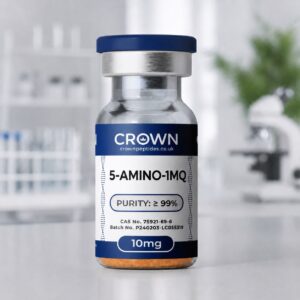
5-Amino-1MQ research compound UK 10mg and 50mg vial - Crown Peptides
≥99% PURITY
HPLC & MS TESTED
5-Amino-1MQ Research Compound
From: £24.99

Buy Now

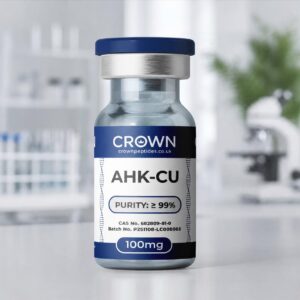
AHK-Cu 100mg research peptide vial – Crown Peptides UK
≥99% PURITY
HPLC & MS TESTED
AHK-Cu Research Peptide
From: £29.99

Buy Now

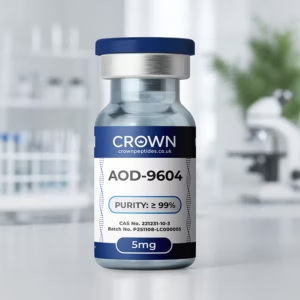
AOD-9604 5mg research peptide vial - Crown Peptides
≥99% PURITY
HPLC & MS TESTED
AOD-9604 Research Peptide
From: £34.99

Buy Now

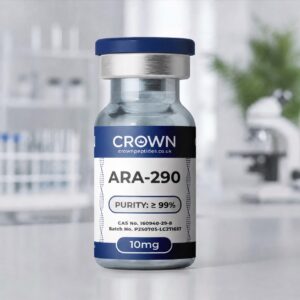
ARA-290 research peptide UK 10mg vial - Crown Peptides
≥99% PURITY
HPLC & MS TESTED
ARA-290 Research Peptide
From: £39.99

Buy Now

Further reading

SUPPORT Mon to Fri, 9am to 5pmDISPATCH Cut-off 2pmEMAIL info@crownpeptides.co.ukWHATSAPP +44 7301 802654

Disclaimer: All products are sold strictly for laboratory research purposes only. Not for human or veterinary use, consumption, therapeutic, or diagnostic application. None of our products are medicines, and none are presented as such. By purchasing, you confirm you are a qualified professional and legally permitted to handle these materials in compliance with all applicable laws and regulations. Misuse, resale for unauthorised purposes, or unlawful application is strictly prohibited. Crown Peptides UK disclaims all liability for improper use, handling, or regulatory non-compliance.

© 2026 Crown Peptides UK, a trading name of Crown Peptides Ltd (company no. 17068950), Suite Ra01, 195-197 Wood Street, London E17 3NU . All Rights Reserved.