Research Peptides
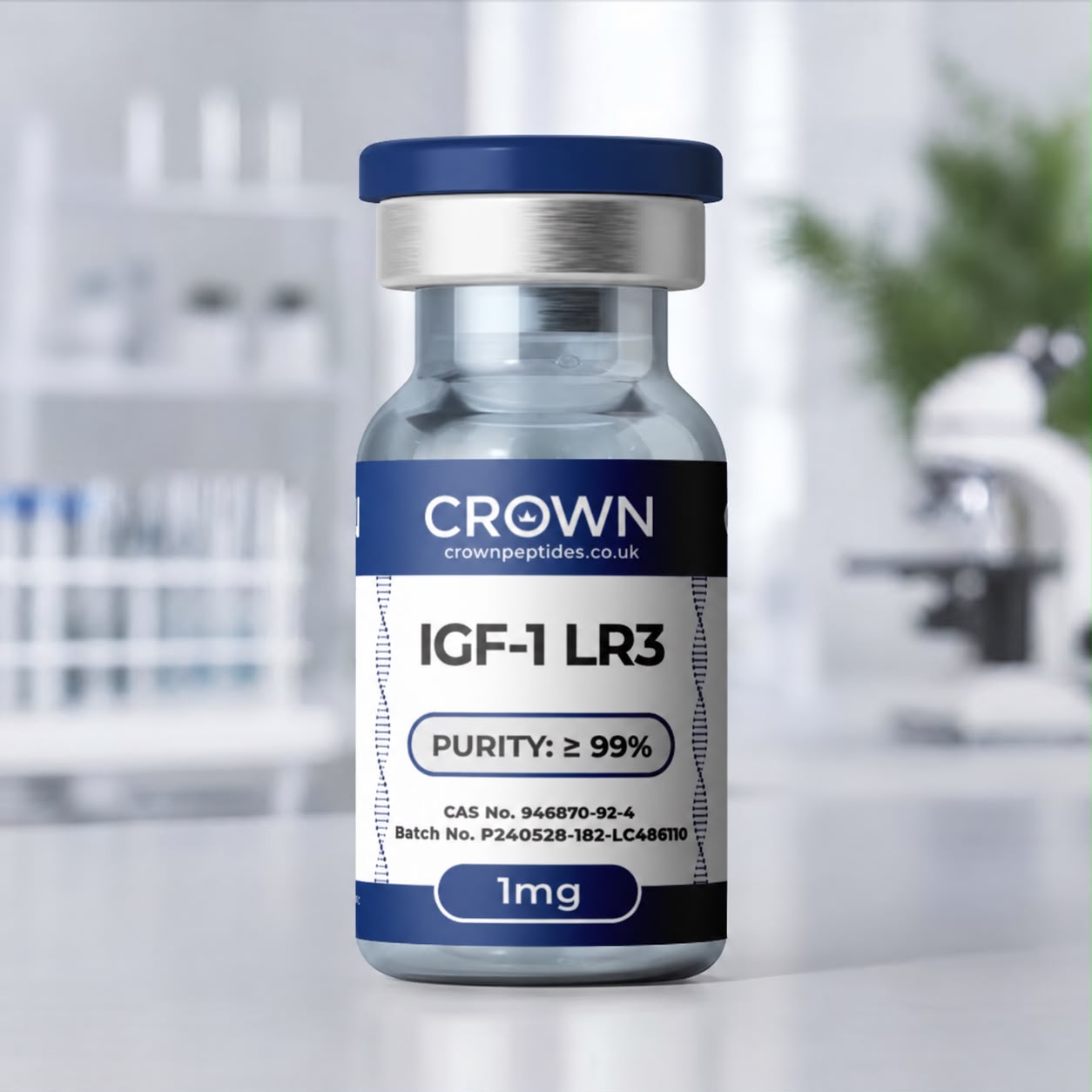
A high-purity research peptide studied in cell-growth and muscle research. Available in 1mg, with every batch independently tested and dispatched from the UK.
IGF-1 LR3 peptide UK is Crown Peptides' long R3 analogue of insulin-like growth factor 1, available in 1mg strength for laboratory research.
Supplied for laboratory research purposes only — not for human consumption or for medical, veterinary or diagnostic use.
IGF-1 LR3 is a modified analogue of insulin-like growth factor 1 containing an extended N-terminus and an arginine substitution. These changes reduce binding to several IGF-binding proteins and create a research profile distinct from native IGF-1.
Also known as: IGF1 LR3, Long R3 IGF-1, LR3-IGF-1, Long Arg3 IGF-1.
IGF-1 LR3 is an 83-amino-acid analogue of insulin-like growth factor 1. Native IGF-1 has 70 amino acids. IGF-1 LR3 adds a 13-amino-acid extension at the N-terminus and swaps the glutamic acid at position 3 for arginine, which is where the "R3" in its name comes from.
Those two changes reduce how strongly the peptide binds to IGF-binding proteins, which normally hold native IGF-1 in an inactive state. In laboratory systems IGF-1 LR3 therefore stays available for longer, which is why it has long been used in cell-culture work and in research on the IGF-1 receptor.
It is often researched alongside growth-hormone pathway compounds such as Ipamorelin and Tesamorelin, which act further up the same signalling axis. The IGF-1 LR3 research guide covers the detail.
IGF-1 LR3 is used in experimental work on IGF-1 receptor signalling, PI3K-AKT and MAPK pathways, cell growth, differentiation, protein-synthesis signalling and nutrient metabolism. The analogue’s reduced interaction with binding proteins (Learn more) makes it useful for studying IGF-receptor biology under conditions that differ from endogenous IGF-1 regulation, alongside related growth-factor research such as Tesamorelin and AOD-9604.
IGF-1 LR3 was the product of a deliberate engineering exercise in Adelaide, South Australia. In 1992, Francis, Ballard and colleagues at the Cooperative Research Centre for Tissue Growth and Repair and CSIRO described a family of IGF-I fusion proteins expressed in E. coli. Each one opened with a 13-residue leader, Met-Phe-Pro-Ala-Met-Pro-Leu-Ser-Ser-Leu-Phe-Val-Asn, made of methionine, the next ten residues from the start of porcine growth hormone, then valine and asparagine, joined to the 70-residue IGF-I chain. Three versions were built: Long IGF-I with the authentic sequence, Long [Gly3]-IGF-I, and Long [Arg3]-IGF-I, in which the glutamic acid at position 3 became arginine (Learn more).
The position-3 swap took its cue from nature. A truncated form called des(1-3)IGF-I, missing the opening tripeptide Gly-Pro-Glu, had been isolated from bovine colostrum, human brain and porcine uterus, and its much weaker attachment to binding proteins was traced to the absent glutamate. The leader brought a bonus of its own: the authors found that this hydrophobic stretch helped the reduced protein fold into its active shape, something native-length IGF-I does far less reliably.
Native IGF-1 rarely travels alone. Six high-affinity binding proteins, IGFBP-1 to IGFBP-6, hold it in blood and tissue fluid, and most circulating IGF-1 sits in a ternary complex of about 150 kDa with IGFBP-3 and the acid-labile subunit. While bound, IGF-1 is largely kept away from its receptor, so the binding proteins work as both reservoir and brake. Cultured cells add their own layer of control by releasing binding proteins into the medium.
The Adelaide data showed how much this matters. In L6 rat myoblasts, every Long analogue outperformed IGF-I at stimulating protein and DNA synthesis and at slowing protein breakdown, with Long [Arg3]-IGF-I and des(1-3)IGF-I at the top of the table. In chicken embryo fibroblasts, a line that secretes no detectable binding proteins, the ranking flipped and Long [Arg3]-IGF-I was less potent than IGF-I. A companion rat study reported that LR3 binds the type 1 IGF receptor about three-fold less well than the native hormone. The extra activity comes from staying free, not from a tighter grip on the receptor.
Cell culture is where IGF-1 LR3 found its widest audience. Chinese hamster ovary (CHO) cells, hybridomas, fibroblasts and many stem-cell lines carry the type 1 IGF receptor or respond to insulin, and serum-free media have long relied on insulin to supply that growth signal. Because LR3 is not soaked up by the binding proteins those cells secrete, it can deliver a steadier signal from a smaller quantity, which is why it has become a common insulin alternative in defined media.
A cGMP-grade version produced in E. coli is now used in the manufacture of several biopharmaceuticals approved in the United States, Europe and Japan, where it helps to raise cell growth and extend culture duration. For research labs, that history brings a deep stock of published culture methods in which the analogue is a familiar, well-characterised reagent.
Once free, IGF-1 LR3 works through the same receptor as native IGF-1, a tyrosine kinase that switches on two main branches: PI3K–Akt, which steers protein synthesis through mTOR and supports cell survival, and Ras–MAPK, which favours proliferation. Because binding proteins in the medium do not hold the analogue back, those pathways can be driven at defined concentrations and changes attributed to the receptor rather than to shifting IGFBP levels. Muscle cells make a natural test bed: the original potency comparisons were run in L6 myoblasts, and cultured myoblasts have since been used to examine how IGF-1 LR3 influences proliferation and the later switch to fused, differentiated myotubes.
In rats made catabolic with dexamethasone, Tomas and colleagues found LR3 and des(1-3)IGF-I roughly 2.5-fold more potent than IGF-I at improving body weight and nitrogen retention, despite LR3’s weaker receptor binding. A parallel study from Read’s group identified the gut as one of the most sensitive targets of all: IGF-I enlarged the stomach, small intestine and colon, and the analogues were consistently severalfold more potent. Over 14 days in normal female rats, Steeb and colleagues recorded rises of 43% in total gut weight, 47% in small-intestinal weight and 13% in small-intestinal length at the highest LR3 level tested, with deeper crypts and taller villi.
Pigs told a different story. In finisher pigs, a four-day infusion of LR3 reduced daily weight gain and food intake, lowered plasma IGFBP-3, IGF-I and insulin, and cut the area under GH peaks by 60%, effects the authors linked to suppression of the animals’ own GH secretion (Learn more). The contrast is a useful reminder that escaping binding proteins can play out very differently from one species to the next.
Compound-level reference data. Batch-specific results appear on the Certificate of Analysis.
Work out concentration with the peptide calculatorCrown Peptides IGF-1 LR3 is supplied for controlled laboratory research with batch-specific analytical documentation. High-Performance Liquid Chromatography (HPLC) can assess chromatographic purity, while Mass Spectrometry provides molecular information used to support identity verification.
The batch-specific Certificate of Analysis is the definitive source for the exact purity result, identity data and analytical specification of the material supplied.
Researchers working with IGF-1 LR3 may also be interested in Tesamorelin, AOD-9604, CJC-1295 with DAC, GHRP-6 and MOTS-c — other compounds studied in growth-factor and metabolic signalling research.
IGF-1 LR3 is an 83-residue analogue of human insulin-like growth factor 1: the complete 70-residue IGF-1 chain with a 13-residue N-terminal leader and arginine in place of glutamic acid at position 3. Crown Peptides supplies it in 1mg vials of white freeze-dried powder. Australian researchers first described it as Long [Arg3]-IGF-I, which is why it is also listed as Long R3 IGF-1, LR3-IGF-1, Long Arg3 IGF-1 or IGF1 LR3.
L is for Long, referring to the 13-residue extension at the N-terminus, and R3 uses the single-letter code for arginine (R) at position 3 of the IGF-1 sequence, where the native hormone carries glutamic acid. The name mirrors its sister compounds from the same project, Long IGF-I and Long [Gly3]-IGF-I.
Surprisingly, from growth hormone. The leader reads MFPAMPLSSLFVN: methionine and the following ten residues of porcine growth hormone’s N-terminus, then valine and asparagine. It was introduced as part of an efficient bacterial expression system, and its hydrophobic character also helped the protein fold correctly. Even with the authentic IGF-I sequence behind it, the leader alone made Long IGF-I more potent than IGF-I in cells that secrete binding proteins.
They behave differently wherever binding proteins are present. Native IGF-1’s activity in a culture well or a tissue depends on how much IGFBP surrounds it, so results can drift with cell density, medium changes or species. LR3 largely sidesteps that variable and gives a cleaner read-out of receptor signalling. Where no binding proteins are present, the advantage disappears and native IGF-1 can be the more potent of the two.
Slightly less tightly, as it happens. The original Adelaide group put its affinity for the type 1 IGF receptor at about a third of native IGF-1’s. Its higher potency in most systems comes from being far less captured by binding proteins, which leaves more of it free to reach the receptor.
They are different molecules. Mecasermin is recombinant human IGF-1 with the native 70-residue sequence, and it has been approved in the US and the EU under the brand name Increlex for severe primary IGF-1 deficiency in children. IGF-1 LR3, with its leader and arginine swap, has never been approved as a medicine anywhere. In sport, IGF-1 and its analogues are banned under the World Anti-Doping Agency’s list of prohibited substances.
Because nothing holds on to it. In catheterised rats given radiolabelled tracers, native IGF-1 travelled mainly in the 150 kDa complex and cleared slowly, at about 0.9 ml/min per kg in non-pregnant animals, while LR3 circulated mostly as free peptide and cleared roughly ten times faster, at about 9.8 ml/min per kg. Free peptide moves into tissues and is degraded more readily, so the idea of a “longer-lasting” IGF-1 applies to culture media rather than to the bloodstream.
Mainly as a tool for asking how growth factors reach a wound. Across a model endothelial barrier, binding proteins slowed the passage of IGF-1 but left LR3 unaffected. In rats fitted with subcutaneous wound chambers, more intact LR3 than IGF-1 was recovered from wound fluid after an intravenous tracer, although only a tiny fraction of either arrived, and the authors concluded that circulating IGF-1 plays only a minor role in surface wound repair.
At the far end of the same axis. GHRH analogues such as Tesamorelin and CJC-1295 with DAC act on the pituitary to raise growth hormone, which then prompts the liver and other tissues to make native IGF-1, and that IGF-1 is promptly taken up by binding proteins. LR3 skips the pituitary and liver entirely and acts at the IGF-1 receptor itself, so comparing the two levels helps separate the effects of GH from those of IGF-1 signalling.
They are the central quality question for any IGF-1 protein. Its six cysteines can pair correctly (Cys6–Cys48, Cys18–Cys61 and Cys47–Cys52 in IGF-1 numbering) or in a mismatched arrangement, and the mispaired form has exactly the same mass. Mass spectrometry confirms the 9.11 kDa molecule, and high-resolution instruments can resolve the 6 Da by which the folded protein is lighter than its fully reduced chain, but reversed-phase HPLC is what separates correctly folded material from isomers.
Here the LR3 sequence is much better behaved than IGF-1: in a refolding study it gave 85% native structure and 10% of the alternative form, against 45% and 24% for IGF-1. The nine sulphur atoms in its formula are the six cysteines plus three methionines, two of which sit in the leader.
Dissolving IGF-1 proteins in dilute acid is common practice; the culture-grade liquid form of LR3 is made up at 1 mg/mL in 100 mM acetic acid, and its maker recommends low-protein-binding tubes for reconstituted stock so that material is not lost to plastic surfaces. Our IGF-1 LR3 is shipped as a white lyophilised powder, sealed in glass; keep unopened vials frozen at -20°C and shielded from warmth and light, as our storage guide explains.
Growth-factor work runs at very small concentrations: culture-grade LR3 is typically used at 10 to 100 micrograms per litre of medium, so a single milligram goes a long way and one vial is usually ample for method development. Boxes of five or ten suit labs feeding several cell lines over months or running a bioprocess series, where staying on one lot number avoids re-qualifying every new batch, and they lower the cost per vial.
Every batch is published openly — identity, purity and batch number, with no account needed.
Supplied for laboratory research purposes only — not for human consumption or for medical, veterinary or diagnostic use.
Each batch undergoes internal analytical verification using chromatographic and spectrometric methods prior to lyophilisation.
• HPLC Analysis
• Mass Spectrometry Confirmation
• Batch Traceability
By purchasing this product you confirm that you are a qualified researcher and that this compound will be used exclusively for laboratory research purposes.
This product is not intended for diagnostic or therapeutic use.
Any human or medical use is strictly prohibited.
Store in a cool, dry, secure and sterile environment away from any unauthorised persons or children.
Disclaimer: All products are sold strictly for laboratory research purposes only. Not for human or veterinary use, consumption, therapeutic, or diagnostic application. None of our products are medicines, and none are presented as such. By purchasing, you confirm you are a qualified professional and legally permitted to handle these materials in compliance with all applicable laws and regulations. Misuse, resale for unauthorised purposes, or unlawful application is strictly prohibited. Crown Peptides UK disclaims all liability for improper use, handling, or regulatory non-compliance.