Research Peptides
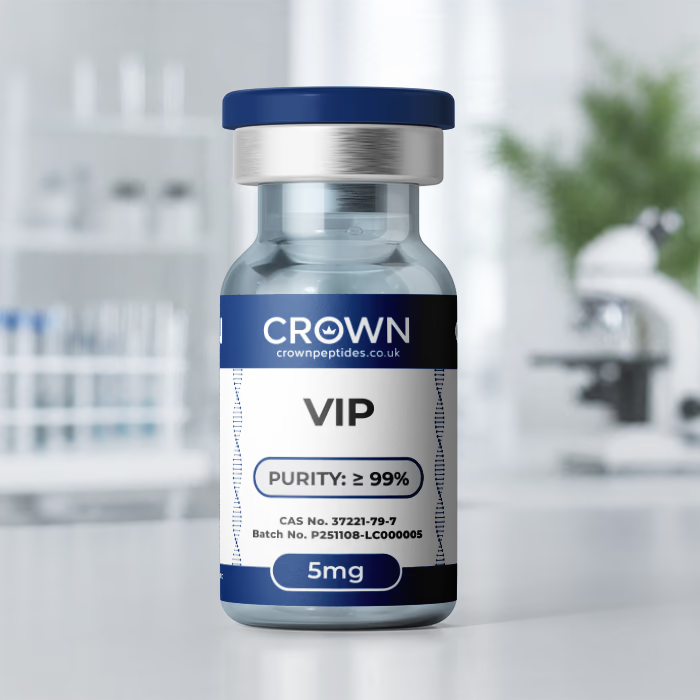
A high-purity research peptide studied in gut, immune and vascular research. Available in 5mg, with every batch independently tested and dispatched from the UK.
VIP peptide UK is Crown Peptides' vasoactive intestinal peptide, a naturally occurring 28-amino-acid neuropeptide, supplied in 5mg vials for laboratory research into VPAC1/VPAC2 receptor biology and neuropeptide signalling.
Supplied for laboratory research purposes only — not for human consumption or for medical, veterinary or diagnostic use.
VIP, or Vasoactive Intestinal Peptide, is a naturally occurring 28-amino-acid neuropeptide that signals mainly through VPAC1 and VPAC2 receptors. It is broadly distributed in neural, gastrointestinal and vascular systems and is therefore used in research spanning several areas of physiology.
Also known as: vasoactive intestinal peptide, vasoactive intestinal polypeptide, aviptadil.
VIP research examines VPAC receptor pharmacology, cyclic-AMP signalling, smooth-muscle responses, vascular biology, gastrointestinal secretion and motility, neuropeptide signalling and immune regulation. In a mouse model of induced colitis, VIP reduced both the clinical and tissue-level severity of intestinal inflammation while lowering inflammatory cytokines including TNF-alpha, IL-1 and IL-6 (Learn more). Because VPAC receptors occur across multiple tissues, VIP is particularly useful for studying how the same peptide signal produces different responses depending on cell type and receptor expression, alongside related neuro and signalling-research peptides such as Selank and DSIP.
VIP entered the literature in September 1970, when Sami Said and Viktor Mutt reported in Science that they had purified a 28-residue polypeptide from hog small intestine. Their extract behaved like nothing they had catalogued before. It widened systemic blood vessels, lowered blood pressure, raised cardiac output, stimulated breathing and nudged blood glucose upwards, yet it was chemically distinct from the kinins, substance P, glucagon and secretin (Learn more).
Vascular action plus intestinal origin gave the peptide its name, which has aged oddly: later mapping found VIP in nerve fibres throughout the brain, airways, gut wall and lymphoid tissue, so it is now classed primarily as a neuropeptide, and a member of the secretin–glucagon family. Mammalian VIP turned out to be strikingly conserved, with the human, pig and rat forms sharing one identical sequence, which makes rodent findings straightforward to line up against human tissue work.
VIP acts through class B G-protein-coupled receptors, the same broad family used by secretin and glucagon. Its two main receptors, VPAC1 and VPAC2, couple to Gs, so receptor activation typically raises intracellular cyclic AMP, which is why cAMP accumulation and reporter assays are standard readouts in VIP pharmacology.
A complication makes this field interesting. A second neuropeptide, PACAP, binds both VPAC receptors with roughly the same nanomolar affinity as VIP, and the first 28 residues of PACAP-38 are around 68% identical to VIP. A third receptor, PAC1, separates the two: it binds PACAP tightly but VIP several hundred times more weakly. Researchers therefore compare VIP and PACAP side by side, with receptor-selective analogues or knockout tissue, to work out which receptor carries a given response in lung, gut, smooth muscle, immune cells or brain.
The suprachiasmatic nucleus (SCN) of the hypothalamus is the brain’s master clock, and VIP-expressing neurons are one of its defining cell populations. Two mouse studies made VIP central to circadian biology. In 2002, Harmar and colleagues in Edinburgh reported in Cell that mice lacking the VPAC2 receptor could not sustain normal rest–activity rhythms, and that the core clock genes Per1, Per2 and Cry1 lost their daily expression pattern in the SCN. Light pulses at night also failed to switch on Per1 and Per2 as they normally would.
A year later, Colwell and colleagues described mice lacking both VIP and its sister peptide PHI. Under a normal light–dark cycle they looked largely ordinary, but once moved into constant darkness their activity began about eight hours earlier than expected, their free-running period shortened, and around a quarter eventually became arrhythmic. Together these results support the view that VIP helps the thousands of individual SCN cell clocks stay synchronised with one another and with the light cycle, and SCN slice recordings remain a key model for studying it.
VIP is released by nerve fibres in lymphoid organs and is also made by some immune cells, which has made it a classic subject in neuroimmunology. The colitis study above is one of a series from Mario Delgado, Rosa Gomariz and colleagues in Madrid. In 2001 the group reported in Nature Medicine that VIP given to mice with collagen-induced arthritis reduced both how often and how severely the disease developed, with joint swelling and cartilage and bone destruction abolished in treated animals. The authors linked this to suppression of both the inflammatory and the autoimmune arms of the model.
Later work shifted attention to regulatory T cells. In culture, VIP was shown to convert naive CD4+CD25− T cells into CD4+CD25+FoxP3+ regulatory T cells, the population that restrains effector responses. That offers a mechanistic handle on why one neuropeptide quietens several unrelated inflammatory models, and why VIP features in dendritic-cell, macrophage and T-cell differentiation studies.
Sami Said spent much of his career on VIP in the lung, where it relaxes airway and pulmonary vascular smooth muscle. In 2007 his group reported that male mice lacking the VIP gene developed moderate pulmonary arterial hypertension, with right-ventricular enlargement and thickened, muscularised pulmonary arteries, and that four weeks of VIP replacement attenuated both forms of remodelling. In a small open-label phase II study, 20 people with active sarcoidosis inhaled nebulised VIP for four weeks; cells recovered by bronchoalveolar lavage produced less TNF-alpha and regulatory T-cell numbers rose.
Synthetic VIP carries the international non-proprietary name aviptadil. In the UK, aviptadil is licensed only in combination with phentolamine, as Invicorp, a prescription medicine for erectile dysfunction. During the COVID-19 pandemic, intravenous aviptadil (developed by NRx as Zyesami) was tested in critically ill patients: the company’s 196-patient trial missed its primary endpoint, the FDA twice declined emergency use authorisation, and the NIH-sponsored TESICO trial found no significant improvement in outcomes to day 90 versus placebo. Crown Peptides VIP is research material and is not any of these medicinal products.
Compound-level reference data. Batch-specific results appear on the Certificate of Analysis.
Work out concentration with the peptide calculatorCrown Peptides VIP is supplied for controlled laboratory research with batch-specific analytical documentation. High-Performance Liquid Chromatography (HPLC) can assess chromatographic purity, while Mass Spectrometry provides molecular information used to support identity verification. The batch-specific Certificate of Analysis is the definitive source for the exact purity result, identity data and analytical specification of the material supplied.
Researchers working with VIP may also be interested in Selank, DSIP, Kisspeptin-10, ARA-290 and Semax — other neuro and signalling-research peptides studied in related research areas.
VIP is vasoactive intestinal peptide (older papers say vasoactive intestinal polypeptide), a 28-residue neuropeptide with an amidated C-terminus that signals mainly through the VPAC1 and VPAC2 receptors. Our VIP comes freeze-dried in 5mg vials for receptor, circadian, immune and smooth-muscle work.
The name records where it was first purified, not where it works. Antibody mapping later revealed VIP in nerve fibres from cortex and hypothalamus to airways, blood vessels and lymphoid organs, so it is now studied mainly as a neurotransmitter.
It is. Mammalian VIP is unusually well conserved, and the human, porcine and rat peptides share one sequence. That lets researchers move between rodent models, pig tissue and human cells with the same material, without species-specific analogues.
Very closely. PACAP-38 matches VIP at roughly 68% of the positions across its first 28 residues, and both peptides activate VPAC1 and VPAC2 with similar potency. Many papers test them in parallel, because their receptor overlap is partial rather than complete.
VPAC1 and VPAC2 bind VIP with high, nanomolar affinity, and both are Gs-coupled receptors that raise cyclic AMP. The PACAP-preferring PAC1 receptor is the outlier: it responds to VIP only at concentrations several hundred times higher than those needed for PACAP, which makes PAC1-rich tissue a useful negative comparison.
PHI (peptide histidine isoleucine, or PHM-27 in humans, where it ends in methionine) is cut from the same precursor protein as VIP. Knockout mice that lose the VIP gene therefore lose PHI too, which is why circadian papers often describe their animals as VIP/PHI-deficient.
Inside the suprachiasmatic nucleus, each neuron runs its own molecular clock, and VIP helps couple those cells into one coherent rhythm. Mice lacking the VPAC2 receptor lost rhythmic expression of Per1, Per2 and Cry1, while VIP/PHI-deficient mice drifted, shortened their free-running period or became arrhythmic in constant darkness.
Both peptides converge on GnRH neurons, which control the reproductive axis. VIP-containing fibres from the clock region reach GnRH cells, helping time the pre-ovulatory LH surge in female rodents. In one study of middle-aged female rats, VIP increased activation of GnRH neurons but not of Kiss1 neurons, making Kisspeptin-10 a natural companion tool for separating the two inputs.
Cell-culture work showed VIP can turn naive CD4+ T cells into FoxP3+ regulatory T cells. In animal models such as collagen-induced arthritis and chemically induced colitis, VIP lowered inflammatory cytokines and dampened autoimmune responses, so it is often used to probe how nerves talk to the immune system.
Mice bred without the VIP gene developed moderate pulmonary arterial hypertension, with right-heart enlargement and narrowed, thickened lung arteries, and replacing VIP for four weeks lessened that remodelling. The authors put the knockout forward as a working model for exploring the molecular basis of pulmonary vascular disease.
Chemically, aviptadil is the international non-proprietary name for synthetic VIP. As a medicine, though, it exists in the UK only as Invicorp, a licensed aviptadil–phentolamine combination, manufactured and regulated as a finished product. Our VIP is research-grade peptide and is neither Invicorp nor any other aviptadil medicine.
Results were disappointing. An industry trial in 196 patients with critical COVID-19 respiratory failure did not meet its primary endpoint, and the FDA declined emergency use authorisation on two occasions. The larger NIH-funded TESICO trial, reported in The Lancet Respiratory Medicine in 2023, found intravenous aviptadil did not significantly improve 90-day outcomes compared with placebo.
VIP contains a single methionine, at position 17, and its sulphur can pick up an oxygen atom on exposure to air or oxidising conditions. Oxidised VIP appears about 16 daltons heavier than the expected 3325.8 Da, so a small +16 signal next to the main peak is a recognisable, sequence-specific marker. The C-terminal amide matters too: a free-acid form would read about one dalton heavier, which is why the terminal form should match the batch documentation.
Clock experiments often run for days or weeks across many time points, slices or animals, and every sample should see identical material. A five- or ten-vial box from the same order keeps a whole time series on matching stock, while the single 5mg vial suits short receptor or cAMP assays.
Every batch is published openly — identity, purity and batch number, with no account needed.
Supplied for laboratory research purposes only — not for human consumption or for medical, veterinary or diagnostic use.
Each batch undergoes internal analytical verification using chromatographic and spectrometric methods prior to lyophilisation.
• HPLC Analysis
• Mass Spectrometry Confirmation
• Batch Traceability
By purchasing this product you confirm that you are a qualified researcher and that this compound will be used exclusively for laboratory research purposes.
This product is not intended for diagnostic or therapeutic use.
Any human or medical use is strictly prohibited.
Store in a cool, dry, secure and sterile environment away from any unauthorised persons or children.
Disclaimer: All products are sold strictly for laboratory research purposes only. Not for human or veterinary use, consumption, therapeutic, or diagnostic application. None of our products are medicines, and none are presented as such. By purchasing, you confirm you are a qualified professional and legally permitted to handle these materials in compliance with all applicable laws and regulations. Misuse, resale for unauthorised purposes, or unlawful application is strictly prohibited. Crown Peptides UK disclaims all liability for improper use, handling, or regulatory non-compliance.