Research Peptides
A high-purity research peptide studied in skin and wrinkle research. Available in 10mg, with every batch independently tested and dispatched from the UK.
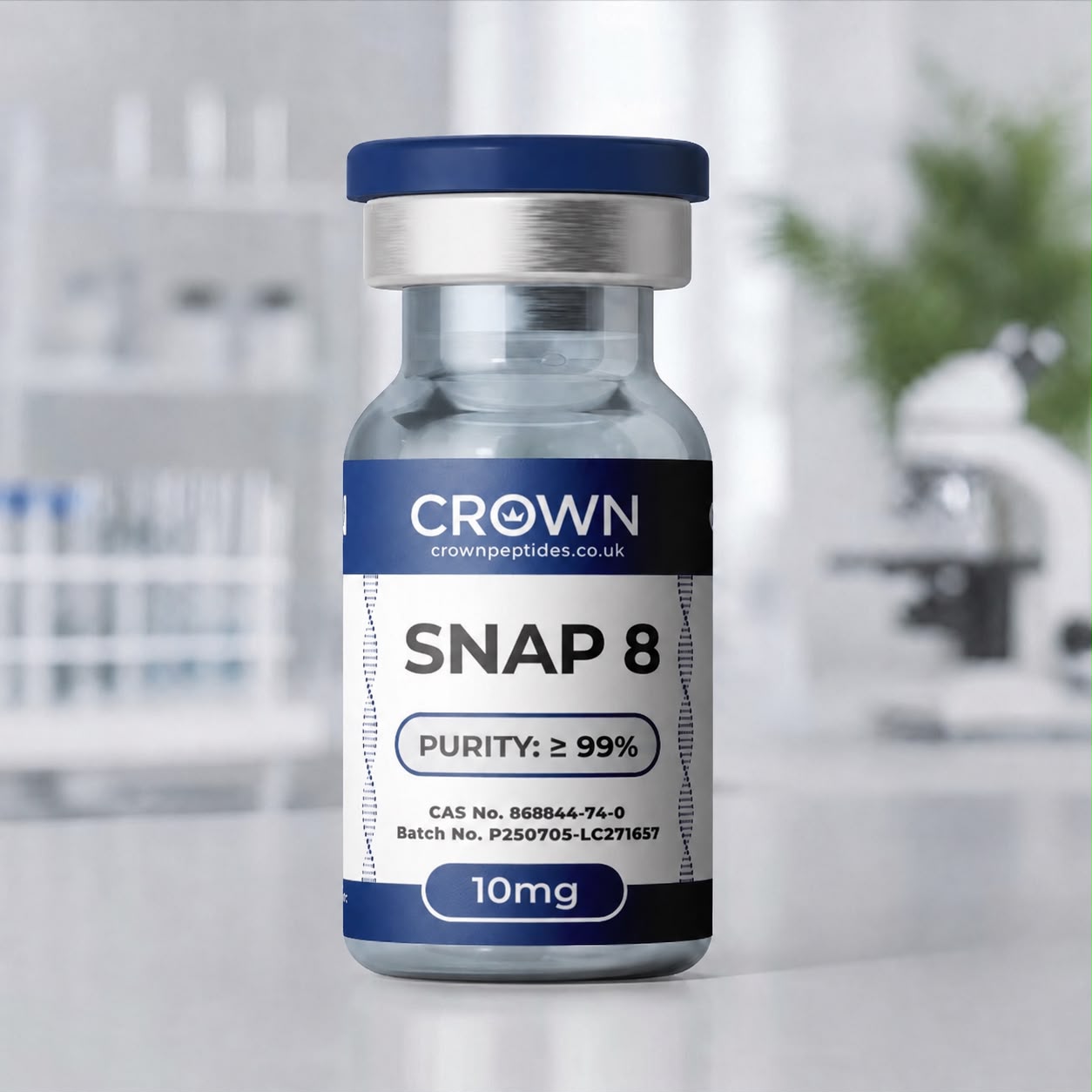
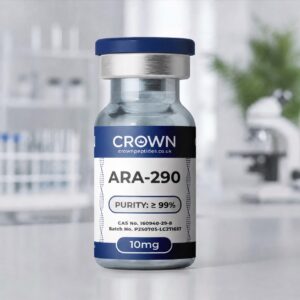
SNAP-8 peptide UK is Crown Peptides' synthetic acetylated octapeptide, also known as Acetyl Octapeptide-3, supplied in 10mg vials for laboratory research into SNARE-complex biology and neuronal exocytosis.
Supplied for laboratory research purposes only — not for human consumption or for medical, veterinary or diagnostic use.
SNAP-8, also known as Acetyl Octapeptide-3, is a synthetic octapeptide used primarily in cosmetic and biochemical research. It was developed as a peptide designed to interact with processes related to the SNARE complex and neuronal exocytosis.
Also known as: SNAP 8, SNAP8, Acetyl Octapeptide-3.
SNAP-8 research is associated with SNARE-complex biology, vesicle fusion and peptide interactions relevant to neurotransmitter release models, an area of membrane biology with an extensive independent research literature of its own (Learn more). It is also widely examined in cosmetic skin models because of its proposed ability to influence signalling processes associated with superficial expression-line formation, alongside related structural and signalling peptides such as GHK-Cu and KPV.
Neurotransmitter release depends on three proteins zipping together. Synaptobrevin (also called VAMP2) sits on the synaptic vesicle, while syntaxin-1 and SNAP-25 sit on the inner face of the cell membrane. Synaptobrevin and syntaxin each contribute one helix and SNAP-25 contributes two, and the four helices twist into a tight bundle known as the SNARE complex. As the bundle zips up, it pulls the vesicle and cell membranes close enough to fuse when calcium arrives, releasing the vesicle’s contents.
SNAP-8 is a direct copy of a short stretch of that machinery. Its sequence, Ac-Glu-Glu-Met-Gln-Arg-Arg-Ala-Asp-NH2, matches residues 12 to 19 of human SNAP-25, near the start of the protein’s first helix. The acetyl group on the N-terminus and the amide on the C-terminus remove the charged ends a free peptide would carry, so the fragment more closely resembles a piece cut from the middle of a protein chain. The design idea is competition: a free fragment that resembles part of SNAP-25 may occupy a place in the assembling complex and leave it less stable.
SNAP-8 is the longer sibling of Argireline, the hexapeptide Ac-EEMQRR-NH2. Argireline came out of a rational design programme involving researchers at Universidad Miguel Hernández in Alicante and the Barcelona peptide company Lipotec, published in 2002. It was first listed under the INCI name acetyl hexapeptide-3 and now appears as acetyl hexapeptide-8.
Lipotec then extended the sequence by two residues, alanine and aspartic acid, which are exactly the next two amino acids in SNAP-25. The result was marketed as SNAP-8 and listed for cosmetic ingredient labelling as Acetyl Octapeptide-3. The manufacturer describes SNAP-8 as roughly 30% more active than Argireline in its own testing. That comparison comes from company data rather than independent peer-reviewed work, so it is best read as a starting hypothesis for a head-to-head assay, and laboratories comparing the two peptides directly can generate their own answer under matched conditions.
Two kinds of experiment dominate this area. The first measures assembly itself: recombinant synaptobrevin, syntaxin and SNAP-25 are mixed with and without the test peptide, and the amount of assembled complex is compared. A fully zipped SNARE bundle is remarkably resistant to the detergent SDS, so it runs as a distinct high-molecular-weight band on a gel, which makes the readout easy to quantify.
The second measures release from living secretory cells, typically catecholamine output from chromaffin-type cells or transmitter release from cultured neurons after a calcium-raising stimulus. In the founding Argireline paper, the hexapeptide reduced calcium-dependent neurotransmitter release with a potency in the same range as botulinum toxin A, though with much lower maximum efficacy, and the authors traced the effect to interference with SNARE complex formation or stability. Both readouts suit SNAP-8 equally well, so the octapeptide and its shorter parent can be compared on equal terms.
SNAP-25 is also the target of botulinum neurotoxin type A, which explains why this peptide family is so often discussed alongside it. The toxin’s light chain is an enzyme that cuts SNAP-25 near its far end, between Gln197 and Arg198, removing the last nine amino acids. The shortened protein can still join a SNARE complex, but the complex no longer supports efficient calcium-triggered fusion, and the effect is long-lasting in nerve terminals.
SNAP-8 works at the opposite end of SNAP-25 and by a different principle. It cleaves nothing; it is a non-enzymatic mimic of the N-terminal region that competes during assembly, so any effect depends on how much peptide is present and should fade as it is washed out. That contrast between irreversible enzymatic cleavage and reversible competition makes the pair a useful teaching and comparison system in exocytosis research.
Because SNAP-8 and Argireline are used in topical formulations, a separate line of work asks how far such peptides travel into skin at all. Delivery is a real question for molecules of this size and charge. In one University of Vienna study, researchers applied acetyl hexapeptide-8 to porcine ear skin in Franz-type diffusion cells and by tape stripping, then measured it by LC-MS/MS. Water-rich formulations, particularly a multiple water-in-oil-in-water emulsion, delivered significantly more peptide into the skin than an oil-rich emulsion did, and the authors noted that skin penetration of this peptide had been sparsely studied and controversially discussed.
SNAP-8 is around 186 daltons heavier than Argireline and carries a net negative charge, so penetration data for the hexapeptide cannot simply be assumed to transfer. Franz cells, tape stripping and LC-MS/MS quantification give researchers a ready-made framework for measuring SNAP-8 directly.
Compound-level reference data. Batch-specific results appear on the Certificate of Analysis.
Work out concentration with the peptide calculatorCrown Peptides SNAP-8 is supplied for controlled laboratory research with batch-specific analytical documentation. High-Performance Liquid Chromatography (HPLC) can assess chromatographic purity, while Mass Spectrometry provides molecular information used to support identity verification. The batch-specific Certificate of Analysis is the definitive source for the exact purity result, identity data and analytical specification of the material supplied.
Researchers working with SNAP-8 may also be interested in GHK-Cu, KPV, LL-37, KLOW and Melanotan-1 — other structural and skin-model research peptides studied in related research areas.
SNAP-8 is an acetylated, C-terminally amidated octapeptide, Ac-EEMQRRAD-NH2, modelled on part of the neuronal protein SNAP-25. It is also written SNAP 8 or SNAP8 and carries the cosmetic ingredient name Acetyl Octapeptide-3. Crown Peptides supplies it as freeze-dried powder in 10mg vials for SNARE and exocytosis research.
Its eight residues correspond to positions 12 to 19 of human SNAP-25, a 206-amino-acid protein. That stretch lies near the start of the first of the two helices SNAP-25 donates to the SNARE bundle, so the fragment is designed to mimic a region involved in complex assembly.
Argireline is the six-residue parent, Ac-EEMQRR-NH2. SNAP-8 keeps those six residues and adds alanine and aspartic acid, the next two amino acids along the SNAP-25 chain. Argireline is labelled acetyl hexapeptide-8 (formerly acetyl hexapeptide-3); SNAP-8 is labelled Acetyl Octapeptide-3.
It is the protein machine that fuses vesicles with the cell membrane. Synaptobrevin on the vesicle pairs with syntaxin-1 and SNAP-25 on the membrane, the four helices wind together, and the energy of that zipping drives membrane fusion when calcium enters the terminal. SNAP-8 research asks whether a free SNAP-25 fragment can disturb this assembly.
INCI names follow a simple pattern for synthetic peptides: any modification first (here an acetyl group), then the number of amino acids (octa, eight), then a serial number that distinguishes it from other registered octapeptides. The label describes the class of molecule rather than its sequence, which is why the sequence itself is the more useful identifier in a laboratory.
The Spanish cosmetic peptide company Lipotec, based near Barcelona, created SNAP-8 as an extension of Argireline, which it had co-developed with academic researchers in Alicante. SNAP-8 is a registered trade name of the manufacturer; the generic sequence is what Crown Peptides supplies for research.
Botulinum neurotoxin A is a protease that permanently cuts nine residues from the C-terminal end of SNAP-25. SNAP-8 is a short, non-enzymatic mimic of the N-terminal region that can only compete during complex assembly, so it acts at the opposite end of the protein and its effects in assays depend on concentration.
The usual approach mixes recombinant synaptobrevin, syntaxin and SNAP-25 with or without the peptide, then runs the samples on a gel without boiling. Fully assembled SNARE complexes survive SDS and appear as a heavier band, so the band intensity gives a direct measure of how much complex formed.
Secretory cells with well-characterised exocytosis are preferred. Adrenal chromaffin cells and chromaffin-derived lines release catecholamines on a calcium signal, and cultured neurons release transmitters such as glutamate. Comparing release with and without the peptide, often next to Argireline, shows whether the SNAP-25 mimic changes output.
Less than its popularity suggests. Most mechanistic data on this family come from the 2002 Argireline paper, and the claims specific to the octapeptide come largely from manufacturer testing. That gap is exactly why independent SNARE-assembly and release experiments with characterised material are valuable.
As a topical cosmetic ingredient, SNAP-8 only reaches cells if it crosses the stratum corneum. Work on acetyl hexapeptide-8 using porcine ear skin in Franz cells found that the emulsion type changed delivery markedly, and SNAP-8 is larger and differently charged, so its own penetration needs measuring rather than assuming.
Alanine and aspartic acid together add about 186 daltons, so SNAP-8 and Argireline sit well apart on a mass spectrum and can be distinguished without ambiguity. The added aspartate also brings a third acidic side chain, giving the peptide a net charge of about minus one at neutral pH (three acidic residues against two arginines, with both ends capped), which affects its retention on reversed-phase HPLC and its behaviour in solution.
The two are studied in skin models for unrelated reasons, which is what makes the pairing useful. GHK-Cu is a copper tripeptide researched for its effects on fibroblasts and the extracellular matrix, whereas SNAP-8 targets nerve-terminal machinery. Using both lets a study keep matrix and neurotransmitter-release questions separate.
SNAP-8 is offered in a single 10mg size, so the choice is really about project length. One vial covers a pilot assembly assay; a box of five or ten suits dose-response work, repeated release experiments or penetration studies across several formulations, all run on material from one order.
Every batch is published openly — identity, purity and batch number, with no account needed.
Supplied for laboratory research purposes only — not for human consumption or for medical, veterinary or diagnostic use.
Each batch undergoes internal analytical verification using chromatographic and spectrometric methods prior to lyophilisation.
• HPLC Analysis
• Mass Spectrometry Confirmation
• Batch Traceability
By purchasing this product you confirm that you are a qualified researcher and that this compound will be used exclusively for laboratory research purposes.
This product is not intended for diagnostic or therapeutic use.
Any human or medical use is strictly prohibited.
Store in a cool, dry, secure and sterile environment away from any unauthorised persons or children.
Disclaimer: All products are sold strictly for laboratory research purposes only. Not for human or veterinary use, consumption, therapeutic, or diagnostic application. None of our products are medicines, and none are presented as such. By purchasing, you confirm you are a qualified professional and legally permitted to handle these materials in compliance with all applicable laws and regulations. Misuse, resale for unauthorised purposes, or unlawful application is strictly prohibited. Crown Peptides UK disclaims all liability for improper use, handling, or regulatory non-compliance.