Register today and get 10% off your first orderRegister for 10% off your first orderRegister now
Crown Peptides
SAVE25%

Research Peptides

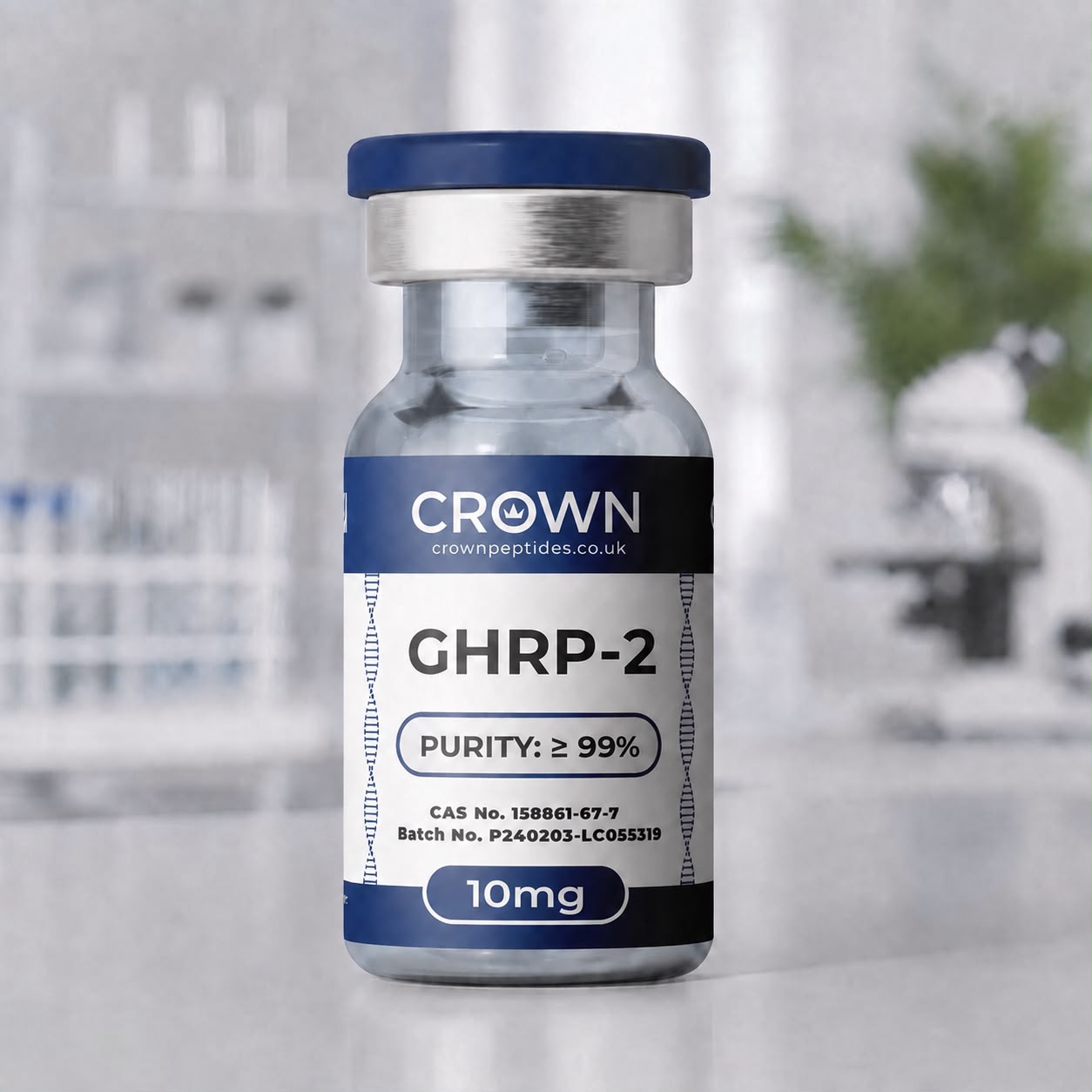
GHRP-2 Research Peptide

A high-purity research peptide studied in growth-hormone research. Available in 10mg, with every batch independently tested and dispatched from the UK.

£20.99or from £15.74 per vial in packs of 10
Save up to 25%
From: £20.99
Your selection:
Batch level verified
All Batches TestedEvery batch, no exceptions
HPLC & MS VerifiedFull certificate published
Same Day PostageOrder before 2pm
UK Based CompanyDispatched from the UK
Product Overview

A high-purity research peptide studied in growth-hormone research. Available in 10mg, with every batch independently tested and dispatched from the UK.

Full Product Specification
Overview

Product Overview

GHRP-2 peptide UK is Crown Peptides' synthetic hexapeptide growth-hormone secretagogue research compound, available in 10mg for laboratory research.

10mgAvailable strengthHPLC testedChromatographic purityMS verifiedIdentity confirmedBatch CoADocumentation supplied

Supplied for laboratory research purposes only — not for human consumption or for medical, veterinary or diagnostic use.

Key features

Key Features

  • Studied in research involving ghrelin/GHSR receptor signalling
  • Studied in research involving growth-hormone secretagogue activity
  • Studied in research involving pituitary and endocrine research
  • Studied in research involving appetite-associated signalling models
  • Batch-specific quality documentation available
Background

About GHRP-2 Peptide UK

GHRP-2, also known as pralmorelin, is a synthetic six-amino-acid peptide and one of the more potent growth-hormone-releasing peptides studied in research. Its activity is associated primarily with the growth-hormone secretagogue receptor, also known as the ghrelin receptor or GHSR.

Also known as: GHRP 2, GHRP2, pralmorelin, KP-102.

Research

GHRP-2 Research

GHRP-2 is studied in receptor-pharmacology and endocrine models involving GHSR activation and pituitary growth-hormone release, with one comparative study examining its growth-hormone-releasing activity against GHRP-6 in rat pituitary cells (Learn more). Research also extends into appetite and food-intake signalling, alongside related growth-hormone secretagogue compounds such as GHRP-6.

  • Ghrelin/GHSR receptor signalling
  • Growth-hormone secretagogue activity
  • Pituitary and endocrine research
  • Appetite-associated signalling models
Pralmorelin in Japan: a growth-hormone reserve test

GHRP-2 is one of very few ghrelin-receptor agonists to become a licensed product. As pralmorelin dihydrochloride, it is approved in Japan as a diagnostic agent and sold by Kaken Pharmaceutical under the name GHRP Kaken 100. Its role is narrow: to show whether the pituitary can still release growth hormone when challenged, a question that arises when adult growth-hormone deficiency is suspected. That approval belongs to the Japanese medicine and its diagnostic use; research-grade GHRP-2 is a separate product with no licensed role.

Why was a new test wanted? The international reference method, the insulin tolerance test, works by deliberately lowering blood sugar, which rules it out for some patients. A Japanese multicentre team, the KP-102 Study Group led by Chihara, set GHRP-2 against it in 77 healthy adults and 58 patients whose insulin test had already shown a very low growth-hormone peak. In every participant the peak arrived within an hour. Healthy volunteers averaged around 85 µg/L at the top of the curve, while the patients averaged under 1.4 µg/L, with no gap between hypothalamic and pituitary causes. Repeat tests gave consistent readings.

Two swaps from GHRP-6: D-alanine and D-2-naphthylalanine

Line the two sequences up and the family likeness is plain. GHRP-6 reads His-D-Trp-Ala-Trp-D-Phe-Lys-NH2; GHRP-2 keeps its last four residues untouched and edits only the first two. The opening histidine becomes D-alanine, and the D-tryptophan in second place becomes D-2-naphthylalanine, usually shortened to D-2-Nal. Naphthylalanine is absent from natural proteins. Its side chain is naphthalene, two benzene rings fused edge to edge, so it is flatter and more water-repelling than the indole of tryptophan and contains no nitrogen.

Those edits paid off. Cyril Bowers, whose Tulane laboratory built this peptide family, reported that GHRP-6, the seven-residue GHRP-1 and then GHRP-2 grew steadily more effective at releasing growth hormone, first in rats and then in human volunteers. Yet a Merck comparison in rat pituitary cells showed that the structural changes had not altered the target: maximal amounts of GHRP-2 and GHRP-6 given together released no more than either alone, and each peptide desensitised the cells to the other. With D-residues at positions one, two and five, the chain is also an awkward fit for many protein-cutting enzymes.

Prolactin, ACTH and cortisol: the wider hormone signature

Growth hormone is the headline, but GHRP-2 does not send a perfectly clean signal. In Turin, Ezio Ghigo’s group gave GHRP-2 and its relative hexarelin to six healthy young adults and compared four hormones against reference stimuli. Both peptides produced a strong growth-hormone rise, larger than the response to GHRH itself. Prolactin increased as well, though by less than after TRH, the classic prolactin trigger. ACTH and cortisol climbed to levels comparable with those seen after corticotrophin-releasing hormone, the body’s main stress-axis messenger. A follow-up from the same group found matching prolactin, ACTH and cortisol rises for GHRP-2, hexarelin and an easily iodinated hexarelin analogue used in binding work.

The species makes a difference. In the KP-102 rat pharmacology programme, GHRP-2 raised ACTH and corticosterone, the main rodent stress steroid, yet left prolactin unchanged. The choice of model therefore shapes which secondary signals appear, and a panel covering prolactin and adrenal hormones alongside growth hormone gives a much fuller picture of a GHRP-2 experiment.

Waking a quiet pituitary: the critical-illness studies

One of the more surprising settings for GHRP-2 research has been the intensive care unit. Greet Van den Berghe’s group in Leuven studied men with prolonged critical illness, a state in which the pulsed release of growth hormone, TSH and LH becomes heavily suppressed. Their hypothesis was that the pituitary in these patients is under-stimulated rather than worn out, and so might answer a releasing signal.

In a randomised study of 33 men, five days of GHRP-2 infusion restarted pulsatile growth-hormone secretion and returned IGF-I and its main binding-protein complex to normal levels. Adding TRH restored thyroid hormones within a day, and adding pulses of GnRH on top raised LH output and testosterone. Markers of protein breakdown, such as urea production, fell only in the combination groups and not with GHRP-2 on its own. The work is best read as a demonstration of how far a suppressed pituitary can be reawakened, with GHRP-2 serving as the probe.

Specifications

Specifications

Product
GHRP-2
Classification
Synthetic hexapeptide growth-hormone secretagogue
Available strength
10mg
CAS number
158861-67-7
Molecular weight
817.9 g/mol
Molecular formula
C45H55N9O6
Sequence
D-Ala-D-2Nal-Ala-Trp-D-Phe-Lys-NH2 (6 amino acids)
Form
Research material supplied according to product label
Purity and assay
99% (HPLC), batch-specific — refer to Certificate of Analysis
Verification
HPLC and Mass Spectrometry where analytically appropriate

Compound-level reference data. Batch-specific results appear on the Certificate of Analysis.

Work out concentration with the peptide calculator
Testing

Purity and Testing

Crown Peptides GHRP-2 is supplied for controlled laboratory research with batch-specific analytical documentation. High-Performance Liquid Chromatography (HPLC) can assess chromatographic purity, while Mass Spectrometry provides molecular information used to support identity verification.

The batch-specific Certificate of Analysis is the definitive source for the exact purity result, identity data and analytical specification of the material supplied.

Storage

Storage Conditions

  • Store unreconstituted material at -20°C ± 5°C in a cool, dry environment
  • Prepared research solutions should use validated storage conditions appropriate to the compound and study design
  • Protect from unnecessary heat, direct light and repeated temperature fluctuations
Full storage guide
Related

Related Compounds

Researchers working with GHRP-2 may also be interested in GHRP-6, Ipamorelin, Sermorelin, Tesamorelin and CJC-1295 — other compounds studied in growth-hormone secretagogue and pituitary-signalling research.

Compliance

Research Use Only

  • Laboratory research only
  • Not for human or clinical use
  • Not for human or veterinary consumption
  • Qualified personnel only
Questions

GHRP-2 Frequently Asked Questions

About GHRP-26 questions
What is GHRP-2?

GHRP-2 is a six-residue synthetic agonist of the ghrelin receptor, sequence D-Ala-D-2-Nal-Ala-Trp-D-Phe-Lys-NH2, formula C45H55N9O6, with a molecular weight close to 818 g/mol. It is the same molecule as pralmorelin. Crown Peptides offers it in a single 10mg fill size, and catalogues also list it as GHRP 2 or GHRP2.

Is GHRP-2 a licensed medicine anywhere?

Only in one specific form. Pralmorelin dihydrochloride is approved in Japan as a diagnostic reagent for testing growth-hormone reserve, marketed by Kaken Pharmaceutical as GHRP Kaken 100. That salt carries its own CAS number, 158827-34-0, distinct from the 158861-67-7 given for the peptide on this page. It holds no licence as a treatment, and the Japanese approval does not extend to research material.

What do the names pralmorelin and KP-102 tell you?

Pralmorelin is the official non-proprietary name, and its -relin ending places it in the naming family for peptides that prompt pituitary hormone release, alongside sermorelin and tesamorelin. KP-102 was its code during the Japanese clinical programme, and some older pharmacology papers call it GPA-748. Searching all three names turns up far more of the literature than GHRP-2 on its own.

How does GHRP-2 compare to GHRP-6?

The pair share a receptor and four of their six residues. GHRP-2 trades the histidine at the front of GHRP-6 for D-alanine and its D-tryptophan for D-2-naphthylalanine. Merck researchers found the two worked through the same receptor and mechanism in rat pituitary cells, with no extra release when combined, while human studies from the Bowers group ranked GHRP-2 as the more effective growth-hormone releaser.

Why did GHRP-2 end up being studied in intensive care?

Prolonged critical illness silences growth-hormone pulses in a way that looks like a pituitary short of stimulation. Researchers in Leuven used GHRP-2 infusions to test that idea and found secretion could be restarted, with IGF-I and its binding proteins returning to normal. Giving TRH and GnRH alongside it revived the thyroid and reproductive axes too.

Does GHRP-2 act directly on the pituitary, or through the brain?

Both, according to the rat and dog work behind the KP-102 programme. GHRP-2 still released growth hormone from cultured rat pituitary cells, although it was weaker than GHRH there. Its effect vanished in rats without a pituitary and shrank in rats whose median eminence, the link between hypothalamus and pituitary, had been lesioned, so full activity relies on the hypothalamus supplying its own GHRH.

Hormone responses in research4 questions
Does GHRP-2 raise prolactin and cortisol as well as growth hormone?

It does in human pharmacology studies. Prolactin rises, though less than after TRH, while ACTH and cortisol rise to roughly the degree seen after corticotrophin-releasing hormone. Rats respond a little differently, with ACTH and corticosterone going up but prolactin staying flat. Measuring these hormones alongside growth hormone is sound practice in any GHRP-2 design.

Why is GHRP-2 less affected by somatostatin than GHRH?

Somatostatin is the brake on growth-hormone release. In conscious rats it blunted GHRH far more than GHRP-2, so GHRP-2 appeared the stronger of the two; under pentobarbital anaesthesia, which lowers somatostatin output, they became roughly equal. Conscious dogs sharpened the contrast further, because GHRP-2 released growth hormone in them while GHRH failed to raise it at all.

How was the cut-off for the GHRP-2 diagnostic test chosen?

The Japanese validation study looked for the growth-hormone level at which sensitivity and specificity crossed, which landed between 15 and 20 µg/L. A peak of 15 µg/L after GHRP-2 matched the 3 µg/L threshold long used with the insulin tolerance test. A lower GHRP-2 cut-off of 9 µg/L is now used in Japan to identify severe adult deficiency.

Does age or body fat change the growth-hormone response to GHRP-2?

Only slightly. In the Japanese diagnostic study, peaks were a little lower in older volunteers and in those carrying more body fat, but not by enough to change who was classed as deficient. Men and women responded alike. That steadiness across groups is part of what suited GHRP-2 to a diagnostic role.

Identity & lab planning3 questions
Why is GHRP-2 about 55 daltons lighter than GHRP-6?

Its two swaps pull in opposite directions. Exchanging histidine for alanine removes about 66 Da, while exchanging D-tryptophan for the larger D-2-naphthylalanine adds about 11 Da, leaving GHRP-2 some 55 Da lighter despite its bulky ring system. Its monoisotopic mass of about 817.43 Da appears as [M+H]+ near m/z 818.4 and [M+2H]2+ near 409.7, readings that cannot be mistaken for GHRP-6.

How many micromoles does a 10mg GHRP-2 vial hold?

Roughly 12.2 µmol, based on a molecular weight of about 818 g/mol; any counter-ion or water in the supplied material lowers the true figure slightly, so the net peptide content on the batch certificate is worth checking. Pituitary-cell assays run at nanomolar concentrations, so a single vial can supply a long series. The five- and ten-vial boxes help when every experiment in a project should draw on one production lot.

Can GHRP-2 be paired with Sermorelin in pituitary-cell experiments?

There is a clear precedent. In the Merck rat pituitary-cell study, GHRP-2 and GRF released more growth hormone together than either managed separately, and cells desensitised to GHRP-2 still answered GRF normally. Sermorelin is GRF(1-29), the shortest fully active stretch of GHRH, which makes it a natural partner on the GHRH side; Tesamorelin and CJC-1295 are modified GHRH analogues built to persist for longer.

Read the batch certificate before you order

Every batch is published openly — identity, purity and batch number, with no account needed.

View lab reports

Supplied for laboratory research purposes only — not for human consumption or for medical, veterinary or diagnostic use.

All Batches Purity Tested

Each batch undergoes internal analytical verification using chromatographic and spectrometric methods prior to lyophilisation.

• HPLC Analysis
• Mass Spectrometry Confirmation
• Batch Traceability

For Research Use Only

By purchasing this product you confirm that you are a qualified researcher and that this compound will be used exclusively for laboratory research purposes.

Not for Human Consumption

This product is not intended for diagnostic or therapeutic use.

Any human or medical use is strictly prohibited.

Store Safely at All Times

Store in a cool, dry, secure and sterile environment away from any unauthorised persons or children.

Other Research Peptides

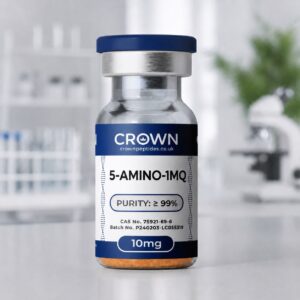
5-Amino-1MQ research compound UK 10mg and 50mg vial - Crown Peptides
≥99% PURITY
HPLC & MS TESTED
5-Amino-1MQ Research Compound
From: £24.99

Buy Now

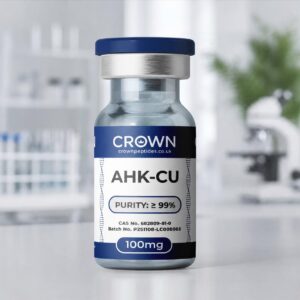
AHK-Cu 100mg research peptide vial – Crown Peptides UK
≥99% PURITY
HPLC & MS TESTED
AHK-Cu Research Peptide
From: £29.99

Buy Now

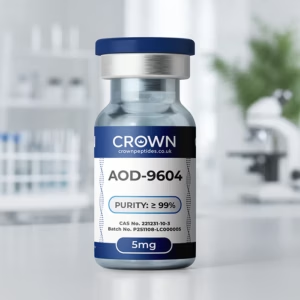
AOD-9604 5mg research peptide vial - Crown Peptides
≥99% PURITY
HPLC & MS TESTED
AOD-9604 Research Peptide
From: £34.99

Buy Now

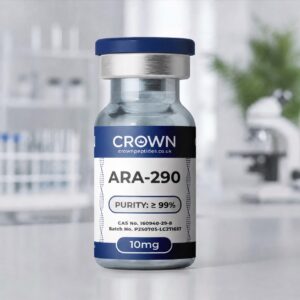
ARA-290 research peptide UK 10mg vial - Crown Peptides
≥99% PURITY
HPLC & MS TESTED
ARA-290 Research Peptide
From: £39.99

Buy Now

Further reading

SUPPORT Mon to Fri, 9am to 5pmDISPATCH Cut-off 2pmEMAIL info@crownpeptides.co.ukWHATSAPP +44 7301 802654

Disclaimer: All products are sold strictly for laboratory research purposes only. Not for human or veterinary use, consumption, therapeutic, or diagnostic application. None of our products are medicines, and none are presented as such. By purchasing, you confirm you are a qualified professional and legally permitted to handle these materials in compliance with all applicable laws and regulations. Misuse, resale for unauthorised purposes, or unlawful application is strictly prohibited. Crown Peptides UK disclaims all liability for improper use, handling, or regulatory non-compliance.

© 2026 Crown Peptides UK, a trading name of Crown Peptides Ltd (company no. 17068950), Suite Ra01, 195-197 Wood Street, London E17 3NU . All Rights Reserved.