Tesamorelin + Ipamorelin (Blend)
A high-purity research blend studied in growth-hormone research.
In stock
Supplied for laboratory research purposes only — not for human consumption or for medical, veterinary or diagnostic use.
Product Overview
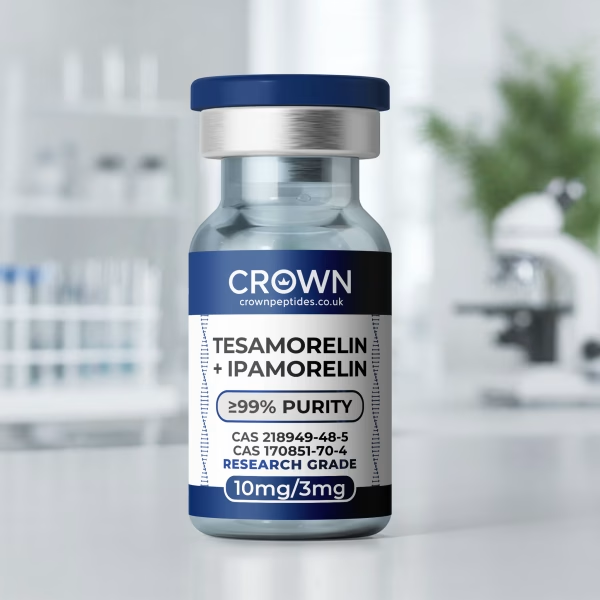
Tesamorelin + Ipamorelin blend UK is Crown Peptides’ research blend pairing a full-length GHRH analogue with a selective ghrelin-receptor agonist, supplied in a 10mg/3mg vial for laboratory research.
- Studied in research involving GHRH receptor signalling
- Studied in research involving ghrelin/GHSR receptor biology
- Studied in research involving pulsatile growth-hormone release
- Studied in research involving visceral fat and metabolic-endocrine models
- Batch-specific quality documentation available
About Tesamorelin + Ipamorelin Blend UK
This blend puts two very different growth-hormone-releasing peptides in one vial. Tesamorelin is the complete 44-amino-acid chain of human growth-hormone-releasing hormone, protected at its N-terminus by a trans-3-hexenoyl group. Ipamorelin is a five-residue peptide that acts on a separate receptor, the growth-hormone secretagogue receptor (GHSR-1a), the receptor that the stomach hormone ghrelin also uses.
Also known as: Tesa Ipa blend, Tesamorelin Ipamorelin, Tesamorelin/Ipamorelin 10/3, TH9507 + Ipamorelin.
Each vial holds 10mg of Tesamorelin and 3mg of Ipamorelin, 13mg of peptide in total. It sits beside our CJC-1295 (No DAC) + Ipamorelin blend, which pairs Ipamorelin with a shorter 29-residue GHRH fragment instead of the full-length hormone.
Tesamorelin + Ipamorelin Blend Research
Growth hormone is controlled by two stimulating signals and one brake. GHRH from the hypothalamus acts on the GHRH receptor of the pituitary somatotroph, ghrelin acts on the GHSR, and somatostatin holds both back. Research on this blend uses one compound for each of the two stimulating routes, so that their combined effect on growth-hormone release can be studied in a single preparation. Ipamorelin was the first growth-hormone secretagogue shown to release GH without a matching rise in ACTH or cortisol (Learn more), which is why it is the usual ghrelin-receptor partner in combination models.
- GHRH receptor signalling
- Ghrelin/GHSR receptor biology
- Pulsatile growth-hormone release
- Visceral fat and metabolic-endocrine models
Two receptors, two second messengers
The GHRH receptor, the target of Tesamorelin, is coupled to the Gs protein and works by raising cyclic AMP inside the somatotroph, which drives both the release of stored growth hormone and the production of new hormone. The GHSR, the target of Ipamorelin, is coupled mainly to Gq and works through phospholipase C and a rise in intracellular calcium. The GHSR is also found in the hypothalamus, where ghrelin-receptor agonists appear to weaken the restraining effect of somatostatin. Because the two signals travel by different routes, a pituitary cell receiving both can respond more strongly than to either one alone.
That cooperation has been measured directly with the body’s own ghrelin. In 2001, Hataya and colleagues at Kyoto University gave healthy men GHRH alone, ghrelin alone or the two together, and found that at low ghrelin doses the combined GH response was greater than the two single responses added together. There was no matching synergy in ACTH or prolactin (Learn more). A blend of a GHRH analogue with a ghrelin-receptor agonist is a practical way to model that interaction in the laboratory.
The receptor found before its hormone
The ghrelin route was discovered backwards. Synthetic growth-hormone-releasing peptides such as GHRP-6 were in laboratory use through the 1980s, long before anyone knew what they acted on. In 1996, a Merck team led by Howard cloned their target, a G-protein-coupled receptor in the pituitary and hypothalamus (Learn more), and suggested that the body must make a hormone of its own for it. Three years later, Kojima and colleagues isolated that hormone from rat stomach and named it ghrelin. Ipamorelin, published in 1998, was designed in the gap between those two discoveries.
Tesamorelin: the full GHRH chain with a protective cap
Natural GHRH is 44 amino acids long and is broken down quickly in the blood, mainly by the enzyme dipeptidyl peptidase IV, which cuts between the second and third residues. Tesamorelin keeps the whole human sequence and adds a trans-3-hexenoyl group at the point where that enzyme attacks. That makes it different from Sermorelin and Mod GRF 1-29, which use only the first 29 residues, and from CJC-1295 with DAC, which is built to bind albumin and last for days.
Tesamorelin also has one of the largest human datasets of any GHRH analogue. In a 26-week trial of 412 adults with HIV-associated abdominal fat, published in the New England Journal of Medicine in 2007, visceral fat measured by CT fell by 15.2% on Tesamorelin and rose by 5.0% on placebo, while IGF-1 rose by 81% (Learn more). That work led to its US approval as Egrifta in 2010 for that single, narrow use. Crown Peptides supplies a lyophilised research material, not the branded medicine; our Tesamorelin page covers its liver and cognitive research in detail.
What a 10mg/3mg ratio means at the molecular level
By weight, the vial holds more than three times as much Tesamorelin as Ipamorelin. By number of molecules, the balance is the other way round. Tesamorelin weighs about 5,136 g/mol and Ipamorelin about 712 g/mol, so 10mg of Tesamorelin is roughly 1.95 micromoles while 3mg of Ipamorelin is roughly 4.21 micromoles. Each vial therefore contains a little over two Ipamorelin molecules for every Tesamorelin molecule. That is worth bearing in mind when comparing results with studies that report their combinations in molar terms.
The size gap also helps with analysis. On HPLC the two peptides interact with the column differently and come off at different times, giving two distinct peaks, and on mass spectrometry their masses are around seven times apart, so each identity can be confirmed from one sample of the mixture.
Specifications
- Product
- Tesamorelin + Ipamorelin (Blend)
- Classification
- Research blend combining a full-length GHRH analogue with a selective ghrelin-receptor agonist
- Available strength
- 10mg/3mg (10mg Tesamorelin + 3mg Ipamorelin per vial)
- Form
- Research material supplied according to product label
- Purity / assay
- ≥99% (HPLC), batch-specific; refer to Certificate of Analysis
- Verification
- HPLC and Mass Spectrometry where analytically appropriate
- Also known as
- Tesa Ipa blend, Tesamorelin Ipamorelin, Tesamorelin/Ipamorelin 10/3
- Product Name
- Tesamorelin + Ipamorelin (Blend)
- Components
- Tesamorelin (CAS 218949-48-5) and Ipamorelin (CAS 170851-70-4)
Purity and Testing
Crown Peptides Tesamorelin + Ipamorelin Blend will be supplied for controlled laboratory research with batch-specific analytical documentation. High-Performance Liquid Chromatography (HPLC) can assess chromatographic purity of each component, while Mass Spectrometry provides molecular information used to support the identity of both peptides in the mixture.
The batch-specific Certificate of Analysis is the definitive source for the exact purity result, identity data and analytical specification of the material supplied.
Storage Conditions
- Store unreconstituted material at -20°C ± 5°C in a cool, dry environment
- Prepared research solutions should use validated storage conditions appropriate to the compound and study design
- Protect from unnecessary heat, direct light and repeated temperature fluctuations
Related Compounds
Researchers working with the Tesamorelin + Ipamorelin blend may also be interested in Tesamorelin, Ipamorelin, CJC-1295 (No DAC) + Ipamorelin, Sermorelin and IGF-1 LR3, other compounds studied along the growth-hormone and IGF-1 pathway.
Tesamorelin + Ipamorelin Blend Frequently Asked Questions
About Tesamorelin + Ipamorelin4 questions
What is in the Tesamorelin + Ipamorelin blend?
Each vial holds 10mg of Tesamorelin, a full-length GHRH analogue, and 3mg of Ipamorelin, a selective ghrelin-receptor agonist, as one freeze-dried powder. Searches for Tesa Ipa, Tesamorelin Ipamorelin or Tesamorelin/Ipamorelin 10/3 all refer to this same product.
Why pair a GHRH analogue with a ghrelin-receptor agonist?
Because they reach the growth-hormone cell through different receptors and different internal signals. Human studies with GHRH and ghrelin itself found the combined GH response was greater than the sum of the two alone, and this blend is designed for models that explore that interaction.
Why is there more Tesamorelin than Ipamorelin by weight?
Mostly because Tesamorelin is a much bigger molecule. At about 5,136 g/mol it is roughly seven times heavier than Ipamorelin, so 10mg of Tesamorelin contains fewer molecules than 3mg of Ipamorelin. In molecular terms the vial holds a little over two Ipamorelin molecules for each Tesamorelin molecule.
Is this blend the same as Egrifta?
No. Egrifta is the branded medicine containing Tesamorelin alone, approved in the US for one narrow use. This blend is a research material that combines the same Tesamorelin sequence with Ipamorelin, supplied as a lyophilised powder for laboratory work only.
Choosing between blends and single peptides4 questions
How does this blend differ from CJC-1295 (No DAC) + Ipamorelin?
The ghrelin-receptor side is the same; the GHRH side is not. This blend uses Tesamorelin, the full 44-residue GHRH chain with a hexenoyl cap, while the CJC-1295 (No DAC) + Ipamorelin blend uses Mod GRF 1-29, a modified 29-residue fragment, in equal amounts with Ipamorelin. Which suits a study depends on whether the full native sequence matters to the design.
Why use the pre-mixed blend instead of two separate vials?
The 10mg/3mg ratio is fixed at manufacture and stays the same from vial to vial, both peptides share one lot number and one Certificate of Analysis, and there is a single reconstitution step. When a design needs to vary the ratio, separate Tesamorelin and Ipamorelin vials are the better choice.
Could another ghrelin-receptor agonist replace Ipamorelin?
In principle, yes, but the results would differ. GHRP-2, GHRP-6 and Hexarelin also act on the GHSR but raise ACTH and cortisol alongside GH in the classic studies. Ipamorelin was chosen for this blend because its GH release is cleaner, which keeps hormonal side-signals out of the data.
How far does a 10mg/3mg vial go?
That depends entirely on the working concentration of each study. As a guide, the vial contains about 1.95 micromoles of Tesamorelin and 4.21 micromoles of Ipamorelin, which is plenty for most cell-based and receptor assays. Boxes of three, five or ten vials keep a longer series on matched material from one batch.
Identity, testing & handling4 questions
How is each peptide in the mixture identified?
The two components are easy to tell apart. On HPLC they leave the column at different times and appear as two separate peaks, and on mass spectrometry their masses are about seven times apart, so both identities can be confirmed from a single sample. The batch-specific Certificate of Analysis records the results for the material supplied.
Why does Tesamorelin carry a hexenoyl group at one end?
It protects the most vulnerable point of the chain. The enzyme dipeptidyl peptidase IV normally clips native GHRH between its second and third amino acids, leaving an inactive fragment. The trans-3-hexenoyl group sits on the first residue and makes that cut much harder, while the rest of the 44-residue sequence stays identical to human GHRH.
Where can I buy Tesamorelin + Ipamorelin in the UK?
Tesamorelin + Ipamorelin is stocked by Crown Peptides in 10mg/3mg vials, available singly or in packs of 3, 5 or 10 with a saving on every vial. Orders ship from the UK, and every batch is independently tested, with its Certificate of Analysis published on this page once stock arrives.
How should the Tesamorelin + Ipamorelin blend be stored?
As a freeze-dried powder it keeps best at -20°C, dry and away from light. Once dissolved, both peptides should be held under storage conditions validated for the study, and repeated warming and cooling should be avoided. Our storage guide has more detail.
Read the batch certificate before you order
Every batch is published openly — identity, purity and batch number, with no account needed.
View lab reports- Laboratory research only
- Not for human or clinical use
- Not for human or veterinary consumption
Supplied for laboratory research purposes only — not for human consumption or for medical, veterinary or diagnostic use.
Other Research Peptides
 Musculoskeletal researchBPC-157 + TB-500 Blend (Wolverine Stack)5mg / 5mg · 2 strengths ›