Register today and get 10% off your first orderRegister for 10% off your first orderRegister now
Crown Peptides

Research Peptides

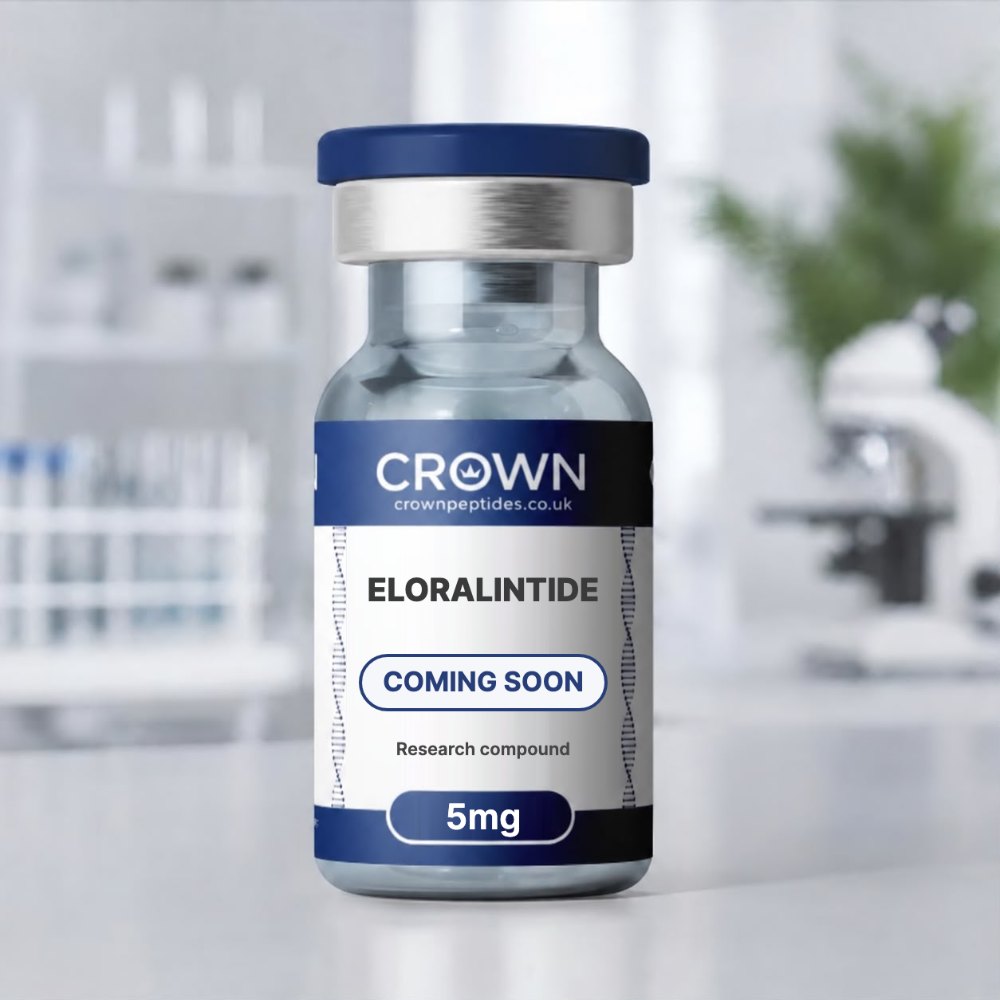
Eloralintide Research Peptide

A research peptide studied in amylin receptor, appetite and body weight research. Coming soon in 5mg and 10mg, with every batch independently tested and dispatched from the UK.

All Batches TestedEvery batch, no exceptions
HPLC & MS VerifiedFull certificate published
Same Day PostageOrder before 2pm
UK Based CompanyDispatched from the UK
Product Overview

A research peptide studied in amylin receptor, appetite and body weight research. Coming soon in 5mg and 10mg, with every batch independently tested and dispatched from the UK.

Full Product Specification
Overview

Product Overview

Eloralintide peptide UK is Crown Peptides’ selective amylin receptor agonist research compound, coming soon in 5mg and 10mg for laboratory research.

5mg & 10mg (coming soon)Available strengthsHPLC testedChromatographic purityMS verifiedIdentity confirmedBatch CoADocumentation supplied

Supplied for laboratory research purposes only — not for human consumption or for medical, veterinary or diagnostic use.

Key features

Key Features

  • Studied in research involving amylin receptor signalling
  • Studied in research involving appetite, satiety and food intake
  • Studied in research involving body weight and fat mass regulation
  • Studied in research involving long-acting peptide design
  • Batch-specific quality documentation available
Background

About Eloralintide Peptide UK

Eloralintide is a long-acting synthetic analogue of amylin, the hormone released from the pancreas alongside insulin after a meal. Developed by Eli Lilly under the code LY3841136, it was designed to activate the amylin 1 receptor (AMY1R) selectively and to last long enough for once-weekly dosing in studies. In just a few years it has gone from receptor assays to large clinical trials, making it one of the most closely watched compounds in metabolic and weight regulation research.

Also known as: Eloralintide peptide, LY3841136, LY-3841136, selective amylin receptor agonist.

Research

Eloralintide Research

Research uses Eloralintide to study how selective amylin receptor activation affects food intake, body weight and metabolic markers, from cell assays and rodent models through to large clinical trials (Learn more). This work sits within a fast-growing field of metabolic peptide research, alongside related compounds such as MOTS-c and AOD-9604.

  • Amylin and calcitonin receptor pharmacology
  • Satiety and food intake regulation
  • Body weight and fat mass in obesity models
  • Pharmacokinetics of once-weekly peptides
Amylin: the other meal hormone

Every time the pancreas releases insulin after a meal, it releases a 37-amino-acid partner called amylin from the same beta cells. Amylin slows stomach emptying, dampens the hormone glucagon and signals fullness to the brain, particularly to an area of the brainstem called the area postrema. Natural amylin breaks down within minutes and tends to clump together into fibrils, so researchers have spent decades building more stable versions. Eloralintide is one of the newest, engineered to stay active for days rather than minutes.

Amylin works through a family of receptors built from the calcitonin receptor paired with one of three helper proteins called RAMPs (receptor activity-modifying proteins). Pair it with RAMP1 and you get AMY1R; pair it with RAMP3 and you get AMY3R; on its own it is the plain calcitonin receptor. Earlier long-acting amylin analogues were designed to act fairly evenly across this whole family. Eloralintide was deliberately designed to favour AMY1R, which gives researchers a cleaner tool for asking what that one receptor subtype does.

Selectivity, measured

In cell lines expressing individual human receptors, Eloralintide activated AMY1R about 12 times more potently than the calcitonin receptor and about 11 times more potently than AMY3R. In rats the picture was slightly different, with both rat AMY1R and AMY3R activated more potently than the calcitonin receptor, a reminder that receptor pharmacology does not always translate one-to-one between species. In diet-induced obese rats Eloralintide reduced food intake and lowered body weight in a dose-dependent way, with the loss coming mainly from fat mass.

One of the more interesting preclinical results came from a test called conditioned taste avoidance. Eloralintide produced significantly less avoidance in lean rats than a non-selective amylin receptor agonist used as a comparator, which the discovery team linked to its receptor selectivity. For researchers trying to separate genuine satiety signals from signs that an animal simply feels unwell, that distinction matters a great deal.

Built to last a week

Eloralintide is a modified peptide of about 4,526 daltons. Its chain includes a ring formed between two cysteine residues near the start, several non-standard amino acids such as ornithine, alpha-methyl phenylalanine and N-methyl asparagine that resist enzymes, and a fatty acid chain attached to a lysine side chain. That fatty acid lets the peptide bind albumin in the blood, the same half-life extension strategy used in other once-weekly peptides. Pharmacokinetic studies in rats and monkeys were favourable, and human data went on to support once-weekly dosing.

From first-in-human to phase 2

The clinical programme moved quickly. In a single-dose phase 1 study in 48 healthy participants, single doses of 4mg and 12mg were followed by mean body weight changes of -2.5% and -4.4% at week 4, against +0.6% with placebo, with most adverse events mild. A 12-week multiple-dose phase 1 study in 100 participants with obesity or overweight then reported weight reductions of 2.6% to 11.3% across dose groups. In that study, decreased appetite was the most commonly reported event, while gastrointestinal events such as nausea and vomiting were infrequent (Learn more).

The headline results came from a 48-week phase 2 trial in 263 adults with obesity or overweight at 46 research centres in the USA, published in The Lancet in late 2025 (Learn more). Mean body weight fell by 9% at the lowest dose and by up to 20% at the higher doses, compared with 0.4% on placebo, and every dose arm met the primary endpoint. Waist circumference, blood pressure, lipids and markers of inflammation also improved. Nausea and fatigue were the most common side effects and were more frequent at higher doses, and slower dose escalation was associated with fewer of them.

What comes next

Eli Lilly has since moved Eloralintide into phase 3, with registered studies of Eloralintide on its own in people with obesity or overweight, and of Eloralintide added to weekly incretin therapy. A separate phase 2 study is looking at Eloralintide on its own and alongside an incretin-based compound in people with type 2 diabetes. With so much new data on the way, Eloralintide is set to remain a reference compound for amylin research for years to come.

Specifications

Specifications

Product
Eloralintide
Classification
Selective amylin receptor agonist research peptide
Available strengths
5mg and 10mg (coming soon)
CAS number
2883634-40-8
Molecular weight
≈ 4,526 g/mol
Molecular formula
C201H319N49O65S2
Form
Research material supplied according to product label
Purity and assay
batch-specific — refer to Certificate of Analysis
Verification
HPLC and Mass Spectrometry where analytically appropriate

Compound-level reference data. Batch-specific results appear on the Certificate of Analysis.

Work out concentration with the peptide calculator
Testing

Purity and Testing

Crown Peptides Eloralintide will be supplied with batch-specific quality documentation appropriate to the material. A long, modified, fatty-acid-bearing peptide like this is far more demanding to make than a short sequence: every coupling step and every modification is a chance for truncated or incomplete versions to form. That makes HPLC purity and mass spectrometry identity confirmation especially important, and the Certificate of Analysis should be used as the definitive source for identity, assay, purity and relevant impurity information.

Storage

Storage Conditions

  • Store unreconstituted material at -20°C ± 5°C in a cool, dry environment
  • Prepared research solutions should use validated storage conditions appropriate to the compound and study design
  • Protect from unnecessary heat, direct light and repeated temperature fluctuations
Full storage guide
Related

Related Compounds

Researchers interested in Eloralintide may also be interested in MOTS-c, AOD-9604, 5-Amino-1MQ, Tesamorelin and L-Carnitine — other compounds studied in metabolic, appetite and body composition research.

Compliance

Research Use Only

  • Laboratory research only
  • Not for human or clinical use
  • Not for human or veterinary consumption
  • Qualified personnel only
Questions

Eloralintide Frequently Asked Questions

About Eloralintide5 questions
What is Eloralintide?

Eloralintide is a long-acting synthetic amylin analogue, developed by Eli Lilly as LY3841136, with a molecular weight of about 4,526 and the CAS number 2883634-40-8. It selectively activates the amylin 1 receptor and has been studied in receptor assays, rats, monkeys and clinical trials now in phase 3. Crown Peptides will supply it in 5mg and 10mg vials.

Are Eloralintide and LY3841136 the same compound?

Yes. LY3841136 was the development code used during early research, and Eloralintide is the international non-proprietary name it was later given. Older conference abstracts and trial registrations use the code, while the published phase 2 results use the name, so searching for both gives the fullest picture of the literature.

What makes Eloralintide “selective”?

It favours one amylin receptor subtype, AMY1R, over the others. In human receptor assays it was about 12-fold more potent at AMY1R than at the calcitonin receptor and about 11-fold more potent than at AMY3R. Earlier long-acting analogues act more evenly across the whole receptor family, so Eloralintide gives researchers a way to study what AMY1R activation does on its own.

How is Eloralintide different from GLP-1 peptides?

They act on completely different hormone systems. GLP-1 compounds mimic a gut hormone released from the intestine, while Eloralintide mimics amylin from the pancreas. Both reduce food intake in research models, but through separate receptors, which is why Lilly is also testing Eloralintide alongside weekly incretin therapy to see how the two pathways combine.

Why does it only need weekly dosing in studies?

Two design features stretch its half-life. A fatty acid chain on a lysine side chain lets it bind albumin, the most abundant protein in blood, which shields it from rapid clearance, and several unusual amino acids make it harder for enzymes to cut. Pharmacokinetic data in rats, monkeys and people all supported a once-weekly schedule.

Findings in research models4 questions
What is conditioned taste avoidance and why does it matter?

It is a rodent test in which animals learn to avoid a flavour they experienced alongside a compound. Strong avoidance suggests the compound made them feel unwell, which can be confused with genuine appetite suppression. Eloralintide caused significantly less conditioned taste avoidance than a non-selective amylin agonist in lean rats, a result the discovery team linked to its receptor selectivity.

What did the phase 2 trial find?

In 263 adults with obesity or overweight treated once weekly for 48 weeks, mean body weight fell by 9% at 1mg, 12% at 3mg, 18% at 6mg and 20% at 9mg, against 0.4% on placebo. Waist circumference, blood pressure, lipids and inflammation markers also improved. Nausea and fatigue were the most common side effects, rising with dose and lower with slower dose escalation.

Was weight loss in animal studies fat or muscle?

In diet-induced obese rats, the body weight reduction came mainly from fat mass. That is one of the reasons amylin analogues are attracting so much attention in metabolic research, where the quality of weight change matters as much as the amount.

Where is Eloralintide research heading next?

Phase 3 studies are now under way, including trials of Eloralintide on its own in people with obesity or overweight and trials adding it to weekly incretin treatment. A separate phase 2 study is looking at Eloralintide on its own and alongside an incretin-based compound in people with type 2 diabetes, so a large amount of new data is expected over the coming years.

Buying, testing & storage5 questions
Is Eloralintide legal to buy in the UK?

Eloralintide is not a controlled drug under the Misuse of Drugs Act 1971, and it is not a licensed medicine in the UK. It is an investigational compound that has not yet been brought to market, and it is sold in the UK as a research compound for laboratory use only, which is how Crown Peptides supplies it. This is general information, not legal advice.

Where can I buy Eloralintide in the UK?

Eloralintide is coming soon to Crown Peptides in 5mg and 10mg vials, each available singly or in packs of 5 or 10 with a saving on every vial. Orders ship from the UK, and every batch is independently tested, with its Certificate of Analysis published on this page once stock arrives.

Which strength should I choose, 5mg or 10mg?

The 5mg vial suits receptor assays and pilot work, where only small amounts are used at a time. The 10mg vial gives more material from a single batch for longer animal studies, and choosing one batch for a whole project keeps results comparable from start to finish.

Why is mass spectrometry so important for Eloralintide?

Because it is a large, modified peptide, there are many ways a batch could differ subtly from the intended structure, such as a missing residue or an incomplete fatty acid attachment. Mass spectrometry confirms the molecule has the expected mass of about 4,526, while HPLC shows how much of the material is that single species. Each batch’s Certificate of Analysis documents both.

How should Eloralintide be stored?

Keep the unreconstituted powder at -20°C ± 5°C, dry and away from light. Lipidated peptides like Eloralintide can stick to some plastics once in solution, so researchers often use low-binding tubes and validate their own storage conditions for prepared solutions.

Read the batch certificate before you order

Every batch is published openly — identity, purity and batch number, with no account needed.

View lab reports

Supplied for laboratory research purposes only — not for human consumption or for medical, veterinary or diagnostic use.

All Batches TestedEvery batch, no exceptions

Each batch undergoes internal analytical verification using chromatographic and spectrometric methods prior to lyophilisation.

• HPLC Analysis
• Mass Spectrometry Confirmation
• Batch Traceability

For Research Use Only

By purchasing this product you confirm that you are a qualified researcher and that this compound will be used exclusively for laboratory research purposes.

Not for Human Consumption

This product is not intended for diagnostic or therapeutic use.

Any human or medical use is strictly prohibited.

Store Safely at All Times

Store in a cool, dry, secure and sterile environment away from any unauthorised persons or children.

Other Research Peptides

2 strengths5-Amino-1MQ research compound UK 10mg and 50mg vial - Crown PeptidesAgeing research

5-Amino-1MQ Research Compound


From£24.99Strength10mg
Add to basket
AHK-Cu 100mg research peptide vial – Crown Peptides UKAgeing research

AHK-Cu Research Peptide


From£29.99Strength100mg
Add to basket
AOD-9604 5mg research peptide vial - Crown PeptidesMetabolic research

AOD-9604 Research Peptide


From£34.99Strength5mg
Add to basket
ARA-290 research peptide UK 10mg vial - Crown PeptidesImmunology research

ARA-290 Research Peptide


From£39.99Strength10mg
Add to basket

Further reading

SUPPORT Mon to Fri, 9am to 5pmDISPATCH Cut-off 2pmEMAIL info@crownpeptides.co.ukWHATSAPP +44 7301 802654

Disclaimer: All products are sold strictly for laboratory research purposes only. Not for human or veterinary use, consumption, therapeutic, or diagnostic application. None of our products are medicines, and none are presented as such. By purchasing, you confirm you are a qualified professional and legally permitted to handle these materials in compliance with all applicable laws and regulations. Misuse, resale for unauthorised purposes, or unlawful application is strictly prohibited. Crown Peptides UK disclaims all liability for improper use, handling, or regulatory non-compliance.

© 2026 Crown Peptides UK, a trading name of Crown Peptides Ltd (company no. 17068950), Suite Ra01, 195-197 Wood Street, London E17 3NU . All Rights Reserved.