Research Peptides
Three complementary research compounds studied in metabolism and energy research. Save 20% compared with buying the nine vials individually, with every batch independently tested and dispatched from the UK.
In stock
Three complementary research compounds studied in metabolism and energy research. Save 20% compared with buying the nine vials individually, with every batch independently tested and dispatched from the UK.
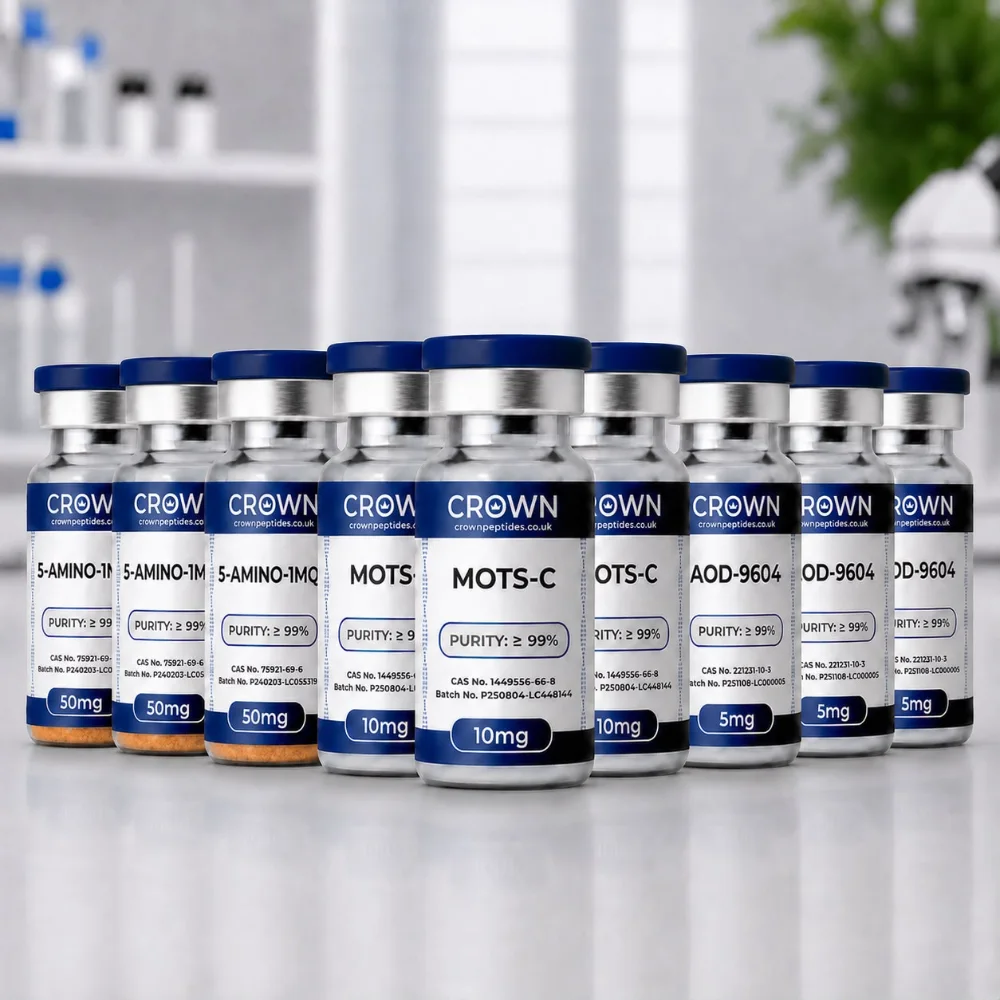
Metabolic Research Bundle UK is Crown Peptides' 9-vial research bundle combining MOTS-c, 5-Amino-1MQ and AOD-9604, supplied as 3 × MOTS-c 10mg, 3 × 5-Amino-1MQ 50mg and 3 × AOD-9604 5mg for laboratory research into mitochondrial signalling, NAD+ metabolism and lipid metabolism.
Supplied for laboratory research purposes only — not for human consumption or for medical, veterinary or diagnostic use.
Metabolic research is really three questions at once: how cells sense energy, how they manage their NAD+ supply and how they store or release fat. This bundle pairs a compound with each. MOTS-c is a 16-amino-acid peptide encoded within the mitochondrial genome, studied as a signal between mitochondria and the nucleus. 5-Amino-1MQ is a small-molecule inhibitor of nicotinamide N-methyltransferase (NNMT), an enzyme linked to NAD+ salvage and fat-cell metabolism. AOD-9604 is a synthetic 16-amino-acid fragment from the C-terminal region of human growth hormone, investigated for its effects on lipid metabolism.
Because each works through a different mechanism, the bundle suits comparative and pathway-mapping work within the same metabolic models.
MOTS-c: the mitochondrial signal of the trio; the study that identified it linked the peptide to AMPK activation in skeletal muscle and reported that high-fat-fed mice given it were protected from obesity and insulin resistance (Learn more). Discovery and biology are on the MOTS-c page.
5-Amino-1MQ: the only non-peptide here, a selective NNMT inhibitor tested in diet-induced obese mice (Learn more). Its chemistry is explained on the 5-Amino-1MQ page.
AOD-9604: the fat-cell-focused growth-hormone fragment, with chronic-treatment lipid studies in obese mice (Learn more). Its clinical history is set out on the AOD-9604 page.
Each member of this bundle sits at a different point along the route from energy status to fat handling. MOTS-c belongs to the sensing end, studied as a mitochondrial signal that engages AMPK, the cell’s main energy gauge. 5-Amino-1MQ belongs in the middle, at cofactor supply: blocking NNMT spares nicotinamide for NAD+ salvage and saves methyl groups. AOD-9604 belongs to the output end, studied in adipocytes for lipolysis and lipid synthesis. A design using all three can therefore ask layered questions. Does raising cellular NAD+ change how cells respond to an AMPK-engaging signal? Does a lipolysis readout behave differently when energy sensing is already switched on? Because the three mechanisms barely overlap, any interaction observed is more informative than it would be for three compounds acting on one target.
Two members touch the same metabolic network from different ends. MOTS-c’s reported mechanism runs through the folate cycle, where blocking it lets AICAR accumulate, which in turn switches on AMPK. NNMT, the target of 5-Amino-1MQ, consumes S-adenosylmethionine, the methyl donor regenerated by the methionine cycle, which is itself linked to the folate cycle. Whether the two influence each other in the same cells has not, to our knowledge, been studied. A targeted metabolomics panel can test it: SAM and SAH (and their ratio), 1-methylnicotinamide as the direct product of NNMT, AICAR or ZMP, and NAD+. Including that panel in the combination arm turns a speculative link into a measurable one.
The published evidence does not sit in a single tissue. 5-Amino-1MQ and AOD-9604 have adipocyte data, including cultured fat-cell work for 5-Amino-1MQ, whereas MOTS-c’s strongest findings come from skeletal muscle. Two approaches handle that mismatch. One is differentiated 3T3-L1 adipocytes alongside a muscle line, linked by conditioned medium, which keeps each compound in its best-evidenced tissue. The other is a diet-induced obese mouse model, since all three have obese-mouse data, with muscle and fat analysed separately at the end. Useful readouts include glycerol release, lipid-droplet staining, 2-deoxyglucose uptake, phosphorylated AMPK and ACC, and NAD+/NADH. Staging three vials of each fits naturally: one set for short signalling experiments read within hours, one for multi-day differentiation runs where compounds are refreshed at each medium change, and one for confirming the key result.
The vial weights translate into very different molecule counts. A 10mg MOTS-c vial (about 2,174.6 g/mol) holds roughly 4.6 micromoles and a 5mg AOD-9604 vial (about 1,815.1 g/mol) about 2.75 micromoles, while a 50mg 5-Amino-1MQ vial (about 286.1 g/mol as the iodide salt) holds nearly 175 micromoles, around 38 times the MOTS-c and 64 times the AOD-9604. About 27.8mg of that 50mg is the active cation; the rest is iodide. Small-molecule inhibitors are typically used at micromolar concentrations, well above the range used for signalling peptides, which explains the larger fill. Matching arms by molarity rather than milligrams keeps comparisons fair, and the net-content figure on each batch certificate is the right starting point for that sum.
Compound-level reference data. Batch-specific results appear on the Certificate of Analysis.
Work out concentration with the peptide calculatorEach compound in the Metabolic Research Bundle is supplied for controlled laboratory research with its own batch-specific analytical documentation. High-Performance Liquid Chromatography (HPLC) can assess chromatographic purity, while Mass Spectrometry provides molecular information used to support identity verification. With two peptides and a small molecule in the same bundle, batch-specific identity confirmation for each compound is what keeps comparisons between them reliable.
The batch-specific Certificate of Analysis is the definitive source for the exact purity result, identity data and analytical specification of each material supplied.
Researchers working with this bundle may also be interested in MOTS-c, 5-Amino-1MQ, AOD-9604, NAD+ and L-Carnitine — the individual compounds in this bundle, plus NAD+ and L-Carnitine, both used in energy-metabolism research.
Three 10mg MOTS-c vials, three 50mg 5-Amino-1MQ vials and three 5mg AOD-9604 vials. That is two peptides of 16 residues each and one small molecule, nine vials in all, each with its own batch documentation.
The bundle is organised by mechanism, not by chemical class. NNMT is an enzyme, and the best-studied way to block it is with a small inhibitor, so 5-Amino-1MQ is the right tool for the cofactor-supply part of the question even though it is not a peptide.
Both make useful comparators. NAD+ supplied directly is a reference point for the 5-Amino-1MQ arm, which raises NAD+ indirectly, and L-Carnitine shuttles long-chain fats across the mitochondrial membrane, linking the lipids released in AOD-9604 experiments to their oxidation.
As a set, the nine vials come in 20% below the combined single-product price, with all three compounds dispatched together.
Use one marker per mechanism: a fall in 1-methylnicotinamide for 5-Amino-1MQ, phosphorylated AMPK or ACC for MOTS-c, and glycerol or free fatty acid release for AOD-9604. Confirming each arm hits its target before reading the combinations prevents a null result being misread as no interaction.
AICAR is a fitting AMPK reference, since it is the very metabolite MOTS-c causes to accumulate. Isoproterenol is the standard lipolysis stimulus for adipocytes, and an NAD+ precursor such as nicotinamide riboside gives a comparison for the NNMT arm.
At the micromolar concentrations typical for this inhibitor, iodide is unlikely to matter, but at high concentrations or in thyroid-related tissues it is worth controlling for. A sodium iodide control matched to the same molar concentration settles the question cheaply.
Not necessarily as a first step. It is the one model where all three compounds have published data, but strains, diets and study lengths differed between those papers, so cell work usually comes first to define concentrations and readouts before an animal study is planned.
Mixing them in advance is best avoided. MOTS-c carries two oxidation-prone methionines, the molar ranges differ by more than an order of magnitude, and single-agent arms need their own stocks anyway. Prepare each separately and combine at the point of use.
That depends on the concentrations chosen. As a guide, at 10 micromolar in 1 mL wells one 5-Amino-1MQ vial covers about 17,500 wells, while at the same concentration a MOTS-c vial covers about 460 and an AOD-9604 vial about 275. Running that sum for your own plan shows which vial sets the pace.
Every batch is published openly — identity, purity and batch number, with no account needed.
Supplied for laboratory research purposes only — not for human consumption or for medical, veterinary or diagnostic use.
Each batch undergoes internal analytical verification using chromatographic and spectrometric methods prior to lyophilisation.
• HPLC Analysis
• Mass Spectrometry Confirmation
• Batch Traceability
By purchasing this product you confirm that you are a qualified researcher and that this compound will be used exclusively for laboratory research purposes.
This product is not intended for diagnostic or therapeutic use.
Any human or medical use is strictly prohibited.
Store in a cool, dry, secure and sterile environment away from any unauthorised persons or children.
Disclaimer: All products are sold strictly for laboratory research purposes only. Not for human or veterinary use, consumption, therapeutic, or diagnostic application. None of our products are medicines, and none are presented as such. By purchasing, you confirm you are a qualified professional and legally permitted to handle these materials in compliance with all applicable laws and regulations. Misuse, resale for unauthorised purposes, or unlawful application is strictly prohibited. Crown Peptides UK disclaims all liability for improper use, handling, or regulatory non-compliance.