Vilon Research Peptide
Vilon, the thymus peptide bioregulator Lys-Glu (KE), studied in research on thymocyte proliferation and immune signalling.
Out of stock
Supplied for laboratory research purposes only — not for human consumption or for medical, veterinary or diagnostic use.
Product Overview
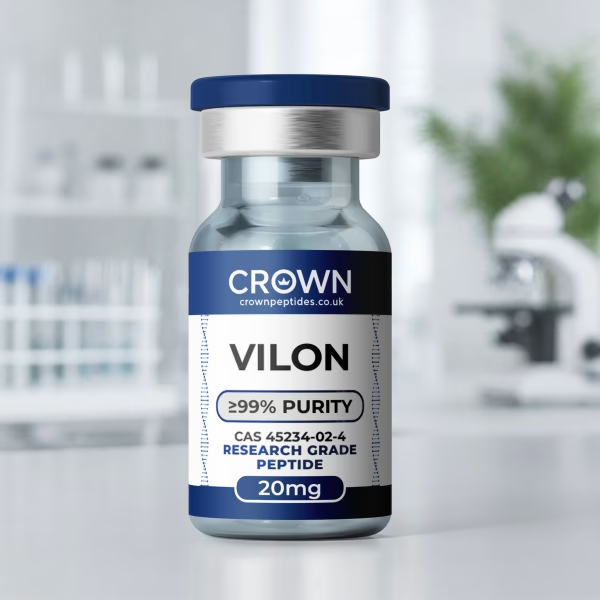
Vilon UK is Crown Peptides’ thymus peptide bioregulator, the dipeptide Lys-Glu, supplied in 20mg for laboratory research.
- Studied in research involving thymus tissue and thymocyte proliferation
- Studied in research involving immune signalling, including interleukin-2 expression
- Studied in research involving gene expression in ageing cell cultures
- Studied in research involving chromatin structure in cells from elderly donors
- CAS number and sequence confirmed on every batch certificate
About Vilon UK
Vilon is a synthetic peptide of just two amino acids, lysine and glutamic acid, written in shorthand as KE. That makes it the shortest member of the Khavinson bioregulator family and one of the smallest research peptides there is, at around 275 daltons.
Also known as: KE, Lys-Glu, L-lysyl-L-glutamic acid, lysylglutamic acid, H-Lys-Glu-OH, AB-0 peptide, thymus peptide bioregulator
It is the one associated with the thymus, the gland that trains the immune system’s T-cells, and with immune tissue generally.
Its size is the interesting thing about it scientifically. A two-amino-acid chain is close to the smallest unit that can still be called a peptide, which raises an obvious question: does it do anything that its two amino acids would not do separately? That question was tested directly, and the answer is set out in the research section below.
Vilon is not Thymalin, and the difference matters. Thymalin is a polypeptide complex extracted from thymus tissue, containing many different components. Vilon is a single synthetic dipeptide of known formula and mass. The research group behind both describes Lys-Glu as one of the active constituents within the thymus extract, which is a real relationship but not the same as them being the same product. Research carried out on the extract is not research on Vilon, and we do not present it as such.
In the bioregulator research peptides range, Vilon is the immune one. The others are matched to their own tissues: Epitalon to the pineal gland, Pinealon to brain tissue, Vesugen to blood vessels, Bronchogen to the airways and Cartalax to cartilage.
Vilon Research
Published work on Lys-Glu goes back to 2000, with a cluster of Russian studies in the early 2000s and a revival of cell-culture work from 2020 onwards. The bulk of it comes from one research institute in St Petersburg and its immediate collaborators, and there is very little from groups outside that orbit. Several of the studies are short reports whose abstracts give no sample sizes or effect sizes. We have set out the ones that report something concrete.
- Thymocyte proliferation and recovery of immune tissue
- Immune signalling molecules and interleukin expression
- Gene expression in ageing cell cultures
- Chromatin structure in cells from elderly donors
Does the peptide bond actually matter?
This is the first question worth answering for a two-amino-acid compound, and a 2015 study tested it head on. It compared Lys-Glu against a simple mixture of free lysine and free glutamic acid in organotypic culture. The dipeptide stimulated growth of spleen cells; the mixture of the same two amino acids, unjoined, inhibited it. Molecular modelling in the same paper placed the dipeptide in the minor groove of DNA with a stronger interaction than either amino acid alone. It is the clearest evidence that Vilon is not just its ingredients. (Learn more)
Thymus tissue after radiation damage
A 2001 study gave Vilon to rats, both healthy and after a single whole-body dose of radiation. It stimulated thymocyte proliferation and increased the proliferative potential of intestinal stem cells, supporting recovery of the thymus, spleen and duodenum. The same experiment tested a sibling peptide which had the opposite effect in some of those tissues, which was the authors’ actual point: these peptides act differently depending on the tissue. (Learn more)
How it acts on thymus cells
A 2002 study compared three peptides on mouse thymocytes. Vilon had the strongest effect on thymocyte proliferation of the three, altered the activity of interleukin-1 beta, and raised the activity of an enzyme in the thymocyte membrane more than the others, which the authors read as signalling through a specific membrane pathway. A separate 2002 study found Vilon switched on production of interleukin-2 messenger RNA in spleen cells with no other trigger present, with the effect depending on concentration and time. (Learn more) (Learn more)
Human thymus cells
A 2004 study co-cultured human thymocytes with the epithelial cells that support them. Vilon increased markers of ribosome assembly and protein synthesis, and had a direct effect on cell division, with thymocytes transforming into actively dividing cells. A sibling peptide suppressed the same markers, again illustrating that these compounds are not interchangeable. (Learn more)
A measured, and modest, effect on gene expression
A 2002 study used a microarray of 15,247 gene clones in mouse heart tissue. Vilon on its own changed 36 of them. We quote that figure because it is one of the few genuinely quantified results in this literature, and because it gives an honest sense of scale: this is a selective effect on a small number of genes, not a broad switch. (Learn more)
More recent cell-culture work
A 2023 study in human mesenchymal stem cells reported that Lys-Glu raised expression of the SIRT1 gene six-fold and its protein 8.2-fold in young cells, and reduced PARP1 and PARP2 expression roughly two-fold as the cells aged. A 2020 study in the same cell type found IGF1 expression rose between three and a half and five and a half times with peptide addition. A separate 2020 study in human skin fibroblasts reported reduced inflammatory signalling and increased sirtuin-6. Worth noting for anyone reading closely: that fibroblast study and the stem cell study point in opposite directions on one signalling molecule, in different cell types and using different measurements. (Learn more) (Learn more) (Learn more)
Chromatin in cells from elderly donors
A 2004 study from a group in Tbilisi, working with cultured lymphocytes from elderly people, found Vilon unwound densely packed chromatin and reactivated ribosomal genes, freeing genes that had been switched off. It also reported what Vilon did not do: it left one particular type of tightly packed chromatin untouched, where two sibling peptides decondensed it. This is among the few studies in the field not led from St Petersburg, though the peptides and the model came from there. (Learn more)
Tissue specificity
A 2001 study grew explants of different organs in culture and applied different peptides. Vilon stimulated growth of thymus explants specifically, while the other peptides acted on brain cortex, subcortical tissue and liver respectively. (Learn more)
Work from an Italian laboratory
A 2022 open-access study tested five peptides from this family, Vilon among them, on a human immune cell line. All five altered cell proliferation patterns and increased a form of protein signalling, and all five reduced the production of two inflammatory signalling molecules in stimulated cells. It is one of the few papers in this field published in a mainstream Western journal, though the research group behind the peptides is a co-author on it. (Learn more)
Taken together, Vilon has a consistent set of findings in thymus and immune tissue, one quantified gene-expression result, a good direct test showing it behaves differently from its free amino acids, and recent cell-culture data. It also has real limitations, which we set out in the questions below rather than leaving for you to find. Related compounds in the same family include Vesugen and Bronchogen.
Specifications
- Product
- Vilon
- Classification
- Short peptide bioregulator, synthetic dipeptide
- Sequence
- Lys-Glu (KE)
- Available strength
- 20mg
- Form
- Lyophilised research material supplied according to product label
- Purity / assay
- batch-specific; refer to Certificate of Analysis
- Verification
- HPLC and Mass Spectrometry
- CAS Number
- 45234-02-4
- Also known as
- KE, Lys-Glu, AB-0 peptide
- Product Name
- Vilon
- Molecular Formula
- C11H21N3O5
- Molecular Weight
- approximately 275.30 g/mol; refer to the batch Certificate of Analysis for the confirmed mass
Purity and Testing
A two-amino-acid peptide is about as simple as identity testing gets, and at 275 daltons mass spectrometry pins it down precisely. HPLC shows how clean the preparation is.
Crown Peptides Vilon is supplied with batch-specific quality documentation, published on our lab reports page before the batch goes on sale, stating the sequence and CAS number alongside the assay result. The Certificate of Analysis should be used as the definitive source for identity, assay, purity and relevant impurity information.
Storage Conditions
- Store unreconstituted material at -20°C ± 5°C in a cool, dry environment
- Prepared research solutions should use validated storage conditions appropriate to the compound and study design
- Protect from unnecessary heat, direct light and repeated temperature fluctuations
Related Compounds
Compounds studied alongside Vilon in the peptide bioregulator family include Vesugen, Bronchogen, Epitalon, Pinealon, Cartalax and Thymalin. The full range is in our bioregulator research peptides category.
Vilon Frequently Asked Questions
About Vilon5 questions
What is Vilon?
Vilon is a synthetic dipeptide made of lysine and glutamic acid, known in shorthand as KE. Of the short peptide bioregulators that came out of Russian gerontology research, it is the shortest, and the one studied in connection with the thymus gland and immune tissue.
Why is it only two amino acids?
Because that is the fragment the original researchers identified as active. It raises a fair question about whether a two-amino-acid chain can do anything its separate ingredients cannot, and that was tested directly: the joined dipeptide and a mixture of the same two free amino acids had opposite effects on cell growth in culture.
Is Vilon the same as Thymalin?
No. Thymalin is an extract of thymus tissue containing many polypeptides. Vilon is one synthetic dipeptide. The connection is that Lys-Glu is described as one of the active components found within that extract, but a study done on the extract is not a study of Vilon.
What is the AB-0 peptide?
A research code used for Vilon in some published work. If you are reading a paper that refers to AB-0, it is referring to the same Lys-Glu dipeptide, though papers rarely spell this out.
How does Vilon compare with the other bioregulators?
Each is a different sequence matched to a different tissue, and several studies test them side by side precisely to show they are not interchangeable. In those comparisons Vilon has consistently been the strongest on thymus and immune measures, and in other experiments it has been the weaker one. That pattern is the point of the family rather than a flaw in it.
Findings in research models5 questions
What is the strongest finding on Vilon?
Arguably the 2015 comparison against free amino acids, because it tests the most obvious objection to a two-amino-acid compound and answers it clearly. For effects, the most consistent body of work is on thymus tissue: increased thymocyte proliferation, assisted recovery of immune tissue after radiation damage, and activation of interleukin-2 production.
Does Vilon extend lifespan?
You will see a figure of 20 to 40% quoted widely by suppliers. We cannot support it. A 2000 mouse study did report prolonged lifespan alongside increased activity and endurance, but its published abstract contains no lifespan figures at all, and we could find no study producing that percentage for this compound. We would rather tell you that than repeat a number we cannot trace.
Does Vilon affect telomeres?
There is no published study of Lys-Glu and telomere length or telomerase activity that we could find. Telomere research in this family belongs to Epitalon, a different peptide. If you see telomere claims attached to Vilon, they have been carried across from its relative.
Has Vilon been shown to enter cells and bind DNA?
Not directly. The cell-penetration and DNA-binding experiments most often cited for this family tested four other peptides from the group, and Lys-Glu was not among them. What exists for Vilon itself is molecular modelling placing it in the minor groove of DNA, and a bioinformatics study, neither of which is a measurement of binding. It is a reasonable proposal rather than a demonstrated fact.
How strong is the evidence overall?
Honestly, limited. Most of it is short Russian-language reports from a single institute, published between 2000 and 2006, with a smaller revival of cell-culture work from 2020. There are no randomised controlled trials, no independent group has reproduced the main findings, and several abstracts give no sample sizes or statistics. The recent stem cell and fibroblast work is better documented. We set this out because the alternative is implying a depth of evidence that is not there.
Buying, testing & storage4 questions
Is Vilon legal to buy in the UK?
Vilon is supplied in the UK as a laboratory research material. It is not a licensed medicine and is not sold for human or veterinary use. It is supplied strictly for laboratory research purposes by qualified personnel.
Where can I buy Vilon in the UK?
Crown Peptides supplies Vilon in 20mg vials from the UK, with HPLC and mass spectrometry verification and a batch-specific Certificate of Analysis published for every batch. Orders placed before 2pm are dispatched the same working day.
Does Vilon have a CAS number?
Yes: 45234-02-4. It is a well-established registry entry for the dipeptide, and we state it on the certificate alongside the sequence.
How should Vilon be stored and handled?
Unreconstituted material should be kept at -20°C ± 5°C in a cool, dry place, away from direct light and repeated temperature swings. Prepared solutions should follow storage conditions validated for the study in question. Our storage information page covers handling in more detail.
Read the batch certificate before you order
Every batch is published openly — identity, purity and batch number, with no account needed.
View lab reports- Laboratory research only
- Not for human or clinical use
- Not for human or veterinary consumption
Supplied for laboratory research purposes only — not for human consumption or for medical, veterinary or diagnostic use.
Other Research Peptides
 Endocrine researchCJC-1295 + IpamorelinBlend