Research Peptides
A research peptide studied in TREK-1 channel and mood-research models. Coming soon in 10mg, with every batch independently tested and dispatched from the UK.
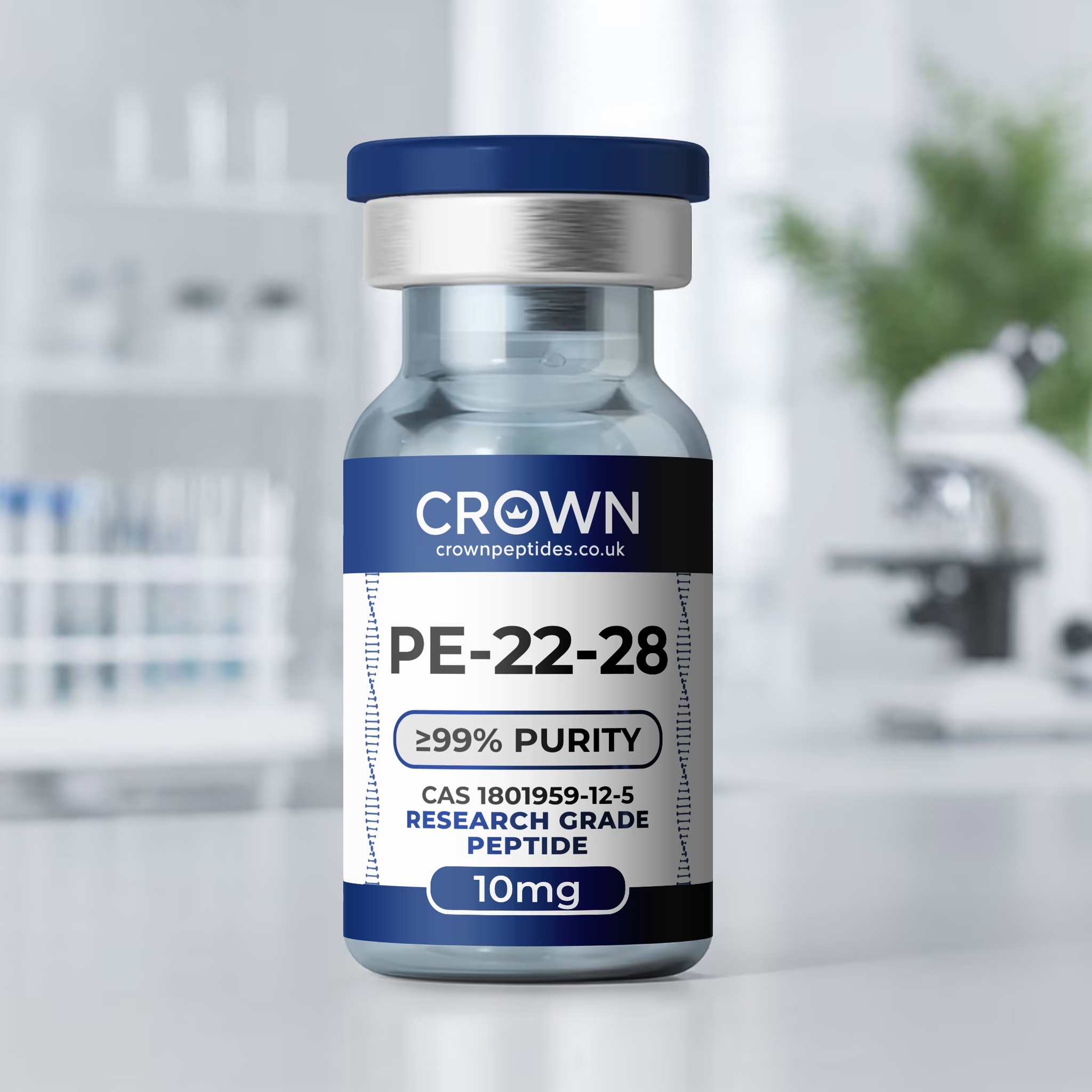
PE-22-28 peptide UK is Crown Peptides’ synthetic seven-residue, sortilin-derived research compound, coming soon in 10mg for laboratory research.
Supplied for laboratory research purposes only — not for human consumption or for medical, veterinary or diagnostic use.
PE-22-28 is a synthetic peptide of seven amino acids, Gly-Val-Ser-Trp-Gly-Leu-Arg (GVSWGLR). It is a shortened analogue of spadin, a 17-residue peptide taken from the propeptide of the sorting protein sortilin, and it is used in research on the TREK-1 potassium channel. It sits alongside Semax and Selank in the neurocognitive research area, although it works through a very different mechanism.
The peptide was developed by the French research group that first described spadin. When they studied how spadin breaks down in blood, they found that its final seven residues, positions 22 to 28 of the sortilin propeptide, carried the activity they were interested in. That fragment became PE-22-28, and in their experiments it proved both more potent and longer lasting than the parent peptide, which is why it is often called mini-spadin.
Also known as: PE 22-28, PE22-28, mini-spadin, spadin analogue, GVSWGLR
PE-22-28 was first described in 2017, in a study comparing a series of shortened spadin analogues on cells carrying the human TREK-1 channel and in standard mouse behavioural tests. (Learn more) Its research profile builds on almost a decade of earlier spadin work, and it is studied alongside other neurocognitive compounds such as Pinealon and DSIP.
Sortilin is a protein that helps sort other proteins inside nerve cells. As it matures, an enzyme called furin cuts off a 44-amino-acid piece known as the propeptide, or PE. In 2010 researchers showed that sortilin physically associates with the TREK-1 channel, and that a synthetic stretch of the propeptide, residues 12 to 28, blocked TREK-1 current in cultured neurons and in brain slices. They named it spadin. In mice, spadin raised the firing rate of serotonin-producing neurons in the dorsal raphe nucleus and, after four days, increased CREB activation and the number of newly formed cells in the hippocampus. (Learn more)
Spadin had one practical limitation. Its effect in mice faded within about seven hours of a single dose, and in serum it was broken down within half an hour. The group tried three ways to improve it: reversing the chemistry of the backbone, joining the chain into a ring, and simply making it shorter. Shortening gave the best result.
By analysing the fragments spadin leaves behind in blood, the researchers designed PE-22-28 and tested it on a human TREK-1 cell line using patch-clamp recording. It blocked the channel with a half-maximal concentration of about 0.12 nanomolar, against 40 to 60 nanomolar for spadin. In mice it reduced immobility in the forced swim test, shortened the time to approach food in the novelty-suppressed feeding test after four days, roughly doubled the count of newly formed hippocampal cells over the same period, and raised the synapse protein PSD-95 in cortical neurons. (Learn more)
The same study also looked at selectivity. PE-22-28 had no measurable effect on the related channels TREK-2, TRAAK, TRESK or TASK-1, and did not alter the cardiac hERG current even at 10 micromolar. Shorter fragments such as PE 22-27 and PE 22-25 lost activity altogether, which suggests that all seven residues are needed.
Work on the parent peptide helps explain what the behavioural tests may reflect. In cultured neurons and in mice, spadin activated the MAPK and PI3K signalling pathways, increased both the messenger RNA and protein for the synapse markers PSD-95 and synapsin, raised the share of mature dendritic spines, and quickly increased BDNF in the hippocampus. (Learn more) A 2019 review by the originating group sets these findings out in full and describes PE-22-28 as the shortest, most efficient sequence in the series. (Learn more)
In 2019 the group studied mini-spadin in mice after a blockage of the middle cerebral artery, comparing it with spadin and escitalopram. Their recordings showed a two-way effect on TREK-1: low concentrations increased channel activity, while higher ones blocked it. Using a low dose in the first week and a higher dose afterwards, they reported less body-weight loss, reduced loss of dopamine-producing cells in the substantia nigra, better scores on motor and memory tasks, normal behaviour in mood-related tests, and more neurogenesis and synapse formation. The paper also gives a half-life of about 23 hours for mini-spadin, compared with about 6 hours for spadin. (Learn more)
TREK-1 is also found in insulin-secreting cells. A 2021 study tested the propeptide, spadin and mini-spadin on an insulin-secreting cell line. All three raised calcium inside the cells and protected them against inflammation-induced cell death through the CREB pathway, and mini-spadin also encouraged the cells to divide. It worked at 10 nanomolar, where spadin needed 100. (Learn more)
Taken together, PE-22-28 is a well-characterised tool for studying TREK-1 in the laboratory: a short, defined sequence with published channel data, a selectivity profile across its channel family, and a growing set of studies in behavioural, neurogenesis, ischaemia and cell-survival models.
Compound-level reference data. Batch-specific results appear on the Certificate of Analysis.
Work out concentration with the peptide calculatorCrown Peptides PE-22-28 will be supplied with batch-specific quality documentation appropriate to the material. Because the published work shows that dropping even one residue from the end of the sequence removes its activity, identity matters as much as purity: HPLC shows how clean a batch is, while mass spectrometry confirms that the full seven-residue chain is present. The Certificate of Analysis should be used as the definitive source for identity, assay, purity and relevant impurity information.
Researchers working with PE-22-28 may also be interested in Semax, Selank, Semax 5mg + Selank 5mg (Blend), Pinealon and DSIP — other compounds studied in neurocognitive, stress-response and mood research.
PE-22-28 is a synthetic research peptide made of seven amino acids, Gly-Val-Ser-Trp-Gly-Leu-Arg. It was designed in 2017 as a shorter, more stable version of spadin, a peptide taken from the sortilin propeptide. It is used in laboratory research on the TREK-1 potassium channel, in cell-based channel recordings and in rodent behavioural, neurogenesis and ischaemia models.
“PE” is the name of the 44-amino-acid propeptide cut from sortilin as it matures, and “22-28” gives the positions of the residues taken from it. So PE-22-28 is simply residues 22 to 28 of that propeptide. Spadin, by comparison, is residues 12 to 28, which is why the two peptides share the same final seven amino acids.
It is the last seven residues of spadin’s seventeen, so it is literally a miniature spadin. The researchers found it by studying the fragments spadin leaves behind when it breaks down in blood. In their tests the shortened version blocked TREK-1 at a much lower concentration than spadin and kept its effect in mice for many more hours, so the shorter name stuck in later papers.
TREK-1 is a potassium channel in the outer membrane of nerve cells, also known as K2P2.1, with its gene called KCNK2. It lets potassium leak out of the cell, which keeps the cell’s electrical charge low and makes it harder to fire. Research interest grew after mice lacking the TREK-1 gene were found to behave much like animals already given mood-related compounds, which pointed to the channel as a research target.
Spadin worked well in the original studies, but its effect in mice faded within about seven hours and it was broken down in serum within half an hour. The group tried reversing the backbone chemistry, joining the chain into a ring and shortening it. Shortening gave the most potent, longest-lasting result, and PE-22-28 was the outcome of that work.
In the 2017 study it was tested against TREK-1’s close relatives. It had no measurable effect on TREK-2, TRAAK, TRESK or TASK-1, and it did not change the cardiac hERG current even at 10 micromolar, far above the concentration needed to block TREK-1. That selectivity is one reason it is useful as a laboratory tool for studying TREK-1 on its own.
All three are short peptides used in neurocognitive research, but they come from different sources. Semax is based on a fragment of the hormone ACTH, and Selank on the immune peptide tuftsin. PE-22-28 comes from the sortilin propeptide and is studied mainly through one defined target, the TREK-1 potassium channel, which makes its mechanism unusually specific.
The hippocampus is one of the few brain regions where new neurons keep forming in adult animals, and the rate is a widely used marker in mood research. Researchers label dividing cells with a tracer called BrdU and count them. In the 2017 study, PE-22-28 roughly doubled that count after just four days, a timescale that interested the group because conventional reference compounds usually take several weeks.
Mice were given mini-spadin after a blockage of the middle cerebral artery. Because low concentrations increased TREK-1 activity and higher ones blocked it, a low dose was used in the first week and a higher dose later. The researchers reported less loss of dopamine-producing cells, better motor and memory scores, more new neurons and synapses, and normal behaviour in mood-related tests.
Yes. TREK-1 is also present in insulin-secreting cells of the pancreas. A 2021 study found that mini-spadin raised calcium inside these cells, protected them against cell death triggered by the inflammatory signal interleukin-1-beta through the CREB pathway, and encouraged them to divide. It was active at 10 nanomolar, a tenth of the concentration spadin needed in the same experiments.
Very similar peptides can look alike on HPLC. The 2017 study found that PE 22-27, missing only the final arginine, lost its activity, and swapping the first glycine for alanine creates a different analogue just 14 mass units heavier. Mass spectrometry confirms the full GVSWGLR chain at about 773.9 daltons, so researchers know they have the exact sequence described in the published work.
PE-22-28 is not a controlled drug under the Misuse of Drugs Act 1971, and it is not a licensed medicine in the UK. It is sold in the UK as a research compound for laboratory use only, which is how Crown Peptides supplies it. This is general information, not legal advice.
PE-22-28 is coming soon to Crown Peptides in 10mg vials, available singly or in packs of 3, 5 or 10 with a saving on every vial. Orders ship from the UK, and every batch is independently tested, with its Certificate of Analysis published on this page once stock arrives.
Ten milligrams of a 774-dalton peptide is roughly 13 micromoles. The published cell work used PE-22-28 at nanomolar concentrations, so one vial covers a substantial amount of in vitro work. The 5 and 10-vial packs keep a longer project on a single batch, which makes results easier to compare from start to finish.
Keep the unreconstituted powder at -20°C ± 5°C, dry and away from light. The sequence contains tryptophan, an amino acid that is sensitive to light and oxidation, so vials are best kept sealed and dark until use. Prepared solutions should follow storage conditions validated for your study design, and each batch’s Certificate of Analysis documents the material as dispatched.
Every batch is published openly — identity, purity and batch number, with no account needed.
Supplied for laboratory research purposes only — not for human consumption or for medical, veterinary or diagnostic use.
Each batch undergoes internal analytical verification using chromatographic and spectrometric methods prior to lyophilisation.
• HPLC Analysis
• Mass Spectrometry Confirmation
• Batch Traceability
By purchasing this product you confirm that you are a qualified researcher and that this compound will be used exclusively for laboratory research purposes.
This product is not intended for diagnostic or therapeutic use.
Any human or medical use is strictly prohibited.
Store in a cool, dry, secure and sterile environment away from any unauthorised persons or children.
Disclaimer: All products are sold strictly for laboratory research purposes only. Not for human or veterinary use, consumption, therapeutic, or diagnostic application. None of our products are medicines, and none are presented as such. By purchasing, you confirm you are a qualified professional and legally permitted to handle these materials in compliance with all applicable laws and regulations. Misuse, resale for unauthorised purposes, or unlawful application is strictly prohibited. Crown Peptides UK disclaims all liability for improper use, handling, or regulatory non-compliance.