Research Peptides
Three complementary research peptides studied in gut, inflammation and tissue-repair research. Save 20% compared with buying the nine vials individually, with every batch independently tested and dispatched from the UK.
In stock
Three complementary research peptides studied in gut, inflammation and tissue-repair research. Save 20% compared with buying the nine vials individually, with every batch independently tested and dispatched from the UK.
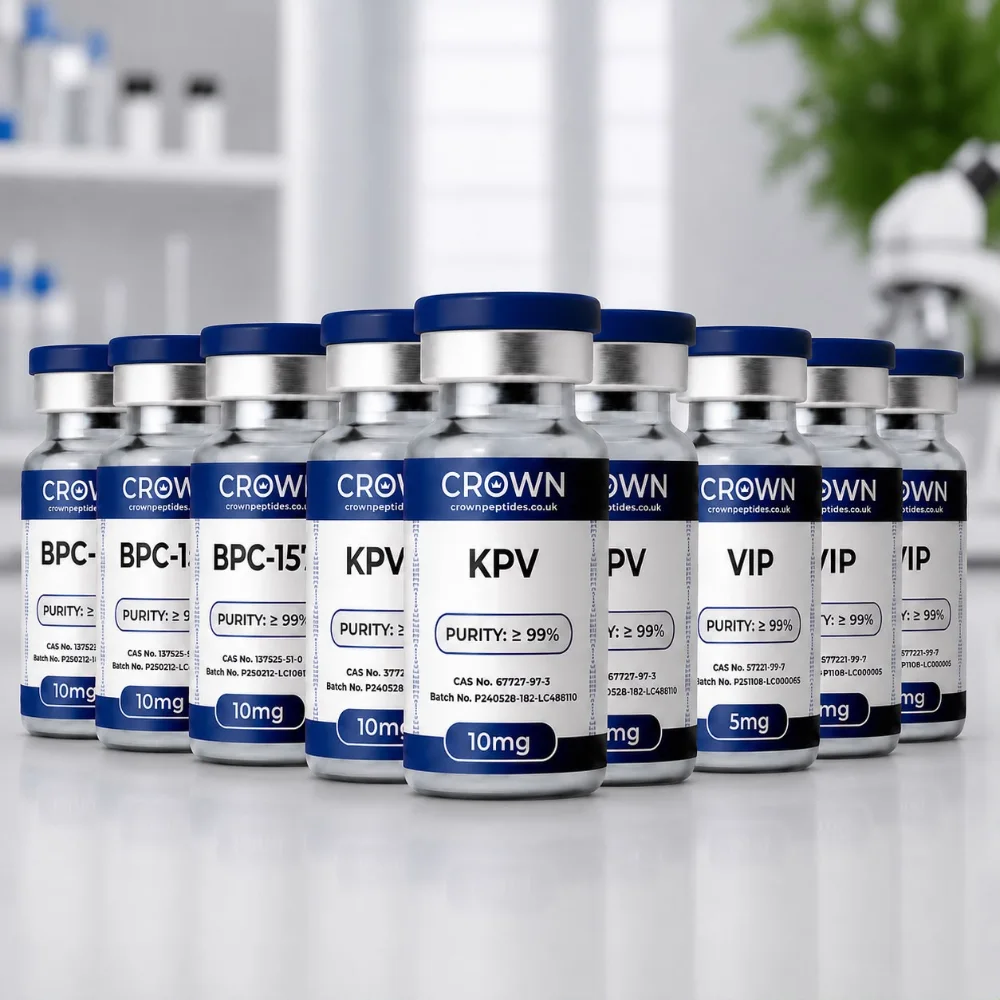
Gastrointestinal Research Bundle UK is Crown Peptides' 9-vial research bundle combining KPV, BPC-157 and VIP, supplied as 3 × KPV 10mg, 3 × BPC-157 10mg and 3 × VIP 5mg for laboratory research into gastrointestinal, inflammatory and neuropeptide signalling pathways.
Supplied for laboratory research purposes only — not for human consumption or for medical, veterinary or diagnostic use.
The gut is where the epithelial barrier, local inflammation and nerve signalling all meet, and this bundle groups three peptides studied across exactly those layers. BPC-157 is a synthetic 15-amino-acid peptide based on a sequence first described in gastric juice, and one of the most widely studied peptides in gastrointestinal and tissue-repair research. KPV is the Lys-Pro-Val tripeptide from the C-terminal end of alpha-melanocyte-stimulating hormone, investigated in intestinal epithelial and inflammatory models. VIP, vasoactive intestinal peptide, is a naturally occurring 28-amino-acid neuropeptide found throughout the digestive tract and studied through its VPAC1 and VPAC2 receptors.
Supplied together, they let researchers compare repair-focused, inflammation-focused and neuropeptide-focused approaches within the same gut and digestive models.
BPC-157: the repair-oriented member, built on a sequence described in gastric juice and studied across tissue-injury and nociception research (Learn more). Its full research history lives on the BPC-157 page.
KPV: in this set it represents the epithelial side of gut inflammation, following mouse colitis work in which it eased disease severity and pro-inflammatory signalling (Learn more). Its origins are explained on the KPV page.
VIP: the neural messenger of the three, acting through VPAC receptors; in a mouse colitis study it cut TNF-alpha, IL-1 and IL-6 alongside tissue damage (Learn more). Receptors and history are covered on the VIP page.
The gut wall can be read in layers, and each peptide in this set enters at a different one. KPV, at just three residues, can enter intestinal epithelial cells and act on inflammatory signalling inside them, so it stands for the lining cell’s own response. VIP is released by enteric neurons and binds VPAC receptors on epithelial, smooth-muscle and immune cells, so it stands for the nervous system’s input to secretion, motility and inflammation. BPC-157’s gastrointestinal work has centred on mucosal integrity, lesion healing and blood-vessel responses. That gives a combined model three separate entry points and lets hypotheses be framed precisely: does neural VPAC signalling add anything once epithelial inflammatory signalling is already damped, and does either change how quickly a damaged mucosa recovers?
The colitis evidence behind each peptide was gathered in different systems. The KPV papers that put it on the map used dextran sodium sulfate (DSS) and T-cell transfer colitis in mice; the VIP study above used TNBS-induced colitis in mice; and most of BPC-157’s gut literature comes from rat work by one Zagreb group. We are not aware of any published study testing two or all three of these peptides together. In practice, each one needs its own response curve in your chosen model before a combination arm means anything. The choice of model matters too: DSS injures the epithelium chemically and suits barrier questions, while TNBS produces a hapten-driven, T-cell-led inflammation, so picking one effectively decides which bundle member is tested on home ground.
In culture, Caco-2 or T84 monolayers give transepithelial electrical resistance and tracer flux for barrier function, IL-8 release after a cytokine challenge for epithelial inflammation, and scratch-wound closure for restitution. VIP brings a classic readout of its own: it stimulates chloride secretion in T84 monolayers, measurable as short-circuit current in an Ussing chamber, which confirms that the VIP arm is actually engaging its receptor. In rodent colitis models the standard panel of disease-activity score, colon length, histology and myeloperoxidase activity applies to all three. Reading every arm on every measure is what turns three single-peptide experiments into a genuine comparison of how the layers interact.
Equal milligrams mean very different numbers of molecules here. KPV’s 10mg fill (roughly 342.4 g/mol) amounts to about 29 micromoles, a 10mg BPC-157 vial (about 1,419.5 g/mol) about 7 micromoles, and a 5mg VIP vial (about 3,325.8 g/mol) around 1.5 micromoles, so the KPV vial carries about four times the molecules of BPC-157 and nearly twenty times those of VIP. Comparisons between arms are therefore best set on a molar basis. VIP is also the most delicate of the three, quickly cut by peptidases and carrying an oxidation-prone methionine, so the three VIP vials suit a one-vial-per-run pattern: each experimental series starts from freshly opened material instead of a solution kept for weeks.
Compound-level reference data. Batch-specific results appear on the Certificate of Analysis.
Work out concentration with the peptide calculatorEach compound in the Gastrointestinal Research Bundle is supplied for controlled laboratory research with its own batch-specific analytical documentation. High-Performance Liquid Chromatography (HPLC) can assess chromatographic purity, while Mass Spectrometry provides molecular information used to support identity verification. With peptides ranging from 3 amino acids (KPV) to 28 (VIP), batch-specific identity confirmation for each compound is what keeps comparisons between them reliable.
The batch-specific Certificate of Analysis is the definitive source for the exact purity result, identity data and analytical specification of each material supplied.
Three 10mg KPV vials, three 10mg BPC-157 vials and three 5mg VIP vials, nine in all. The peptides range from three residues (KPV) through fifteen (BPC-157) to twenty-eight (VIP), and each vial has its own batch documentation.
Think of them as three levels of the gut wall: KPV inside the epithelial cell, VIP at the nerve-to-tissue interface through VPAC receptors, and BPC-157 at the level of mucosal repair and vessels. A design that uses all three can ask which level drives the outcome being measured.
Not yet in the published literature, as far as we know. Each has its own colitis or gut data, but in different species and induction models, so any interaction seen in your work would be new. That is a strong reason to include each peptide alone alongside the combinations.
Their molar strengths differ widely, VIP needs gentler handling than the other two, and single-agent arms need separate stocks. Separate vials let each peptide be prepared, stored and added to the model on its own terms. A related pre-mixed option exists in KLOW, which combines KPV and BPC-157 with GHK-Cu and TB-500.
Buying the nine vials as this set is 20% cheaper than ordering three of each peptide individually, and every vial ships together.
Yes, and that is often the sensible first step. Caco-2, T84 and HT-29 epithelial lines, intestinal organoids, and epithelial–macrophage co-cultures all give barrier and cytokine readouts for KPV and BPC-157, while T84 cells also respond to VIP with measurable chloride secretion.
In the body VIP arrives from nerve endings close to its target cells; in culture it is simply added to the medium, and receptor levels vary widely between cell lines. Checking that your line expresses VPAC1, the main epithelial VIP receptor, avoids a flat result that says more about the cells than the peptide.
It depends on the question. Starting all three with the injury tests protection; starting them after injury is established tests recovery. Staggering them, for example KPV during the inflammatory phase and BPC-157 during healing, mirrors the layered roles they play in this bundle.
VIP is a large peptide that acts through high-affinity receptors at low concentrations. Its 1.5 micromoles is ample for receptor work: at 10 nanomolar, one vial could in principle supply around 150 litres of medium, far beyond any realistic plate study.
Prepare small single-use aliquots, avoid repeated freezing and thawing, and consider low-binding tubes, since long peptides of this kind can stick to plastic. Comparing a fresh aliquot with an older one by HPLC is a quick way to spot oxidation or breakdown.
Every batch is published openly — identity, purity and batch number, with no account needed.
Supplied for laboratory research purposes only — not for human consumption or for medical, veterinary or diagnostic use.
Each batch undergoes internal analytical verification using chromatographic and spectrometric methods prior to lyophilisation.
• HPLC Analysis
• Mass Spectrometry Confirmation
• Batch Traceability
By purchasing this product you confirm that you are a qualified researcher and that this compound will be used exclusively for laboratory research purposes.
This product is not intended for diagnostic or therapeutic use.
Any human or medical use is strictly prohibited.
Store in a cool, dry, secure and sterile environment away from any unauthorised persons or children.
Disclaimer: All products are sold strictly for laboratory research purposes only. Not for human or veterinary use, consumption, therapeutic, or diagnostic application. None of our products are medicines, and none are presented as such. By purchasing, you confirm you are a qualified professional and legally permitted to handle these materials in compliance with all applicable laws and regulations. Misuse, resale for unauthorised purposes, or unlawful application is strictly prohibited. Crown Peptides UK disclaims all liability for improper use, handling, or regulatory non-compliance.