Livagen Research Peptide
Livagen, the liver peptide bioregulator Lys-Glu-Asp-Ala (KEDA), studied in research on chromatin structure and liver cell protein synthesis.
Out of stock
Supplied for laboratory research purposes only — not for human consumption or for medical, veterinary or diagnostic use.
Product Overview
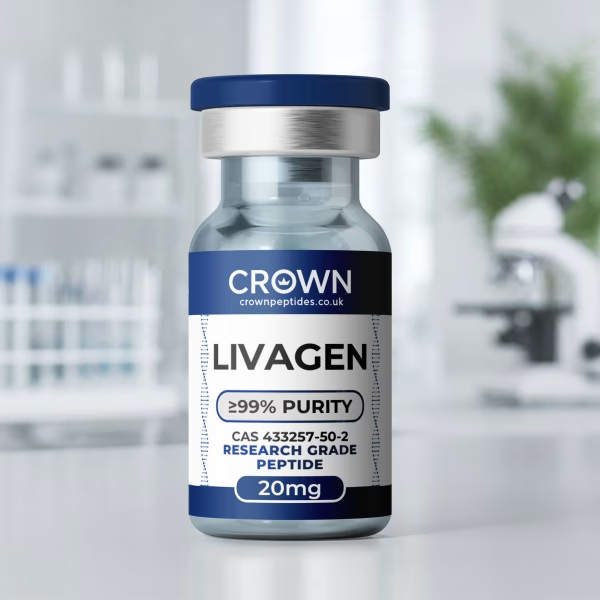
Livagen UK is Crown Peptides’ liver peptide bioregulator, the tetrapeptide Lys-Glu-Asp-Ala, supplied in 20mg for laboratory research.
- Studied in research involving chromatin structure in cells from elderly donors
- Studied in research involving ribosomal gene activity
- Studied in research involving protein synthesis in liver cells
- Studied in research involving chromosome stability under chemical stress
- CAS number and sequence confirmed on every batch certificate
About Livagen UK
Livagen is a synthetic peptide of four amino acids, lysine, glutamic acid, aspartic acid and alanine, written in shorthand as KEDA. Within the Khavinson bioregulator family it is the one matched to the liver, having been derived from analysis of liver polypeptide preparations.
Also known as: KEDA, Lys-Glu-Asp-Ala, H-Lys-Glu-Asp-Ala-OH, lyvagen, liver peptide bioregulator
What makes it interesting is where the research actually went. Most of this family’s evidence sits with the group that created the peptides. Livagen is the exception: the largest body of work on it comes from a university group in Tbilisi, Georgia, working on chromosome structure in cells from elderly donors. Nine of their eleven papers on it carry no author from the originating institute. That is the closest thing to outside work any peptide in this family has, and it is why the strongest evidence here is about chromosomes rather than about liver tissue.
Livagen is not Svetinorm. Svetinorm is a liver tissue-extract product, a mixture of many polypeptides. Livagen is one synthetic tetrapeptide with a defined formula, mass and registry number. The tetrapeptide was originally identified from the amino acid makeup of liver preparations, which is why the two get conflated, but they are chemically different things and we do not transfer claims between them.
In the bioregulator research peptides range, Livagen is the liver one. The rest are matched to their own tissues: Epitalon to the pineal gland, Vilon to the thymus, Vesugen to blood vessels, Bronchogen to the airways, Pinealon to brain tissue and Cartalax to cartilage.
Livagen Research
The published work on KEDA splits unevenly. There is a small set of liver studies from the early 2000s, mostly qualitative, and a much larger and better-developed body of work on chromosome structure running from 2002 to 2023. We have put the chromosome work first because it is the stronger of the two, which is not what the product name would lead you to expect.
- Chromatin decondensation and ribosomal gene activity in lymphocytes from elderly donors
- Chromosome stability under chemical and radiation stress
- Protein synthesis in liver cells
- Enzyme activity and resistance to breakdown in the gut
The best-documented study
A 2007 paper in the Annals of the New York Academy of Sciences is the one with real numbers, and it is from the Tbilisi group alone. Working with lymphocytes from donors aged 80 to 91 against younger controls, it tested Livagen against chromosome damage caused by a cobalt compound. Livagen reduced the induced chromosomal changes to 3.4% against a control value of 4.2%. It also shifted where sister chromatid exchanges occurred, away from the regions near the chromosome centre and towards the ends. (Learn more)
Unwinding packed chromatin
The founding study in this series, from 2002, worked with lymphocytes from people aged 75 to 88. It reported that Livagen activated ribosomal genes, unwound tightly packed chromatin near the chromosome centre, and released genes that age-related packing had switched off. A 2004 comparison of five peptides from the family found Livagen among the three that decondensed packed chromatin on chromosome 1, and one of only two that also acted on chromosome 9. (Learn more) (Learn more)
Each peptide to its own region
A 2020 study compared four peptides by their sequences rather than their trade names, using heat measurement, chromosome banding and exchange analysis on lymphocytes from both elderly and young donors. All four unwound packed chromatin and shifted where exchanges happened, and the authors concluded that each peptide acted selectively on a specific chromosome region. (Learn more)
Where the same group disagreed with itself
Their 2023 paper reported that the peptides activated ribosomal gene processes and decondensed total chromatin, but did not unwind the packed chromatin near the chromosome centre, which is the opposite of what their 2006 and 2020 papers found on that specific point. The abstracts do not explain the difference. We mention it because anyone citing this series ought to know the result is not settled. (Learn more)
Chromosome stability in patient cells
Several further studies from the same group applied Livagen to lymphocyte cultures from people with various conditions, reporting improvement in measures of genome stability. One of those studies is worth reporting against interest: in cells from people with a heart muscle condition, a sibling peptide rather than Livagen was the most effective at normalising the measures taken. (Learn more) (Learn more)
The liver work
A 2001 study grew liver cells from rats aged between one and twenty-four months. Livagen raised protein synthesis at every age, with the largest effect in cells from the oldest animals. The useful detail is the control: a sibling peptide tested in the same cells produced no change in protein synthesis at all. That is the one genuinely discriminating piece of liver-specific evidence for this compound. A 2001 explant study pointed the same way: of four peptides applied to tissue from four different organs, Livagen was the one that stimulated the liver explants. (Learn more) (Learn more)
A hard number on enzyme activity
A 2003 study measured how strongly Livagen inhibits the enzymes that break down enkephalins in human serum. It gave a half-maximal concentration of 20 micromolar against 500 micromolar for a sibling peptide, a twenty-five-fold difference, and reported it as more effective than three established inhibitors. The same study found no interaction with opioid receptors, so this is an effect on the breakdown enzymes rather than on the receptors themselves. (Learn more)
Surviving the gut
A 2005 study in rats found Livagen is only weakly broken down by the enzymes of the small intestine, which is the usual argument for why these peptides are given by mouth in some research. The same study reported that after two weeks of oral administration, digestive enzyme activity fell in young rats but rose in old ones, in most cases towards the levels seen in young controls. (Learn more)
Taken together, Livagen has the most nearly independent evidence base of any peptide in this family, concentrated on chromosome structure in cells from elderly donors, with two studies reporting usable figures. Its liver credentials rest on a smaller and largely qualitative set of papers. Related compounds in the same family include Vilon and Epitalon.
Specifications
- Product
- Livagen
- Classification
- Short peptide bioregulator, synthetic tetrapeptide
- Sequence
- Lys-Glu-Asp-Ala (KEDA)
- Available strength
- 20mg
- Form
- Lyophilised research material supplied according to product label
- Purity / assay
- batch-specific; refer to Certificate of Analysis
- Verification
- HPLC and Mass Spectrometry
- CAS Number
- 433257-50-2
- Also known as
- KEDA, Lys-Glu-Asp-Ala
- Product Name
- Livagen
- Molecular Formula
- C18H31N5O9
- Molecular Weight
- approximately 461.5 g/mol; refer to the batch Certificate of Analysis for the confirmed mass
Purity and Testing
Crown Peptides Livagen is supplied with batch-specific quality documentation, published on our lab reports page before the batch goes on sale, stating the sequence and CAS number alongside the assay result. At around 461 daltons, mass spectrometry confirms identity precisely, and HPLC shows how clean the preparation is. The Certificate of Analysis should be used as the definitive source for identity, assay, purity and relevant impurity information.
Storage Conditions
- Store unreconstituted material at -20°C ± 5°C in a cool, dry environment
- Prepared research solutions should use validated storage conditions appropriate to the compound and study design
- Protect from unnecessary heat, direct light and repeated temperature fluctuations
Related Compounds
Compounds studied alongside Livagen in the peptide bioregulator family include Vilon, Vesugen, Bronchogen, Epitalon, Pinealon and Cartalax. The full range is in our bioregulator research peptides category.
Livagen Frequently Asked Questions
About Livagen5 questions
What is Livagen?
Livagen is a synthetic tetrapeptide, Lys-Glu-Asp-Ala, known in shorthand as KEDA. It is the liver-associated member of a group of short peptides that came out of Russian gerontology research, each one matched to a particular organ or tissue.
Is Livagen the same as Svetinorm?
No. Svetinorm is a tissue-extract product made from liver, containing many polypeptides. Livagen is a single defined tetrapeptide. The tetrapeptide was identified from the amino acid makeup of liver preparations, which is the source of the confusion, but they are different products and there is no published research literature on the extract under that name.
Why is most of the research about chromosomes rather than the liver?
Because of where the work went. The group that took the strongest interest in this peptide was a university laboratory in Tbilisi studying chromosome structure in cells from elderly people, and they used Livagen repeatedly over about twenty years. The liver-specific work is older, smaller and mostly descriptive. It is an honest oddity of this compound that the evidence is strongest somewhere other than the organ in its name.
How independent is the research?
More so than for most of this family, though not fully. Nine of the eleven Tbilisi papers carry no author from the institute that created the peptide, and the group uses its own methods. Against that, the collaboration began as a joint project with the originating institute, the peptide was supplied by them, and most of the output appears in one local journal. Two papers reached internationally indexed journals. No third laboratory anywhere has tested this compound.
How does it compare with the other bioregulators?
Each is a different sequence matched to a different tissue, and the published comparisons are what make the family interesting: in several studies the peptides behaved differently from one another in the same experiment, which is the point. In those comparisons Livagen has sometimes come out strongest and at least once has been beaten by a sibling.
Findings in research models4 questions
What are the best-documented results?
Two. The 2007 chromosome study reported reduced chemically induced chromosome damage with specific percentages, and a 2003 enzyme study reported a half-maximal inhibitory concentration of 20 micromolar, twenty-five times stronger than the sibling peptide tested alongside it. Most of the other work is qualitative.
What did the liver studies find?
A 2001 study in rat liver cells found Livagen raised protein synthesis at every age tested, most strongly in cells from the oldest animals, where a sibling peptide tested in the same cells produced no change. A separate explant study found it stimulated liver tissue growth specifically.
Has Livagen been shown to enter cells and bind DNA?
Not for this peptide. The cell-penetration and DNA-binding experiments cited for this family tested other sequences, and Lys-Glu-Asp-Ala was not among them in any of them. What exists for Livagen is the chromosome-level work above, which measures changes in how chromatin is packed rather than binding itself.
Has it been studied in people?
Not as a treatment. There are no clinical trials of this compound. The human element of the research is cells taken from people, mostly elderly donors and patients, and studied in culture.
Buying, testing & storage4 questions
Is Livagen legal to buy in the UK?
Livagen is supplied in the UK as a laboratory research material. It is not a licensed medicine and is not sold for human or veterinary use. It is supplied strictly for laboratory research purposes by qualified personnel.
Where can I buy Livagen in the UK?
Crown Peptides supplies Livagen in 20mg vials from the UK, with HPLC and mass spectrometry verification and a batch-specific Certificate of Analysis published for every batch. Orders placed before 2pm are dispatched the same working day.
Does Livagen have a CAS number?
Yes: 433257-50-2. We state it on the certificate alongside the sequence.
How should Livagen be stored and handled?
Unreconstituted material should be kept at -20°C ± 5°C in a cool, dry place, away from direct light and repeated temperature swings. Prepared solutions should follow storage conditions validated for the study in question. Our storage information page covers handling in more detail.
Read the batch certificate before you order
Every batch is published openly — identity, purity and batch number, with no account needed.
View lab reports- Laboratory research only
- Not for human or clinical use
- Not for human or veterinary consumption
Supplied for laboratory research purposes only — not for human consumption or for medical, veterinary or diagnostic use.
Other Research Peptides
 Endocrine researchCJC-1295 + IpamorelinBlend