Research Peptides
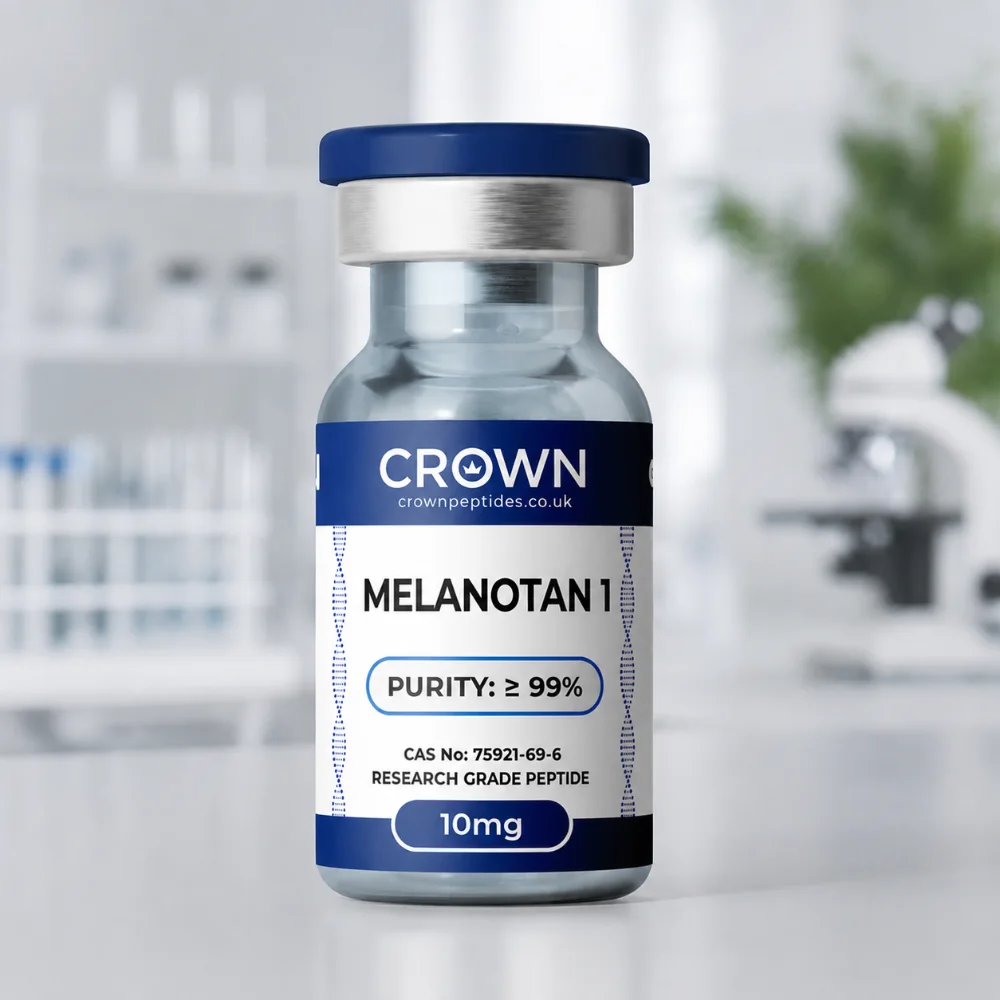
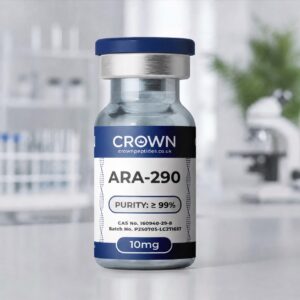
A high-purity research peptide studied in skin-pigmentation research. Available in 10mg, with every batch independently tested and dispatched from the UK.
Melanotan-1 peptide UK is Crown Peptides' synthetic alpha-MSH analogue with the same sequence as afamelanotide, available in 10mg strength for laboratory research.
Supplied for laboratory research purposes only — not for human consumption or for medical, veterinary or diagnostic use.
Melanotan-1 is a synthetic analogue of alpha-melanocyte-stimulating hormone designed to investigate melanocortin receptor signalling and melanogenesis. It is structurally related to afamelanotide and is studied primarily through the melanocortin-1 receptor pathway in pigment-cell models.
Also known as: Melanotan 1, Melanotan I, MT-1, MT1, afamelanotide.
Melanotan-1 research focuses on melanocortin receptor pharmacology, melanocyte biology, melanin synthesis and cellular responses to ultraviolet-related signalling, with MC1R structure and regulation reviewed extensively in the literature (Learn more). Experimental models examine how alpha-MSH analogues activate MC1R and influence downstream cyclic-AMP pathways involved in pigmentation biology, alongside related melanocortin research such as Melanotan-2 and PT-141.
Melanotan-1 began with a puzzle at the University of Arizona. Chemist Victor Hruby and physiologist Mac Hadley noticed that alpha-MSH briefly heated in alkali went on darkening frog skin for far longer than the untreated hormone. Gas chromatography of the treated peptide explained why: the heat-alkali step had partly converted two residues, methionine at position 4 and phenylalanine at position 7, into altered forms. Instead of working with an unpredictable mixture, the team designed those changes in on purpose.
The result, reported by Sawyer and colleagues in PNAS in 1980, was [Nle4, D-Phe7]-alpha-MSH, the molecule sold today as Melanotan-1. It shrugged off serum enzymes, was 26 times as potent as alpha-MSH at switching on adenylate cyclase in mouse melanoma cells, and raised tyrosinase activity in the same cells. A follow-up paper in Science described frog skins that stayed dark for at least six weeks after a single treatment with the analogue, compared with a few days for the natural hormone. The authors predicted it would become an important probe for melanotropin receptors, and so it proved.
Natural alpha-MSH reads Ac-Ser-Tyr-Ser-Met-Glu-His-Phe-Arg-Trp-Gly-Lys-Pro-Val-NH2. Melanotan-1 keeps eleven of those thirteen residues exactly, along with the acetyl cap at the front and the amide at the tail. Only two positions change.
At position 4, methionine gives way to norleucine. The two side chains are almost the same length, but methionine carries a sulphur atom that oxidises readily, while norleucine is a plain hydrocarbon chain. At position 7, ordinary L-phenylalanine is replaced by its mirror image, D-phenylalanine. This residue sits inside His-Phe-Arg-Trp, the four-residue core that every melanocortin peptide uses to engage its receptors, and the D-form is thought to help the backbone fold into a turn that the receptor recognises more readily. The combined result is higher potency and slower breakdown, which is why Melanotan-1 became a reference agonist.
MC1R is best known as the switch for eumelanin production, but cell research has shown that it does more than colour. Zalfa Abdel-Malek’s group at the University of Cincinnati found that in cultured human melanocytes, alpha-MSH acting through MC1R reduced DNA photoproducts and oxidative stress after ultraviolet exposure and helped the cells survive UV-induced apoptosis. Later work showed the hormone raising levels of XPC, the protein that recognises damaged DNA, and boosting signalling through the damage sensors ATR and ATM.
The striking control in these experiments was genetic. Melanocytes carrying loss-of-function MC1R variants did not show the protective responses, tying them firmly to the receptor itself. The same group has since built small analogues around the His-D-Phe-Arg core to probe this repair pathway. For researchers, that makes potent MC1R agonists useful tools for questions about genomic stability in pigment cells as well as for classic melanogenesis assays.
The sequence of Melanotan-1 also carries an international nonproprietary name, afamelanotide, and in that form it reached the clinic. The Australian company Clinuvel developed afamelanotide as a 16mg controlled-release implant under the brand name Scenesse, for erythropoietic protoporphyria (EPP). EPP is an inherited disorder in which protoporphyrin IX accumulates and triggers painful phototoxic reactions when skin is exposed to light.
Two randomised, placebo-controlled trials, one in Europe with 74 participants and one in the United States with 94, were published in the New England Journal of Medicine in 2015. The European Medicines Agency authorised Scenesse on 22 December 2014, under exceptional circumstances, for the prevention of phototoxicity in adults with EPP. The US FDA followed on 8 October 2019, approving it to increase pain-free light exposure in adults with a history of phototoxic reactions from EPP, the first FDA-approved treatment for the condition. Crown Peptides Melanotan-1 is a freeze-dried research peptide with the same amino-acid sequence; it is not Scenesse, which is a formulated, licensed implant.
Compound-level reference data. Batch-specific results appear on the Certificate of Analysis.
Work out concentration with the peptide calculatorCrown Peptides Melanotan-1 is supplied for controlled laboratory research with batch-specific analytical documentation. High-Performance Liquid Chromatography (HPLC) can assess chromatographic purity, while Mass Spectrometry provides molecular information used to support identity verification.
The batch-specific Certificate of Analysis is the definitive source for the exact purity result, identity data and analytical specification of the material supplied.
Researchers working with Melanotan-1 may also be interested in Melanotan-2, PT-141, GHK-Cu, KPV and Kisspeptin-10 — other melanocortin and receptor-signalling peptides studied in related research contexts.
Melanotan-1 is a 13-amino-acid linear analogue of alpha-melanocyte-stimulating hormone in which norleucine replaces methionine at position 4 and D-phenylalanine replaces L-phenylalanine at position 7. Both ends are capped, with an acetyl group at the N-terminus and an amide at the C-terminus. You will also see it written as Melanotan I, MT-1 or MT1; our vials hold 10mg.
Chemically, they share one sequence and one formula, C78H111N21O19, under CAS number 75921-69-6. Afamelanotide is the international nonproprietary name, and it is most often used for the licensed medicine Scenesse, an implant authorised in the EU and the US for erythropoietic protoporphyria. Our product is research-grade peptide powder, not that medicine.
It came out of Victor Hruby and Mac Hadley’s melanotropin programme at the University of Arizona, with Tomi Sawyer as first author on the 1980 PNAS paper that introduced [Nle4, D-Phe7]-alpha-MSH. The group’s starting point was a curiosity: alkali-treated alpha-MSH acted for much longer than fresh hormone in frog skin assays.
Two features combine. The D-phenylalanine and norleucine substitutions make the peptide resistant to the serum enzymes that rapidly clip natural alpha-MSH, and the analogue appears to stay engaged with melanophores long after it is washed away. In lizard skin studies, previously darkened tissue could be lightened by removing calcium and re-darkened by adding it back, without any fresh peptide.
MC1R on melanocytes is the main focus of Melanotan-1 research, but the analogue is not exclusive to it. Work with cloned receptors showed that [Nle4, D-Phe7]-alpha-MSH is recognised by MC1R, MC3R, MC4R and MC5R. The odd one out is MC2R, the adrenal receptor that responds to ACTH and essentially nothing else in the melanocortin family.
Agouti signalling protein is the natural counterweight to alpha-MSH in skin. It blocks MC1R, pushing melanocytes away from dark eumelanin and towards red-yellow pheomelanin, which is how banded agouti hairs get their colour in mice. Pairing a strong agonist like Melanotan-1 with agouti, or with agouti-like blockers, lets researchers push the receptor in both directions in one model.
Several common human MC1R variants reduce receptor function and are associated with red hair and fair skin. Melanocytes grown from donors with these variants respond weakly or not at all to MC1R agonists, so comparing them with cells carrying the standard receptor is a clean way to prove that an effect really runs through MC1R rather than another pathway.
MC1R couples to a stimulatory G protein, so agonist binding raises cyclic AMP. That activates protein kinase A and the transcription factor CREB, which increases MITF, the master regulator of melanocyte genes. MITF in turn drives tyrosinase and the related enzymes TYRP1 and DCT, shifting melanin output towards eumelanin. Each step offers a measurable readout.
Its earliest data came from frog (Rana pipiens) and lizard (Anolis carolinensis) skin bioassays, where melanosome dispersion darkens the tissue. Mouse melanoma cells provided adenylate cyclase and tyrosinase measurements, and later studies moved to cultured human melanocytes and to cell lines engineered to express a single cloned melanocortin receptor, which allow subtype-by-subtype comparisons.
NDP-MSH, or NDP-alpha-MSH, is shorthand for [Nle4, D-Phe7]-alpha-MSH, and it is the name you will meet most often in receptor pharmacology papers. A radioiodinated version is a standard tracer in melanocortin binding assays, used to measure how strongly new compounds compete for each receptor. Search under both names for the full literature.
Replacing methionine with norleucine trades a sulphur atom for a CH2 group, so the average molecular weight drops from about 1664.9 to 1646.8 g/mol. That gap looks suspiciously like a lost water molecule, but the monoisotopic difference is 17.96 Da rather than 18.01 Da, and Melanotan-1 lacks the extra isotope signal that sulphur adds to alpha-MSH. High-resolution mass spectrometry can therefore tell the two apart cleanly.
Melanotan-1 is a potent agonist, typically worked with at low concentrations in cell assays, so a 10mg vial covers a substantial run of experiments. It can be ordered as one vial, a five-vial pack or a ten-vial pack. The larger packs suit long receptor-screening projects where drawing every assay from the same batch keeps results comparable.
It removes one common route of degradation, since methionine oxidation is a familiar problem in stored peptides. Melanotan-1 still contains tryptophan, histidine and tyrosine, which can be affected by light and oxidation, so freezer storage at -20°C, protection from light and limited freeze-thaw cycling remain good practice, as set out in the Storage Conditions section.
Every batch is published openly — identity, purity and batch number, with no account needed.
Supplied for laboratory research purposes only — not for human consumption or for medical, veterinary or diagnostic use.
Each batch undergoes internal analytical verification using chromatographic and spectrometric methods prior to lyophilisation.
• HPLC Analysis
• Mass Spectrometry Confirmation
• Batch Traceability
By purchasing this product you confirm that you are a qualified researcher and that this compound will be used exclusively for laboratory research purposes.
This product is not intended for diagnostic or therapeutic use.
Any human or medical use is strictly prohibited.
Store in a cool, dry, secure and sterile environment away from any unauthorised persons or children.
Disclaimer: All products are sold strictly for laboratory research purposes only. Not for human or veterinary use, consumption, therapeutic, or diagnostic application. None of our products are medicines, and none are presented as such. By purchasing, you confirm you are a qualified professional and legally permitted to handle these materials in compliance with all applicable laws and regulations. Misuse, resale for unauthorised purposes, or unlawful application is strictly prohibited. Crown Peptides UK disclaims all liability for improper use, handling, or regulatory non-compliance.