Research Peptides
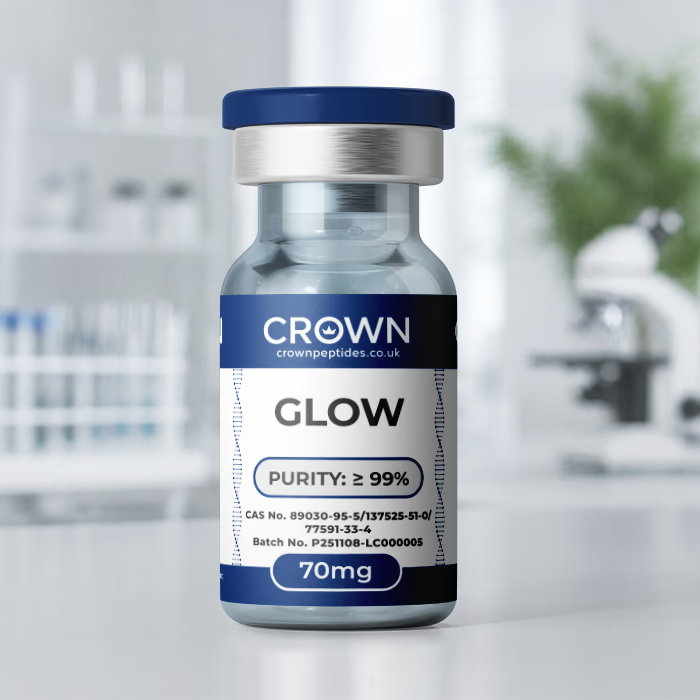
A high-purity research blend studied in skin and tissue-repair research. Available in 70mg, with every batch independently tested and dispatched from the UK.
Glow 70mg peptide blend UK is Crown Peptides' 70mg multi-peptide research blend containing GHK-Cu 50mg, BPC-157 10mg and TB-500 10mg, supplied for laboratory research into tissue and cellular biology.
Supplied for laboratory research purposes only — not for human consumption or for medical, veterinary or diagnostic use.
Glow is a 70mg research blend combining GHK-Cu, BPC-157 and TB-500. Each component has a distinct research profile: GHK-Cu is studied in copper-peptide and extracellular-matrix biology, BPC-157 in tissue-response and gastrointestinal models, and TB-500 in thymosin-related actin, cell-migration and angiogenesis research.
Also known as: GLOW blend, GLOW peptide, GLOW 70mg.
The blend brings together three compounds associated with overlapping areas of tissue and cellular research, with dedicated review literature on GHK-Cu's regenerative and protective actions underpinning much of the interest in this component (Learn more). GHK-Cu literature includes fibroblast, collagen and matrix-remodelling models; BPC-157 literature includes wound-healing, gastrointestinal and vascular-response models; and TB-500-related research includes actin dynamics, cellular migration and angiogenesis, alongside related tissue-repair products such as KLOW and BPC-157.
GHK-Cu makes up 50mg of every 70mg GLOW vial, and it has one of the most interesting back stories in peptide research. In 1973, biochemist Loren Pickart isolated a tiny tripeptide, glycyl-L-histidyl-L-lysine, from human plasma while investigating why plasma from younger donors changed the behaviour of older liver tissue. The tripeptide turned out to bind copper with remarkable strength, and that copper complex, GHK-Cu, has been the subject of research ever since.
Plasma levels of GHK are reported to fall with age, from around 200 ng/mL at 20 to roughly 80 ng/mL by 60, which helped make it a fixture in tissue-remodelling research. But what really put GHK-Cu on the map was gene data. Using the Broad Institute’s Connectivity Map, researchers reported that GHK changed the expression of around 31% of human genes by 50% or more, many of them linked to tissue remodelling, antioxidant activity and the response to injury. Pickart and Margolina’s review sets out the data in detail.
At the cellular level, the findings are just as striking. In cultured human dermal fibroblasts, GHK-Cu increased collagen and elastin production at concentrations as low as 0.01 nM, while shifting the balance between the enzymes that break down and rebuild the extracellular matrix. In rat wound models, GHK-Cu improved healing of ischaemic open wounds. It is a small molecule with a very large research footprint.
The other 20mg of GLOW is split evenly between two peptides, each with a large body of research of its own.
BPC-157 is a 15-amino-acid fragment derived from a protective protein first identified in gastric juice. Its literature spans tendon, ligament, muscle, gut and blood-vessel models, with studies pointing to activity through growth-factor signalling such as VEGFR2 and the FAK–paxillin pathway involved in cell spreading and migration. There is more on our BPC-157 page.
TB-500 is a synthetic peptide modelled on the active region of thymosin beta-4, a 43-amino-acid protein found in almost every cell in the body. Thymosin beta-4 is best known for binding G-actin, the building block of the cell’s internal scaffolding, which is why TB-500 research centres on cell migration, new blood-vessel formation and tissue repair in experimental models. There is more on our TB-500 page.
This is where GLOW gets interesting. Each component sits at a different point in the same biological story. GHK-Cu is studied for building and remodelling the extracellular matrix, the collagen-rich framework that holds tissue together. BPC-157 is studied in vascular and tissue-response models. TB-500 is studied for the cell movement and blood-vessel growth that repair depends on. Together, they let researchers look at matrix, blood supply and cell migration side by side, and a recent narrative review placed BPC-157 and GHK-Cu next to each other in wound-healing research for exactly that reason: their mechanisms complement rather than duplicate each other.
A pre-combined vial brings practical advantages too. The ratio is fixed at 5 : 1 : 1 by mass (50mg GHK-Cu to 10mg each of BPC-157 and TB-500) and stays identical from vial to vial. There is one reconstitution instead of three, and less handling of separate freeze-dried powders, which keeps protocols simpler and more repeatable.
GLOW has a close relative. KLOW contains the same three peptides in the same amounts and adds 10mg of KPV, a tripeptide derived from alpha-melanocyte-stimulating hormone that is studied in inflammation-signalling models, for 80mg in total. If your work centres on matrix remodelling and tissue repair, GLOW covers it. If you also want to look at inflammatory signalling in the same models, KLOW adds that fourth dimension. And if you would rather set your own ratios, GHK-Cu, BPC-157 and TB-500 are all available individually.
Compound-level reference data. Batch-specific results appear on the Certificate of Analysis.
Work out concentration with the peptide calculatorCrown Peptides Glow (Blend) is supplied for controlled laboratory research with batch-specific analytical documentation. High-Performance Liquid Chromatography (HPLC) can assess chromatographic purity, while Mass Spectrometry provides molecular information used to support identity verification. The batch-specific Certificate of Analysis is the definitive source for the exact purity result, identity data and analytical specification of the material supplied.
Glow contains GHK-Cu 50mg, BPC-157 10mg and TB-500 10mg, giving a total stated content of 70mg.
Their individual research areas overlap around extracellular-matrix biology, tissue response, cell migration and angiogenesis, although each component acts through different mechanisms.
Each is studied in a complementary area of tissue research — GHK-Cu in extracellular-matrix and copper-peptide research, BPC-157 in tissue-response models and TB-500 in actin dynamics and cell migration — so the blend lets researchers study those pathways together in a single formulation.
No. It is a mixture of three research compounds and therefore does not have one meaningful CAS number or molecular formula.
Yes. They are different names for the same blend. You may also see it written as GLOW 70mg.
The blue tint comes from GHK-Cu. Copper complexes are naturally blue, and with 50mg of GHK-Cu in every vial the colour carries through to the whole blend. It is expected, and a useful visual sign that the copper peptide is present.
KLOW contains everything in GLOW plus 10mg of KPV, making 80mg in total. GLOW is the three-peptide version: GHK-Cu 50mg, BPC-157 10mg and TB-500 10mg.
GHK-Cu accounts for 50mg of the 70mg in every GLOW vial, so it sets the blend's main research focus: extracellular-matrix and collagen work, with BPC-157 and TB-500 added in smaller amounts for repair and cell-migration models. The copper peptide's own background, from its isolation in human plasma to its copper chemistry, is covered on the GHK-Cu page.
None of the peptides in GLOW (GHK-Cu, BPC-157 or TB-500) is a controlled drug under the Misuse of Drugs Act 1971, and GLOW is not a licensed medicine in the UK. It is sold in the UK as a research compound for laboratory use only, which is how Crown Peptides supplies it. Researchers who compete in tested sport should note that BPC-157 and TB-500 are on the World Anti-Doping Agency prohibited list. This is general information, not legal advice.
Crown Peptides supplies GLOW from UK stock in 70mg vials, as a single vial or in packs of 3 or 5 with a saving on each. Every order ships from the UK, and every batch is independently tested with its certificate published on this page.
Yes. Orders placed before 2pm, Monday to Friday, are dispatched the same day. UK orders go by 24-hour tracked and signed or Special Delivery, and UK delivery is free on orders over £100.
The product label and batch-specific Certificate of Analysis should be used to confirm component identity, stated composition and analytical results.
Yes. The Certificate of Analysis for the current batch is linked on this page and on the Lab Reports page. Each vial also carries a QR code that opens the report for its own batch.
Store unreconstituted vials at -20°C (±5°C) in a cool, dry place, away from direct light and repeated temperature changes. Full details are in the Storage Conditions section above.
No. Crown Peptides GLOW is supplied for laboratory research only. It is not a medicine and is not for human or veterinary use.
Every batch is published openly — identity, purity and batch number, with no account needed.
Supplied for laboratory research purposes only — not for human consumption or for medical, veterinary or diagnostic use.
Each batch undergoes internal analytical verification using chromatographic and spectrometric methods prior to lyophilisation.
• HPLC Analysis
• Mass Spectrometry Confirmation
• Batch Traceability
By purchasing this product you confirm that you are a qualified researcher and that this compound will be used exclusively for laboratory research purposes.
This product is not intended for diagnostic or therapeutic use.
Any human or medical use is strictly prohibited.
Store in a cool, dry, secure and sterile environment away from any unauthorised persons or children.
Disclaimer: All products are sold strictly for laboratory research purposes only. Not for human or veterinary use, consumption, therapeutic, or diagnostic application. None of our products are medicines, and none are presented as such. By purchasing, you confirm you are a qualified professional and legally permitted to handle these materials in compliance with all applicable laws and regulations. Misuse, resale for unauthorised purposes, or unlawful application is strictly prohibited. Crown Peptides UK disclaims all liability for improper use, handling, or regulatory non-compliance.