GLOW Peptide Blend: The Three-Peptide Formula Built Around Skin and Tissue Research
Three peptides, one idea: give tissue-repair research a single formulation instead of three vials. What GHK-Cu, BPC-157 and TB-500 each contribute to the GLOW blend.
On this page
- What Is in a Vial of GLOW?
- How Skin Repairs Itself
- GHK-Cu: The Matrix Builder
- BPC-157: Blood Supply and Burn Repair
- TB-500: Moving Cells, Growing Hair, Softening Scars
- The One Simple Idea: Why These Three Together
- Scars, Hair and Ageing: Three Questions GLOW Research Touches
- GLOW Compared With Its Relatives
- A Short History of Combining Repair Peptides
- Designing Research With GLOW
- The Technical Breakdown: Counting Molecules in the Vial
- Why Blend Quality Is Harder to Get Right
- Related Compounds in Skin and Tissue Research
- GLOW Questions, Answered
- Build, Supply, Move: The Whole Repair Story in One Vial
Skin is the organ we see every day, and it is also one of the hardest-working. It is wounded, burned, stretched, sun-damaged and aged, and it rebuilds itself constantly. That makes it one of the most studied tissues in regenerative research, and it is the idea at the heart of GLOW: take three of the most researched repair peptides, each with its own evidence in skin and connective tissue, and put them in a single vial.
This guide explains what GLOW contains, how skin actually repairs itself, what each ingredient has been shown to do in skin and hair research with the studies named, why the three were combined, and how the blend compares with its close relatives. For the comparison with the four-peptide version, see KLOW vs GLOW. Crown Peptides supplies GLOW for laboratory research use only.
What Is in a Vial of GLOW?
GLOW is a 70mg lyophilised blend of three peptides:
- GHK-Cu, 50mg: a copper-binding tripeptide found naturally in human plasma, the headline ingredient.
- BPC-157, 10mg: a 15-amino-acid peptide derived from a protein in human gastric juice.
- TB-500, 10mg: a research peptide based on thymosin beta-4, the body's main actin-regulating protein.
The simple idea behind the blend is complementarity. GHK-Cu is studied mainly for rebuilding the skin's structural framework. BPC-157 and TB-500 are studied mainly for the vascular and cell-migration stages of repair. Together, they cover much of the repair sequence in one vial.
GLOW's family
GLOW sits between two close relatives. The Wolverine Stack (BPC-157 + TB-500 Blend) contains just the repair pair without GHK-Cu. KLOW contains everything in GLOW plus 10mg of KPV, an anti-inflammatory peptide. GLOW is the version centred on structure and repair, without the added inflammation-signalling component.
How Skin Repairs Itself
To understand why these three peptides were chosen, it helps to know what skin has to do when it is damaged.
Two layers, two jobs
Skin has two main layers. The epidermis on top is a thin, constantly renewing sheet of cells called keratinocytes, which form the protective barrier. Beneath it, the dermis is a thicker layer of connective tissue built by cells called fibroblasts, made mostly of collagen, which provides strength, elastin, which provides stretch, and glycosaminoglycans, which hold water and give skin its plumpness. The dermis also carries the blood vessels, nerves and hair follicles.
The repair sequence
When skin is wounded or burned, repair runs through overlapping stages. First, bleeding stops and a clot forms. Then immune cells arrive to clear debris. Next, new blood vessels grow into the area, fibroblasts move in and start laying down new collagen, and keratinocytes migrate across the surface to close the wound, a process called re-epithelialisation. Finally, over weeks and months, the new tissue is remodelled and strengthened, and the scar gradually matures.
Where each GLOW ingredient fits
BPC-157's research has strong links to the vascular stage, the growth of new blood vessels. TB-500's research centres on cell migration, including keratinocytes closing the wound, and on reducing scar-forming cells. GHK-Cu's research centres on the dermis: collagen, glycosaminoglycans and remodelling. That spread is the blend's rationale.
GHK-Cu: The Matrix Builder
GHK was discovered in 1973 by Loren Pickart, who found that a factor in young people's blood plasma made older liver cells behave more youthfully. That factor was glycine-histidine-lysine, a tiny peptide with a strong attraction to copper. Its levels in blood decline with age.
Evidence in wounds
In a 1993 study in the Journal of Clinical Investigation, Maquart and colleagues implanted small mesh chambers under rats' skin and injected them with GHK-Cu or saline (PMID: 8227353, PMC288419). GHK-Cu produced a concentration-dependent increase in the collagen, glycosaminoglycans, total protein and DNA of the tissue that formed, with messenger RNA for type I and type III collagen, the main structural collagens of skin, also increased. A control tripeptide had no effect.
Evidence in skin specifically
A 2015 review in BioMed Research International by Pickart, Vasquez-Soltero and Margolina focused on GHK in skin regeneration (PMID: 26236730, PMC4508379). It described research indicating that GHK stimulates both the synthesis and breakdown of collagen and glycosaminoglycans, balancing the enzymes that remodel tissue with their inhibitors, and stimulates decorin, a molecule that organises collagen fibres. It noted that GHK accelerates wound healing in skin and hair follicles in animal models, attracts immune and blood vessel cells to injuries, and has been reported to restore the ability of fibroblasts to divide after radiation damage. In cosmetic studies described in the review, products containing GHK were reported to improve skin firmness, elasticity and density and to reduce fine lines, photodamage and hyperpigmentation.
The review also described research indicating that GHK can influence the activity of at least 4,000 human genes, which may explain why its effects are so broad. Our GHK-Cu guide goes deeper.
BPC-157: Blood Supply and Burn Repair
BPC-157 is a 15-amino-acid sequence derived from a protein in human gastric juice, studied for decades by Predrag Sikirić's group at the University of Zagreb. It is unusually stable, even in stomach acid.
The burn study
BPC-157's most directly skin-relevant research comes from burns. In a 2001 study in the journal Burns, Mikus, Sikirić and colleagues induced deep partial-thickness burns in mice and treated them with BPC-157 either as a cream applied to the burn or given systemically, comparing it with an untreated control, a vehicle cream and silver sulfadiazine, a standard burn treatment (PMID: 11718984).
Compared with untreated controls, BPC-157 cream improved every measured aspect of burn healing throughout the experiment. There was less swelling, fewer inflammatory cells and less dead tissue. More new capillaries formed, dermal collagen and reticulin fibres developed faster, and more hair follicles were preserved. By two weeks, BPC-157-treated mice had completely reversed the poor resurfacing of the skin seen in controls. Tension testing showed the healed skin was stronger and more elastic. The vehicle cream did not produce these effects, and silver sulfadiazine improved only collagen formation and inflammatory cell numbers.
The blood vessel mechanism
The increase in capillaries in burned skin fits with later mechanistic work. In a 2017 study in the Journal of Molecular Medicine, Hsieh and colleagues at Chang Gung University showed that BPC-157 increased blood vessel formation in living and laboratory models and accelerated blood flow recovery in rats with reduced limb circulation (PMID: 27847966). They traced the effect to VEGFR2, the main receptor for vascular endothelial growth factor, whose expression and signalling BPC-157 increased. Research has indicated, in short, that BPC-157 may support repair by helping damaged tissue grow the blood supply it needs.
A 2021 review in Frontiers in Pharmacology by Seiwerth, Sikirić and colleagues brought together BPC-157's wound healing research across incisional and excisional wounds, burns, diabetic ulcer models and alkali burns (PMID: 34267654, PMC8275860). Our BPC-157 guide covers the full literature.
TB-500: Moving Cells, Growing Hair, Softening Scars
TB-500 is based on thymosin beta-4, a 43-amino-acid protein first characterised in the thymus by Allan Goldstein's group and later found in almost every cell, where it regulates actin, the scaffolding cells use to move.
Closing wounds faster
In a 1999 study in the Journal of Investigative Dermatology, a National Institutes of Health team including Malinda, Kleinman and Goldstein tested thymosin beta-4 in a rat full-thickness wound model (PMID: 10469335). Whether applied to the wound or given systemically, it increased re-epithelialisation by 42% over controls at four days and by up to 61% at seven days. Treated wounds contracted at least 11% more by day seven and showed increased collagen deposition and new blood vessel growth. In laboratory tests, thymosin beta-4 increased keratinocyte migration two- to three-fold even at tiny amounts.
Waking hair follicle stem cells
Hair follicles are among the most active structures in skin, cycling constantly between growth and rest. In a 2004 study in the FASEB Journal, Philp, Kleinman and colleagues at the NIH reported that thymosin beta-4 stimulated hair growth in normal rats and mice (PMID: 14657002). They found that a specific group of keratinocytes originating in the hair follicle bulge, a niche for skin stem cells, expressed thymosin beta-4 in a coordinated way during the growth phase. In the laboratory, thymosin beta-4 increased the migration and differentiation of these stem-like cells and boosted MMP-2, an enzyme that remodels the surrounding matrix. The authors concluded that it accelerates hair growth partly by helping stem cells and their progeny move to the base of the follicle.
Less scarring
A 2012 review in Expert Opinion on Biological Therapy by Goldstein, Hannappel, Sosne and Kleinman described thymosin beta-4 as a multi-functional regenerative peptide released by platelets, macrophages and many other cells after injury (PMID: 22074294). Among its activities, the review noted that it decreases the number of myofibroblasts in wounds, the contractile cells that drive scar formation, resulting in reduced scarring and fibrosis in research models. It also highlighted research on thymosin beta-4 in the eye, heart and brain. Our TB-500 guide tells its full story.
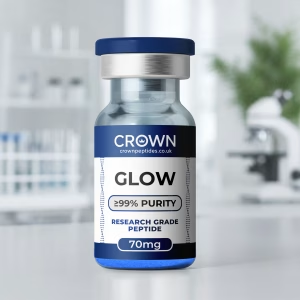
GLOW Research Peptide
From £79.99
HPLC and MS verified · same-day UK dispatch before 2pm
View GLOW Research Peptide ›The One Simple Idea: Why These Three Together
Put the three stories side by side and the design of GLOW becomes clear.
Structure
GHK-Cu brings the dermal matrix: collagen, glycosaminoglycans, decorin and the balanced remodelling that turns rough new tissue into organised skin.
Supply
BPC-157 brings the blood supply: new capillaries through VEGFR2 signalling, which every other stage of repair depends on.
Movement
TB-500 brings cell migration: keratinocytes closing the surface, stem cells moving within hair follicles, and fewer scar-driving myofibroblasts.
No single ingredient covers all three. Together, they span the building, supplying and moving that skin repair requires. That is the one simple idea behind the blend, and it is why GLOW is best thought of not as three peptides that do the same thing, but as three that each do a different, necessary thing at a different moment in the same process.
Scars, Hair and Ageing: Three Questions GLOW Research Touches
Beyond simple wound closure, GLOW's ingredients connect to three of the most interesting questions in skin biology.
Why do wounds scar?
When skin heals, fibroblasts near the wound transform into myofibroblasts, cells packed with contractile fibres that pull the wound edges together and lay down dense collagen. That helps close the wound quickly, but if myofibroblasts persist too long, they produce the thick, disorganised collagen of a scar. Normal skin has collagen woven in a flexible basket-weave pattern; scar collagen tends to run in dense parallel bundles, which is why scars are stiffer and look different.
Two GLOW ingredients speak to this. Thymosin beta-4 research, summarised in the 2012 review, indicates it reduces myofibroblast numbers in wounds, associated with less scarring. And GHK's balanced effect on both building and breaking down matrix, including its stimulation of decorin, a molecule that helps organise collagen fibres into their proper arrangement, points towards better-organised repair rather than simply more collagen.
How do hair follicles regenerate?
Each hair follicle is a miniature organ that cycles repeatedly through growth, regression and rest throughout life. At the start of each growth phase, stem cells in a region called the bulge are activated, move down to the base of the follicle and begin producing a new hair. The follicle is surrounded by blood vessels that must expand to supply the growing hair, and by matrix that must be remodelled.
GLOW's ingredients touch several parts of that cycle. Thymosin beta-4 research showed it promotes the migration of bulge-derived stem cells and increases the matrix-remodelling enzyme MMP-2. BPC-157 treatment preserved more hair follicles in burned mouse skin. And GHK's research, as the 2015 review noted, includes accelerated healing of hair follicles in animal models. That is why skin research using GLOW often includes follicle measures alongside wound measures.
Why does repair slow with age?
Older skin heals more slowly, with thinner dermis, fewer active fibroblasts, less responsive blood vessels and slower keratinocyte migration. Each of those changes maps onto a GLOW ingredient's research area: matrix production for GHK-Cu, vessel growth for BPC-157 and cell migration for thymosin beta-4. Plasma GHK itself declines with age, which is part of what first drew attention to it. Studying the blend in older animal models is therefore a natural way to explore how the different stages of repair are affected by ageing.
GLOW Compared With Its Relatives
GLOW vs the Wolverine Stack
The Wolverine Stack contains BPC-157 and TB-500 only. It is the repair core, focused on vascular and cell-migration processes, and is widely used in tendon, ligament and muscle research. GLOW adds GHK-Cu, shifting the emphasis towards the dermal matrix and making it more naturally suited to skin and connective tissue research. See the Wolverine Stack guide and BPC-157 vs TB-500.
GLOW vs KLOW
KLOW adds KPV, a fragment of the hormone alpha-MSH studied for inhibiting NF-kappaB and inflammatory signalling. GLOW leaves inflammation signalling out, keeping the blend focused on repair and structure. Our KLOW blend guide explains the four-peptide version.
GLOW vs GHK-Cu alone
GHK-Cu on its own is the right choice when the research question is specifically about the copper peptide. GLOW is the choice when the question involves the whole repair sequence rather than one part of it.
A Short History of Combining Repair Peptides
GLOW is part of a longer story. Researchers studying BPC-157 and thymosin beta-4 separately through the 1990s and 2000s built up two substantial but largely independent literatures, one centred in Zagreb and the other at the US National Institutes of Health and George Washington University. Because both compounds were repeatedly linked to blood vessel growth and cell migration, but through different mechanisms, combining them was an obvious next step, and the BPC-157 and TB-500 pairing became known as the Wolverine Stack.
GHK-Cu's research had grown in parallel, centred on skin, wound chambers and later gene expression. Adding it to the repair pair created a blend spanning the dermal matrix as well as vessels and migration. That is how GLOW came about: not as a random combination of popular names, but as the meeting of three research traditions that each explained a different part of how skin rebuilds itself.
The same logic applies at the next step. Adding KPV, from yet another research tradition centred on alpha-MSH and gut inflammation, produced KLOW. Each blend in the family therefore represents a deliberate choice about which parts of the repair sequence a study wants to include.
Designing Research With GLOW
Measure across the stages
Because each ingredient's research is concentrated at a different stage, useful designs measure several: capillary density for the vascular stage, re-epithelialisation and cell migration for the movement stage, and collagen, glycosaminoglycans and tensile strength for the structural stage. Burn and wound studies such as those above offer ready-made sets of measures.
Build a ladder of comparisons
Because every GLOW ingredient is available on its own, along with the Wolverine Stack and KLOW, researchers can compare single peptides, the repair pair, GLOW and KLOW in the same model. Each step adds one variable.
Include the right controls
Every GLOW experiment benefits from a control group or condition that receives everything except the peptides, including the same diluent and handling. In wound and burn models, a vehicle control matters in particular: the 2001 burn study showed that the cream vehicle alone did not reproduce BPC-157's effects, which is exactly the kind of comparison that makes a result convincing. Where possible, including a standard reference treatment alongside, as that study did with silver sulfadiazine, adds useful context.
Keep the batch constant
With three components in fixed proportions, using a single batch across a study and recording lot numbers removes a common hidden source of variation.
The Technical Breakdown: Counting Molecules in the Vial
This section is for readers who want the arithmetic and chemistry.
From milligrams to molecules
Because the three peptides differ enormously in size, the label amounts translate into very different numbers of molecules:
- GHK-Cu, roughly 400 g/mol: 50mg is about 125 micromoles.
- BPC-157, roughly 1,419 g/mol: 10mg is about 7 micromoles.
- TB-500, based on thymosin beta-4 at roughly 4,960 g/mol: 10mg is about 2 micromoles.
In molecule count, GHK-Cu outnumbers BPC-157 by nearly twenty to one and TB-500 by more than sixty to one. That reflects the very different concentrations at which each is typically studied.
Working out concentrations
When GLOW is reconstituted, each component's concentration is calculated separately. For example, in 3.5ml of diluent, GHK-Cu would be about 14.3mg per ml and BPC-157 and TB-500 about 2.9mg per ml each. Our peptide calculator and mg vs mcg explainer make this straightforward.
Why reconstituted GLOW is blue
GHK binds copper(II) through its histidine, its glycine amino group and the peptide backbone. Copper(II) complexes absorb orange-red light, so the solution appears blue, a normal sign that the copper complex is present.
Actin and TB-500
Thymosin beta-4 binds single actin molecules, holding them in a reserve pool. When a cell needs to move, actin is released to build the filaments that push the cell's leading edge forward. That is the core of TB-500's link to cell migration in wound closure and hair follicle research.
Why Blend Quality Is Harder to Get Right
Each of the three peptides has to be made and purified separately before blending. BPC-157 involves 15 coupling steps and thymosin beta-4-based material many more, so deletion impurities are a genuine consideration. The proportions must be accurate, and each component must be identified separately in analysis, with GHK-Cu's copper adding an extra dimension. A single overall purity figure is not enough for a blend.
The Crown Peptides standard
Every batch of GLOW supplied by Crown Peptides comes with a batch-specific certificate of analysis. HPLC separates and measures the components, and mass spectrometry confirms each peptide's identity. Lot numbers on certificates match those on vial labels. Published certificates are on our Lab Reports page, and our guides to peptide testing and reading a certificate of analysis explain multi-component results.
Handling
GLOW is supplied lyophilised and should be stored cold, dry and away from light. Reconstitute slowly and swirl gently rather than shaking. Our guides to peptide reconstitution and how long peptides last cover the practical side, and Bacteriostatic Water is available alongside.
Related Compounds in Skin and Tissue Research
The single ingredients
GHK-Cu, BPC-157 and TB-500 are each available on their own.
Other skin research peptides
AHK-Cu, GHK-Cu's close relative, is studied particularly in hair follicle research; see AHK-Cu vs GHK-Cu. Glutathione is studied for oxidative stress and pigment, compared in GHK-Cu vs Glutathione. SNAP-8 is a signal peptide studied for expression lines, and KPV for skin inflammation.
Bundles
The Dermal & Cellular Research Bundle brings skin-related compounds together in separate vials. Browse the wider tissue biology research peptides category for more.
GLOW Questions, Answered
What is in GLOW?
GHK-Cu 50mg, BPC-157 10mg and TB-500 10mg, for a total of 70mg per vial.
How is GLOW different from KLOW?
KLOW contains everything in GLOW plus 10mg of KPV, an anti-inflammatory peptide. GLOW focuses on structure and repair without the added inflammation-signalling component.
Why is GHK-Cu the largest component?
GHK-Cu is a very small molecule typically studied at higher amounts than the other two, so it makes up most of the blend by weight and by far the most by molecule count.
Can I study GLOW's ingredients separately?
Yes. GHK-Cu, BPC-157 and TB-500 are each available on their own, which makes it possible to compare the blend against its parts.
What has research shown for each ingredient in skin?
In animal research, GHK-Cu increased collagen and matrix in rat wounds, BPC-157 improved burn healing in mice with more capillaries, faster resurfacing and stronger healed skin, and thymosin beta-4 accelerated wound closure, stimulated hair growth and was associated with reduced scarring.
Is GLOW studied for hair research?
Its ingredients have hair-related research behind them: thymosin beta-4 stimulated hair growth in rats and mice by activating follicle stem cells, BPC-157 preserved more hair follicles in burned mouse skin, and GHK has been associated with hair follicle healing in animal models.
Does GLOW contain KPV?
No. GLOW contains GHK-Cu, BPC-157 and TB-500 only. KPV is the extra ingredient that turns GLOW into KLOW.
Why is my reconstituted GLOW blue?
Because of the copper in GHK-Cu. The blue colour is expected.
Build, Supply, Move: The Whole Repair Story in One Vial
GLOW brings together three molecules with three very different origin stories: a copper peptide found in young blood plasma, a stable fragment of a gastric protein and an actin regulator first found in the thymus. In skin research, each has earned its place. GHK-Cu rebuilds the dermal matrix. BPC-157 grows the blood supply and, in burned mice, produced stronger, faster-healing skin. Thymosin beta-4 moves cells across wounds, wakes hair follicle stem cells and has been associated with softer scars.
Combined, they cover the building, supplying and moving that every repair depends on, which is exactly why GLOW has become a go-to blend for skin and tissue research. Explore GLOW from Crown Peptides, every batch HPLC and mass spectrometry verified and dispatched from the UK.