
Search "BPC-157 vs TB-500" and you'll land in the middle of one of the most active comparison conversations in the entire research peptide space. These two names get typed into the same search bar together more than almost any other pairing — and lately, thanks to a nickname borrowed from a comic-book character, that conversation has spilled well outside the usual research-peptide crowd.
That nickname is the "Wolverine Stack," and it's turned BPC-157 and TB-500 into something close to household names among people who'd never previously read a peptide research paper in their life. But mainstream attention doesn't automatically mean people understand what's actually being compared. Ask most people what separates the two and you'll usually get a shrug, or an answer that treats them as roughly interchangeable — two names for the same idea. They're not. BPC-157 and TB-500 are structurally distinct peptides, studied through different mechanisms, with research bases that only partially overlap in what they actually point to.
This is a comparison, not a re-introduction — if you want the full individual research picture on either compound, that's covered in depth elsewhere. What matters here is what actually separates them: structure, mechanism, research history, and why so many protocols end up examining them side by side rather than picking one over the other.
BPC-157 and TB-500 are sold by Crown Peptides for laboratory research use only and have not been evaluated or approved by the FDA for human treatment.
The short version
- BPC-157 is 15 residues from human gastric juice; TB-500 is 43-residue thymosin beta-4.
- Different origins and different mechanisms — they are not variants of one idea.
- TB-500 sequesters actin; BPC-157 research centres on angiogenesis and gut models.
- Frequently searched together, which is why the Wolverine Stack pairs them.
Two Names, One Search Bar
There's a reason "BPC-157 and TB-500" gets searched together so consistently rather than as two separate queries. Both compounds emerged from the same broad research territory — tissue repair, recovery, and regeneration — around a similar period, and both built reputations as some of the most extensively discussed peptides among researchers working in that space. When two compounds keep showing up in the same conversations, in the same protocols, and in the same comparison articles, the search behaviour follows naturally.
But proximity in search results isn't the same as similarity in biology. That's really the whole reason a direct, structural comparison is useful: the two names travel together so often that it's easy to assume the underlying science does too. It doesn't, and understanding exactly where it diverges is what actually helps a researcher decide which one — or whether both — belongs in a given protocol.
Built From Entirely Different Blueprints
Start with structure, because this is where the two compounds part ways immediately. BPC-157 is a synthetic pentadecapeptide — fifteen amino acids — derived from a partial sequence of a protective protein found in human gastric juice. It's a small, stable fragment, and its size is part of what makes it practical to synthesise consistently at research scale.
TB-500 is a different animal entirely. It's a synthetic version of a fragment of thymosin beta-4, a naturally occurring 43-amino-acid protein found in nearly every cell type in the human body. The research-grade version typically used is a 17-amino-acid active fragment of that larger protein — already larger than BPC-157 on its own, and derived from a completely different parent molecule with an entirely different biological job description.
So even before getting to what either compound does, it's worth sitting with what they are: one is a gastric-derived stability peptide, small and localised in its origins. The other is a fragment of a protein that exists throughout the entire body, involved in some of the most fundamental processes a cell uses to move and rebuild itself. Same broad research category, genuinely different starting points.
- Classification
- Multi-peptide research blend combining BPC-157 and TB-500
- Available strengths
- 5mg+5mg and 10mg+10mg
Where Each One Actually Came From
The discovery stories behind the two compounds are as different as their structures, and knowing them helps explain why each has ended up studied the way it has. BPC-157's story starts in Croatia in the early 1990s, where researcher Predrag Sikiric and colleagues were investigating protective compounds naturally present in human gastric juice — substances the stomach lining appeared to use to defend and repair itself against its own acidic environment. BPC-157 was isolated as a stable fragment of one of those protective proteins, and its gut-protective origin is precisely why so much of its early research focused on gastrointestinal healing before expanding outward into tendon, ligament, and muscle studies.
TB-500's origin traces back much further and through a different discipline entirely. Thymosin beta-4, the parent protein TB-500 is derived from, was first identified in the 1960s during immunology research into thymic hormones, and its role in actin regulation and cell motility was established over subsequent decades of cell-biology research — work that had nothing to do with gut protection or tendon repair at all. It was only later that researchers connected thymosin beta-4's actin-binding activity to wound healing and tissue-repair applications, and TB-500 was developed as a synthetic fragment carrying that specific activity forward into a more practical, research-friendly compound.
Two different decades, two different countries, two entirely different scientific questions — one about gastric self-protection, one about the cellular machinery of movement itself — and they only ended up compared at all because both trails eventually led to the same destination: tissue repair. That's a useful thing to sit with, because it's a reminder that the comparison isn't between two variations on one idea. It's between two independent research lineages that happen to converge on an overlapping outcome.
Where the Pathways Split
The structural difference isn't just academic — it maps directly onto how each peptide is thought to work, and this is the heart of any serious BPC-157 TB-500 research comparison.
BPC-157's research centres on angiogenesis — the formation of new blood vessels — through pathways involving VEGF (vascular endothelial growth factor) and nitric oxide signalling. In practical terms, that means BPC-157 is studied for its ability to encourage blood supply to reach damaged tissue, which in turn supports the delivery of oxygen, nutrients, and repair signals to the site of an injury. Its research footprint tends to concentrate on localised effects — the gut lining, tendons, ligaments, muscle tissue — sites where restoring vascular supply is a rate-limiting step in repair.
TB-500 works through an entirely different mechanism: actin regulation. Actin is a structural protein that cells rely on to change shape, move, and migrate — it's part of the internal scaffolding that lets a cell crawl toward a wound site in the first place. TB-500 is studied for its ability to bind actin monomers and influence that cytoskeletal machinery, which researchers believe supports the migration of cells like keratinocytes, endothelial cells, and fibroblasts toward damaged tissue. Rather than acting locally, TB-500 is understood to distribute more systemically — it's been studied crossing the blood-brain barrier, for instance, something not typically discussed with BPC-157.
Put simply: BPC-157 is studied for building the vascular supply lines a repair site needs. TB-500 is studied for helping the right cells physically get there and reorganise once they've arrived. Those are two different, complementary jobs in the same overall process — which is exactly why the comparison keeps coming up, and why the two are so often discussed as partners rather than competitors.
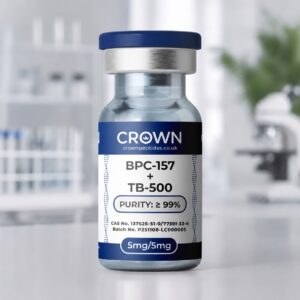
BPC-157 + TB-500 Blend (Wolverine Stack)
HPLC and MS verified · batch certificate published · dispatched from the UK before 2pm
BPC-157 Compared With TB-500: The Research Snapshot
Both compounds have accumulated a substantial preclinical research base — much of it in animal models of tendon, ligament, muscle, and gut injury — alongside a large and growing volume of anecdotal reports from researchers and the broader peptide community. Anecdotal reports are worth acknowledging here, clearly labelled as exactly that: interesting, widely discussed, but not a substitute for controlled trial data, and never proof on their own.
BPC-157's preclinical work spans some of the widest tissue coverage of any research peptide — studies covering tendon-to-bone healing, muscle injury recovery, and gastrointestinal tissue repair, consistent with its origins in a gut-protective protein fragment. TB-500's research base leans more toward systemic and cardiac tissue models, along with wound-healing studies examining cell migration directly, which tracks with its actin-based mechanism and broader tissue distribution.
Where the two research bases genuinely overlap is tendon and connective tissue repair — both compounds have independently accumulated preclinical evidence in this area, approached from different mechanistic angles. That overlap, more than anything else, is what originally got researchers asking whether the two might work well examined together rather than separately.
How the "Wolverine Stack" Actually Got Its Name
Here's where the story gets a bit more interesting than a straight science comparison. Over the past couple of years, the pairing of BPC-157 and TB-500 has picked up a nickname in recovery and biohacking circles: the Wolverine Stack, a nod to the Marvel character best known for near-instant regenerative healing. It's not a clinical term, and no research paper uses it — but it's done more to put these two peptides in front of a mainstream audience than almost any single study has.
That's worth noting honestly rather than dismissively. A comic-book nickname obviously isn't evidence of anything, but it is a genuinely accurate signal of how much attention this specific combination has picked up outside the core research-peptide audience — recovery clinics, strength and conditioning communities, and general wellness content have all picked up the phrase over the past year. The name is marketing shorthand, not science. The reason people reach for it, though — two compounds studied through complementary repair pathways, often discussed together — is grounded in something real.
Why Researchers Sometimes Examine Them Together
The logic behind studying BPC-157 and TB-500 in combination isn't complicated once the mechanisms are laid out side by side. Tissue repair isn't a single event — it's a sequence, running roughly from restoring blood supply, to recruiting and mobilising the right repair cells, to those cells actually reorganising and rebuilding the damaged structure. BPC-157's angiogenic, VEGF-driven mechanism sits closer to the first part of that sequence. TB-500's actin-based cell-migration mechanism sits closer to the second and third.
That's the whole rationale in a sentence: two peptides, two distinct non-overlapping mechanisms, mapped onto two different phases of the same underlying biological process. It's the same logic that shows up elsewhere in multi-peptide research — pairing compounds with genuinely different targets rather than doubling up on the same one — and it's a reasonable, mechanistically grounded hypothesis. It's also worth being precise about what it is and isn't: no large controlled trial has directly tested BPC-157 and TB-500 administered together against either compound alone, so the combination remains a logical, mechanism-driven research question rather than a settled, proven result.
How Researchers Actually Test These Two Compounds
It's worth grounding all of this in what the underlying experiments actually look like, since "angiogenic signalling" and "actin regulation" can otherwise feel like abstract labels rather than something measured in a lab. BPC-157's angiogenic activity is typically assessed by tracking new blood vessel formation in damaged tissue — counting vascular density in histological sections of healing tendon or muscle, or measuring VEGF expression levels directly — alongside functional healing-rate measures like tensile strength of a repairing tendon or the rate of ulcer closure in gut-tissue models.
TB-500's actin-related activity is measured differently, closer to the cellular level. Researchers typically use cell-migration assays — tracking how quickly cells like fibroblasts or endothelial cells move across a lab-created gap in a cell culture (a standard "scratch assay") when exposed to the peptide compared with an untreated control — alongside direct biochemical measures of actin polymerisation dynamics. That's a meaningfully different kind of measurement from BPC-157's tissue-level vascular assessments, and it's a large part of why the two compounds' research bases, while both substantial, don't map onto each other in a simple side-by-side table. They're being measured by different tools because they're doing different jobs.
That distinction matters practically too: a researcher designing a study around one compound needs a genuinely different experimental setup than one designed around the other, which is part of why direct head-to-head trials comparing them are rarer than the volume of interest in the comparison might suggest.
There's a knock-on implication worth spelling out: because the two compounds are validated through different assay types, a researcher can't simply borrow a study design built for one and run it unmodified on the other and expect comparable, meaningful results. A scratch-assay migration study tells you very little about angiogenic potential, and a vascular-density count tells you nothing about actin dynamics. Any genuinely rigorous side-by-side comparison has to run both types of assay in parallel — which is itself part of why so much of the current "BPC-157 vs TB-500" research conversation still rests on separately conducted studies with different protocols and endpoints, rather than one unified trial built to test both compounds under identical conditions.
BPC-157 Alone Versus TB-500 Alone
For researchers who want a clean, single-mechanism model rather than a combination, the choice generally comes down to what's being studied. BPC-157 alone tends to be the more frequently reached-for compound in gut-tissue and localised soft-tissue research, given its origin and the concentration of its evidence base in those areas. TB-500 alone tends to come up more in research questions about systemic recovery, cell migration specifically, or cardiac and smooth-muscle tissue, where its broader distribution and actin-based mechanism are the more directly relevant fit.
Neither is a strictly "better" compound in the abstract — that framing misses the point. They're built differently, work differently, and answer different research questions. A protocol built around a single, clean mechanistic model has good reason to isolate one or the other. A protocol built around the broader question of full-sequence tissue repair has good reason to look at both, precisely because their mechanisms don't compete for the same biological ground.
The 2026 Regulatory Picture: A Genuinely Positive Update
This is one of the more encouraging developments either compound has seen. On 23 July 2026, the FDA's Pharmacy Compounding Advisory Committee met at the agency's White Oak campus to review seven peptides for potential inclusion on the Section 503A Category 1 bulk drug substances list — the list the FDA maintains for substances compounding pharmacies may work with. BPC-157 and TB-500 were both among them, and both received favourable recommendations, passing 8–6 with one abstention.
That followed an earlier, similarly positive signal from April 2026, when the FDA removed both compounds from its more restrictive Category 2 list entirely — a list reserved for substances the agency has flagged safety or effectiveness concerns about — after their original nominations for that restricted category were withdrawn.
It's worth being precise about what the July vote actually means, because it's genuinely good news without needing to be overstated. A PCAC recommendation is advisory — the committee has told the FDA it supports moving forward, but the agency isn't legally bound to follow that advice, and formal rulemaking to actually implement any list change typically takes eight to twenty-four months. What it does represent is a clear, public signal from the FDA's own advisory body that both compounds cleared a meaningful regulatory hurdle — a genuinely positive step for two peptides that have spent years as leading names in the research conversation.
BPC-157 and TB-500 UK: Where Things Stand
For UK-based researchers, the position is straightforward. Neither BPC-157 nor TB-500 is a controlled substance under the Misuse of Drugs Act 1971, and neither carries a marketing authorisation from the MHRA for human medicinal use — meaning both are lawfully sold and purchased in the UK specifically as research chemicals, for laboratory and research purposes, rather than as licensed medicines. That's a narrower legal status than a medicine authorisation, and it's worth keeping that distinction clear rather than assuming "legal to purchase" means "cleared for human use" — the two are separate questions with separate answers.
Both compounds also appear on the World Anti-Doping Agency's Prohibited List, under the categories covering non-approved substances and peptide hormones and growth factors, meaning any competitive athlete subject to WADA testing should treat both as banned at all times, in and out of competition — a detail worth knowing regardless of the research context.
Testing and Identification: Why It Matters More With Two Compounds
Comparing two peptides also means comparing two separate manufacturing and identity-verification challenges, and it's worth understanding what actually goes into confirming a batch is what it claims to be. BPC-157's fifteen-amino-acid sequence and TB-500's seventeen-amino-acid fragment are synthesised through different production runs, each requiring its own verification that the finished peptide chain matches its intended sequence, with no truncated fragments, incomplete couplings, or synthesis by-products carried through into the final product.
That verification happens through two standard analytical methods: high-performance liquid chromatography (HPLC), which confirms purity by separating a sample into its component compounds and flagging anything that isn't the target peptide, and mass spectrometry, which confirms molecular identity by measuring the exact mass of the peptide and checking it against the expected value for that specific sequence. Running both tests on every batch of every compound — rather than spot-checking occasionally — is the only way to catch synthesis errors before they reach a researcher's bench.
Crown Peptides applies exactly that standard to both BPC-157 and TB-500, with a batch-specific certificate of analysis provided for every order confirming both HPLC purity and mass spectrometry identity — the same rigour applied whether a researcher is ordering one compound or both.
Storage guidance is worth a mention too, since it applies equally to both: each is supplied as a lyophilised powder, stable when kept cold and protected from light and moisture prior to reconstitution, with the reconstituted solution requiring refrigeration and use within the manufacturer's recommended window.
Choosing Between Them — Or Not Choosing at All
If there's a single practical takeaway from putting BPC-157 and TB-500 side by side, it's that the question "which one is better" is the wrong question. The right one is "which mechanism does this specific research question need" — and increasingly, for researchers looking at the full arc of tissue repair rather than one stage of it, the honest answer is both, examined through their distinct pathways rather than treated as duplicates of each other.
- Localised, angiogenic, VEGF/nitric-oxide driven: BPC-157.
- Systemic, actin-based, cell-migration driven: TB-500.
- Strongest overlapping evidence base: tendon and connective tissue repair, approached from different mechanisms.
- Best understood as: complementary phases of the same repair sequence, not competing options.
That framing is really the entire reason the Wolverine Stack nickname stuck in the first place, even if the name itself is borrowed from fiction rather than a lab. Two compounds, two distinct blueprints, two different jobs in the same overall process — and a research conversation, from the 2026 regulatory developments to the growing tendon-repair overlap, that's genuinely more active right now than almost any other comparison in the peptide space.
Read the certificate before you order
Every batch is published openly — identity by mass spectrometry, purity by HPLC, and the batch number printed on the vial you receive.
Open the COA libraryQuick Answers
Are BPC-157 and TB-500 the same thing?
No. BPC-157 is a fifteen-amino-acid fragment derived from a gastric protective protein; TB-500 is a seventeen-amino-acid fragment of thymosin beta-4, a protein found throughout the body. Different parent molecules, different structures.
What's the core mechanism difference?
BPC-157 is studied through angiogenesis and VEGF/nitric-oxide signalling, largely local in effect. TB-500 is studied through actin regulation and cell migration, with more systemic distribution.
What exactly is the Wolverine Stack?
A nickname coined in recovery and biohacking circles, referencing the Marvel character known for rapid healing. It's not a clinical or scientific term, and it reflects how mainstream attention on this pairing has become rather than a formal research classification.
Is there direct research on combining them?
Not directly — no large controlled trial has tested the two together against either alone. The rationale is mechanistic: two non-overlapping pathways mapped onto different phases of tissue repair, which makes it a logical hypothesis rather than a proven combination effect.
Are BPC-157 and TB-500 legal in the UK?
Neither is a controlled drug under the Misuse of Drugs Act, and neither has MHRA marketing authorisation as a medicine — both are lawfully sold as research chemicals, distinct from being cleared for human use.
How is compound identity actually verified?
Both should be confirmed through a batch-specific certificate of analysis covering HPLC purity and mass spectrometry identity — the only reliable way to verify the finished compound matches its intended sequence.
The Bottom Line
BPC-157 and TB-500 earned their place at the centre of the research-peptide conversation independently, long before a comic-book nickname brought them to a wider audience. What the comparison actually shows is two peptides built from different blueprints, working through genuinely distinct mechanisms, with research bases that converge in exactly the areas — tendon and connective tissue repair — where a multi-pathway approach makes the most biological sense.
That's a far more interesting story than "which one wins," and it's exactly why this remains one of the most searched comparisons in the entire field: not because the two are the same, but because understanding precisely how they differ is what lets a researcher choose the right tool — or the right combination — for the question actually being asked.
Working with BPC-157 + TB-500 Blend (Wolverine Stack)
Batch-tested material, published certificates, and same-day dispatch on orders placed before 2pm.
See BPC-157 + TB-500 Blend (Wolverine Stack)