Register today and get 10% off your first orderRegister for 10% off your first orderRegister now
Crown Peptides

Research Peptides

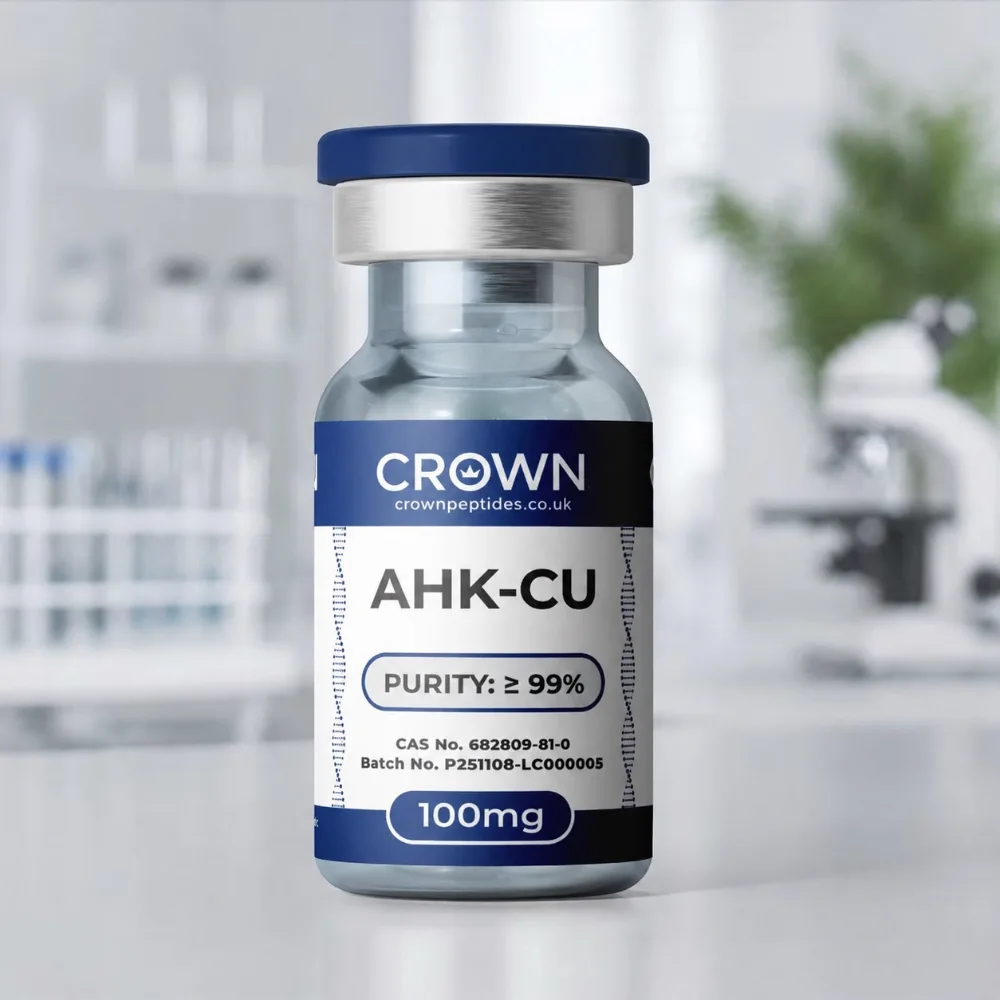
AHK-Cu Research Peptide

A high-purity research peptide studied in skin, hair and wound-repair research. Available in 100mg, with every batch independently tested and dispatched from the UK.

£29.99or from £22.49 per vial in packs of 10
Save up to 25%
From: £29.99
Your selection:
Order within
for dispatch tomorrow
15Hrs:40Min:48Sec
In stockEstimated deliveryEst. delivery Friday 16 OctoberFriday 16 Oct
All Batches TestedEvery batch, no exceptions
HPLC & MS VerifiedFull certificate published
Same Day PostageOrder before 2pm
UK Based CompanyDispatched from the UK
Product Overview

A high-purity research peptide studied in skin, hair and wound-repair research. Available in 100mg, with every batch independently tested and dispatched from the UK.

Full Product Specification
Overview

Product Overview

AHK-Cu peptide UK is Crown Peptides' copper tripeptide research compound, available in 100mg for laboratory research.

100mgAvailable strengthHPLC testedChromatographic purityMS verifiedIdentity confirmedBatch CoADocumentation supplied

Supplied for laboratory research purposes only — not for human consumption or for medical, veterinary or diagnostic use.

Key features

Key Features

  • Studied in research involving dermal and skin biology
  • Studied in research involving hair-growth signalling models
  • Studied in research involving wound-repair mechanisms
  • Studied in research involving copper-dependent tissue remodelling
  • Batch-specific quality documentation available
Background

About AHK-Cu Peptide UK

AHK-Cu is a copper(II) complex of the tripeptide alanine-histidine-lysine (Ala-His-Lys), structurally related to but distinct from GHK-Cu. It is used in research examining copper-peptide effects on dermal tissue, hair follicle biology and wound-repair pathways.

Also known as: AHK Cu, AHKCu, Copper Tripeptide-3, Ala-His-Lys copper.

Research

AHK-Cu Research

Research uses AHK-Cu to study copper-tripeptide effects on tissue, with one in-vitro study examining its effect on human hair-follicle cells (Learn more). This work sits alongside broader copper-peptide research into dermal and wound-repair biology, connecting to related compounds such as GHK-Cu.

  • Dermal and skin biology
  • Hair-growth signalling models
  • Wound-repair mechanisms
  • Copper-dependent tissue remodelling
Inside the human hair-follicle study

The paper that put AHK-Cu on the research map came from the Department of Dermatology at Seoul National University, published in Archives of Pharmacal Research in 2007. Pyo and colleagues worked with two complementary systems. First, they took isolated human hair follicles and kept them growing ex vivo, so the whole mini-organ could be measured as it lengthened. Second, they cultured dermal papilla cells, the specialised cells at the base of each follicle, to see what was happening at the cellular level.

In both systems AHK-Cu produced a response at strikingly low concentrations, between 10-12 and 10-9 M, which is the picomolar to nanomolar range. Follicles elongated further, and dermal papilla cells proliferated more, than in untreated controls. That combination of whole-follicle data and cell-culture data is what makes the study so useful as a starting point: it links an effect on the organ to a measurable change in the cells that drive it. The full abstract is available on PubMed.

Dermal papilla cells and the survival signals

Dermal papilla cells are specialised fibroblasts clustered at the bottom of the follicle, and they act as its signalling centre, guiding how the follicle forms and how long it keeps growing. Because the growth phase ends when follicle cells start to die off in an orderly, programmed way, the balance between cell survival and cell death is a central question in hair biology.

That is exactly where the Seoul team looked next. In dermal papilla cells exposed to AHK-Cu at 10-9 M, the ratio of Bcl-2 (a protein that protects cells from programmed death) to Bax (a protein that promotes it) went up. At the same time, the cleaved, active forms of caspase-3 and PARP, two hallmark markers of a cell committing to programmed death, went down. A flow-cytometry count of dying cells pointed the same way, although that particular change did not reach statistical significance. The authors proposed that AHK-Cu supports follicle growth through two routes at once: more dermal papilla cells dividing, and fewer of them being lost.

One amino acid swap, a distinct copper complex

AHK-Cu is built from L-alanine, L-histidine and L-lysine, with a copper(II) ion held by the peptide. The histidine in second position is the key to that grip. Chemists file AHK under the “Xxx-His” family of copper-binding peptides: a free amino group at the front, then histidine. In that family the metal is gripped at three points supplied by the peptide itself, namely the N-terminal amine, the neighbouring amide link and the imidazole ring of histidine, while the remaining corner of the copper’s binding plane stays open to the surrounding solution.

The alanine at the front is what sets AHK-Cu apart. Its small methyl side chain makes the molecule slightly larger and less polar at the N-terminus than its better-known glycine-containing cousin, giving researchers a closely matched but separate copper peptide to work with. The Ala-His-Lys sequence also has an interesting natural echo: it forms residues two to four of Asp-Ala-His-Lys, the N-terminal copper-binding site of human serum albumin.

Fibroblasts, growth factors and the dermal matrix

Hair is only part of the AHK-Cu story. In framing their work, Pyo and colleagues noted earlier findings that tripeptide-copper complexes stimulate the proliferation of dermal fibroblasts, raise their output of vascular endothelial growth factor (VEGF) and reduce their secretion of transforming growth factor-beta1 (TGF-β1). Those three readouts matter in skin research because fibroblasts lay down collagen, VEGF drives new blood-vessel growth, and TGF-β1 is a master regulator of scarring and matrix build-up.

Copper itself is a working part of the dermal matrix too. Lysyl oxidase, the enzyme that cross-links collagen and elastin fibres so they gain strength, depends on copper to function. That is why copper peptides are studied in tissue-remodelling and wound-repair models, and why AHK-Cu is often designed into experiments alongside repair-focused peptides such as BPC-157 and TB-500, which bring cell-migration and vascular readouts to the same model.

Specifications

Specifications

Product
AHK-Cu
Classification
Copper tripeptide research compound
Available strength
100mg
CAS number
767286-83-9
Molecular weight
≈ 415.9 g/mol
Molecular formula
C15H24CuN6O4
Sequence
Ala-His-Lys copper complex (3 amino acids)
Form
Research material supplied according to product label
Purity and assay
99% (HPLC), batch-specific — refer to Certificate of Analysis
Verification
HPLC and Mass Spectrometry where analytically appropriate

Compound-level reference data. Batch-specific results appear on the Certificate of Analysis.

Work out concentration with the peptide calculator
Testing

Purity and Testing

Crown Peptides AHK-Cu is supplied with batch-specific quality documentation appropriate to the material. Analytical methods vary by compound and formulation, so the Certificate of Analysis should be used as the definitive source for identity, assay, purity and relevant impurity information.

Storage

Storage Conditions

  • Store unreconstituted material at -20°C ± 5°C in a cool, dry environment
  • Prepared research solutions should use validated storage conditions appropriate to the compound and study design
  • Protect from unnecessary heat, direct light and repeated temperature fluctuations
Full storage guide
Related

Related Compounds

Researchers working with AHK-Cu may also be interested in GHK-Cu, KPV, BPC-157, TB-500 and Melanotan 2 — other compounds studied in dermal, tissue-repair and skin-research contexts.

Compliance

Research Use Only

  • Laboratory research only
  • Not for human or clinical use
  • Not for human or veterinary consumption
  • Qualified personnel only
Questions

AHK-Cu Frequently Asked Questions

About AHK-Cu7 questions
What is AHK-Cu?

AHK-Cu is a copper(II) complex of the tripeptide L-alanyl-L-histidyl-L-lysine (Ala-His-Lys). Crown Peptides supplies it at 100mg strength as a copper-peptide research compound, with most published interest centred on hair-follicle and dermal biology.

How is AHK-Cu different from GHK-Cu?

The two differ by a single amino acid. AHK-Cu starts with alanine, while GHK-Cu starts with glycine. Both carry histidine in second position and lysine in third, so both bind copper in a similar way. The research focus differs, though: the key AHK-Cu paper looked specifically at human hair follicles and dermal papilla cells, which is why AHK-Cu tends to be chosen for hair-biology work.

Why is AHK-Cu so closely linked with hair research?

Because its best-known study was designed around the hair follicle. Researchers at Seoul National University showed AHK-Cu lengthening isolated human follicles ex vivo and increasing the proliferation of cultured dermal papilla cells, at picomolar to nanomolar concentrations.

What is a dermal papilla cell?

It is a specialised fibroblast that sits in a small cluster at the base of each hair follicle. The dermal papilla sends the signals that shape the follicle and keep it in its growth phase, so these cells are a standard model for studying how compounds influence follicle activity.

Where does the Ala-His-Lys sequence appear in nature?

The same three residues sit at positions two to four of human serum albumin, whose N-terminal Asp-Ala-His-Lys segment is a well-studied copper-binding site. AHK-Cu itself is studied as a defined, standalone copper tripeptide.

How is AHK-Cu research material produced?

It is made synthetically. The Ala-His-Lys peptide is assembled amino acid by amino acid and then complexed with copper(II), giving a defined compound rather than an extract.

Why is AHK-Cu also listed as Copper Tripeptide-3?

Copper Tripeptide-3 is the cosmetic-ingredient style name AHK-Cu is often catalogued under. You will also see it searched as AHK Cu, AHKCu and Ala-His-Lys copper. All refer to the same copper-peptide complex.

Research context3 questions
What exactly did the AHK-Cu hair-follicle study measure?

Two things in parallel: how far whole human follicles elongated in culture, and how quickly dermal papilla cells multiplied. The team then probed cell-survival markers, finding a higher Bcl-2/Bax ratio and lower levels of cleaved caspase-3 and PARP, which points to fewer dermal papilla cells entering programmed cell death.

Has AHK-Cu been studied in skin and wound-repair models?

The dedicated AHK-Cu literature is compact and centred on the follicle work. Interest in skin and repair comes from the wider copper-tripeptide findings on fibroblast growth, VEGF and TGF-β1, and from copper’s role in lysyl oxidase, the enzyme that strengthens collagen and elastin. That leaves plenty of open ground for new dermal and repair studies.

Which compounds pair well with AHK-Cu in dermal studies?

It depends on the question. TB-500 and BPC-157 add cell-migration and vascular readouts to repair models. KPV brings an inflammatory-signalling angle, useful where follicle or skin models involve an inflammatory challenge. Melanotan 2 is studied in melanocortin and pigmentation research, a separate strand of skin biology.

Handling & identity3 questions
How far does one 100mg vial of AHK-Cu stretch in follicle or fibroblast work?

A long way. The hair-follicle effects were reported between picomolar and nanomolar concentrations, so a 100mg vial, the only strength offered, covers a great deal of dermal papilla or fibroblast culture work. Labs planning a run of follicle experiments can order five or ten vials together and keep the whole series on one batch.

Why does AHK-Cu give a twin-peak pattern on mass spectrometry?

Natural copper is a mix of two isotopes, 63Cu and roughly a third as much 65Cu, so any ion still carrying its copper shows up as a pair of peaks two mass units apart, the taller one first. That doublet is a quick fingerprint of bound metal. The intact complex weighs about 415.9 g/mol (C15H24CuN6O4); if the copper comes off during ionisation, the bare Ala-His-Lys peptide appears instead at around 354 g/mol, without the doublet. Confirmed identity and purity figures for each batch are on its Certificate of Analysis.

Does the copper binding affect how AHK-Cu behaves in solution?

It does. The copper sits in a pH-sensitive pocket formed by the peptide’s N-terminus and histidine. Strongly acidic conditions can protonate those binding groups and release the copper, and strong chelating agents such as EDTA can compete for it. Keeping buffers near neutral and free of strong chelators helps keep the complex intact during experiments.

Read the batch certificate before you order

Every batch is published openly — identity, purity and batch number, with no account needed.

View lab reports

Supplied for laboratory research purposes only — not for human consumption or for medical, veterinary or diagnostic use.

All Batches TestedEvery batch, no exceptions

Each batch undergoes internal analytical verification using chromatographic and spectrometric methods prior to lyophilisation.

• HPLC Analysis
• Mass Spectrometry Confirmation
• Batch Traceability

For Research Use Only

By purchasing this product you confirm that you are a qualified researcher and that this compound will be used exclusively for laboratory research purposes.

Not for Human Consumption

This product is not intended for diagnostic or therapeutic use.

Any human or medical use is strictly prohibited.

Store Safely at All Times

Store in a cool, dry, secure and sterile environment away from any unauthorised persons or children.

Other Research Peptides

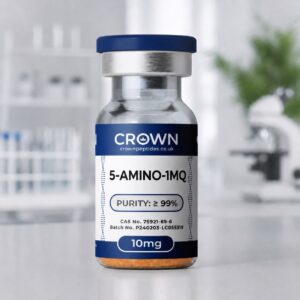
2 strengths5-Amino-1MQ research compound UK 10mg and 50mg vial - Crown PeptidesAgeing research

5-Amino-1MQ Research Compound


From£24.99Strength10mg
Add to basket
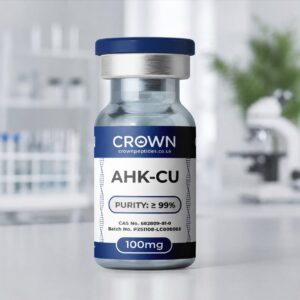
AHK-Cu 100mg research peptide vial – Crown Peptides UKAgeing research

AHK-Cu Research Peptide


From£29.99Strength100mg
Add to basket
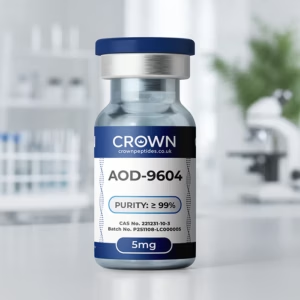
AOD-9604 5mg research peptide vial - Crown PeptidesMetabolic research

AOD-9604 Research Peptide


From£34.99Strength5mg
Add to basket
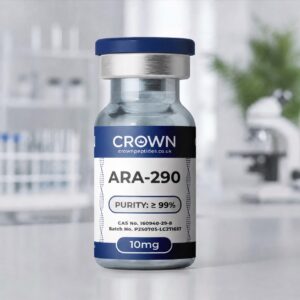
ARA-290 research peptide UK 10mg vial - Crown PeptidesImmunology research

ARA-290 Research Peptide


From£39.99Strength10mg
Add to basket

Further reading

SUPPORT Mon to Fri, 9am to 5pmDISPATCH Cut-off 2pmEMAIL info@crownpeptides.co.ukWHATSAPP +44 7301 802654

Disclaimer: All products are sold strictly for laboratory research purposes only. Not for human or veterinary use, consumption, therapeutic, or diagnostic application. None of our products are medicines, and none are presented as such. By purchasing, you confirm you are a qualified professional and legally permitted to handle these materials in compliance with all applicable laws and regulations. Misuse, resale for unauthorised purposes, or unlawful application is strictly prohibited. Crown Peptides UK disclaims all liability for improper use, handling, or regulatory non-compliance.

© 2026 Crown Peptides UK, a trading name of Crown Peptides Ltd (company no. 17068950), Suite Ra01, 195-197 Wood Street, London E17 3NU . All Rights Reserved.