Research Peptides
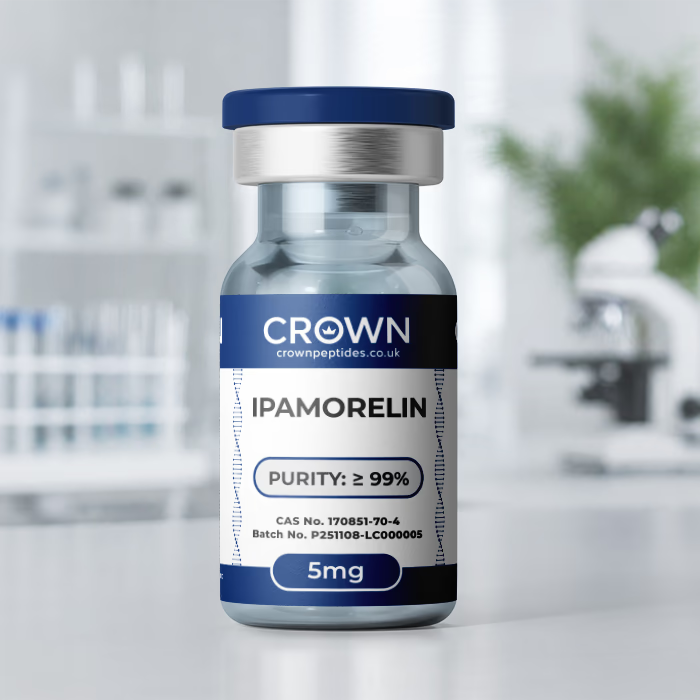
A high-purity research peptide studied in growth-hormone research. Available in 5mg and 10mg, with every batch independently tested and dispatched from the UK.
Ipamorelin peptide UK is Crown Peptides' selective synthetic growth-hormone secretagogue peptide, available in 5mg and 10mg strengths for laboratory research.
Supplied for laboratory research purposes only — not for human consumption or for medical, veterinary or diagnostic use.
Ipamorelin is a synthetic pentapeptide studied as a relatively selective agonist of the growth-hormone secretagogue receptor. It belongs to the ghrelin-mimetic family of compounds but is structurally distinct from endogenous ghrelin.
Also known as: Ipamorelin acetate, NNC 26-0161.
Ipamorelin research focuses on GHSR receptor pharmacology, pituitary growth-hormone release and endocrine selectivity, first characterised in the literature as the original selective secretagogue in its class (Learn more). It is frequently compared with earlier growth-hormone-releasing peptides such as GHRP-6 to examine differences in receptor selectivity and secondary endocrine signalling. This makes it useful in mechanistic studies of the ghrelin-growth-hormone axis, often studied alongside CJC-1295 with DAC.
Ipamorelin was the standout of a large medicinal-chemistry effort at Novo Nordisk in Denmark, where chemists took the heptapeptide GHRP-1 and cut out its central Ala-Trp pair, then refined the shortened series until one pentapeptide stood out. Inside the company it carried the code NNC 26-0161, and that label still turns up in older pharmacology papers.
The same team kept going. A 1998 paper in the Journal of Medicinal Chemistry used Ipamorelin as the parent for a new family of smaller molecules, built with a benzoic-acid fragment and N-methylated backbones in a push towards oral activity; one of them, the tetrapeptide NNC 26-0235, reached about 10% oral bioavailability in dogs. In rats, Ipamorelin’s plasma clearance was about five times lower than that of GHRP-6.
The founding Ipamorelin paper measured far more than growth hormone. In primary rat pituitary cells it released GH at an EC50 of about 1.3 nmol/L, close to GHRP-6 at 2.2 nmol/L, reaching around 85% of GHRP-6’s maximum. In conscious pigs the half-maximal dose was about 2.3 nmol/kg. GHRP-2 behaved differently in the same pigs: more potent, at roughly 0.6 nmol/kg, but with a lower ceiling on the GH peak.
The pig work then screened six other pituitary and adrenal hormones. FSH, LH, prolactin and TSH stayed flat with every secretagogue tested, so prolactin was not what separated the compounds in that model. The dividing line was the stress axis, where GHRP-2 and GHRP-6 pushed ACTH and cortisol up and Ipamorelin did not. Prolactin selectivity is worth checking species by species, though: macimorelin, a later oral ghrelin-receptor agonist, raised prolactin in a study of healthy volunteers while leaving ACTH and cortisol unchanged.
GHSR-1a, the receptor Ipamorelin binds, has an unusual habit. Working in transfected cells, Birgitte Holst and colleagues, with Novo Nordisk chemist Michael Ankersen among the authors, showed in 2003 that it signals strongly with no ligand present at all. A modified substance P peptide, long used as a weak ghrelin-receptor blocker, turned out to be a potent inverse agonist that silenced this background signal. The body has its own brake too: LEAP2, a peptide made in the liver and gut, is now recognised as a natural GHSR antagonist.
That high baseline means an agonist such as Ipamorelin adds to a receptor that is already partly active, something to keep in mind when reading dose-response data. The receptor also reaches well beyond the pituitary. In GH-deficient lit/lit mice, Ipamorelin still increased fat-pad weight relative to body weight, and in GH-intact mice secretagogue treatment raised food intake and serum leptin, pointing to GH-independent effects that may run partly through extra feeding.
Ghrelin speeds up the gut, which gave Ipamorelin a second career. Sapphire Therapeutics, a New Jersey company, developed an intravenous form for postoperative ileus, the stalled bowel that can follow abdominal surgery, and Helsinn bought Sapphire in early 2009, gaining a second ghrelin-receptor agonist, anamorelin, in the same deal and renaming the business Helsinn Therapeutics (U.S.).
Rat data looked encouraging. After laparotomy and handling of the intestine, Ipamorelin shortened the time to the first bowel movement, and in a later study it cut the share of a test meal still left in the stomach from 78% to 52%, while restoring contractions in isolated gastric muscle. Two Phase II trials followed: a study that enrolled 117 patients, in which median time to the first tolerated meal was 25.3 hours against 32.6 hours on placebo (p = 0.15), and a larger dose-finding study of 320 patients completed in 2014. Development then stopped, reportedly for lack of efficacy. Anamorelin went further and was approved in Japan in 2021 as Adlumiz for cancer cachexia, a regulatory fact about that separate molecule only.
Receptors that are stimulated again and again often respond less, and the growth-hormone secretagogue class is no exception: in one rat study, six weeks of the oral agonist MK-677 abolished its GH response, alongside a rise in hypothalamic somatostatin. So how does Ipamorelin behave?
The human pharmacokinetic study by Gobburu and colleagues gives a first clue. Healthy men received 15-minute infusions at five escalating levels, eight per level. Ipamorelin had a terminal half-life of about two hours, yet GH came in a single burst peaking at around 40 minutes and then fell to negligible levels at every dose, which the authors modelled as release over a fixed window. In young female rats given Ipamorelin for 21 days, pituitary cells kept responding: when cultured and challenged afresh with Ipamorelin, GHRP-6 or GHRH, only cells from the Ipamorelin-treated animals raised their GH content, and secretory granule density had risen. Long-term human data on this question remain absent.
Compound-level reference data. Batch-specific results appear on the Certificate of Analysis.
Work out concentration with the peptide calculatorCrown Peptides Ipamorelin is supplied for controlled laboratory research with batch-specific analytical documentation. High-Performance Liquid Chromatography (HPLC) can assess chromatographic purity, while Mass Spectrometry provides molecular information used to support identity verification.
The batch-specific Certificate of Analysis is the definitive source for the exact purity result, identity data and analytical specification of the material supplied.
Researchers working with Ipamorelin may also be interested in GHRP-6, CJC-1295 with DAC, CJC-1295 + Ipamorelin, Sermorelin and Tesamorelin — other growth-hormone-releasing peptides studied in the same endocrine research pathway.
Ipamorelin is a five-residue ghrelin-receptor agonist designed at Novo Nordisk, with the formula C38H49N9O5 and a molecular weight of 711.87 g/mol. It is stocked here as 5mg and 10mg vials. Catalogues often list it as Ipamorelin acetate, which simply names the salt form the purified peptide is isolated in.
NNC 26-0161 was Ipamorelin’s internal Novo Nordisk compound number before it received a generic-style name. Sister compounds carried neighbouring numbers, such as NNC 26-0235, so the code is a handy search term for older papers.
Its ancestor is GHRP-1, a seven-residue growth-hormone-releasing peptide. Novo Nordisk chemists removed GHRP-1’s central alanine-tryptophan pair and worked through the shortened series that resulted, and Ipamorelin was the compound picked out from it. Losing that tryptophan also sets it apart from GHRP-6 and Hexarelin, both of which keep tryptophan residues.
Six: FSH, LH, prolactin, TSH, ACTH and cortisol. The first four did not move with any of the secretagogues tested, including GHRP-2 and GHRP-6, so the reproductive, lactotroph and thyroid axes were quiet across the board. Only ACTH and cortisol separated the compounds, and that adrenal difference is the basis of Ipamorelin’s selective label.
Because its receptor does two jobs. Ghrelin, the natural ligand of GHSR-1a, stimulates stomach and intestinal movement as well as GH release, and Ipamorelin’s clean hormone profile made it an attractive candidate for testing that motility effect after abdominal operations. Sapphire Therapeutics, and then Helsinn, took an intravenous formulation into Phase II trials for postoperative ileus.
It was discontinued. Two Phase II ileus trials completed, the second a 320-patient dose-finding study, but the programme was reportedly halted for lack of efficacy, and Ipamorelin has never been licensed as a medicine anywhere. Its companion compound from the Sapphire portfolio, anamorelin, took a different path to approval in Japan.
Rodent work so far suggests the pituitary stays responsive: somatotrophs from rats given Ipamorelin for three weeks still raised their GH content when challenged in culture. Long human studies addressing tolerance have not been published.
GHRP-2 is the more potent of the pair but not the more effective. In conscious pigs it needed about a quarter of Ipamorelin’s dose for a half-maximal GH response, yet its peak GH level was lower, around 56 ng/mL against 65 ng/mL. It also raised ACTH and cortisol, which Ipamorelin did not, so GHRP-2 suits studies wanting a strong ghrelin-receptor signal that includes the stress axis.
Hexarelin is a six-residue GHRP-6 derivative carrying a 2-methyl-tryptophan, and it leads a double research life. As well as acting on GHSR-1a, it binds CD36, a scavenger receptor on heart and immune cells, which is why it appears so often in cardiac and macrophage studies. Ipamorelin’s literature, by contrast, stays centred on GHSR-1a and growth-hormone release.
A few are, none of them Ipamorelin. Macimorelin, an oral small molecule sold as Macrilen, is FDA-approved as a diagnostic test for adult growth-hormone deficiency. Pralmorelin (GHRP-2) is approved in Japan as a diagnostic agent for growth-hormone reserve testing, and anamorelin, sold as Adlumiz, is approved in Japan for cancer cachexia. Each approval belongs to that exact molecule; Ipamorelin research material is a separate compound with no licensed use.
GHSR-1a signals even when nothing is bound to it, so cell lines that express plenty of receptor start from a raised baseline before Ipamorelin is added. Researchers often include an inverse agonist control to define the true floor, and they report receptor expression levels, since changing expression alone can shift apparent agonist responses.
Several studies say it does. In mice it increased body fat even in animals unable to make growth hormone, and in pancreatic tissue fragments from normal and diabetic rats it raised insulin secretion through calcium-channel and adrenergic pathways. The ileus studies add the gut.
Nothing about the peptide itself: both hold the same freeze-dried Ipamorelin, so a stock solution of a given concentration can be made from either by adjusting the volume of diluent. The 5mg fill is economical for receptor-binding and pituitary-cell assays that use nanomolar concentrations. The 10mg fill means fewer vials to reconstitute across a longer rodent series. Boxes of five or ten, in either fill, keep a project on matched material from one production lot.
Ipamorelin is extensively metabolised, and in a urinary excretion study with one volunteer per peptide its fragment Ipamorelin (1-4) free acid, the first four residues without the C-terminal lysine amide, was still detectable after the parent peptide had cleared. Sports anti-doping rules prohibit growth-hormone-releasing peptides as a class. For identity work on intact material, the amidated pentapeptide’s monoisotopic mass of about 711.39 Da shows up as [M+H]+ near m/z 712.4 and [M+2H]2+ near 356.7; a signal about 1 Da heavier can flag loss of the C-terminal amide.
Every batch is published openly — identity, purity and batch number, with no account needed.
Supplied for laboratory research purposes only — not for human consumption or for medical, veterinary or diagnostic use.
Each batch undergoes internal analytical verification using chromatographic and spectrometric methods prior to lyophilisation.
• HPLC Analysis
• Mass Spectrometry Confirmation
• Batch Traceability
By purchasing this product you confirm that you are a qualified researcher and that this compound will be used exclusively for laboratory research purposes.
This product is not intended for diagnostic or therapeutic use.
Any human or medical use is strictly prohibited.
Store in a cool, dry, secure and sterile environment away from any unauthorised persons or children.
Disclaimer: All products are sold strictly for laboratory research purposes only. Not for human or veterinary use, consumption, therapeutic, or diagnostic application. None of our products are medicines, and none are presented as such. By purchasing, you confirm you are a qualified professional and legally permitted to handle these materials in compliance with all applicable laws and regulations. Misuse, resale for unauthorised purposes, or unlawful application is strictly prohibited. Crown Peptides UK disclaims all liability for improper use, handling, or regulatory non-compliance.