Research Peptides
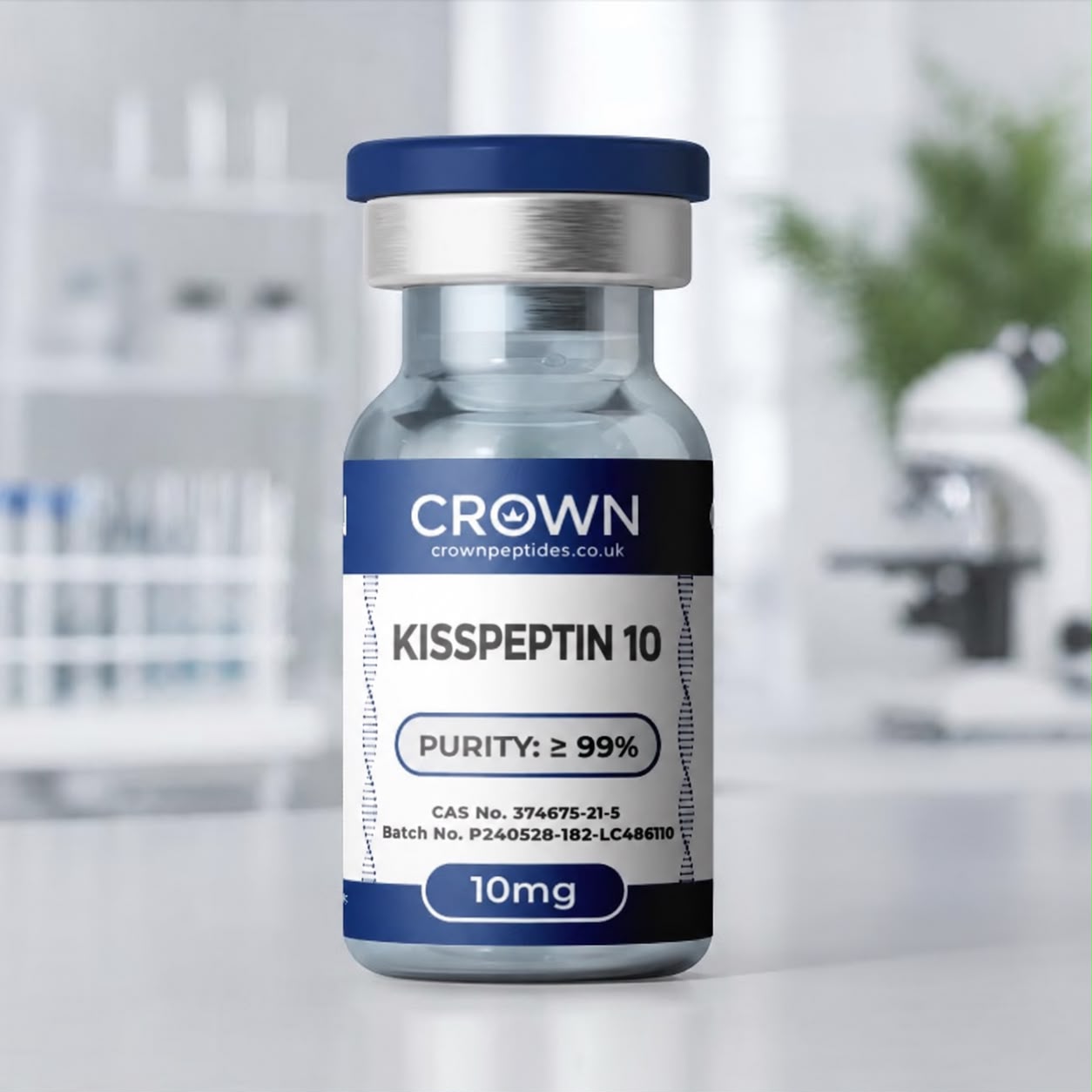
A high-purity research peptide studied in reproductive-hormone research. Available in 10mg, with every batch independently tested and dispatched from the UK.
Kisspeptin-10 peptide UK is Crown Peptides' bioactive 10-amino-acid fragment of kisspeptin, available in 10mg strength for laboratory research.
Supplied for laboratory research purposes only — not for human consumption or for medical, veterinary or diagnostic use.
Kisspeptin-10 is the short C-terminal bioactive fragment of kisspeptin and retains activity at the KISS1 receptor. The kisspeptin system is a central research pathway in reproductive neuroendocrinology because KISS1R signalling regulates gonadotropin-releasing hormone neurons.
Also known as: Kisspeptin 10, KP-10, metastin 45–54.
Kisspeptin-10 is used to study KISS1/KISS1R receptor pharmacology, hypothalamic GnRH signalling and the hypothalamic-pituitary-gonadal axis, including structure-activity work characterising Kisspeptin-10-related peptide conformation (Learn more). Research models also examine how kisspeptin signalling responds to metabolic, developmental and hormonal inputs. Its short defined sequence makes Kisspeptin-10 especially useful in receptor and neuroendocrine experiments.
Kisspeptin began life as a cancer gene. In 1996 Danny Welch’s laboratory at Penn State’s Hershey campus was studying melanoma cells that lost their ability to spread after a copy of human chromosome 6 was introduced. The gene they pinned down was named KiSS-1, a nod to Hershey’s Kisses chocolates made in the same town, with the capital “SS” standing for suppressor sequence.
Five years later, in 2001, the protein product was traced. A team at Takeda isolated a 54-residue amidated peptide from human placenta, showed it was the natural partner of an orphan receptor and called it metastin, after its anti-metastatic activity. Other groups described the same peptide and its shorter relatives as kisspeptins, and the receptor, first catalogued as GPR54, is now usually listed as KISS1R. Kisspeptin-10 corresponds to the last ten residues of that 54-residue chain, which is why it is also labelled metastin 45–54.
The reproductive story arrived suddenly. In 2003 two independent teams, led by Nicolas de Roux in France and Stephanie Seminara in Boston, reported families in which children failed to go through puberty because of loss-of-function changes in the GPR54 gene. The hypothalamus and pituitary looked structurally normal, yet the signal that starts the reproductive axis was missing. Mice engineered to lack the receptor showed the same picture.
That result reframed the whole field. Kisspeptin was no longer just a metastasis curiosity; it sat directly upstream of gonadotropin-releasing hormone, the master signal for luteinising hormone and follicle-stimulating hormone. Later work placed kisspeptin-producing neurons in the arcuate nucleus alongside neurokinin B and dynorphin, the so-called KNDy cells, now widely studied as part of the circuit that sets the rhythm of GnRH pulses.
Kisspeptin-54, -14, -13 and -10 all end in the same C-terminal decapeptide, finished with an arginine–phenylalanine amide. That shared tail places them in the RF-amide peptide family and carries the receptor-binding information, so Kisspeptin-10 is regarded as the minimal sequence with full intrinsic activity at KISS1R. Its small size makes it straightforward to make, purify and characterise, which is a big part of its popularity in receptor work.
One property shapes experimental design more than any other. In juvenile male rhesus monkeys, a continuous four-day infusion of Kisspeptin-10 produced an initial burst of luteinising hormone followed by a steep fall, even though the peptide was still present. GnRH itself could still trigger a response, which showed the receptor had become desensitised. Pulsed versus continuous exposure is therefore a central variable in kisspeptin studies.
The first human data came from Waljit Dhillo’s group in London, who reported in 2005 that kisspeptin-54 raised luteinising hormone in healthy men. Kisspeptin-10 itself was studied in men by an Edinburgh-led team in 2011. A single intravenous bolus produced a rapid rise in LH that grew with bolus size up to a point, after which the response became smaller. During longer infusions, deconvolution analysis showed more frequent and larger LH pulses, and testosterone rose.
Findings in women added a twist. Studies in London and Boston found that the LH response depended heavily on the phase of the menstrual cycle, being clear in the pre-ovulatory and luteal phases but much less consistent in the early follicular phase. The Boston authors interpreted this as a sign that natural kisspeptin tone varies across the cycle, a useful lesson for anyone comparing results between models.
Kisspeptin’s most publicised clinical research has used the longer kisspeptin-54, not the decapeptide. In a 2014 Journal of Clinical Investigation paper, Imperial College researchers gave kisspeptin-54 to 53 women undergoing IVF in place of the usual hormone trigger, and 51 produced mature eggs. The idea behind the design is that kisspeptin does not mimic luteinising hormone directly; it prompts the brain to release GnRH, so the surge that follows comes from the pituitary itself and is shorter-lived than the exposure produced by the conventional trigger. Because kisspeptin acts through the body’s own GnRH system and clears quickly, follow-up studies examined it in women at high risk of ovarian hyperstimulation. These are clinical research findings for kisspeptin-54; Kisspeptin-10 remains the shorter fragment favoured in receptor and pulse-pattern experiments.
Compound-level reference data. Batch-specific results appear on the Certificate of Analysis.
Work out concentration with the peptide calculatorCrown Peptides Kisspeptin-10 is supplied for controlled laboratory research with batch-specific analytical documentation. High-Performance Liquid Chromatography (HPLC) can assess chromatographic purity, while Mass Spectrometry provides molecular information used to support identity verification.
The batch-specific Certificate of Analysis is the definitive source for the exact purity result, identity data and analytical specification of the material supplied.
Researchers working with Kisspeptin-10 may also be interested in PT-141, Melanotan-2, ARA-290, Selank and Semax — other neuroendocrine and receptor-signalling peptides studied in related research contexts.
Kisspeptin-10 is the ten-residue, C-terminally amidated end of the kisspeptin peptide, sequence YNWNSFGLRF-NH2, and it activates the KISS1 receptor on its own. Crown Peptides supplies it at 10mg strength. You may see it written as KP-10, Kisspeptin 10 or metastin 45–54.
Because it was discovered in Hershey, Pennsylvania, the home of the chocolate. The Welch laboratory there identified it in 1996 as a gene that stopped melanoma cells spreading, and the “SS” in the original spelling KiSS-1 stood for suppressor sequence.
Metastin was Takeda’s 2001 name for the full 54-residue peptide, chosen for its ability to curb metastasis in cell and mouse models. Numbering that chain from 1 to 54, Kisspeptin-10 is residues 45 to 54, the final stretch that carries the receptor-binding activity.
All four come from the same precursor protein and share an identical C-terminal tail; the number simply counts the residues. Kisspeptin-54 circulates in human blood, while the shorter forms are cleavage products. Because the tail does the binding, all of them activate KISS1R.
Several groups found the same orphan receptor at around the same time and each gave it a working label. GPR54 is the original database name, AXOR12 and hOT7T175 came from the teams that matched it to kisspeptin in 2001, and KISS1R is the current official symbol. Searching all four catches the older literature.
Through genetics. In 2003 the de Roux and Seminara teams linked absent puberty in several families to faulty GPR54 receptors, and knockout mice confirmed it. The receptor turned out to sit on GnRH neurons, giving a former cancer gene a central place in reproductive neuroendocrinology.
Not in the best-known ones. The Imperial College IVF work used kisspeptin-54, which lasts longer in the circulation. Kisspeptin-10 has been studied in human pharmacology research on LH pulses, and it is the usual choice for receptor assays and cell work.
Published in 2011, it found that intravenous Kisspeptin-10 quickly raised luteinising hormone in healthy men, although the largest bolus produced a smaller response than the one below it. Continuous infusion increased both the number and the size of LH pulses, and testosterone climbed as a result.
Studies found clear LH rises in the pre-ovulatory and luteal phases but patchy, often absent responses in the early follicular phase, and a larger bolus did not restore it. One explanation offered is that the body’s own kisspeptin activity is already high then, leaving less room to respond.
It switches off. Four days of continuous Kisspeptin-10 in juvenile monkeys gave a surge of LH that then collapsed, while GnRH could still provoke a response. That desensitisation is why pulse timing matters so much, and why long-acting kisspeptin analogues have been explored to suppress the axis deliberately.
Mainly in two hypothalamic clusters. In rodents these are the arcuate nucleus and the anteroventral periventricular area; in humans the equivalents are the infundibular nucleus and the preoptic region. The arcuate population co-expresses neurokinin B and dynorphin and is studied as part of the GnRH pulse generator.
Rodent work suggests so. Fasting has been reported to lower hypothalamic Kiss1 expression, and signals such as leptin appear to influence kisspeptin neurons, which is one route by which energy balance is thought to talk to the reproductive axis in animal models.
The final phenylalanine carries an amide rather than a free acid. The free-acid version is almost exactly one dalton heavier, at about 1303.4 g/mol against 1302.44, so a precise mass reading checks the terminal form as well as the sequence. The tryptophan and tyrosine also give the peptide strong UV absorbance, which helps HPLC detection.
Pulse and desensitisation experiments often run over weeks, and changing lots midway adds an avoidable variable. Kisspeptin-10 comes in one 10mg strength, sold individually or as five- and ten-vial sets drawn from the same lot and covered by one certificate, at a lower price per vial.
Every batch is published openly — identity, purity and batch number, with no account needed.
Supplied for laboratory research purposes only — not for human consumption or for medical, veterinary or diagnostic use.
Each batch undergoes internal analytical verification using chromatographic and spectrometric methods prior to lyophilisation.
• HPLC Analysis
• Mass Spectrometry Confirmation
• Batch Traceability
By purchasing this product you confirm that you are a qualified researcher and that this compound will be used exclusively for laboratory research purposes.
This product is not intended for diagnostic or therapeutic use.
Any human or medical use is strictly prohibited.
Store in a cool, dry, secure and sterile environment away from any unauthorised persons or children.
Disclaimer: All products are sold strictly for laboratory research purposes only. Not for human or veterinary use, consumption, therapeutic, or diagnostic application. None of our products are medicines, and none are presented as such. By purchasing, you confirm you are a qualified professional and legally permitted to handle these materials in compliance with all applicable laws and regulations. Misuse, resale for unauthorised purposes, or unlawful application is strictly prohibited. Crown Peptides UK disclaims all liability for improper use, handling, or regulatory non-compliance.