Register today and get 10% off your first orderRegister for 10% off your first orderRegister now
Crown Peptides
SAVE20%

Research Peptides

AOD-9604 Research Peptide

A high-purity research peptide studied in fat-metabolism research. Available in 5mg, with every batch independently tested and dispatched from the UK.

£34.99or from £27.99 per vial in packs of 10
Save up to 20%
From: £34.99
Your selection:
Batch level verified
All Batches TestedEvery batch, no exceptions
HPLC & MS VerifiedFull certificate published
Same Day PostageOrder before 2pm
UK Based CompanyDispatched from the UK
Product Overview

A high-purity research peptide studied in fat-metabolism research. Available in 5mg, with every batch independently tested and dispatched from the UK.

Full Product Specification
Overview

Product Overview

AOD-9604 peptide UK is Crown Peptides' synthetic 16-amino-acid peptide fragment derived from the C-terminal region of human growth hormone, available in 5mg strength for laboratory research.

5mgAvailable strengthHPLC testedChromatographic purityMS verifiedIdentity confirmedBatch CoADocumentation supplied

Supplied for laboratory research purposes only — not for human consumption or for medical, veterinary or diagnostic use.

Key features

Key Features

  • Studied in research involving adipocyte and lipid-metabolism models
  • Studied in research involving lipolysis-related signalling
  • Studied in research involving energy-balance research
  • Studied in research involving cartilage and bone-related experimental models
  • Batch-specific quality documentation available
Background

About AOD-9604 Peptide UK

AOD-9604 is a synthetic peptide based on the C-terminal region of human growth hormone. It contains the hGH 177–191 sequence with an additional N-terminal tyrosine and has been studied separately from full-length growth hormone to investigate the biological activity of this specific region.

Also known as: AOD 9604, AOD9604, modified hGH fragment 176–191.

Research

AOD-9604 Research

AOD-9604 research has concentrated heavily on metabolic studies of this synthetic lipolytic domain of human growth hormone (Learn more), adipocyte biology, lipid metabolism and lipolysis-related pathways. Experimental studies have examined whether the C-terminal growth-hormone fragment can influence fat-cell metabolism without reproducing the full endocrine activity of intact growth hormone. Other laboratory work has explored cartilage and bone-related models, reflecting the broader biological interest in this hGH-derived fragment, alongside related metabolic research compounds such as 5-Amino-1MQ.

  • Adipocyte and lipid-metabolism models
  • Lipolysis-related signalling
  • Energy-balance research
  • Cartilage and bone-related experimental models
Built from the tail of growth hormone

Human growth hormone is a 191-amino-acid protein, and its final stretch has long interested metabolic researchers. AOD-9604 was developed in Melbourne in the late 1990s by Frank Ng and colleagues at Monash University working with Metabolic Pharmaceuticals, who patented it. The design takes hGH residues 177–191 and places a tyrosine at the front, where the native hormone carries a phenylalanine at position 176. That single substitution is why the peptide is often described as a modified 176–191 fragment rather than a plain one.

The fragment keeps a structural feature of the parent hormone: the two cysteines that correspond to positions 182 and 189 of hGH, which are joined by a disulfide bond in the intact protein and close a small loop in the peptide. At around 1.8 kDa, AOD-9604 is roughly a twelfth the size of the 22 kDa hormone, and it was designed to ask a focused question: could the fat-metabolism activity associated with this region be studied without the growth-promoting and glucose-raising effects of full-length growth hormone?

Zucker rats, obese mice and the β3-adrenergic question

The first published metabolic work, by Ng and colleagues in Hormone Research in 2000, used genetically obese Zucker rats. Over 19 days of treatment, the animals’ body-weight gain was less than half that of controls, and adipose tissue from treated rats showed increased lipolytic activity. Crucially for the design goal, euglycaemic clamp measurements showed no adverse effect on insulin sensitivity, in contrast to chronic treatment with intact hGH.

A 2001 study by Heffernan and colleagues in Endocrinology then asked how the effect worked. In obese mice, both hGH and AOD-9604 reduced body weight and body fat over 14 days and raised the depressed expression of the β3-adrenergic receptor, the main lipolytic receptor on fat cells, back towards lean-mouse levels. In β3-receptor knockout mice, the long-term weight change disappeared, yet a short experiment still showed increased energy expenditure and fat oxidation. The authors concluded that the receptor is involved but is not the direct route of action, which left the precise mechanism as an open research question.

Six clinical trials and an obesity programme that stopped

AOD-9604 is unusual among research peptides in having a substantial human trial record. Metabolic Pharmaceuticals ran six randomised, double-blind, placebo-controlled trials, testing safety first and then effect. The decisive test was a 24-week Phase 2b trial known as OPTIONS, which enrolled 536 people with obesity. Its weight-loss results were too small to reach statistical significance against placebo, and in February 2007 the company announced that the results did not support the commercial viability of AOD-9604 as an obesity treatment. Development for that indication ended there.

The programme still produced useful data. A pooled safety analysis by Stier, Vos and Kenley, published in 2013, reported a tolerability profile indistinguishable from placebo, no effect on serum IGF-1 and, unlike growth hormone, no adverse effect on oral glucose tolerance. For laboratory researchers, the absence of an IGF-1 response is the clearest human evidence that the fragment behaves differently from its parent hormone.

Cartilage repair in a rabbit knee model

After the obesity programme, interest shifted towards joint tissue. In a 2015 study in Annals of Clinical and Laboratory Science, Kwon and Park induced knee osteoarthritis in 32 New Zealand white rabbits with collagenase and compared four treatment groups placed directly in the joint: saline, hyaluronic acid, AOD-9604, and AOD-9604 combined with hyaluronic acid.

At eight weeks, all three treated groups had better gross and histological cartilage scores than the saline group, and the combination group scored better than either agent alone, with the shortest period of lameness. The authors interpreted this as enhanced cartilage regeneration in that model. It remains a single animal study, but it explains why AOD-9604 now appears in cartilage and connective-tissue research alongside its better-known metabolic history.

Specifications

Specifications

Product
AOD-9604
Classification
Synthetic 16-amino-acid peptide fragment derived from the C-terminal region of human growth hormone
Available strength
5mg
CAS number
221231-10-3
Molecular weight
≈ 1815.1 g/mol
Molecular formula
C78H123N23O23S2
Form
Research material supplied according to product label
Purity and assay
99% (HPLC), batch-specific — refer to Certificate of Analysis
Verification
HPLC and Mass Spectrometry where analytically appropriate

Compound-level reference data. Batch-specific results appear on the Certificate of Analysis.

Work out concentration with the peptide calculator
Testing

Purity and Testing

Crown Peptides AOD-9604 is supplied for controlled laboratory research with batch-specific analytical documentation. High-Performance Liquid Chromatography (HPLC) can assess chromatographic purity, while Mass Spectrometry provides molecular information used to support identity verification.

The batch-specific Certificate of Analysis is the definitive source for the exact purity result, identity data and analytical specification of the material supplied.

Storage

Storage Conditions

  • Store unreconstituted material at -20°C ± 5°C in a cool, dry environment
  • Prepared research solutions should use validated storage conditions appropriate to the compound and study design
  • Protect from unnecessary heat, direct light and repeated temperature fluctuations
Full storage guide
Related

Related Compounds

Researchers working with AOD-9604 may also be interested in 5-Amino-1MQ, MOTS-c, NAD+, GHK-Cu and Epitalon — other compounds studied in metabolic, cellular energy and ageing-related research.

Compliance

Research Use Only

  • Laboratory research only
  • Not for human or clinical use
  • Not for human or veterinary consumption
  • Qualified personnel only
Questions

AOD-9604 Frequently Asked Questions

About AOD-96047 questions
What is AOD-9604?

AOD-9604 is a 16-residue synthetic peptide, YLRIVQCRSVEGSCGF, made from the last fifteen amino acids of human growth hormone with an extra tyrosine at the start. It is also written AOD 9604 or AOD9604, or described as modified hGH fragment 176–191. Crown Peptides supplies it as a 5mg research vial.

Why does AOD-9604 start with tyrosine when growth hormone has phenylalanine there?

In native hGH, position 176 is phenylalanine. The AOD-9604 design swaps in tyrosine, a closely related aromatic amino acid that carries an extra hydroxyl group, and keeps residues 177–191 unchanged. That deliberate change is the reason the word “modified” appears in its alternative name.

How is AOD-9604 different from full-length growth hormone?

Size is the obvious difference: 16 residues against 191, and about 1.8 kDa against 22 kDa. The functional contrast matters more. In obese Zucker rats AOD-9604 did not impair insulin sensitivity, and in the human safety data it left IGF-1 and glucose tolerance unchanged, whereas intact growth hormone affects both.

Which university and company created AOD-9604?

Frank Ng and co-workers at Monash University in Melbourne, together with the Australian company Metabolic Pharmaceuticals, which patented the peptide in the late 1990s and ran its clinical programme.

Did AOD-9604 work through the β3-adrenergic receptor in mice?

Only indirectly, according to Heffernan and colleagues. Treatment raised β3-receptor expression in obese mice, but knockout mice lacking the receptor still showed higher energy expenditure and fat oxidation in a short experiment, so the receptor was judged not to be the direct pathway.

What did the human trials of AOD-9604 find?

Across six placebo-controlled trials the peptide was well tolerated and did not change IGF-1. On the main question, the 536-person OPTIONS trial failed: weight change versus placebo was too small to be statistically significant, and Metabolic Pharmaceuticals ended its obesity programme in 2007.

Has AOD-9604 been studied outside fat metabolism?

Cartilage is the main second area. A rabbit model of collagenase-induced knee osteoarthritis reported better cartilage scores with AOD-9604, and the best results when it was combined with hyaluronic acid.

Regulatory history3 questions
What is AOD-9604’s GRAS status in the United States?

Metabolic Pharmaceuticals announced a conditional GRAS (Generally Recognised As Safe) determination in 2012, finalised in 2014 once its safety data were published, covering use as a food ingredient at a limited daily level. A GRAS determination of this kind concerns food use; it is not an FDA approval of AOD-9604 as a medicine.

Why does WADA ban AOD-9604 in sport?

In April 2013 WADA confirmed that AOD-9604 falls under category S0, non-approved substances: compounds not covered elsewhere on the list that have no current approval by any government health authority for human therapeutic use. Substances in S0 are banned in and out of competition.

What has the FDA said about compounding AOD-9604?

In September 2023 the FDA placed AOD-9604 in Category 2 of its bulk drug substances for compounding, meaning it raised significant safety concerns. Its briefing for the December 2024 Pharmacy Compounding Advisory Committee proposed that AOD-9604 not be added to the 503A bulks list, citing incomplete chemical characterisation, a lack of effectiveness evidence and possible immunogenicity risks.

Structure & supply3 questions
Why do the two cysteines in AOD-9604 matter for its molecular weight?

They can pair up into a disulfide bridge, just as Cys182 and Cys189 do in growth hormone. The listed formula, C78H123N23O23S2 at about 1815.1 g/mol, describes the bridged, looped form. If the bridge opens, two hydrogen atoms are added and the mass rises by about 2 Da, a shift that high-resolution mass spectrometry can distinguish.

Why is AOD-9604 offered only as a 5mg vial, with five- and ten-vial packs?

A 5mg lyophilised vial suits the modest quantities used in adipocyte, lipolysis and cartilage experiments, and leaves little to keep once a vial has been dissolved. Rather than a larger vial, longer projects can take a pack of five or ten, all drawn from one batch so every experimental arm uses identical material.

How does AOD-9604 sit alongside 5-Amino-1MQ and MOTS-c?

Each approaches fat and energy metabolism from a different angle. AOD-9604 is a hormone-derived fragment studied for lipolysis signalling, 5-Amino-1MQ, a non-peptide NNMT inhibitor, has been studied in adipocytes, and MOTS-c is a mitochondria-encoded peptide linked to AMPK. Comparing them helps separate hormonal, enzymatic and mitochondrial routes in the same models.

Read the batch certificate before you order

Every batch is published openly — identity, purity and batch number, with no account needed.

View lab reports

Supplied for laboratory research purposes only — not for human consumption or for medical, veterinary or diagnostic use.

All Batches Purity Tested

Each batch undergoes internal analytical verification using chromatographic and spectrometric methods prior to lyophilisation.

• HPLC Analysis
• Mass Spectrometry Confirmation
• Batch Traceability

For Research Use Only

By purchasing this product you confirm that you are a qualified researcher and that this compound will be used exclusively for laboratory research purposes.

Not for Human Consumption

This product is not intended for diagnostic or therapeutic use.

Any human or medical use is strictly prohibited.

Store Safely at All Times

Store in a cool, dry, secure and sterile environment away from any unauthorised persons or children.

Other Research Peptides

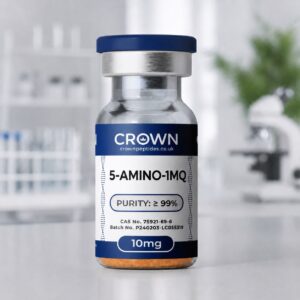
5-Amino-1MQ research compound UK 10mg and 50mg vial - Crown Peptides
≥99% PURITY
HPLC & MS TESTED
5-Amino-1MQ Research Compound
From: £24.99

Buy Now

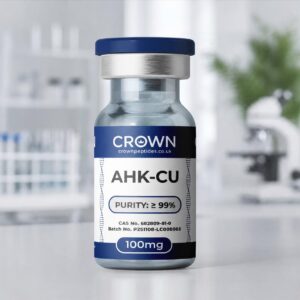
AHK-Cu 100mg research peptide vial – Crown Peptides UK
≥99% PURITY
HPLC & MS TESTED
AHK-Cu Research Peptide
From: £29.99

Buy Now

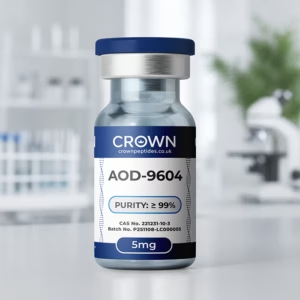
AOD-9604 5mg research peptide vial - Crown Peptides
≥99% PURITY
HPLC & MS TESTED
AOD-9604 Research Peptide
From: £34.99

Buy Now

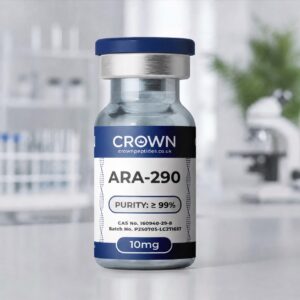
ARA-290 research peptide UK 10mg vial - Crown Peptides
≥99% PURITY
HPLC & MS TESTED
ARA-290 Research Peptide
From: £39.99

Buy Now

Further reading

SUPPORT Mon to Fri, 9am to 5pmDISPATCH Cut-off 2pmEMAIL info@crownpeptides.co.ukWHATSAPP +44 7301 802654

Disclaimer: All products are sold strictly for laboratory research purposes only. Not for human or veterinary use, consumption, therapeutic, or diagnostic application. None of our products are medicines, and none are presented as such. By purchasing, you confirm you are a qualified professional and legally permitted to handle these materials in compliance with all applicable laws and regulations. Misuse, resale for unauthorised purposes, or unlawful application is strictly prohibited. Crown Peptides UK disclaims all liability for improper use, handling, or regulatory non-compliance.

© 2026 Crown Peptides UK, a trading name of Crown Peptides Ltd (company no. 17068950), Suite Ra01, 195-197 Wood Street, London E17 3NU . All Rights Reserved.