Research Peptides
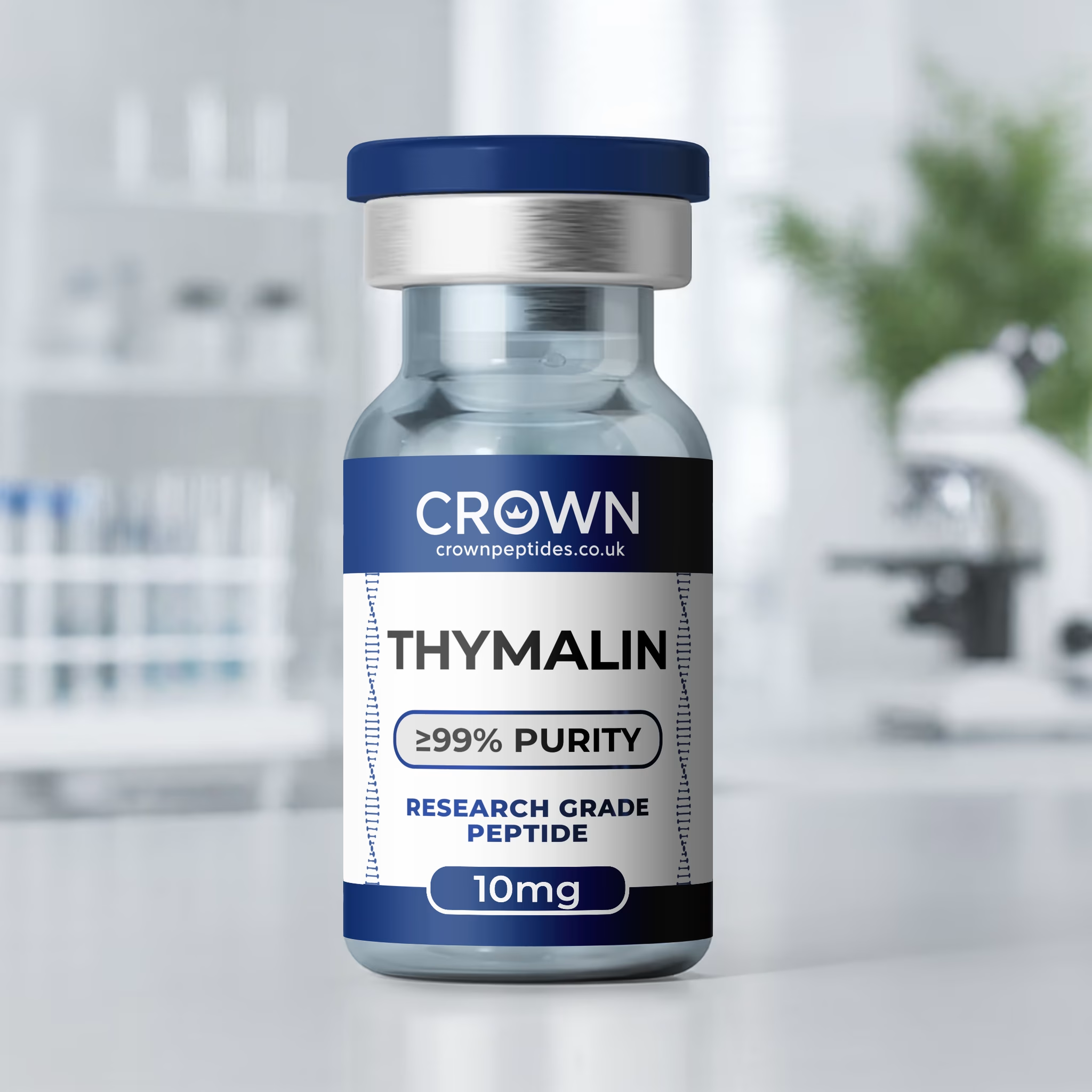
A high-purity research peptide studied in thymus bioregulator, T-cell differentiation and cytokine research. Coming soon in 10mg, with every batch independently tested and dispatched from the UK.
Thymalin peptide UK is Crown Peptides’ thymus-derived bioregulator research compound, coming soon in 10mg for laboratory research.
Supplied for laboratory research purposes only — not for human consumption or for medical, veterinary or diagnostic use.
Thymalin is the name given to a thymus bioregulator first developed in St Petersburg in the 1970s by the research group of Vladimir Khavinson. It belongs to the same family of tissue-specific bioregulator peptides as Epitalon, Pinealon and Cartalax, and it is studied in immune research alongside compounds such as Thymosin Alpha-1.
The name needs a word of explanation, because it is used for more than one material. The original Thymalin is a polypeptide complex extracted from calf thymus. Later work by the same group identified two short dipeptides, Lys-Glu (KE) and Glu-Trp (EW), as active components of that complex, and synthetic research products sold as “Thymalin” may be based on these rather than on a tissue extract. There is no single agreed reference structure, so the batch Certificate of Analysis is the document to check for the confirmed composition of the material in the vial.
Also known as: Thymalin peptide, Timalin, thymus peptide complex, thymic bioregulator
Thymalin was described in the Russian scientific literature in the early 1980s as a thymic polypeptide factor, studied in experimental models and in clinical settings in the Soviet Union. (Learn more) Much of the early literature is in Russian and was carried out by a small number of research groups, so it should be read with that context in mind. Related immune research compounds include KPV and LL-37.
From 1973 onwards, Khavinson’s group developed methods for extracting peptide complexes from different animal tissues and reported that each preparation tended to act on the tissue it came from. A 2002 review sets out this work, describing Thymalin, the thymic preparation, as most notable for its effects on immune function, and explaining how the group later designed short synthetic peptides, including thymus-specific dipeptides, based on the amino acid composition of the extracts. (Learn more)
The group also used antibodies to look for Thymalin-like material in human tissue. A 2002 study reported it in human epidermis and in the fetal thymus reticuloepithelium, two structures that develop from the same embryonic layer. In adults it was found only in young epidermal cells, and by around 70 years of age the layer of Thymalin-containing cells appeared thinned and discontinuous, which the authors read as an age-related decline in this thymic factor. (Learn more)
In 2020, the group studied Thymalin’s effect on human haematopoietic stem cells in culture. They reported that it reduced the expression of the stem cell marker CD44 and the intermediate-stage marker CD117 by two to three times, and raised expression of CD28, a marker of mature T lymphocytes, by 6.8 times, which they interpreted as stimulation of differentiation towards mature T cells. (Learn more)
A 2023 study described KE and EW as active substances of Thymalin and combined computer modelling with cell experiments. Docking simulations suggested that each dipeptide prefers particular short DNA sequences, and database analysis pointed to genes linked to inflammatory signalling. In human peripheral blood mononuclear cells stimulated with bacterial lipopolysaccharide, Thymalin and both dipeptides reduced production of the cytokines IL-1β, IL-6 and TNFα by 1.4 to 6.0 times. (Learn more)
A 2022 collaboration between Italian researchers and the St Petersburg group tested five bioregulators, including the Thymalin peptide complex and the EW dipeptide (sold under the name Thymogen), on the human monocyte cell line THP-1. All five altered signalling linked to cell proliferation and reduced TNF and IL-6 release from differentiated cells stimulated with lipopolysaccharide, and the treated cells adhered less to activated endothelial cells. (Learn more)
A 2013 Russian study compared Thymalin with another tissue-derived peptide preparation in experimental animals and in blood cell cultures. Both preparations stimulated humoral and cellular immune responses in animals and increased production of both pro-inflammatory and anti-inflammatory cytokines in intact blood cells, showing that the direction of cytokine effects depends on the cell state and model used. (Learn more)
Taken together, Thymalin is a long-studied bioregulator with a large but mostly older and regional literature, newer cell work pointing to its KE and EW dipeptides, and an identity that depends on which material a given product contains, which is why composition should always be confirmed batch by batch.
Compound-level reference data. Batch-specific results appear on the Certificate of Analysis.
Work out concentration with the peptide calculatorCrown Peptides Thymalin will be supplied with batch-specific quality documentation appropriate to the material. Because the name Thymalin has been used both for a thymus-derived peptide complex and for synthetic material based on its KE and EW dipeptides, identity matters as much as purity: HPLC shows how clean a batch is, while mass spectrometry shows which molecules are actually present. The Certificate of Analysis should be used as the definitive source for identity, assay, purity and relevant impurity information.
Thymalin is a thymus bioregulator first developed in St Petersburg in the 1970s. The original preparation is a polypeptide complex extracted from calf thymus, and later research identified the dipeptides KE and EW as active components. It is used in laboratory research on T-cell differentiation and cytokine signalling.
Because the name has been applied to different materials. Some descriptions refer to the original thymus extract, a mixture of many peptides, while others describe synthetic material based on the KE and EW dipeptides. There is no single CAS number or structure covering all of these, which is why batch mass spectrometry is the most useful document for this product.
KE is lysine joined to glutamic acid, and EW is glutamic acid joined to tryptophan. A 2023 study described both as active substances of Thymalin. EW on its own has also been studied under the name Thymogen. As two-amino-acid peptides they are among the smallest bioactive peptides researched.
Both are linked to the thymus, but they are different molecules. Thymosin Alpha-1 is a single defined peptide of 28 amino acids, originally isolated from a thymus fraction called thymosin fraction 5. Thymalin is a bioregulator preparation from a separate Russian research tradition, with a different composition and literature.
It is the term Khavinson’s group uses for short peptides and peptide complexes that they report act on the tissue they were derived from. Thymalin is the thymic example. Pinealon, Cartalax and Epitalon are other members of the same family, each linked to a different tissue.
The St Petersburg group reported Thymalin-like material, detected with antibodies, in human epidermis and fetal thymus tissue, and found the layer of cells containing it thinned with age. Those findings come from a single group’s immunostaining work, so they describe a reported tissue factor rather than a fully characterised human hormone.
Relatively little. Most of the several hundred indexed papers are older Russian-language publications, many of them clinical reports from the Soviet period. The more recent cell and molecular studies, including the 2020, 2022 and 2023 work described on this page, are available in English.
In a 2020 study on human haematopoietic stem cells, Thymalin lowered the stem cell marker CD44 and the intermediate marker CD117 by two to three times and raised the mature T-cell marker CD28 by 6.8 times. The authors interpreted this as stimulating differentiation of stem cells towards mature T lymphocytes.
In human blood mononuclear cells stimulated with bacterial lipopolysaccharide, Thymalin and its KE and EW dipeptides lowered IL-1β, IL-6 and TNFα production by 1.4 to 6.0 times in a 2023 study. A 2022 study on THP-1 monocytes found reduced TNF and IL-6 release under similar conditions.
Yes, though often in collaboration with the original group. The 2022 THP-1 study was led by researchers at the University of Chieti in Italy, and a 2013 study from Vladivostok compared Thymalin with a squid-derived peptide preparation in animals and blood cells. Independent replication remains limited.
Because the starting conditions differ. In cells stimulated to produce an inflammatory response, studies reported reduced inflammatory cytokines, while in unstimulated blood cells a 2013 study reported increases in both pro-inflammatory and anti-inflammatory cytokines. The model, cell state and material used all shape the result.
Thymalin is not a controlled drug under the Misuse of Drugs Act 1971, and it is not a licensed medicine in the UK. It is sold in the UK as a research compound for laboratory use only, which is how Crown Peptides supplies it. This is general information, not legal advice.
Thymalin is coming soon to Crown Peptides in 10mg vials, available singly or in packs of 3, 5 or 10 with a saving on every vial. Orders ship from the UK, and every batch is independently tested, with its Certificate of Analysis published on this page once stock arrives.
That depends on the confirmed composition. If the material is the EW dipeptide, about 333 daltons, 10mg is roughly 30 micromoles; for the KE dipeptide, about 275 daltons, it is roughly 36 micromoles. A peptide complex has no single molecular weight, so use the mass and composition on your batch’s Certificate of Analysis for exact calculations.
Keep the unreconstituted powder at -20°C ± 5°C, dry and away from light. Material containing the EW dipeptide includes tryptophan, an amino acid that is sensitive to light and oxidation, so vials are best kept sealed and dark until use. Prepared solutions should follow storage conditions validated for your study design, and each batch’s Certificate of Analysis documents the material as dispatched.
Every batch is published openly — identity, purity and batch number, with no account needed.
Supplied for laboratory research purposes only — not for human consumption or for medical, veterinary or diagnostic use.
Each batch undergoes internal analytical verification using chromatographic and spectrometric methods prior to lyophilisation.
• HPLC Analysis
• Mass Spectrometry Confirmation
• Batch Traceability
By purchasing this product you confirm that you are a qualified researcher and that this compound will be used exclusively for laboratory research purposes.
This product is not intended for diagnostic or therapeutic use.
Any human or medical use is strictly prohibited.
Store in a cool, dry, secure and sterile environment away from any unauthorised persons or children.
Disclaimer: All products are sold strictly for laboratory research purposes only. Not for human or veterinary use, consumption, therapeutic, or diagnostic application. None of our products are medicines, and none are presented as such. By purchasing, you confirm you are a qualified professional and legally permitted to handle these materials in compliance with all applicable laws and regulations. Misuse, resale for unauthorised purposes, or unlawful application is strictly prohibited. Crown Peptides UK disclaims all liability for improper use, handling, or regulatory non-compliance.