Research Peptides
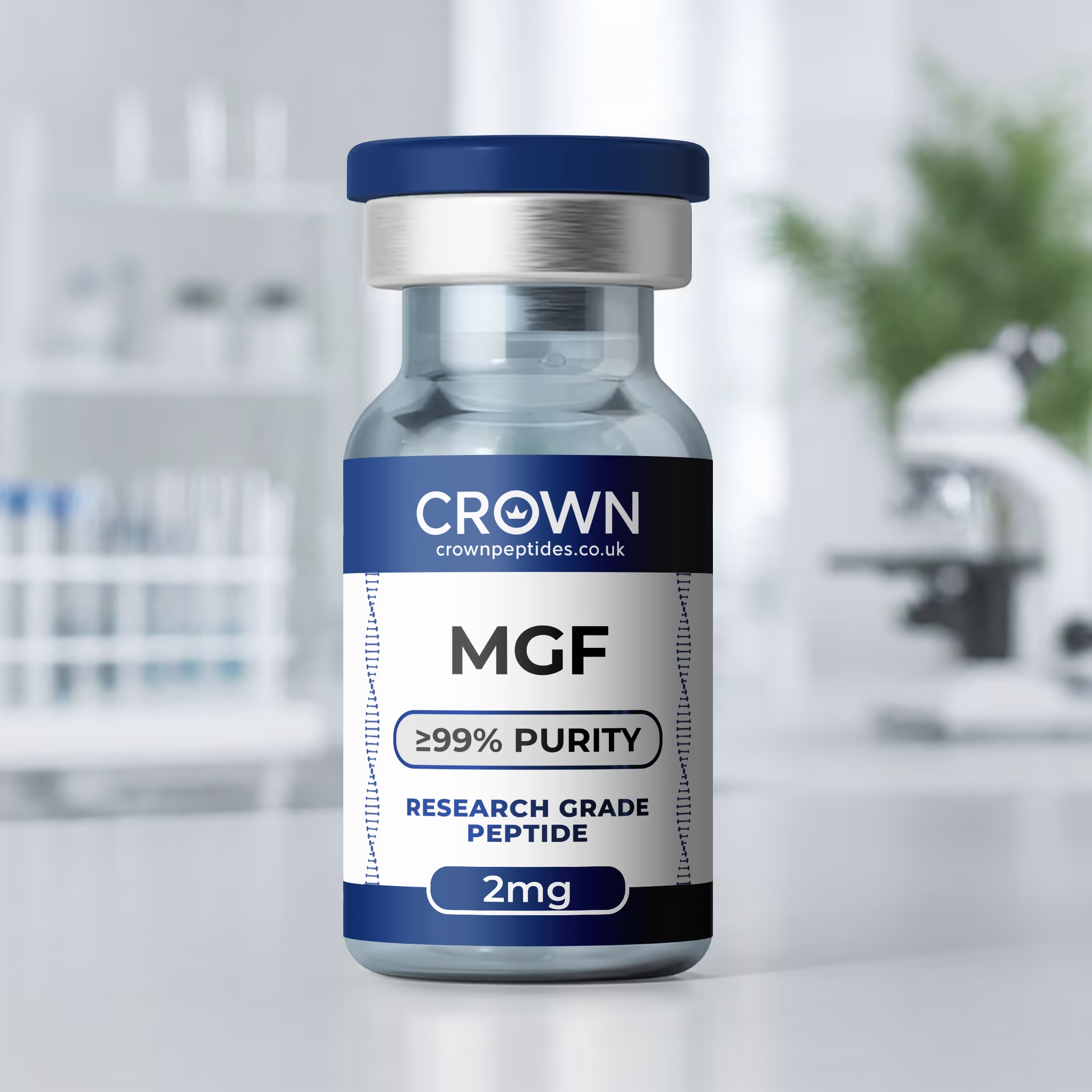
A high-purity research peptide studied in IGF-1 splicing, muscle satellite cell and tissue repair research. Coming soon in 2mg, with every batch independently tested and dispatched from the UK.
MGF peptide UK is Crown Peptides’ synthetic 24-residue E-domain peptide of the IGF-1Ec splice variant, coming soon in 2mg for laboratory research.
Supplied for laboratory research purposes only — not for human consumption or for medical, veterinary or diagnostic use.
MGF, short for mechano growth factor, is the name given to a splice variant of the IGF-1 gene and, in the laboratory, to a synthetic peptide made from the unique tail end of that variant. Most IGF-1 research, including work with the long-acting analogue IGF-1 LR3, focuses on the 70-amino-acid mature hormone. MGF is different: it is the 24-residue C-terminal stretch of the E domain, the extension that is normally cut away from the IGF-1 precursor. It sits in the tissue biology research area alongside TB-500 and BPC-157.
The IGF-1 gene can be spliced in more than one way. The common form, IGF-1Ea, is the main source of circulating IGF-1. A second form contains an extra stretch of genetic code, 49 base pairs in humans and 52 in rodents, which shifts the reading frame and gives the E domain a completely different ending. This form is called IGF-1Ec in humans and IGF-1Eb in rodents, and it was the one Geoffrey Goldspink’s group in London found switched on in stretched muscle. The peptide normally sold as MGF corresponds to the last 24 residues of the human IGF-1Ec E domain, Tyr-Gln-Pro-Pro-Ser-Thr-Asn-Lys-Asn-Thr-Lys-Ser-Gln-Arg-Arg-Lys-Gly-Ser-Thr-Phe-Glu-Glu-Arg-Lys. Supplier listings are not fully consistent, though: many give a version ending Glu-Glu-His-Lys with an amidated end, and the rodent sequences differ at several positions.
Also known as: mechano growth factor, mechano-growth factor, MGF E-peptide, MGF-Ct24E, MGF-24aa-E, IGF-1Ec E-peptide, IGF-1Eb E-peptide (rodent)
MGF research began with gene-expression work in muscle in the mid-1990s and widened into studies of synthetic E-domain peptides on muscle, nerve, heart, bone and tendon cells. A 2010 review in Endocrinology sets out the field and its open questions, including that no free E-domain peptide had then been found in tissue. (Learn more) In 2017 an Athens group reported detecting the Ec peptide alongside its precursor in human and rodent muscle, liver and heart. (Learn more) Related growth-axis compounds include Tesamorelin and CJC-1295 with DAC.
In 1996 the Goldspink group extracted RNA from rabbit muscle made to grow rapidly by active stretch. Resting muscle produced only the familiar IGF-1Ea form, but stretched muscle also produced a second isoform whose E domain carried a 52-base-pair insert that changed the reading frame. The equivalent human variant, the Ec form, appeared in muscle within hours to days of altered activity and was barely detectable without it. (Learn more)
In 2003 the same group measured both splice variants in rat tibialis anterior muscle after damage caused either by electrical stimulation of stretched muscle or by injection of bupivacaine. The MGF transcript rose quickly and fell back within a few days, while IGF-1Ea rose more slowly as MGF declined. The timing of the satellite cell markers M-cadherin and MyoD led the authors to propose that the early MGF pulse activates satellite cells, the muscle’s resident stem cells, and that later splicing towards IGF-1Ea supplies mature IGF-1 for the repair itself. (Learn more)
The next question was whether the E domain did anything on its own. In 2002, in C2C12 myoblast cultures, a synthetic MGF E-domain peptide increased proliferation and held back terminal differentiation, the opposite pattern to mature IGF-1. Blocking the IGF-1 receptor with an antibody suggested the E domain acted through a different receptor. (Learn more) In 2007 a Canadian group found that the 24-residue peptide, which they called MGF-Ct24E, increased migration of human myogenic precursor cells in culture and after transplantation, raising u-PA, u-PAR and MMP-7 while lowering PAI-1 activity. (Learn more) In 2011, in primary satellite cell cultures from human muscle of different ages, the same 24-residue peptide lengthened proliferative life span and delayed senescence in cells from neonatal and young adult donors, and increased fusion in all cultures. (Learn more)
In 2005 a Polish and British team tested the synthetic C-terminal MGF peptide in a gerbil model of transient brain ischaemia, where it gave significant protection to vulnerable hippocampal neurons. In hippocampal slice cultures it was as potent as full-length IGF-1 and its effect lasted longer. The protection did not depend on the IGF-1 receptor. (Learn more)
In rat H9c2 heart cells, a synthetic MGF E-domain peptide was rapidly taken up without activating the IGF-1 receptor, moved to the nucleus, and protected cells against stress-induced apoptosis by preserving mitochondrial membrane potential and preventing caspase-3 activation. In mice given the peptide at the time of a myocardial infarction, the authors reported better-preserved contractility after two weeks, less pathological hypertrophy and fewer apoptotic nuclei. (Learn more)
Not every laboratory has reproduced these results. In 2012 a Pennsylvania group found that synthetic rodent E-peptides increased MAPK signalling and myoblast proliferation and migration, but that these effects were blocked when the IGF-1 receptor was inhibited, suggesting the E-peptides work by modulating IGF-1 signalling rather than independently. (Learn more) In 2014, scientists at two pharmaceutical companies tested MGF peptides at up to 500 nanograms per millilitre on C2C12 cells, primary human myoblasts and primary mouse muscle stem cells and saw no effect on proliferation or differentiation, while mature IGF-1 and full-length IGF-1Eb worked as expected. Neither the native nor a stabilised MGF peptide activated ERK in cardiac myocytes. (Learn more)
Taken together, MGF is a well-studied but still debated research tool: a defined 24-residue peptide with a clear origin in IGF-1 gene splicing, published data across muscle, nerve and heart models, and a live question about whether it acts alone or through the IGF-1 system.
Compound-level reference data. Batch-specific results appear on the Certificate of Analysis.
Work out concentration with the peptide calculatorCrown Peptides MGF will be supplied with batch-specific quality documentation appropriate to the material. Because suppliers describe more than one version of the 24-residue sequence, identity matters as much as purity: HPLC shows how clean a batch is, while mass spectrometry confirms which sequence is in the vial. The human IGF-1Ec reference sequence ending in arginine-lysine and the common variant ending in histidine-lysine differ by about 19 daltons, and an amidated end changes the mass by about one dalton more, so the measured mass tells researchers exactly which form they hold. The Certificate of Analysis should be used as the definitive source for identity, assay, purity and relevant impurity information.
Researchers working with MGF may also be interested in IGF-1 LR3, TB-500, BPC-157, GHK-Cu, MOTS-c, Sermorelin and Ipamorelin — other compounds studied in tissue repair, muscle biology and growth-axis research.
MGF, or mechano growth factor, is a synthetic research peptide of 24 amino acids taken from the end of the E domain of IGF-1Ec, a splice variant of the IGF-1 gene. It does not contain the mature IGF-1 hormone itself. It is used in research on how muscle, nerve and heart cells respond to load and damage.
The name comes from the 1996 discovery that this IGF-1 splice variant appeared in rabbit muscle subjected to stretch, but was barely detectable in resting muscle. Because mechanical signals seemed to switch it on, the Goldspink group called it mechano growth factor. The name was later carried over to the synthetic E-domain peptide.
IGF-1 is made as a longer precursor. The 70-residue mature hormone is followed by an extension called the E domain, which is normally cut off before the hormone is released. Different splicing of the gene produces different E domains, named Ea, Eb and Ec. MGF is built from the distinctive end of the human Ec version, not from the hormone.
Most published work and most suppliers use the last 24 residues of the human IGF-1Ec E domain. UniProt gives these as YQPPSTNKNTKSQRRKGSTFEERK. Many retail listings instead end in ...EEHK, often with an amidated end, and rodent IGF-1Eb sequences differ at several positions. The batch mass spectrometry result shows which version a vial contains.
They come from opposite ends of the same precursor. IGF-1 LR3 is an 83-residue analogue of the mature hormone, designed to bind its receptor while avoiding IGF binding proteins. MGF is the 24-residue E-domain tail and contains none of the hormone sequence, so it is studied for actions separate from, or alongside, the hormone.
MGF is the unmodified 24-residue peptide and is the form used in nearly all published E-domain studies. PEG-MGF is the same peptide with a polyethylene glycol chain attached, a modification usually intended to slow breakdown and clearance.
Yes. The World Anti-Doping Agency’s 2026 Prohibited List names “Mechano growth factors (MGFs)” under section S2, peptide hormones, growth factors, related substances and mimetics, as substances prohibited at all times.
After muscle damage, the MGF transcript rose rapidly and fell back within a few days, while IGF-1Ea rose more slowly as MGF declined. Satellite cell markers peaked before IGF-1Ea did. The authors read this as MGF starting the repair process by activating stem cells, with IGF-1Ea following to support the rebuilding phase.
This is the central open question. Studies in myoblasts, neurons and heart cells reported effects that appeared not to involve the IGF-1 receptor. A 2012 study with rodent E-peptides found the opposite: their effects on signalling, proliferation and migration needed the receptor, and the peptides increased the receptor’s availability at the cell surface.
It was a careful attempt to reproduce earlier findings using several cell types. MGF peptides up to 500 nanograms per millilitre did not increase proliferation or delay differentiation of mouse or human myoblasts, or of primary mouse muscle stem cells, while mature IGF-1 did. It is the main published negative result.
Yes. In a 2011 study the 24-residue peptide lengthened the proliferative life span of primary satellite cells from neonatal and young adult human muscle, though not from older adult muscle, and increased cell fusion at every age tested.
MGF is not a controlled drug under the Misuse of Drugs Act 1971; the Class C list of polypeptide hormones covers somatropin, somatrem, somatotropin and chorionic gonadotrophins, not IGF-1 fragments. There is no licensed medicine containing MGF in the UK. It is sold as a research compound for laboratory use only, which is how Crown Peptides supplies it. This is general information, not legal advice.
MGF is coming soon to Crown Peptides in 2mg vials, available singly or in packs of 3, 5 or 10 with a saving on every vial. Orders ship from the UK, and every batch is independently tested, with its Certificate of Analysis published on this page once stock arrives.
Two milligrams of a peptide of about 2,868 daltons is roughly 0.7 micromoles. At 500 nanograms per millilitre, the highest concentration used in the 2014 myoblast study, 2mg would make about four litres of culture medium. The 5 and 10-vial packs keep a longer project on a single batch.
Keep the unreconstituted powder at -20°C ± 5°C, dry and away from light. The sequence carries six lysines and arginines, so the peptide is strongly positively charged and can stick to glass and some plastics in dilute solution, and its two asparagines can slowly deamidate once dissolved. Prepared solutions should follow conditions validated for your study design.
Every batch is published openly — identity, purity and batch number, with no account needed.
Supplied for laboratory research purposes only — not for human consumption or for medical, veterinary or diagnostic use.
Each batch undergoes internal analytical verification using chromatographic and spectrometric methods prior to lyophilisation.
• HPLC Analysis
• Mass Spectrometry Confirmation
• Batch Traceability
By purchasing this product you confirm that you are a qualified researcher and that this compound will be used exclusively for laboratory research purposes.
This product is not intended for diagnostic or therapeutic use.
Any human or medical use is strictly prohibited.
Store in a cool, dry, secure and sterile environment away from any unauthorised persons or children.
Disclaimer: All products are sold strictly for laboratory research purposes only. Not for human or veterinary use, consumption, therapeutic, or diagnostic application. None of our products are medicines, and none are presented as such. By purchasing, you confirm you are a qualified professional and legally permitted to handle these materials in compliance with all applicable laws and regulations. Misuse, resale for unauthorised purposes, or unlawful application is strictly prohibited. Crown Peptides UK disclaims all liability for improper use, handling, or regulatory non-compliance.