Research Peptides
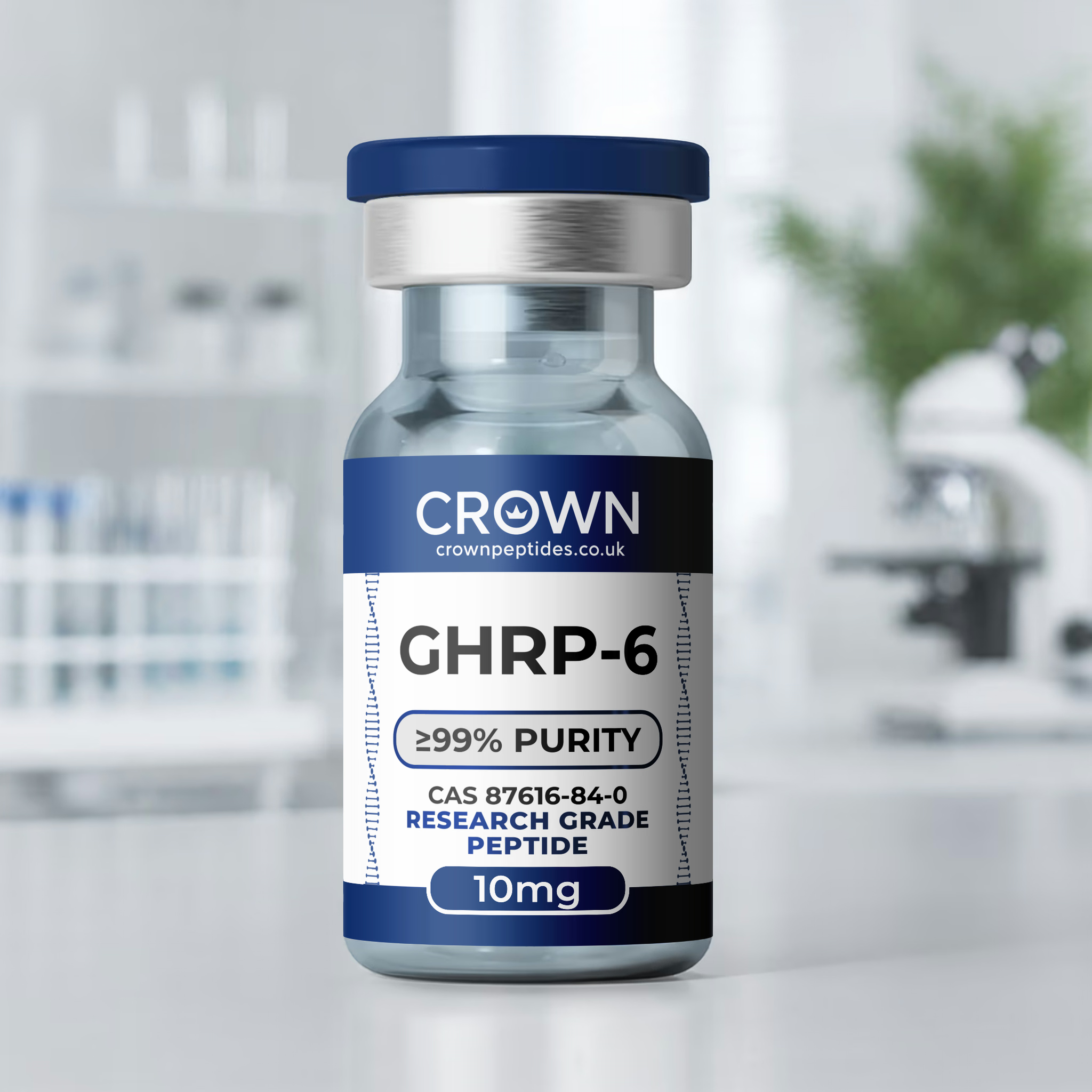
A high-purity research peptide studied in growth-hormone and appetite research. Available in 10mg, with every batch independently tested and dispatched from the UK.
GHRP-6 peptide UK is Crown Peptides' synthetic hexapeptide growth-hormone secretagogue, available in 10mg strength for laboratory research.
Supplied for laboratory research purposes only — not for human consumption or for medical, veterinary or diagnostic use.
GHRP-6 is a synthetic six-amino-acid peptide and one of the classic growth-hormone-releasing peptides. Its research activity is associated primarily with the growth-hormone secretagogue receptor, also known as the ghrelin receptor or GHSR.
Also known as: GHRP 6, GHRP6, growth hormone-releasing peptide-6, SKF-110679.
GHRP-6 is studied in endocrine and receptor-pharmacology models involving GHSR activation, pituitary growth-hormone release and appetite-associated signalling. It is historically important in growth-hormone secretagogue research because it helped demonstrate that ghrelin-receptor pathways can regulate pituitary signalling independently of the GHRH receptor (Learn more), alongside related secretagogue peptides such as Ipamorelin and CJC-1295 with DAC.
GHRP-6 was designed long before anyone knew what it was imitating. In the late 1970s, Cyril Bowers’ laboratory at Tulane University in New Orleans noticed that two altered versions of methionine enkephalin amide, one of the brain’s own opioid peptides, with D-tryptophan or D-phenylalanine at position two, weakly released growth hormone from rat pituitary tissue. Working with Frank Momany, who used conformational energy calculations to predict which shapes should be active, the team cycled through design, synthesis and testing. By 1981 a pentapeptide, Tyr-D-Trp-Ala-Trp-D-Phe-NH2, was about a thousand times more active than the enkephalin starting points.
The 1984 Endocrinology paper that introduced His-D-Trp-Ala-Trp-D-Phe-Lys-NH2, then labelled [His1,Lys6]GHRP, described a peptide that released growth hormone without shifting LH, FSH, TSH or prolactin. It was active in rats, monkeys, lambs and calves, and in chicks under special conditions, so it showed little species dependence. Despite its opioid ancestry, later work established that it acted through non-opiate receptors, an early hint that an undiscovered signalling system lay behind it.
For more than a decade, GHRP-6 and its successors released growth hormone through a target nobody could name. Bowers’ group detected specific binding sites in pig pituitary and hypothalamic membranes, but the receptor itself stayed elusive until a Merck team led by Andrew Howard isolated it. Using the company’s non-peptide secretagogue MK-0677 to pick it out, they cloned a G-protein-coupled receptor from the pituitary and the arcuate and infundibular hypothalamus of pigs and humans, and wrote in Science that the synthetic secretagogues seemed to be mimicking a hormone yet to be identified.
That hormone turned up in an unexpected organ. Masayasu Kojima, Kenji Kangawa and colleagues purified it from rat stomach and called it ghrelin, after ghre, the Proto-Indo-European root of “grow”. It is a 28-residue peptide carrying an octanoyl fatty-acid chain on serine 3, and that modification is essential for activity. GHRP-6 therefore belongs to a rare group of compounds designed against a pathway almost two decades before its natural messenger came to light.
GHRP-6 was among the first tools to show that the secretagogue receptor reaches into brain circuits for feeding. Suzanne Dickson, Gareth Leng and Iain Robinson reported that systemic GHRP-6 switched on Fos, a marker of recent neuronal activity, in a subpopulation of rat hypothalamic neurons, and increased the firing of arcuate nucleus cells thought to make GHRH. Two years later, a study in sated adult rats found that GHRP-6 delivered into the brain’s ventricles triggered eating in a dose-related way while plasma growth hormone showed no matching change, suggesting the feeding effect ran on a separate track from GH release.
Ghrelin’s discovery later made sense of those results, and GHRP-6 is still in use as a probe. In a recent mouse study from Dickson’s group, intranasal GHRP-6 increased both meal frequency and meal size and activated arcuate neurons, about four in five of which expressed AgRP, a peptide made by the neurons that drive feeding. All of this is rodent work, and that is exactly where GHRP-6 earns its place as a feeding-circuit tool.
A separate strand of GHRP-6 research has little to do with growth hormone. A group at the Center for Genetic Engineering and Biotechnology in Havana has spent years asking whether the peptide shields tissue from lethal stress. Their best-known experiment used Cuban Creole pigs with a coronary artery closed for an hour and then reopened. Compared with saline, GHRP-6 reduced infarct mass by 78% and infarct thickness by half, more than half of the treated pigs showed no pathological Q waves on ECG, and oxidative stress markers pointed to fewer reactive oxygen species as part of the mechanism.
The same themes recur in other models. In rats subjected to hepatic ischaemia and reperfusion, pretreatment curbed liver and intestinal damage, neutrophil infiltration and lipid peroxidation, and in cultured intestinal epithelial cells GHRP-6 tripled the migration rate without changing proliferation. Newer rat studies have examined doxorubicin-induced heart damage and permanent coronary ligation. A review from the Havana team proposes that part of this protection runs through CD36, a second binding site, which switches on PI-3K/AKT1 survival signalling.
Compound-level reference data. Batch-specific results appear on the Certificate of Analysis.
Work out concentration with the peptide calculatorCrown Peptides GHRP-6 is supplied for controlled laboratory research with batch-specific analytical documentation. High-Performance Liquid Chromatography (HPLC) can assess chromatographic purity, while Mass Spectrometry provides molecular information used to support identity verification.
The batch-specific Certificate of Analysis is the definitive source for the exact purity result, identity data and analytical specification of the material supplied.
Researchers working with GHRP-6 may also be interested in Ipamorelin, CJC-1295 with DAC, CJC-1295 + Ipamorelin, Sermorelin and Tesamorelin — other growth-hormone-releasing peptides studied in the same endocrine research pathway.
GHRP-6 is the original hexapeptide growth-hormone secretagogue, His-D-Trp-Ala-Trp-D-Phe-Lys-NH2, with the formula C46H56N12O6, weighing in at about 873 g/mol. Each vial sold here contains 10mg. You will also find it spelled GHRP 6 or GHRP6, and some older literature uses the code SKF-110679.
Cyril Bowers, an endocrinologist at Tulane University, working with the computational chemist Frank Momany. Their designs grew out of enkephalin analogues refined over several rounds of modelling and testing, and the hexapeptide was formally introduced in Endocrinology in 1984. Bowers’ group later took GHRP-1 and GHRP-2 into human studies as well.
Not in how it acts, even though it descends from one. The design work began with methionine enkephalin analogues, but GHRP-6 releases growth hormone through non-opiate receptors in rats. Combining it with the opioid peptide dermorphin produced a synergistic growth-hormone release, evidence that the two travel by separate routes. Papers that call it opioid-related are describing its origins.
An orphan receptor is one whose natural messenger is unknown. When Merck scientists cloned the secretagogue receptor in 1996, only synthetic compounds such as GHRP-6 and MK-0677 were known to activate it. The gap closed in 1999, once ghrelin had been purified from rat stomach and shown to be the receptor’s own hormone.
Largely, it seems. When University of Michigan researchers gave healthy men a GHRH-receptor blocker first, the growth-hormone response to GHRP-6 fell by around four-fifths. An earlier study from the same centre found GHRP-6 still worked after the pituitary had been desensitised to GHRH, so it does not act by releasing GHRH; it needs GHRH present to reach its full effect.
Close to it, but not entirely. The 1984 study saw no change in LH, FSH, TSH or prolactin in rat and in vitro tests. In healthy men, Bowers and Michael Thorner’s team found prolactin and cortisol roughly doubled, though only at the highest amount tested, while LH and TSH held steady through the first hour.
It made them larger rather than more frequent. In nine healthy young men, continuous infusion roughly doubled the integrated growth-hormone concentration and raised average pulse amplitude, while pulse frequency did not change and IGF-I rose. That pattern fits GHRP-6 amplifying pulses already present instead of imposing a new rhythm.
It engages the same hypothalamic circuits as ghrelin, and it was doing so years before ghrelin was found. In sated rats, GHRP-6 placed into the brain ventricles started eating, and more peptide meant more eating, without a matching change in growth hormone, which makes it handy for separating appetite signalling from pituitary effects.
Mainly neurons of the arcuate nucleus. In the recent intranasal study, around 79% of activated arcuate cells contained AgRP messenger RNA, about 64% carried the ghrelin-receptor gene and roughly 11% made GHRH, so both the feeding and growth-hormone arms of the circuit were engaged.
It fell sharply. In a model of one-hour coronary occlusion followed by three days of reperfusion, pigs treated with GHRP-6 had infarcts with 78% less mass and half the thickness of saline controls, together with lower CK-MB and CRP. The peptide did not change deaths from rhythm disturbances during the ischaemia itself.
The Havana group has repeatedly tested the two as a pair. In rat liver ischaemia, adding epidermal growth factor strengthened GHRP-6’s protective effect. In autoimmune encephalitis models in rats and mice, only the combination lowered clinical scores, and in a mouse axonopathy model the single peptides barely sped recovery while the pair improved behaviour and nerve conduction.
Twelve nitrogen atoms give it plenty of places to hold a charge, and the histidine ring, the lysine side chain and the free N-terminus are all basic. Alongside [M+H]+ near m/z 873.4, electrospray spectra therefore often show [M+2H]2+ near 437.2 and sometimes [M+3H]3+ near 291.8, all from a monoisotopic mass of about 872.44 Da.
The two work on different receptors. GHRP-6 binds the ghrelin receptor, and in the original rat work it produced a growth-hormone rise within two minutes that peaked at 10 to 20 minutes and was usually gone by two hours. GHRH analogues act through the GHRH receptor instead, and CJC-1295 with DAC is engineered to last for days by binding to albumin.
Every vial holds the same 10mg fill, so the decision is really about batches. Feeding experiments are often run in several cohorts weeks apart, and drawing them all from one production lot keeps batch differences out of the comparison. The five-vial pack makes that straightforward, and noting the batch number against each cohort makes later checks simple.
Every batch is published openly — identity, purity and batch number, with no account needed.
Supplied for laboratory research purposes only — not for human consumption or for medical, veterinary or diagnostic use.
Each batch undergoes internal analytical verification using chromatographic and spectrometric methods prior to lyophilisation.
• HPLC Analysis
• Mass Spectrometry Confirmation
• Batch Traceability
By purchasing this product you confirm that you are a qualified researcher and that this compound will be used exclusively for laboratory research purposes.
This product is not intended for diagnostic or therapeutic use.
Any human or medical use is strictly prohibited.
Store in a cool, dry, secure and sterile environment away from any unauthorised persons or children.
Disclaimer: All products are sold strictly for laboratory research purposes only. Not for human or veterinary use, consumption, therapeutic, or diagnostic application. None of our products are medicines, and none are presented as such. By purchasing, you confirm you are a qualified professional and legally permitted to handle these materials in compliance with all applicable laws and regulations. Misuse, resale for unauthorised purposes, or unlawful application is strictly prohibited. Crown Peptides UK disclaims all liability for improper use, handling, or regulatory non-compliance.