Research Peptides
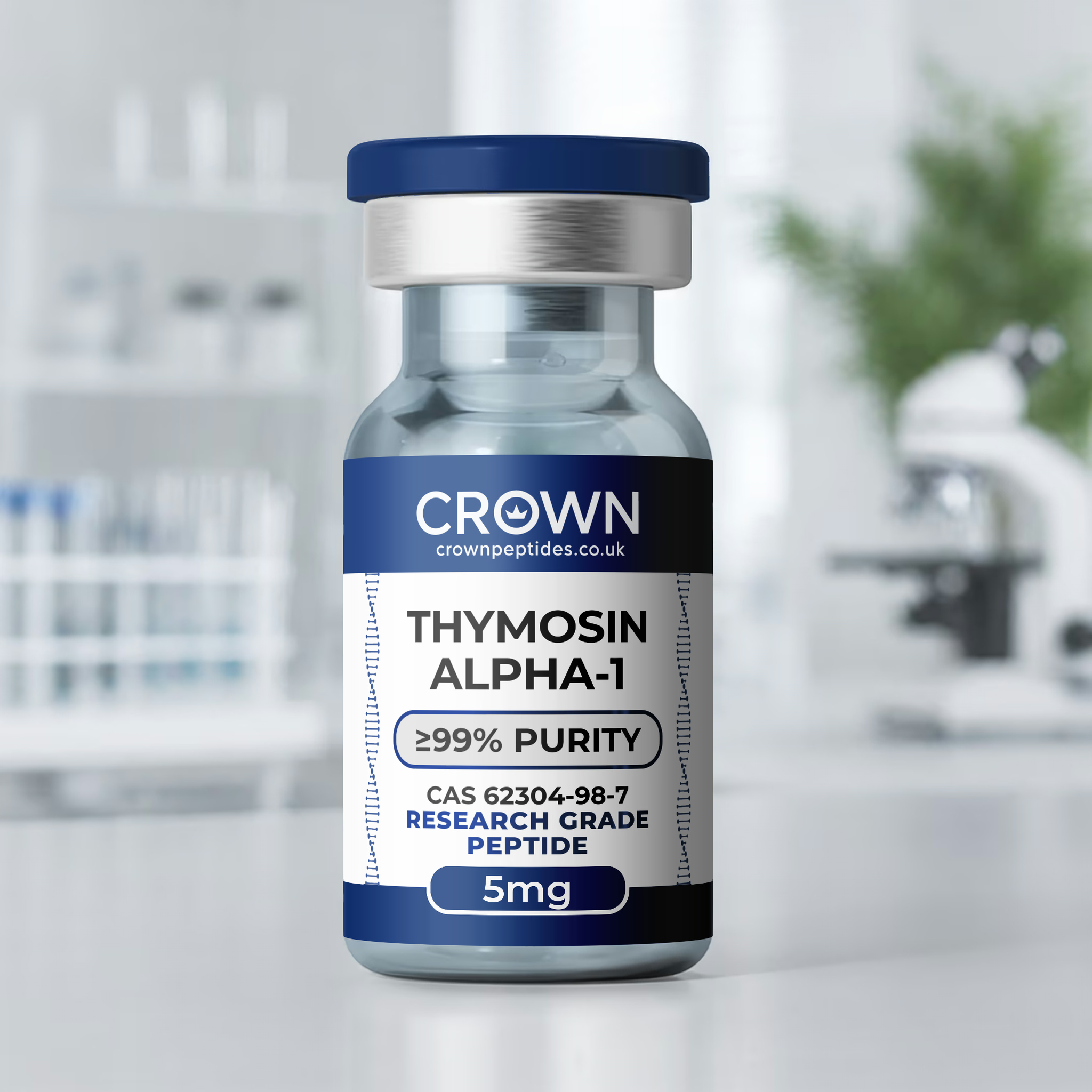
A high-purity research peptide studied in immune research. Available in 5mg and 10mg, with every batch independently tested and dispatched from the UK.
Thymosin Alpha-1 peptide UK is Crown Peptides' synthetic 28-amino-acid thymic peptide, supplied in 5mg and 10mg vials for laboratory research into T-cell maturation, dendritic-cell biology and immune signalling.
Supplied for laboratory research purposes only — not for human consumption or for medical, veterinary or diagnostic use.
Thymosin Alpha-1 is a 28-amino-acid peptide originally identified from thymic peptide preparations. It is widely used in immunology research because experimental work has linked it with T-cell function, dendritic-cell signalling and interactions between innate and adaptive immune pathways.
Also known as: Thymosin α1, Tα1, TA1, thymalfasin.
Thymosin Alpha-1 research includes T-cell maturation and activation, dendritic-cell biology, toll-like receptor pathways, cytokine signalling and immune responses to experimental infectious or inflammatory challenges, including documented activation of dendritic cells through toll-like-receptor signalling (Learn more). Its research profile is broader than simple immune stimulation, with studies examining how it can modulate different arms of immune signalling depending on context, alongside related host-defence and immune-research peptides such as LL-37 and KPV.
Thymosin Alpha-1 came out of a long hunt for the hormones of the thymus. In the mid-1960s the group of Klein, Goldstein and White prepared thymosin fraction 5 from calf thymus, a crude mixture of peptides between roughly 1 and 15 kDa. In 1977 Allan Goldstein’s team pulled one component out of that mixture, a heat-stable, highly acidic polypeptide of 28 residues, worked out its complete sequence and named it thymosin α1 (Learn more).
The “thymus” label turned out to be only part of the story. Thymosin Alpha-1 is the opening section of a bigger protein, prothymosin alpha, which is involved in chromatin remodelling and is made well beyond the thymus. The free peptide has been detected in the cytosol of a range of mammalian tissues, so researchers now treat it as a naturally occurring fragment with possible roles of its own, not just an artefact of the original extraction.
A large share of modern work focuses on dendritic cells, the sentinels that sample microbes and decide what kind of T-cell response follows. A widely cited study in the journal Blood used dendritic cells exposed to the mould Aspergillus fumigatus. Thymosin Alpha-1 drove those cells to mature and release interleukin-12, acting through the p38 MAP kinase and NF-κB pathways and relying on MyD88, the adaptor protein that most toll-like receptors signal through.
The animal results gave that cell work its weight. In mice, the synthetic peptide strengthened T-helper 1 antifungal immunity, accelerated the recovery of myeloid cells, and protected highly susceptible animals that had received haematopoietic transplants from aspergillosis. The authors framed it as a candidate adjuvant able to coordinate innate and adaptive responses, and dendritic-cell maturation assays remain a common entry point for new Thymosin Alpha-1 projects.
Thymalfasin is the generic drug name for synthetic Thymosin Alpha-1, and it is sold as Zadaxin by SciClone Pharmaceuticals. China approved it for hepatitis B in 1995, and it has since been registered in around three dozen countries, from Argentina to Vietnam, for uses that have included chronic hepatitis B and C and, in some markets, support for vaccine responses.
The picture in the US and UK is different. Thymalfasin has never been approved by the US Food and Drug Administration; it received an FDA orphan-drug designation in 2006 for stage IIb to IV malignant melanoma, but a designation is not an approval. Nor does it hold a UK marketing authorisation. The material Crown Peptides supplies shares the same sequence but is research-grade peptide made for laboratory work, and it is not Zadaxin.
Severe sepsis can leave the immune system depleted after the first inflammatory surge, so Thymosin Alpha-1 has long been examined in critical-care research. The biggest test so far, the TESTS trial, randomised 1,106 adults with sepsis across 22 hospitals in China between 2016 and 2020, and its results appeared in the BMJ in 2025 (Learn more).
The headline was clear. Death from any cause by day 28 occurred in 23.4% of the thymosin α1 group and 24.1% of the placebo group, a difference that was not statistically significant, and no secondary or safety outcome differed either. Pre-specified subgroups hinted that age and diabetes might change the response, findings that still need confirming. For laboratory scientists, the trial is a reminder that striking immune-cell data do not automatically carry through to the clinic, and it has sharpened interest in exactly which immune states the peptide modulates.
In plain water the peptide has no preferred shape: circular dichroism and NMR studies show it behaving as a flexible, disordered chain. Give it a membrane-like environment and it changes. With phospholipid vesicles, detergent micelles or zinc ions it becomes partly ordered, and in a mixture of water and trifluoroethanol an 800 MHz NMR study found a stable alpha-helix running from residue 14 to residue 26, with a twisted, turn-rich region across the first twelve.
A later study in sodium dodecyl sulphate micelles reported that the N-terminal end pushes into the micelle as the peptide folds, giving a helix with a break around residues 9 to 14. Because no single dedicated receptor has yet been identified, these membrane experiments are one of the main ways researchers picture how Thymosin Alpha-1 first meets a cell.
Compound-level reference data. Batch-specific results appear on the Certificate of Analysis.
Work out concentration with the peptide calculatorCrown Peptides Thymosin Alpha-1 is supplied for controlled laboratory research with batch-specific analytical documentation. High-Performance Liquid Chromatography (HPLC) can assess chromatographic purity, while Mass Spectrometry provides molecular information used to support identity verification. The batch-specific Certificate of Analysis is the definitive source for the exact purity result, identity data and analytical specification of the material supplied.
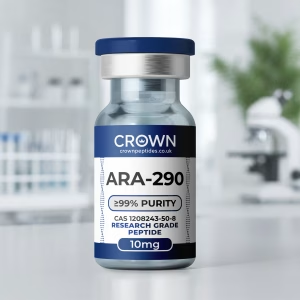
Researchers working with Thymosin Alpha-1 may also be interested in LL-37, KPV, TB-500, ARA-290 and Kisspeptin-10 — other immune and signalling-research peptides studied in related research areas.
Thymosin Alpha-1 is a 28-residue peptide whose first amino acid, serine, carries an acetyl cap, giving the formula C129H215N33O55 and a molecular weight of about 3,108.3 g/mol. It forms the N-terminal end of the protein prothymosin alpha. Papers write it as Thymosin α1, Tα1 or TA1, and thymalfasin is the medicine name for the same sequence.
Allan Goldstein and colleagues isolated and sequenced it in 1977, working from the calf-thymus fraction 5 that Goldstein had helped prepare with Abraham White in the previous decade. In the mid-1980s Milton Mutchnick at Wayne State University began the hepatitis B studies that eventually led to the medicine thymalfasin.
It is a charge label. When the peptides in thymosin fraction 5 were first sorted, they were grouped by isoelectric point: alpha thymosins below 5.0, beta thymosins up to 7.0 and gamma thymosins above that. Thymosin Alpha-1 landed in the alpha group because it is strongly acidic, and the “1” marks it as the first alpha peptide characterised.
Apart from the shared family name, very little connects them. Both were first purified from the same thymus extract, but they are unrelated in sequence, gene and function. Thymosin beta-4 is a 43-residue actin-binding protein studied in cell migration and is the basis of TB-500, while Thymosin Alpha-1 is an acidic 28-mer studied mainly in immune-cell signalling.
That final asparagine marks the cut site. In 2003 researchers showed that legumain, an enzyme found in lysosomes, cleaves prothymosin alpha between asparagine 28 and glycine 29, releasing Thymosin Alpha-1 as a free peptide. The same enzyme can also cut after asparagine 35 to make the longer thymosin α11, but Thymosin Alpha-1 is the main product found inside cells.
Same sequence, different product. Zadaxin is SciClone’s licensed thymalfasin medicine, approved in China and a few dozen other countries but never by the US FDA and not in the UK. Crown Peptides Thymosin Alpha-1 is research material made to the identical N-acetylated 28-residue sequence, with its own batch documentation, and is not a pharmaceutical product.
Because the outcome depends on the setting. In fungal and viral infection models it has pushed dendritic cells toward T-helper 1 responses, while other experimental studies describe anti-inflammatory effects. “Immunomodulatory” captures that two-directional profile far better than a simple on switch.
Early work centred on T-cell maturation, which fitted its thymus origin. Since the 2000s the spotlight has shifted to dendritic cells and their toll-like receptor signalling, with macrophages and other myeloid cells close behind. Many projects now track interleukin-12 output, maturation markers and the T-helper balance as their main readouts.
A 2017 Nature Medicine paper proposed it as a single-molecule approach to cystic fibrosis, reporting better maturation and function of the common F508del-CFTR protein. Three independent laboratories then failed to reproduce those results, and a 2019 Scientific Reports study found that bioactive Thymosin Alpha-1 did not influence F508del-CFTR maturation or activity, making it a well-known example of why replication matters.
Charge is the first big contrast, and mechanism the second. LL-37 is a 37-residue, positively charged cathelicidin that can act directly on microbial membranes. Thymosin Alpha-1 is negatively charged and is studied for how it tunes the host’s own immune cells, so the two are often used to compare direct antimicrobial activity with immune signalling.
Older clinical studies reported stronger antibody responses to influenza vaccine in elderly people, including haemodialysis patients, when thymalfasin was added. In mice, the dendritic-cell work pointed the same way, describing it as a candidate adjuvant, and vaccine-response studies remain one of its most distinctive research niches.
The acetyl group on serine 1 adds 42 Da, so a correctly capped peptide has an average mass near 3,108.3 Da (monoisotopic about 3,106.5 Da), while an uncapped chain would come in around 3,066.3 Da. At this size electrospray produces a ladder of multiply charged ions that are combined back into one mass. The cap is also a manufacturing hurdle: bacteria do not add it on their own, which is why recombinant versions need an extra enzymatic acetylation step.
Count the side chains: six glutamates and three aspartates against just four lysines. The acetyl cap removes the positive charge a free N-terminus would carry, and the C-terminal carboxyl adds another negative one, so the molecule is heavily negative at neutral pH. That is why the 1977 paper described it as highly acidic, and charged chains like this generally dissolve readily in water.
For most cell work it is ample. Five milligrams is roughly 1.6 micromoles of peptide, and dendritic-cell and lymphocyte assays usually run at nanomolar to micromolar concentrations in small culture volumes, so one vial supports a long run of plates. The 10mg vial suits larger screens, animal work or projects that want every experiment drawn from a single lot.
Every batch is published openly — identity, purity and batch number, with no account needed.
Supplied for laboratory research purposes only — not for human consumption or for medical, veterinary or diagnostic use.
Each batch undergoes internal analytical verification using chromatographic and spectrometric methods prior to lyophilisation.
• HPLC Analysis
• Mass Spectrometry Confirmation
• Batch Traceability
By purchasing this product you confirm that you are a qualified researcher and that this compound will be used exclusively for laboratory research purposes.
This product is not intended for diagnostic or therapeutic use.
Any human or medical use is strictly prohibited.
Store in a cool, dry, secure and sterile environment away from any unauthorised persons or children.
Disclaimer: All products are sold strictly for laboratory research purposes only. Not for human or veterinary use, consumption, therapeutic, or diagnostic application. None of our products are medicines, and none are presented as such. By purchasing, you confirm you are a qualified professional and legally permitted to handle these materials in compliance with all applicable laws and regulations. Misuse, resale for unauthorised purposes, or unlawful application is strictly prohibited. Crown Peptides UK disclaims all liability for improper use, handling, or regulatory non-compliance.