Research Peptides
Three complementary research peptides studied in immune, inflammation and tissue-repair research. Save 20% compared with buying the nine vials individually, with every batch independently tested and dispatched from the UK.
In stock
Three complementary research peptides studied in immune, inflammation and tissue-repair research. Save 20% compared with buying the nine vials individually, with every batch independently tested and dispatched from the UK.
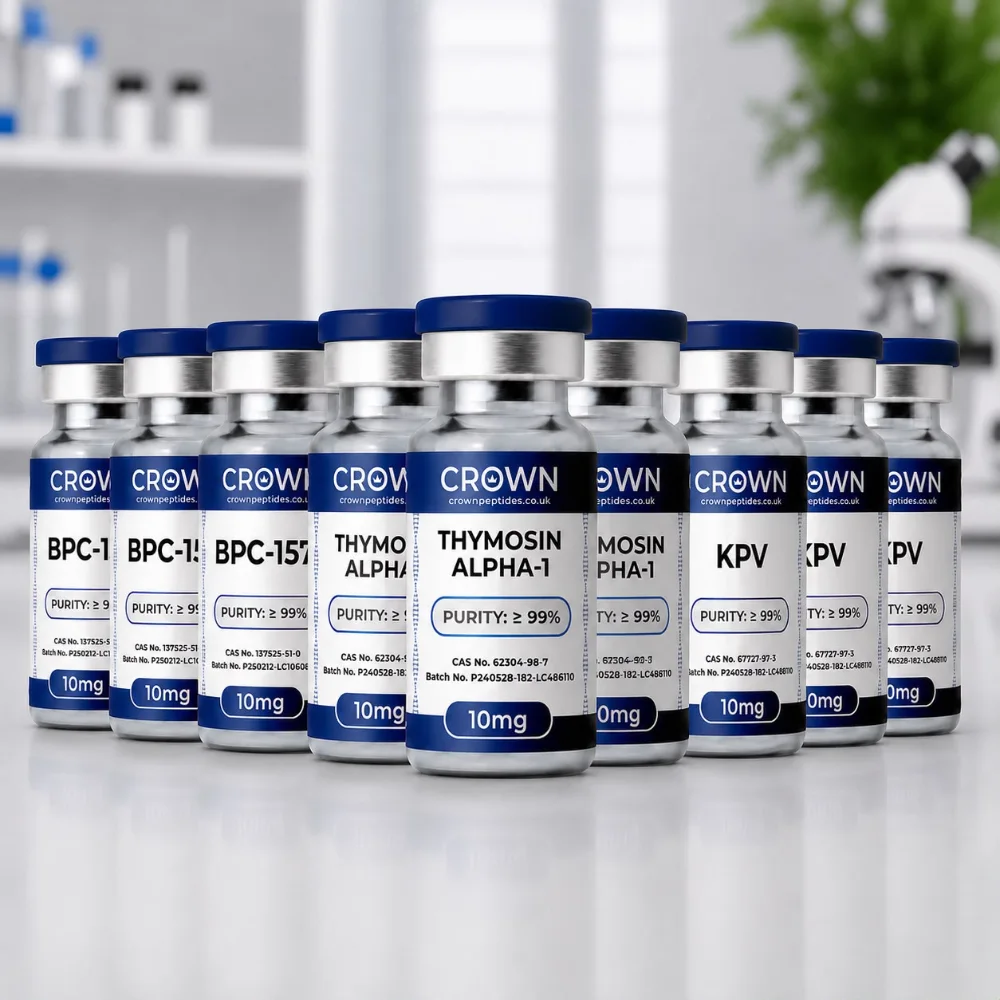
Immune Pathway Research Bundle UK is Crown Peptides' 9-vial research bundle combining Thymosin Alpha-1, KPV and BPC-157, supplied as 3 × Thymosin Alpha-1 10mg, 3 × KPV 10mg and 3 × BPC-157 10mg for laboratory research into immune regulation, inflammatory signalling and tissue-barrier pathways.
Supplied for laboratory research purposes only — not for human consumption or for medical, veterinary or diagnostic use.
Immune research increasingly follows the whole chain, from how immune cells are activated, to how inflammation is resolved, to how tissue barriers respond afterwards. This bundle brings together a peptide studied at each stage. Thymosin Alpha-1 is a 28-amino-acid peptide first isolated from thymus tissue, studied for its role in T-cell maturation and innate immune signalling. KPV, the Lys-Pro-Val fragment of alpha-melanocyte-stimulating hormone, is investigated for anti-inflammatory signalling in immune and epithelial models. BPC-157, a synthetic 15-amino-acid peptide, is widely studied in tissue-repair and barrier-related research.
Grouped together, they let researchers study immune activation, inflammatory regulation and tissue repair side by side, using one consistently documented set of materials.
Thymosin Alpha-1: the activating member, a thymic peptide shown to activate dendritic cells via toll-like receptors (Learn more). How it was isolated, and the licensed medicine thymalfasin, are covered on the Thymosin Alpha-1 page.
KPV: in an immune design it acts as the counterweight, the tripeptide whose mouse colitis results (Learn more) pointed to reduced inflammatory signalling inside the cell. The KPV page explains where it comes from.
BPC-157: the tissue-side member, studied for how injured tissue recovers, including in repair and pain-signalling work (Learn more). Its literature is summarised on the BPC-157 page.
Most bundles group compounds that point the same way. This one deliberately does not. Thymosin Alpha-1 is studied chiefly for pushing immune cells towards activation: dendritic-cell maturation, interleukin-12 release and Th1-type responses. KPV is studied chiefly for the opposite tendency, with lower NF-κB activity and fewer pro-inflammatory cytokines. BPC-157 sits further downstream, in work on how tissue recovers once the inflammatory phase passes. Putting an activator and a brake in the same set lets a lab ask whether an immune response can be tuned rather than simply turned up or down, while the third peptide reports what the surrounding tissue experiences as a result. That makes the set well suited to models built around a defined trigger, such as a toll-like-receptor ligand or an epithelial wound.
The two immune members converge on the same transcription factor from opposite sides. Thymosin Alpha-1’s dendritic-cell activation has been traced through MyD88, p38 MAP kinase and NF-κB, while KPV has been reported to reduce NF-κB activation in epithelial and immune cells. Combined, the result could be additive, cancelling or dependent on timing and cell type, and to our knowledge no published study has tested it. That uncertainty makes NF-κB the obvious first readout: a reporter cell line, imaging of p65 moving into the nucleus, or phospho-IκBα on a western blot. Pair it with a downstream cytokine panel (IL-12p70 for activation, TNF-alpha for shared inflammatory tone, IL-10 for regulation) so a change at the transcription factor can be matched to its consequences.
Because two members push in opposite directions, the order of addition matters more here than in most combined designs. Thymosin Alpha-1 given before a stimulus tests priming; KPV given after it tests resolution; adding both together reports the net balance. A practical way to stage three vials of each is to give each a different job. The first set runs a single-agent timing matrix in a dendritic-cell or macrophage model. The second repeats the most informative timing with the paired and triple combinations. The third carries the work into tissue: conditioned medium from the treated immune cells is transferred onto epithelial monolayers, with and without BPC-157, linking the immune arm to a barrier or wound-closure readout.
The trio also differs sharply in chemistry. Thymosin Alpha-1, acetylated at its N-terminus and 28 residues long, is a peptide of about 3,108 g/mol and is strongly acidic; BPC-157 has 15 residues, about 1,419.5 g/mol, and also leans acidic; KPV is a basic tripeptide of about 342.4 g/mol. From identical 10mg fills that gives roughly 3.2, 7.0 and 29 micromoles respectively, a ninefold molar spread, so arms are best matched by molarity. Opposite charges are also a reason to dissolve each peptide separately and combine them only in the final medium. The acetyl cap on Thymosin Alpha-1 and the proline-rich BPC-157 sequence give each a distinct identity signature too, so a quick LC-MS check of the working solutions confirms that no arm has been mislabelled.
Compound-level reference data. Batch-specific results appear on the Certificate of Analysis.
Work out concentration with the peptide calculatorEach compound in the Immune Pathway Research Bundle is supplied for controlled laboratory research with its own batch-specific analytical documentation. High-Performance Liquid Chromatography (HPLC) can assess chromatographic purity, while Mass Spectrometry provides molecular information used to support identity verification. With peptides ranging from 3 amino acids (KPV) to 28 (Thymosin Alpha-1), batch-specific identity confirmation for each compound is what keeps comparisons between them reliable.
The batch-specific Certificate of Analysis is the definitive source for the exact purity result, identity data and analytical specification of each material supplied.
Researchers working with this bundle may also be interested in Thymosin Alpha-1, KPV, BPC-157, LL-37 and VIP — the individual peptides in this bundle, plus LL-37 and VIP, both studied in immune and inflammatory signalling.
Thymosin Alpha-1, KPV and BPC-157, three 10mg vials of each for nine in total. Each vial carries its own label and batch-specific documentation, so every arm of a study can be traced to its material.
Because the interesting question in many immune models is balance, not direction. With Thymosin Alpha-1 on one side and KPV on the other, a study can map how activation and restraint interact at a shared control point, then use BPC-157 to see how the tissue responds.
Very little that we can find: no peer-reviewed study has tested this trio, or any pair from it, as far as we know. The case for grouping them rests on their individual mechanisms, which is exactly why single-peptide arms belong in every design.
It gives the bundle a tissue readout. Immune cells change what happens in the surrounding epithelium and stroma, and BPC-157 is studied in those repair settings, so it lets a study follow an immune intervention through to its effect on wound closure or barrier recovery.
It does: the nine vials are priced 20% below the total of three Thymosin Alpha-1, three KPV and three BPC-157 bought singly.
Bone-marrow-derived dendritic cells and macrophages, or human THP-1 and peripheral blood mononuclear cells, cover the Thymosin Alpha-1 and KPV arms. Epithelial monolayers or fibroblasts provide the tissue side for BPC-157, ideally linked to the immune cells by co-culture or conditioned medium.
A vehicle control, a stimulus-only group such as LPS or another toll-like-receptor ligand, and a reference NF-κB inhibitor give the activator and brake arms fixed points to compare against. Every peptide should also appear alone at the same concentration used in the combinations.
Nobody has shown it either way. A checkerboard of concentrations for both peptides, analysed for additivity with a model such as Bliss independence, will reveal whether they offset, add or interact in your cells, and whether that changes with timing.
Its strong acidity and size mean it generally dissolves best in neutral to slightly basic aqueous buffer, while the small, basic KPV is more forgiving. Prepare each stock separately, record the pH, and follow the batch documentation for each peptide.
Further than many expect. At 1 micromolar in 1 mL wells, one Thymosin Alpha-1 vial could in theory cover over 3,000 wells, and a KPV vial nearly ten times that, so the three-vial depth mostly buys repeat experiments and fresh material across a long project.
Every batch is published openly — identity, purity and batch number, with no account needed.
Supplied for laboratory research purposes only — not for human consumption or for medical, veterinary or diagnostic use.
Each batch undergoes internal analytical verification using chromatographic and spectrometric methods prior to lyophilisation.
• HPLC Analysis
• Mass Spectrometry Confirmation
• Batch Traceability
By purchasing this product you confirm that you are a qualified researcher and that this compound will be used exclusively for laboratory research purposes.
This product is not intended for diagnostic or therapeutic use.
Any human or medical use is strictly prohibited.
Store in a cool, dry, secure and sterile environment away from any unauthorised persons or children.
Disclaimer: All products are sold strictly for laboratory research purposes only. Not for human or veterinary use, consumption, therapeutic, or diagnostic application. None of our products are medicines, and none are presented as such. By purchasing, you confirm you are a qualified professional and legally permitted to handle these materials in compliance with all applicable laws and regulations. Misuse, resale for unauthorised purposes, or unlawful application is strictly prohibited. Crown Peptides UK disclaims all liability for improper use, handling, or regulatory non-compliance.