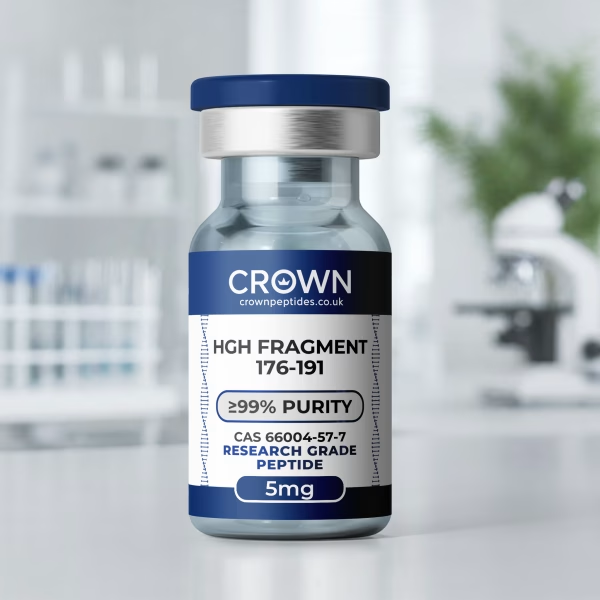
HGH Fragment 176-191 Research Peptide
A high-purity research peptide studied in fat metabolism research.
Out of stock
Supplied for laboratory research purposes only — not for human consumption or for medical, veterinary or diagnostic use.
Product Overview
HGH Fragment 176-191 UK is Crown Peptides’ C-terminal fragment of human growth hormone, supplied in 5mg for laboratory research.
- Studied in research involving fat metabolism and lipolysis in animal models
- Studied in research involving acetyl-CoA carboxylase and fat synthesis
- Studied in research involving energy expenditure and fat oxidation
- Studied in research separating the fat-related actions of growth hormone from its effects on blood glucose
- Supplied as the true 176-191 sequence, confirmed on every batch certificate
About HGH Fragment 176-191 UK
Human growth hormone is a single chain of 191 building blocks that does several unrelated jobs at once. It drives growth, it changes how the body handles fat, and it raises blood glucose and works against insulin.
Also known as: HGH Frag 176-191, hGH 176-191, Fragment 176-191, Frag 176-191, somatotropin (176-191), lipolytic fragment of hGH, C-terminal fragment of hGH
Through the 1970s and 1980s a group at Monash University in Melbourne set out to find whether those jobs could be separated, by cutting the hormone into pieces and testing each piece on its own. HGH Fragment 176-191 is the piece that carried the fat-related activity: the last sixteen building blocks of the chain.
It is a short peptide, around 1,799 daltons, with a single internal sulphur bridge linking the two cysteines. The original chemistry work found that breaking that bridge did not stop it working, which was an early sign that the activity sits in the sequence itself rather than in the folded shape.
A note on what you are actually buying, because this matters. There are two closely related compounds sold under this name, and most UK suppliers do not distinguish between them. The genuine fragment begins with phenylalanine and has the sequence FLRIVQCRSVEGSCGF, CAS number 66004-57-7. The other is AOD-9604, which is a modified version built from residues 177-191 with a tyrosine added at the front, giving YLRIVQCRSVEGSCGF and a different CAS number, 221231-10-3. The tyrosine was added in the laboratory to make the peptide easier to track in experiments. It was never part of growth hormone at position 176.
The practical consequence is that the molecular weight quoted on most “176-191” pages online, 1817, is AOD-9604’s figure rather than the fragment’s. We supply the genuine 176-191 sequence and state it, with its own CAS number and mass, on the certificate for every batch. If you are comparing suppliers, the sequence on the certificate is the thing to check. We stock AOD-9604 separately, as its own product, because it is its own compound with its own research record.
The fragment sits in the metabolic research area. It is a different kind of tool from the growth hormone secretagogues such as Ipamorelin and CJC-1295 with DAC, which prompt the body to release more of the whole hormone. This does the opposite: it isolates one activity and leaves the rest of the hormone out of it.
HGH Fragment 176-191 Research
The research record on this region of growth hormone runs from the late 1970s to the early 2000s and comes almost entirely from one group, working methodically through the chemistry, then the mechanism, then whole-animal studies. The work covers fat synthesis, fat breakdown, energy use and the question of what happens to blood glucose.
- Which part of growth hormone carries the fat-related activity
- Effects on fat synthesis and fat breakdown in fat tissue
- Energy expenditure and fuel use in animal models
- Why this region does not produce the insulin resistance that whole growth hormone does
Where the story starts: cutting the hormone up
In 1979 the Monash group synthesised several versions of the tail end of growth hormone and tested them. They found the region had to keep its full length at the front end to stay active, and that a version with the sulphur bridge chemically opened still worked. That established both the active region and the fact that the bridge is not essential to it. (Learn more)
Narrowing it down
A follow-up in 1982 tested six progressively shortened versions in rats. Only the full-length fragment produced effects at low doses; versions trimmed from the back end were inactive even at a hundred times the dose. That placed the active core firmly within this short stretch of the molecule. (Learn more)
How it affects fat synthesis
In 1983 the group showed that both whole growth hormone and this region of it inhibit acetyl-CoA carboxylase, the enzyme that commits the body to building new fat. They traced the effect to the surface of fat cells and liver cells, and to a messenger released there that switches the enzyme off. This was the first mechanical account of how the fragment reduces fat synthesis rather than simply burning fat. (Learn more)
As strong as the whole hormone
A 1993 study found the synthetic fragment matched intact growth hormone for its effect on fat synthesis. Worth reporting accurately: in that particular experiment the researchers did not detect a lipolytic effect, meaning the fragment was blocking fat being made rather than breaking down fat already there. Later work using different measures did find fat breakdown, so the two effects appear to depend on the model used. (Learn more)
Glucose entry into fat cells
Also in 1993, work in fat cells from genetically obese rats found the fragment reduced glucose uptake into those cells, both at rest and when stimulated by insulin, and did so more strongly than intact growth hormone at the same concentration. That suggested part of the effect comes from limiting the raw material fat cells use to build fat. (Learn more)
The first long-run animal study
In 1994 the group dosed genetically obese mice over an extended period and recorded reduced weight gain, reduced fat tissue mass and inhibited fat synthesis in that tissue. It was the first demonstration that the short-term biochemistry translated into a measurable change in the animal. (Learn more)
Clear numbers in obese rats
A 2000 study dosed obese Zucker rats orally for nineteen days. Weight gain was reduced by more than half, from 35.6 grams in controls to 15.8 grams in treated animals, with increased fat-breakdown activity in fat tissue. Importantly, a glucose clamp study found no adverse effect on insulin sensitivity, in contrast to what chronic whole growth hormone does. (Learn more)
Not appetite suppression
A separate 2000 study in obese mice found weight gain diverged from controls from around day sixteen onwards, with no difference in how much the animals ate. Fat tissue examined afterwards showed less fat synthesis and more fat breakdown, alongside an acute rise in energy expenditure and in the burning of both glucose and fat. The same study found increased fat breakdown and reduced fat synthesis in human fat tissue tested in the laboratory. (Learn more)
Twenty days, measured at the cell
Another 2000 paper working with the unmodified fragment found it stimulated hormone-sensitive lipase, inhibited acetyl-CoA carboxylase, and over twenty days in obese rats reduced weight gain and brought average fat cell diameter down from 110 to 80 micrometres. Unlike whole growth hormone, it did not produce insulin resistance or glucose intolerance. (Learn more)
The structure
A 2000 study used NMR to work out the shape the cyclic fragment takes in solution, finding two defined turns within the ring and some resemblance to how this stretch sits inside the full crystal structure of growth hormone. That supported the idea that this is a genuine self-contained functional region rather than an arbitrary cut. (Learn more)
Why the blood glucose effects are missing
A 2001 study gave the answer. In cells engineered to carry the growth hormone receptor, the fragment did not compete for binding at that receptor and did not trigger cell division, while whole growth hormone did both. Because it never engages the growth hormone receptor, the pathways that drive insulin antagonism and growth are simply not switched on. In the same study it reduced weight gain in obese mice with increased fat oxidation, without the rise in blood glucose seen with the whole hormone. (Learn more)
A common misreading worth correcting
A 2001 study is often cited online as showing the fragment works through the beta-3 adrenergic receptor. It showed something more interesting than that. In mice lacking that receptor, chronic dosing no longer changed body weight, but an acute dose still raised energy expenditure and fat oxidation. The authors concluded the action is not directly through that receptor; rather, the compound increases how much of the receptor the tissue makes, which may then make it more responsive. (Learn more)
Taken together, this is an unusually well-characterised short peptide: a defined sequence with a solved solution structure, a mechanism traced to a specific enzyme, consistent animal data on fat mass and energy use, and a clear explanation for why it behaves differently from the hormone it came from. The modified analogue AOD-9604 was later taken into human safety studies covering several hundred participants, which is further than most compounds in this category go. Related compounds studied in the same area include Tesamorelin and 5-Amino-1MQ.
Specifications
- Product
- HGH Fragment 176-191
- Classification
- C-terminal fragment of human growth hormone, research peptide
- Sequence
- FLRIVQCRSVEGSCGF
- Available strength
- 5mg
- Form
- Lyophilised research material supplied according to product label
- Purity / assay
- batch-specific; refer to Certificate of Analysis
- Verification
- HPLC and Mass Spectrometry
- Also known as
- HGH Frag 176-191, hGH 176-191, lipolytic fragment of hGH
- Product Name
- HGH Fragment 176-191
- Structure
- single internal disulfide bridge between the two cysteine residues
- Molecular Formula
- C78H123N23O22S2
- Molecular Weight
- approximately 1799 g/mol; refer to the batch Certificate of Analysis for the confirmed mass
- CAS Number
- 66004-57-7
Purity and Testing
On this compound in particular, the certificate is the thing to read. Because two different sequences are sold under the same name across the market, the only way to know which one is in a vial is to look at what the batch analysis reports.
Crown Peptides HGH Fragment 176-191 is supplied with batch-specific quality documentation, published on our lab reports page before the batch goes on sale. HPLC shows how clean the batch is, and mass spectrometry confirms identity against the expected mass for the 176-191 sequence rather than for the modified analogue. The Certificate of Analysis should be used as the definitive source for identity, assay, purity and relevant impurity information.
Storage Conditions
- Store unreconstituted material at -20°C ± 5°C in a cool, dry environment
- Prepared research solutions should use validated storage conditions appropriate to the compound and study design
- Protect from unnecessary heat, direct light and repeated temperature fluctuations
Related Compounds
Compounds studied alongside the fragment in metabolic research include AOD-9604, Tesamorelin, 5-Amino-1MQ, Ipamorelin and CJC-1295 with DAC. The full range is in our metabolic research peptides category.
HGH Fragment 176-191 Frequently Asked Questions
About HGH Fragment 176-1916 questions
What is HGH Fragment 176-191?
It is the last sixteen building blocks of human growth hormone, made as a peptide in its own right. Research in the 1980s and 1990s identified this region as the part of the hormone that carries its effects on fat metabolism, separate from its effects on growth and blood glucose.
Why is it called 176-191?
Because growth hormone is a chain of 191 building blocks, and this is the stretch running from position 176 to the end at 191. The numbering refers to position in the parent hormone, not to anything about the fragment itself.
Is HGH Fragment 176-191 the same as AOD-9604?
No. They are two different molecules with different sequences and different CAS numbers. The genuine fragment starts with phenylalanine (FLRIVQCRSVEGSCGF, CAS 66004-57-7). AOD-9604 is built from residues 177-191 with a tyrosine added at the front (YLRIVQCRSVEGSCGF, CAS 221231-10-3), a change made in the laboratory to help track the peptide in experiments. Many suppliers sell AOD-9604 material under the 176-191 name without saying so.
How can I tell which one a supplier is selling?
Check the sequence and CAS number on the certificate of analysis rather than the product name. A molecular weight of about 1817 and a sequence beginning with tyrosine indicate AOD-9604. A weight of about 1799 and a sequence beginning with phenylalanine indicate the genuine 176-191 fragment.
How does it differ from whole growth hormone?
Whole growth hormone acts on the growth hormone receptor and sets off everything that follows, including growth signalling and a rise in blood glucose. The fragment does not bind that receptor at all, which is why research found it affects fat metabolism without producing the insulin resistance that chronic growth hormone does.
How is it different from Ipamorelin or CJC-1295?
Ipamorelin and CJC-1295 with DAC prompt the body to release more of its own growth hormone, so everything that hormone does increases together. The fragment works the other way round: it is one isolated piece of the hormone, studied specifically to separate the fat-related activity from the rest.
Findings in research models3 questions
What did the obese rat studies show?
In a nineteen-day oral study, weight gain in treated animals was less than half that of controls, 15.8 grams against 35.6 grams, with increased fat-breakdown activity in fat tissue and no adverse effect on insulin sensitivity measured by glucose clamp. A separate twenty-day study recorded average fat cell diameter falling from 110 to 80 micrometres.
Did the animals simply eat less?
No. In one study weight gain diverged from controls from around day sixteen with no difference in food consumption between the groups, which pointed to a change in how energy was used rather than appetite suppression.
Does it work through the beta-3 adrenergic receptor?
Not directly, despite what is often written. In mice without that receptor, an acute dose still increased energy expenditure and fat oxidation. The researchers concluded the compound raises how much of the receptor the tissue produces, which may then increase sensitivity, rather than acting on the receptor itself.
Buying, testing & storage3 questions
Is HGH Fragment 176-191 legal to buy in the UK?
It is supplied in the UK as a laboratory research material. It is not a licensed medicine and is not sold for human or veterinary use. It is supplied strictly for laboratory research purposes by qualified personnel. It is listed on the World Anti-Doping Agency prohibited list, which is relevant to anyone working in sports science research.
Where can I buy HGH Fragment 176-191 in the UK?
Crown Peptides supplies HGH Fragment 176-191 in 5mg vials from the UK, as the genuine 176-191 sequence, with HPLC and mass spectrometry verification and a batch-specific Certificate of Analysis published for every batch. Orders placed before 2pm are dispatched the same working day.
How should it be stored and handled?
Unreconstituted material should be kept at -20°C ± 5°C in a cool, dry place, away from direct light and repeated temperature swings. Prepared solutions should follow storage conditions validated for the study in question. Our storage information page covers handling in more detail.
Read the batch certificate before you order
Every batch is published openly — identity, purity and batch number, with no account needed.
View lab reports- Laboratory research only
- Not for human or clinical use
- Not for human or veterinary consumption
Supplied for laboratory research purposes only — not for human consumption or for medical, veterinary or diagnostic use.
Other Research Peptides
 Endocrine researchCJC-1295 + IpamorelinBlend