HGH Fragment 176-191: Growth Hormone’s Last Sixteen Residues
A full UK research guide to HGH Fragment 176-191, the unmodified C-terminal sequence of human growth hormone: how the Melbourne group mapped the fragment's activity to its last residues, what the rodent and isolated-tissue work actuall…
On this page
- One Hormone, Half a Dozen Different Jobs
- What the Last Sixteen Residues Actually Did to Fat
- Why the Fragment Is Not Just a Weaker Hormone
- The Difference a Single Atom Makes
- What Is Known, and What Is Still Open
- Regulatory Standing and the Grey Market Around It
- Technical Breakdown for the Detail-Minded
- Testing, and What a Batch Certificate Shows
- Related Compounds Worth Knowing About
- Common Questions About HGH Fragment 176-191
- A Compound Worth Picking Back Up
- References
Human growth hormone is one chain of 191 amino acids doing half a dozen jobs at once: driving growth, raising blood glucose, antagonising insulin, changing how fat tissue handles fuel. Which invites one of the better questions in endocrine chemistry: are those jobs separable? Could you keep the part that acts on fat and leave the rest behind? A group in Melbourne spent two decades finding out the hard way — cut the hormone up, synthesise the pieces, test each alone. It worked. The last sixteen residues, made as a standalone peptide, carried metabolic activity of their own, and that activity switched off between residue 178 and 179: of six carboxyl-terminal peptides given to rats at 5 nanomoles per kilogram, the first four acted on glucose and insulin handling and the last two did nothing (PMID: 645904).
That stretch — residues 176 to 191, FLRIVQCRSVEGSCGF — is what Crown Peptides supplies as HGH Fragment 176-191 Research Peptide, listed under Metabolic research peptides and Endocrine & Hormonal research peptides. It is laboratory material, and we supply it for research use only. One thing is worth settling first, because it decides which evidence belongs where: 176-191 is the parent sequence, cut straight out of the hormone, and the analogue later carried into clinical development differs from it by a single hydroxyl group.
- Positional name
- Human growth hormone residues 176-191 — its last sixteen amino acids
- Sequence
- FLRIVQCRSVEGSCGF, with a disulfide between Cys182 and Cys189
- Composition
- C78H123N23O22S2, average mass about 1,799 Da with that bridge closed; C78H125N23O22S2 and about 1,801 Da with the two cysteines free
- Mapped by
- Bornstein, Ng and Wade's group in Melbourne, from the mid-1970s
- Research areas
- Lipogenesis, adipose mass, glucose transport, insulin antagonism
- Receptor
- None identified; does not act through the growth hormone receptor
- Evidence level
- Rodent and isolated-tissue work, 1977-2000; no clinical trials
- Closest relative
- AOD-9604, carrying a tyrosine where this carries a phenylalanine
- Supplied as
- Freeze-dried, sealed powder
One Hormone, Half a Dozen Different Jobs
Growth hormone's reputation is as the molecule that makes children tall, but height is one item on a long list. It also raises blood glucose, drives liver IGF-1 production, pushes fatty acids out of fat cells and — confusingly — produces insulin-like responses in fat tissue (PMID: 2500331). It antagonises insulin too: in a crossover study in nine growth-hormone-deficient men it produced insulin resistance in skeletal muscle that tracked lipolysis (PMID: 32945898). Does one part of the protein really do all of that?
Cutting a hormone into readable pieces
The answer came piece by piece. Peptides from the amino terminus potentiated insulin rather than antagonising it, so the instructions were not spread evenly along the chain, and in 1977 John Wade's team synthesised residues 172-191 and showed that stretch raised blood glucose in rats (PMID: 907713).
The 1978 study that opens this guide is the mapping exercise that followed — and the most relevant paper for anyone searching 176-191 by name, since 176-191 is one of its six peptides. Its conclusion has aged well: an active peptide needs the minimum informational sequence and the right physical configuration (PMID: 645904).
Narrowing the active core
Two papers then drew the boundaries. In 1979 the group compared 177-191, 178-191 and 179-191, and found 179-191 needed extending at its amino terminus to work in living animals (PMID: 429095). The 1982 shortening experiment came from the other end, testing six carboxyl-shortened versions of reduced, carbamidomethylated 177-191 in rats: two were active in nanomolar quantities — one of them the full-length peptide — while 177-180, 177-185, 177-187 and 177-189 did nothing at a hundred times that amount. The active core sits within residues 178 to 190 (PMID: 6751009). Thirteen residues, carrying the instruction.
What a separable activity would be worth
Why go to the trouble? Because the whole hormone is a blunt instrument here. Given patiently it works: over twelve months, forty postmenopausal women with abdominal obesity taking 0.67 mg a day lost visceral fat against placebo, with insulin sensitivity improving rather than worsening across the year (PMID: 15598680). Over hours it does the reverse — an infusion in eight healthy men halved insulin sensitivity (PMID: 24148194) — and it raises IGF-1 and drives proliferation through its own receptor besides (PMID: 11673763). A piece that kept the effect on fat and left the rest behind would be a different proposition entirely.
What the Last Sixteen Residues Actually Did to Fat
A fragment that matched the whole hormone
Here is the result that makes the fragment worth working on. In 1993 Wu and Ng tested synthetic hGH 177-191 in rats and measured its effect on lipogenesis, the building of new fat. Its antilipogenic activity was, in the paper's own words, identical with that of the intact molecule of human growth hormone — sixteen residues out of 191, doing one of the parent's metabolic jobs at full strength. They also measured glycerol release from epididymal fat pads, the standard readout for fat breakdown, and found no significant lipolytic effect, which said as much about the hormone as the fragment: growth hormone's main action on lipid metabolism sits at the level of fat synthesis (PMID: 8358331).
Worth holding onto: restraining the synthesis of new fat and releasing fat already stored are two different levers, and this literature is about the first. Later work on the same sequence under a development code did also report raised lipolytic activity, and we come to that below.
Fat cells that stopped taking up sugar
A second 1993 study asked how, and found better than parity. Adipocytes from obese Zucker rats exposed to hGH 177-191 took up less deoxyglucose at baseline and under insulin stimulation alike, and at equimolar concentrations the peptide beat the intact hormone (PMID: 8118430). A fat cell builds triglyceride largely from glucose-derived carbon, so restricting entry restricts the raw material.
An earlier paper found a step further down: in rat tissue, growth hormone and its part sequence 172-191 both inhibited acetyl CoA carboxylase, the committed step in fatty-acid synthesis, by releasing a non-polar second messenger from adipocyte and hepatocyte membranes that then phosphorylated the enzyme (PMID: 6137122).
Whole animals, and how much less they gained
Isolated tissue is suggestive; live animals are the test, and the fragment passed it. In 1994 Natera, Jiang and Ng gave synthetic hGH 177-191 to C57BL/6J ob/ob mice — the leptin-deficient obese strain — over a long treatment period: cumulative weight gain fell, adipose mass decreased, adipose lipogenesis was significantly inhibited (PMID: 7987248).
The most quantitative study arrived in 2000, by which point the work had commercial backing and a code name: AOD9401, which the primary papers describe as the 177-191 sequence itself rather than an analogue. Two experiments sit in that paper, at two levels. In isolated rat adipose tissue the peptide stimulated hormone-sensitive lipase and inhibited acetyl CoA carboxylase, as the intact hormone does. In obese Zucker rats treated for twenty days it cut weight gain and shrank mean adipocyte diameter from 110 to 80 micrometres. That is a fat cell holding roughly 60% less volume, and it came without the insulin resistance or glucose intolerance intact growth hormone causes — the whole point of separating the activities (PMID: 11116208).
The experiment that went in by mouth
Then they did something short peptides are not supposed to tolerate: they gave it by mouth. Eight ob/ob mice received saline and ten received AOD-9401 orally for thirty days. From day sixteen, weight gain in the peptide group was significantly lower, with no difference in food consumption — not appetite suppression, but a change in how the animals handled fuel. Adipose tissue afterwards showed reduced lipogenic and raised lipolytic activity, alongside an acute rise in energy expenditure and fat oxidation (PMID: 10950816). That paper also carries the only human tissue data in this family: obese human adipose tissue, exposed in vitro to the fifteen-residue peptide, where lipolytic activity rose and lipogenic activity fell.
Why the Fragment Is Not Just a Weaker Hormone
A piece of growth hormone ought to work through the growth hormone receptor, only more weakly. The structural literature says something far more interesting.
The receptor needs the whole molecule twice over
Start with the simple version. To signal at all, growth hormone must grip two receptor molecules at once, using three separate patches of its own chain. The 1992 crystal structure shows one hormone holding two copies of the receptor's outer domain, folded into a bundle of four helices (PMID: 1549776); the receptors arrive in order, site 1 then site 2, which the solution work proposed as the signalling mechanism (PMID: 1948064). The patches were mapped with 62 single alanine mutations across three stretches: residues 2 to 19, 54 to 74, and 167 to 191 (PMID: 2471267).
Look at that third stretch: the fragment's entire sequence sits inside it, and it is no loose tail hanging off the hormone's back. The bundle's fourth helix runs to residue 183, so the fragment's first eight residues are the closing turns of a core helix and only its last eight are genuine tail (UniProt P01241). Cys182, one half of the fragment's disulfide, is the second-to-last residue of that helix.
So why is the fragment not simply a weaker hormone? Because one patch of three is not a grip. The cost shows on a bigger piece: a 17 kDa fragment, hGH44-191, did produce insulin resistance in infused rats, but only at blood levels 50 to 60 times those whole 22 kDa growth hormone needed (PMID: 9225115). Whatever the fragment does, it does by another route.
Different jobs, different receptor populations
The hormone's own two effects on fat already travel separately, which is part of why a separable fragment was plausible. A 1989 study in rat adipose tissue showed it with swainsonine, a drug that leaves newly made receptors with unfinished sugar chains: insulin-like responsiveness survived, the lipolytic response almost vanished, and the cells' fat-breaking machinery was intact throughout. The occupancy numbers agree — about 90% of receptors occupied for half-maximal glucose oxidation, only 8 to 21% for half-maximal lipolysis. If a subclass of receptors carries the lipolytic signal, the authors calculated, it is a tenth or less of the population (PMID: 2500331).
Better still, the split can be engineered on purpose. bGH-M8, a bovine growth hormone analogue with a redesigned third helix, competitively blocked hormone-driven lipolysis in chicken adipose tissue at a dissociation constant of 4.54 nanomolar while keeping full insulin-like antilipolytic activity (PMID: 8516343). Different domains, different jobs — and they come apart along structural lines.
The beta-3 adrenergic thread, and what it showed
The one receptor repeatedly linked to this family in secondary sources is the beta-3 adrenergic receptor, the main lipolytic receptor on fat cells. The primary paper repays reading closely. In 2001, obese mice given growth hormone or the engineered fragment for fourteen days lost weight and fat, and in both the suppressed level of beta-3 receptor messenger RNA rose towards lean levels. In beta-3 knockouts, long-term treatment changed neither body weight nor lipolysis — yet acutely the fragment still raised energy expenditure and fat oxidation in those same animals. The conclusion: the lipolytic actions are not mediated directly through the beta-3 receptor, although both compounds raise its expression, which may add to lipolytic sensitivity (PMID: 11713213).
That is an informative negative: the receptor is downstream and permissive, not the target. Two caveats — the experiment used the engineered analogue, and the equivalent has never been run on 176-191. The hormone's own route in people, by contrast, is mapped. In a randomised crossover trial, nine men given a growth hormone bolus showed rising free fatty acids and STAT5 phosphorylation while the lipolysis-restraining genes G0S2 and FSP27 were suppressed (PMID: 31668393). Nothing comparable is known for the fragment.
The Difference a Single Atom Makes
This is the most useful paragraph here. The parent fragment and its engineered descendant are routinely treated as one compound, and separating them decides which evidence belongs to which molecule.
Lining the two sequences up
Residues 176-191 begin and end with phenylalanine: FLRIVQCRSVEGSCGF. AOD-9604 is defined in the analytical literature as residues 177 to 191 of growth hormone with an added tyrosine at the amino terminus (PMID: 25208511) — written out, YLRIVQCRSVEGSCGF. Same length, same fifteen trailing residues; the difference is position one. Tyrosine is phenylalanine with a hydroxyl group on the ring, so the two molecules differ by one oxygen atom — about 1,799 Da against about 1,815 Da, taking both with their disulfide closed.
Which is why the two names get used interchangeably, even in careful writing: a 2026 review in Frontiers in Endocrinology lists the fragment as "AOD9604 (hGH 176-191)", treating the labels as one compound (PMID: 42395176). One is an endogenous sequence; the other is a deliberate substitution in it.
Which results belong to which molecule
The division is clean. Everything above came from the unmodified sequence or from the 177-191 peptide reported as AOD9401. The analogue's own story — its trial programme and development history — lives in our separate guide, AOD-9604: The Fragment of Growth Hormone Built to Do Just One of Its Jobs, with the material itself as AOD-9604 Research Peptide; it is worth reading on its own terms.
One finding from its literature is worth carrying across, label attached, because it bears on the parent. In mice treated for fourteen days by mini-osmotic pump, the analogue cut weight gain and raised fat oxidation yet did not compete for the growth hormone receptor — read by the authors as growth hormone behaving as a pro-hormone whose fragments act through routes its own pathways do not explain (PMID: 11673763). A hormone that doubles as a reservoir of smaller active pieces is a far more interesting molecule than one with one job.
Why the sequence was changed at all
If the natural sequence worked, why add a tyrosine? The primary papers do not say, so we will not invent a reason. What can be stated is the problem any sixteen-residue peptide has: inside the folded hormone this region is well protected — a Glu-specific protease nicks hGH only at exposed loops, and Glu186, inside the fragment's own sequence, is one of the slowest sites of all (PMID: 7782169) — and cutting the piece out costs it that protection.
The measured consequence comes from the analogue's analytical work: incubated in serum and urine, AOD9604 produced six identifiable metabolites, and one nine-residue product, CRSVEGSCG, proved significantly more stable than the others or than the parent peptide (PMID: 25208511). A peptide whose own breakdown product outlives it has a short working life, which shapes how it is studied — Peptide Half-Life Explained covers that, and What Is a Peptide Bond? why chain ends are vulnerable. Two things a tyrosine there would plausibly buy — a fresh residue for an aminopeptidase to meet, and the residue of choice for radio-labelling — are our inference from the chemistry, not a stated intention.
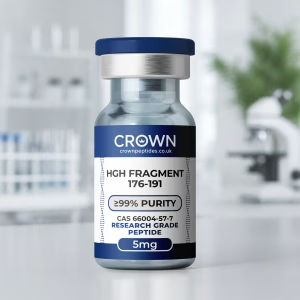
HGH Fragment 176-191 Research Peptide
Out of stock · every batch HPLC and MS tested
View HGH Fragment 176-191 Research Peptide ›What Is Known, and What Is Still Open
The honest summary: the published work on the unmodified sequence is rodent and isolated-tissue work, with no clinical trials of it. Human evidence in this family belongs to the analogue and the fifteen-residue peptide, the nearest thing being obese human adipose tissue in a dish (PMID: 10950816). Obesity trial results quoted for 176-191 belong to a different molecule.
It is also a concentrated literature: strip out the analogue papers and what remains came from one group in one city across twenty-five years, much of it in small journals. The experiments are internally consistent and the measurements standard for the period; what is missing is a second laboratory repeating them — as much an opportunity as a criticism.
One strand deserves more attention than it gets, because it is the best-replicated thing about this sequence: its effect on insulin handling. Rats given 5 nanomoles per kilogram became transiently hyperglycaemic, released more insulin and lost insulin sensitivity on insulin tolerance testing (PMID: 645904), and the chain-shortening study was an assay of exactly that (PMID: 6751009). In isolated rat islets, hGH 177-191 potentiated glucose-induced insulin release without altering the Km for glucose (PMID: 206156); in rat skeletal muscle it shifted glycogen synthase towards its inactive form (PMID: 6307153).
Set against that, chronic lower-level administration of the same sequence in Zucker rats produced no insulin resistance at all (PMID: 11116208). Acute and chronic dosing are different experiments and the two results have never been reconciled — a question waiting to be answered, not a contradiction. The same goes for the receptor: growth hormone's lipolytic pathway in people runs through its own receptor and STAT5 (PMID: 31668393), while the fragment's runs through a second messenger described once, in rat tissue in 1983, and never characterised since (PMID: 6137122). Finding it is the most answerable question in the story.
Regulatory Standing and the Grey Market Around It
In the United Kingdom the legal position follows from what a compound is sold and labelled for, not from the molecule. No medicines regulator anywhere has licensed human growth hormone fragment 176-191. Labelled as laboratory material for in-vitro and preclinical work it is lawful to sell and hold here; Are Peptides Legal in the UK? and What Does "Research Use Only" Actually Mean? set out how that boundary works.
Competitive sport is a separate regime, and there it is named outright: Section S2 of the World Anti-Doping Agency's prohibited list, in the version in force from 1 January 2026, bans growth hormone with its analogues and fragments, giving as its examples "AOD-9604 and hGH 176-191". Testing has caught up, with a validated method detecting AOD9604 in urine down to 50 picograms per millilitre (PMID: 25208511). Anyone in a tested sport should regard the family as off limits.
These compounds also circulate in unregulated channels, where identity is the first casualty: a case report describes Belgian authorities seizing preparations that needed laboratory characterisation before anyone could say they held AOD9604 (PMID: 24976118), and a 2026 review describes the wider pattern of digitally promoted compounds of uncertain identity, purity and sterility (PMID: 42437212). Reports of personal use circulate in forums; those are anecdote rather than research data, cannot be verified, and Crown Peptides does not condone personal or human use of anything we sell.
Technical Breakdown for the Detail-Minded
Sequence, mass and the bridge in the middle
Counting from the amino terminus of the mature 191-residue chain, residues 176 and 191 are both phenylalanine, and the sixteen between them run Phe-Leu-Arg-Ile-Val-Gln-Cys-Arg-Ser-Val-Glu-Gly-Ser-Cys-Gly-Phe. Two masses follow, and it matters which you read. Cysteines free: C78H125N23O22S2, about 1,801 Da. Disulfide closed, two hydrogens lighter: C78H123N23O22S2, about 1,799 Da — the figure a certificate normally reports. Both are arithmetic from the sequence, not lifted from a paper.
Whether the bridge must be closed has a partial answer, and it looks forgiving: the 1979 synthesis found the reduced, S-carbamidomethylated form of 177-191 — cysteines permanently blocked — active in living animals (PMID: 429095), and work on chicken adipose explants concluded the Cys53-Cys165 and Cys182-Cys189 bridges are not required for growth hormone's lipolytic or antilipolytic activity (PMID: 2320598). Nobody has run the open-versus-closed comparison on 176-191 itself.
A numbering problem worth knowing about
Search the literature for "176-191" and you find very little; search "177-191" and the whole programme appears. The reason is historical: the Melbourne group standardised on the fifteen-residue peptide, the market on the sixteen-residue one. They are one phenylalanine apart, and the active core from the chain-shortening study, residues 178 to 190, sits inside both (PMID: 6751009).
One more trap for anyone reading the primary papers. Two of the 1993 abstracts print the sequence with the serine and the valine at positions 184 and 185 the wrong way round, as Cys-Arg-Val-Ser-Glu (PMID: 8358331), (PMID: 8118430). The slip is repeated twice and has spread into secondary writing. In the hormone the order runs Arg-Ser-Val-Glu.
Handling in the laboratory
A small, charged, two-cysteine peptide is straightforward to handle. HGH Fragment 176-191 arrives as a dry, sealed lyophilisate; keep it cold, dark and dry, and let it warm fully before breaking the seal so moisture does not condense onto cold powder. Free thiols oxidise readily in solution, so small volumes are the sensible habit. Three pages cover the practice: Storage information, Peptide Reconstitution and How Long Do Peptides Last?. Most labs dilute into Bacteriostatic Water.
Testing, and What a Batch Certificate Shows
Two questions decide whether a vial is usable: is it the right molecule, and what else is in there. The first is unusually clean here, because the molecule this one gets confused with sits 16 Da away — a mass spectrometer reads the unmodified fragment at about 1,799 and the analogue at about 1,815, settling it outright.
Every batch is checked both ways: chromatography reports the target as a percentage of everything off the column, mass spectrometry confirms which molecule it is. The certificate goes on our Lab Reports page under the batch code on your vial, so the paperwork matches the material in hand.
If certificates are new territory: Peptide Testing UK on the instruments, How to Read a Peptide Certificate of Analysis on an actual document, How to Tell If Peptides Are Real on a bad batch, How to Choose a UK Peptide Supplier on what to ask a supplier, and Are Peptides Safe? on handling. Order by two in the afternoon on a working day and it ships that day; UK delivery is free above £100, and the contact page answers inside a working day.
Related Compounds Worth Knowing About
The engineered descendant
The compound to understand next is the one this sequence became. AOD-9604 Research Peptide is the single-residue variant with the clinical development programme, and AOD-9604: The Fragment of Growth Hormone Built to Do Just One of Its Jobs covers its trials, its history and where its own evidence runs out; AOD-9604 vs 5-Amino-1MQ sets it against a different mechanism. New to the vocabulary? Start with What Are Peptides?, Peptides vs Steroids and Peptide Stacking in Research, or browse the full range.
The hormone this sequence came out of
This story starts with growth hormone, so the compounds that raise the body's own output are the obvious neighbours. Releasing-hormone side: Sermorelin Research Peptide (guide) and Tesamorelin Research Peptide. Secretagogue side: Ipamorelin Research Peptide (guide), GHRP-2 Research Peptide, GHRP-6 Research Peptide and Hexarelin Acetate Research Peptide (guide). Combined: CJC-1295 (No DAC) + Ipamorelin (Blend), Tesamorelin + Ipamorelin (Blend) and CJC-1295 (With DAC) Research Peptide. Growth Hormone Peptides Explained maps the family, Peptide Hormones Explained the chemistry. Downstream sits IGF-1, the arm this fragment does not carry: IGF-1 LR3 Research Peptide (guide), MGF Research Peptide and PEG-MGF Research Peptide.
Other routes into fat metabolism
Adipose tissue is a crowded field, and several compounds reach it other ways. 5-Amino-1MQ Research Compound inhibits a fat-storage enzyme (guide); AICAR Research Compound (guide) and SLU-PP-332 Research Compound (guide) act on energy sensing; MOTS-c Research Peptide is mitochondrially encoded (guide); L-Carnitine (LC216) Research Compound decides which fuel mitochondria burn (guide); CBL-514 Research Compound works locally on adipocytes (guide); and Eloralintide Research Peptide comes at appetite from the amylin side (guide). Best Peptides for Weight Loss Research compares them, Metabolic Research Bundle x 9 Vials brings three together, and more sit in Research Peptide Bundles.
Common Questions About HGH Fragment 176-191
What is HGH Fragment 176-191?
The last sixteen amino acids of human growth hormone, made as a standalone peptide — FLRIVQCRSVEGSCGF, with a disulfide holding Cys182 to Cys189. It was one of six carboxyl-terminal peptides tested in rats in the study that fixed where the tail's activity begins (PMID: 645904).
How is it different from AOD-9604?
By one atom of oxygen. AOD-9604 is residues 177-191 with a tyrosine added at the amino terminus (PMID: 25208511), giving a sixteen-residue peptide identical to 176-191 except that position one is tyrosine rather than phenylalanine. They remain separate compounds: the analogue has a clinical development programme, described in our AOD-9604 guide; the parent sequence does not.
Does it work like growth hormone?
No, and that was the point of isolating it. Growth hormone signals by wrapping two receptor molecules around itself in sequence, using a surface built from three regions of the chain (PMID: 1948064), (PMID: 2471267). Sixteen residues cannot rebuild that, and the engineered analogue does not compete for the receptor at all (PMID: 11673763).
What did the animal work actually measure?
Fat synthesis rather than fat breakdown. Synthetic 177-191 inhibited lipogenesis in rats as effectively as the whole hormone while leaving glycerol release unchanged (PMID: 8358331), cut glucose uptake by Zucker rat adipocytes (PMID: 8118430) and cut weight gain and adipose mass in ob/ob mice (PMID: 7987248). In obese Zucker rats treated for twenty days it shrank mean adipocyte diameter from 110 to 80 micrometres, the enzyme results in that paper coming from isolated adipose tissue rather than the animals (PMID: 11116208).
Has it been studied in people?
No. There are no published clinical trials of the unmodified sequence; the closest human material is obese human adipose tissue exposed in vitro to the fifteen-residue peptide (PMID: 10950816). Human results quoted for "HGH Fragment 176-191" almost always belong to the analogue.
Does it raise IGF-1?
No evidence suggests it does, and the structure says it should not: IGF-1 induction follows growth hormone receptor signalling, which the fragment does not drive. A growth hormone bolus in people raises IGF-1 messenger RNA in adipose tissue alongside STAT5 phosphorylation (PMID: 31668393) — a chain the fragment has never been shown to start. But no study has measured IGF-1 after giving 176-191, so this is inference.
Why do the published papers say 177-191?
Because the laboratory that did most of this work used the fifteen-residue peptide as its standard while the market settled on the sixteen-residue one. The insulin-antagonistic core, residues 178 to 190, sits inside both (PMID: 6751009) — closely related, but not identical.
What does the insulin data show?
Two things, pointing different ways. The earliest in-vivo property described for this sequence was insulin antagonism — hyperglycaemia, raised plasma insulin and reduced insulin sensitivity in rats (PMID: 645904), with potentiated insulin release from isolated islets (PMID: 206156). Chronic lower-level administration in Zucker rats produced none (PMID: 11116208). Nobody has reconciled the two, which makes it a good experiment to run.
Are peptides legal in the UK?
Nothing about this sixteen-residue sequence is controlled by name in UK law. What the law looks at is the purpose a compound is sold and held for: as laboratory material it falls outside the medicines rules governing a licensed product and the food rules governing a supplement, and offering the identical powder for people to use changes that. Are Peptides Legal in the UK? walks through the three categories. Competitive sport runs its own rules, stricter for this family — see above.
A Compound Worth Picking Back Up
Set the name confusion aside and what remains is one of the neater pieces of structure-function work in endocrine chemistry. A 191-residue hormone doing half a dozen things at once. Sixteen residues at one end carrying its effect on fat synthesis at full strength, with a thirteen-residue core inside them doing the work. Fat cells in treated animals holding roughly 60% less volume, without the insulin resistance the whole hormone brings. A peptide that survived being given by mouth. And chemistry good enough that a single-residue variant of it went into clinical development: the company developing AOD-9604 for obesity had phase IIa trials underway by February 2002 (PMID: 15134286).
Then the money followed the variant, and the parent sequence was left roughly where the Melbourne group put it down — which is what makes it inviting now rather than closed. The open questions are specific: an uncharacterised second messenger, an acute-versus-chronic picture on insulin sensitivity nobody has settled, no second laboratory on the antilipogenic result. Every one is answerable with routine assays — lipogenesis in isolated adipocytes, glycerol release, a glucose uptake measurement, a clamp in a rodent model. Few compounds this well defined have this much left to find out.
All of it starts with knowing exactly what is in the vial, which for a molecule 16 Da from its better-known relative is the whole game. HGH Fragment 176-191 Research Peptide ships freeze-dried and sealed, its chromatography and mass spectrometry filed under the batch number printed on it — so you can confirm which of the two molecules you are holding before the first experiment.
References
- Wade JD, Pullin CO, Ng FM, Bornstein J. The synthesis and hyperglycaemic activity of the amino acid sequence 172-191 of human growth hormone. Biochem Biophys Res Commun. 1977;78(2):827-32. PMID: 907713
- Ng FM, Bornstein J. Hyperglycemic action of synthetic C-terminal fragments of human growth hormone. Am J Physiol. 1978;234(5):E521-6. PMID: 645904
- Weerasinghe C, Bornstein J. Effect of synthetic C-terminal fragments of hGH on insulin release by isolated islets. Am J Physiol. 1978;234(5):E527-31. PMID: 206156
- Wade JD, Ng FM, Bornstein J. Diabetogenic action of human growth hormone. Synthesis and activity of C-terminal fragments. Int J Pept Protein Res. 1979;13(2):195-200. PMID: 429095
- Wade JD, Ng FM, Bornstein J, Pullin CO, Pearce JS. Effect of C-terminal chain shortening on the insulin-antagonistic activity of human growth hormone 177-191. Acta Endocrinol (Copenh). 1982;101(1):10-4. PMID: 6751009
- Bornstein J, Ng FM, Heng D, Wong KP. Metabolic actions of pituitary growth hormone. I. Inhibition of acetyl CoA carboxylase by human growth hormone and a carboxyl terminal part sequence acting through a second messenger. Acta Endocrinol (Copenh). 1983;103(4):479-86. PMID: 6137122
- Macaulay SL, Armstrong JM, Bornstein J. Regulation of glycogen synthase activity in muscle by a C-terminal part sequence of human growth hormone. Arch Biochem Biophys. 1983;224(1):365-71. PMID: 6307153
- Cunningham BC, Wells JA. High-resolution epitope mapping of hGH-receptor interactions by alanine-scanning mutagenesis. Science. 1989;244(4908):1081-5. PMID: 2471267
- Chipkin SR, Szecowka J, Tai LR, Kostyo JL, Goodman HM. Different growth hormone-receptor interactions mediate insulin-like and lipolytic responses of rat adipose tissue. Endocrinology. 1989;125(1):450-8. PMID: 2500331
- Campbell RM, Kostyo JL, Scanes CG. Lipolytic and antilipolytic effects of human growth hormone, its 20-kilodalton variant, a reduced and carboxymethylated derivative, and human placental lactogen on chicken adipose tissue in vitro. Proc Soc Exp Biol Med. 1990;193(4):269-73. PMID: 2320598
- Cunningham BC, Ultsch M, De Vos AM, Mulkerrin MG, Clauser KR, Wells JA. Dimerization of the extracellular domain of the human growth hormone receptor by a single hormone molecule. Science. 1991;254(5033):821-5. PMID: 1948064
- de Vos AM, Ultsch M, Kossiakoff AA. Human growth hormone and extracellular domain of its receptor: crystal structure of the complex. Science. 1992;255(5042):306-12. PMID: 1549776
- Campbell RM, Chen WY, Wiehl P, Kelder B, Kopchick JJ, Scanes CG. A growth hormone (GH) analog that antagonizes the lipolytic effect but retains full insulin-like (antilipolytic) activity of GH. Proc Soc Exp Biol Med. 1993;203(3):311-6. PMID: 8516343
- Wu Z, Ng FM. Antilipogenic action of synthetic C-terminal sequence 177-191 of human growth hormone. Biochem Mol Biol Int. 1993;30(1):187-96. PMID: 8358331
- Wijaya E, Ng FM. Effect of an antilipogenic fragment of human growth hormone on glucose transport in rat adipocytes. Biochem Mol Biol Int. 1993;31(3):543-52. PMID: 8118430
- Natera SH, Jiang WJ, Ng FM. Reduction of cumulative body weight gain and adipose tissue mass in obese mice: response to chronic treatment with synthetic hGH 177-191 peptide. Biochem Mol Biol Int. 1994;33(5):1011-21. PMID: 7987248
- Polverino de Laureto P, Toma S, Tonon G, Fontana A. Probing the structure of human growth hormone by limited proteolysis. Int J Pept Protein Res. 1995;45(2):200-8. PMID: 7782169
- Hettiarachchi M, Watkinson A, Leung KC, Sinha YN, Ho KK, Kraegen EW. Human growth hormone fragment (hGH44-91) produces insulin resistance and hyperinsulinemia but is less potent than 22 kDa hGH in the rat. Endocrine. 1997;6(1):47-52. PMID: 9225115
- Heffernan MA, Jiang WJ, Thorburn AW, Ng FM. Effects of oral administration of a synthetic fragment of human growth hormone on lipid metabolism. Am J Physiol Endocrinol Metab. 2000;279(3):E501-7. PMID: 10950816
- Ng FM, Jiang WJ, Gianello R, Pitt S, Roupas P. Molecular and cellular actions of a structural domain of human growth hormone (AOD9401) on lipid metabolism in Zucker fatty rats. J Mol Endocrinol. 2000;25(3):287-98. PMID: 11116208
- Heffernan MA, Thorburn AW, Fam B, Summers R, Conway-Campbell B, Waters MJ, Ng FM. Increase of fat oxidation and weight loss in obese mice caused by chronic treatment with human growth hormone or a modified C-terminal fragment. Int J Obes Relat Metab Disord. 2001;25(10):1442-9. PMID: 11673763
- Heffernan M, Summers RJ, Thorburn A, Ogru E, Gianello R, Jiang WJ, Ng FM. The effects of human GH and its lipolytic fragment (AOD9604) on lipid metabolism following chronic treatment in obese mice and beta(3)-AR knock-out mice. Endocrinology. 2001;142(12):5182-9. PMID: 11713213
- Wilding J. AOD-9604 Metabolic. Curr Opin Investig Drugs. 2004;5(4):436-40. PMID: 15134286
- Franco C, Brandberg J, Lönn L, Andersson B, Bengtsson BA, Johannsson G. Growth hormone treatment reduces abdominal visceral fat in postmenopausal women with abdominal obesity: a 12-month placebo-controlled trial. J Clin Endocrinol Metab. 2005;90(3):1466-74. PMID: 15598680
- Nellemann B, Vendelbo MH, Nielsen TS, et al. Growth hormone-induced insulin resistance in human subjects involves reduced pyruvate dehydrogenase activity. Acta Physiol (Oxf). 2014;210(2):392-402. PMID: 24148194
- Vanhee C, Moens G, Deconinck E, De Beer JO. Identification and characterization of peptide drugs in unknown pharmaceutical preparations seized by the Belgian authorities: case report on AOD9604. Drug Test Anal. 2014;6(9):964-8. PMID: 24976118
- Cox HD, Smeal SJ, Hughes CM, Cox JE, Eichner D. Detection and in vitro metabolism of AOD9604. Drug Test Anal. 2015;7(1):31-8. PMID: 25208511
- Hjelholt AJ, Lee KY, Arlien-Søborg MC, et al. Temporal patterns of lipolytic regulators in adipose tissue after acute growth hormone exposure in human subjects: a randomized controlled crossover trial. Mol Metab. 2019;29:65-75. PMID: 31668393
- Hjelholt AJ, Charidemou E, Griffin JL, et al. Insulin resistance induced by growth hormone is linked to lipolysis and associated with suppressed pyruvate dehydrogenase activity in skeletal muscle: a 2 x 2 factorial, randomised, crossover study in human individuals. Diabetologia. 2020;63(12):2641-53. PMID: 32945898
- Dominikowski A, Rękoś Z, Olejarz M, Szczepanek-Parulska E, Domin R, Ruchała M. The emerging landscape of performance-enhancing peptides modulating GH-IGF1 axis: bridging the gap between clinical evidence and patient self-administration. Front Endocrinol (Lausanne). 2026;17:1822475. PMID: 42395176
- Hailu KT, Abriha FN, Duguma YM, Haddad RR, Liyew T, Kasagga A. Unregulated peptide use in the age of biohacking: digital promotion, gray-market access, and emerging public health risks. Cureus. 2026;18(6):e110657. PMID: 42437212