

Research guide
L-Carnitine: The Molecule That Decides Which Fuel Your Mitochondria Actually Burn
Your mitochondria cannot burn fat without carnitine to carry it across the membrane. The transport chemistry, and why that single step decides which fuel gets used.
RESEARCH USE DISCLAIMER
Crown Peptides supplies L-Carnitine as a laboratory research compound only. It is not sold, marketed, or labelled for the diagnosis, treatment, cure or prevention of any disease, and our products are not intended for human consumption. Nothing in this document should be read as medical advice or as an endorsement of human use. The discussion below summarises published scientific literature only, and is intended for researchers and students of biochemistry and metabolic physiology.
Shop this compound: View this product on crownpeptides.co.uk
Introduction
L-Carnitine occupies a somewhat different position in Crown Peptides’ research range compared to synthetic peptides: it is not a peptide at all, but an amino acid derivative that the body already produces and depends on for one of the most fundamental processes in cellular energy metabolism — transporting fatty acids into mitochondria for oxidation. This article covers what the published biochemical and clinical literature shows about L-Carnitine’s mitochondrial transport mechanism, its genuine, well-established role in rare inherited metabolic disorders, and the considerably broader research interest in its potential applications for common metabolic conditions.
This article is direct about a defining feature of L-Carnitine’s evidence base: unlike most compounds discussed in this series, its fundamental biochemical mechanism is settled, textbook science, but the clinical evidence for many of its most widely discussed research applications (weight management, exercise performance, cardiovascular health) remains considerably more mixed and less conclusive than for its established role in rare carnitine deficiency disorders.
What Is L-Carnitine?
L-Carnitine is a naturally occurring amino acid derivative, synthesised endogenously in the liver and kidneys from the amino acids lysine and methionine, and also obtained from dietary sources, particularly red meat and dairy products. It is essential for mitochondrial fatty acid transport and, by extension, for maintaining normal mitochondrial function — carnitine’s biological role sits at one of the most fundamental control points in how cells generate energy from fat.
L-Carnitine is not a peptide, and it is included in Crown Peptides’ research compound range because it is frequently studied alongside peptides in mitochondrial, metabolic, and longevity-adjacent research contexts, sharing overlapping research applications with compounds like NAD+ and MOTS-c despite being chemically and structurally unrelated to either.
Primary Carnitine Deficiency: The Clearest Demonstration of L-Carnitine’s Essential Role
It’s worth understanding a specific rare genetic disorder that provides the clearest possible demonstration of why L-Carnitine is genuinely essential rather than merely helpful. Primary carnitine deficiency (PCD, also called carnitine transporter defect) is an autosomal-recessive inborn error of fat metabolism caused by mutations in the SLC22A5 gene, resulting in a deficient sodium-dependent carnitine transporter (OCTN2) located in cell membranes throughout the heart, skeletal muscle, kidney, and other tissues. This genetic defect restricts carnitine transport into tissues and compromises the kidney’s ability to reabsorb carnitine, leading to substantial carnitine loss from the body — patients with PCD show very low blood free carnitine concentrations (below 5 micromolar, compared to a normal lower reference value of around 21 micromolar).
Research has specifically demonstrated that L-Carnitine treatment in this disorder positively affects intermediary metabolism, improving skeletal muscle fat oxidation in affected patients — a genuinely direct, mechanistically clear demonstration that restoring carnitine levels restores the specific fatty-acid-oxidation function that carnitine deficiency compromises. This rare-disease evidence is considerably more definitive than the evidence behind most of L-Carnitine’s broader, more commonly discussed research applications.
- Classification
- Multi-component amino acid, lipotropic and vitamin formulation
- CAS Number
- Not applicable as a single CAS number — individual components have separate CAS numbers
- Molecular Weight
- Not applicable to multi-component formulation
- Molecular Formula
- Not applicable to multi-component formulation
L-Carnitine Mechanism: The Carnitine Shuttle System
L-Carnitine’s core mechanism operates through what researchers call the “carnitine shuttle” — a specific enzymatic transport system that moves long-chain fatty acids across the mitochondrial membrane, where they can undergo beta-oxidation to generate cellular energy. The process works through a coordinated sequence: carnitine palmitoyltransferase I (CPT1), located on the outer mitochondrial membrane, couples long-chain fatty acyl-CoA to carnitine, forming long-chain acylcarnitine. This acylcarnitine is then transported across the inner mitochondrial membrane by carnitine-acylcarnitine translocase (CACT), in exchange for free carnitine moving the opposite direction. Once inside the mitochondrial matrix, carnitine palmitoyltransferase II (CPT2) uncouples the fatty acyl group from carnitine, allowing it to couple with coenzyme A and proceed into beta-oxidation, while the freed carnitine is recycled back out via CACT to repeat the shuttle process.
The carnitine shuttle system: L-Carnitine, working with CPT1, CACT, and CPT2, transports long-chain fatty acids across the mitochondrial membrane so they can undergo beta-oxidation and generate cellular energy.
Why CPT1 Is Considered the Rate-Limiting Control Point
It’s worth understanding why researchers specifically focus on CPT1 as the key regulatory bottleneck in this entire pathway, since it explains a great deal about how fat-oxidation research in this area is designed and interpreted. In the liver specifically, CPT1 has been found to exert approximately 80% of the control over the fatty acid beta-oxidation rate under normal physiological conditions — meaning this single enzyme, rather than any other single step in the broader pathway, is disproportionately responsible for determining how quickly fat can actually be oxidised for energy at any given moment. This is precisely why research into factors that increase CPT1 activity (including, in some studies, thyroid hormone derivatives) has been of particular interest for understanding and potentially modulating whole-body fat oxidation capacity, and why carnitine availability itself, as CPT1’s essential substrate partner, is considered such a fundamentally important variable in this system.
L-Carnitine as a Buffer for Excess Acetyl-CoA
Beyond its primary fatty-acid-transport role, L-Carnitine performs a second, mechanistically distinct function worth understanding separately. Within the mitochondrial matrix, carnitine acetyltransferase converts excess acetyl-CoA into acetylcarnitine, effectively buffering the cellular acetyl-CoA/CoA ratio — a genuinely important secondary regulatory function, since this ratio itself influences the metabolism of multiple other substrates beyond fatty acids alone. The resulting acetyl-L-carnitine can then be transported out to the cytoplasm to participate in other metabolic pathways, giving carnitine metabolism a broader regulatory role extending beyond simple fatty acid shuttling into wider cellular metabolic flexibility.
Why Researchers Are Interested in L-Carnitine
L-Carnitine’s research interest spans its clearly established role in primary and secondary carnitine deficiency disorders, broader metabolic research into fatty acid oxidation and non-alcoholic fatty liver disease, cardiovascular and endothelial function research, reproductive biology, and neonatal metabolic support — a genuinely wide range of applications connected by its shared, fundamental role in mitochondrial fatty acid metabolism.
How L-Carnitine Fits Alongside Mitochondrial Peptides in Crown Peptides’ Range
It’s worth situating L-Carnitine relative to the mitochondria-focused peptides covered elsewhere in this article series, since researchers building a broader mitochondrial research programme often want to understand how these tools complement one another. SS-31 (covered separately) works structurally, stabilising cardiolipin within the inner mitochondrial membrane to preserve electron transport chain integrity. MOTS-c works as a signalling molecule, activating AMPK and influencing metabolic gene expression. L-Carnitine’s role is different again — it’s not a peptide at all, but the essential substrate-transport molecule that determines how much fatty acid substrate actually reaches the mitochondria for oxidation in the first place. A researcher studying mitochondrial dysfunction comprehensively might reasonably consider all three: substrate delivery (carnitine), membrane structural integrity (SS-31), and metabolic signalling (MOTS-c) as three genuinely distinct, non-overlapping points of intervention in the same broader system.
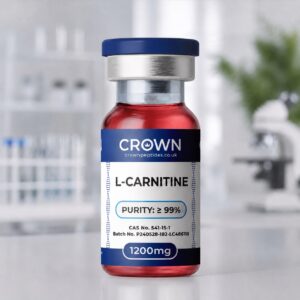
L-Carnitine (LC216) Research Compound
HPLC and MS verified · batch certificate published · dispatched from the UK before 2pm
Key Areas of L-Carnitine Research
Primary carnitine deficiency and inborn errors of fat metabolism. The clearest and best-established research area: L-Carnitine supplementation has been shown to improve skeletal muscle fat oxidation in patients with primary carnitine deficiency, directly addressing the underlying transport defect this rare genetic disorder causes.
Long-chain fatty acid oxidation disorders (LCFAOD). Extensive preclinical and clinical research has examined carnitine’s role in this broader category of fat-metabolism disorders, though reviewers have specifically noted there is still a relative lack of studies definitively supporting this therapeutic approach, and treatment is not without potential complications, including life-threatening arrhythmias or toxic intramitochondrial fatty acid accumulation in some contexts.
Non-alcoholic fatty liver disease (NAFLD) research. Because hepatic steatosis develops when fatty acid uptake, synthesis, and disposal fall out of balance, and because carnitine is specifically required to transport fatty acids into mitochondria for disposal via oxidation, researchers have proposed that relative carnitine insufficiency may contribute to NAFLD, with supplementation studied as a potential therapeutic strategy for promoting fatty acid oxidation and reducing hepatic fat accumulation.
Endothelial function and cardiovascular research. Research has examined whether mitochondrial dysfunction secondary to disrupted carnitine homeostasis contributes to decreased nitric oxide signalling and the development of endothelial dysfunction, connecting carnitine metabolism to broader cardiovascular research questions beyond fat metabolism alone.
Reproductive biology and ovarian ageing. Research examining oxidative stress associated with repeated ovulation found that oocyte maturation impairment induced by this process was suppressed by oral L-Carnitine administration, suggesting potential therapeutic relevance to infertility and age-related reproductive decline, though this remains a specific, comparatively early-stage research direction.
Neonatal and preterm infant metabolic support. Because L-Carnitine assists fatty acid transport, reduces oxidative stress, and maintains cellular energy homeostasis, research has examined its role in preterm infant management specifically, though reviewers have noted there remains no clear consensus on whether prophylactic use is warranted in this population, despite documented effects on neurodevelopment and complication prevention.
Methodology: distinguishing rare-disease treatment from broader metabolic research. A recurring theme worth restating throughout this literature: L-Carnitine’s role in correcting genuine carnitine deficiency states is well established and mechanistically clear. Its broader research applications in common metabolic conditions (NAFLD, cardiovascular health, general fat-oxidation enhancement in non-deficient individuals) rest on a considerably more exploratory and less conclusive evidence base.
Summary of Published L-Carnitine Studies
This table illustrates a genuinely two-tiered evidence picture common to several compounds in this article series: strong, mechanistically clear evidence for correcting a specific, genuine deficiency state (primary carnitine deficiency), alongside a considerably more mixed and exploratory literature for broader metabolic applications in individuals without a diagnosed carnitine deficiency.
Potential L-Carnitine Benefits for Metabolic Research
Based on the published literature, researchers have investigated L-Carnitine as a tool for studying:
- Mitochondrial fatty acid transport mechanisms and the carnitine shuttle system (CPT1, CACT, CPT2)
- Correction of genuine carnitine deficiency states and their metabolic consequences
- Fatty acid oxidation’s role in non-alcoholic fatty liver disease pathophysiology
- Mitochondrial dysfunction’s contribution to endothelial and cardiovascular health
- Acetyl-CoA buffering and its broader influence on cellular metabolic flexibility
As with the other compounds in this series, this is research investigating mechanisms, not evidence of an established treatment effect for general metabolic enhancement. None of the above constitutes a demonstrated therapeutic benefit for general metabolic enhancement under any regulatory framework.
Current Limitations of L-Carnitine Research
- Evidence for LCFAOD treatment remains limited despite mechanistic plausibility. Reviewers have specifically noted a lack of studies definitively supporting carnitine supplementation as a therapeutic approach for long-chain fatty acid oxidation disorders more broadly, despite the logical mechanistic rationale.
- Potential for serious complications in specific contexts. Carnitine supplementation in fatty acid oxidation disorders is not exempt from possible complications, including life-threatening arrhythmias or toxic intramitochondrial long-chain fatty acid accumulation — a genuine, documented safety consideration rather than a purely theoretical one.
- Oral supplementation does not fully normalise tissue carnitine levels in deficiency states. In primary carnitine deficiency specifically, oral pharmacological dosing can increase plasma carnitine levels nearly to normal but does not bring muscle carnitine concentration fully back to normal values, given the underlying transporter defect this disorder involves.
- No clear consensus exists for several proposed applications. Reviewers examining prophylactic use in preterm infants have specifically noted there is still no clear consensus on the need for this application, despite documented effects in some study contexts.
- Broader metabolic enhancement claims outpace the strongest evidence. Much of the commercial and informal discussion of L-Carnitine for weight management, exercise performance, and general metabolic enhancement in non-deficient individuals rests on a considerably thinner evidence base than its well-established role in genuine deficiency states.
L-Carnitine Side Effects Reported in Research
Within its established use for correcting genuine carnitine deficiency states, L-Carnitine has generally been well tolerated. However, research in long-chain fatty acid oxidation disorders specifically has documented potential complications including life-threatening arrhythmias or toxic intramitochondrial long-chain fatty acid accumulation in some contexts — a genuine, non-theoretical safety consideration for research protocols involving this specific patient population or disease model.
Any research protocol involving human or animal subjects should be developed with appropriate ethical and institutional review, following standard safety monitoring practices for investigational compounds, with particular attention to the documented complications associated with fatty acid oxidation disorder contexts specifically.
L-Carnitine Dosage Used in Published Research
This section is included for methodological context only and should not be interpreted as guidance for use.
Published research in primary carnitine deficiency has used oral pharmacological dosing under clinical supervision to correct plasma carnitine levels, with researchers noting this approach can raise plasma levels nearly to normal without fully normalising muscle tissue carnitine concentration. Reproductive biology research examining ovulation-related oxidative stress used oral L-Carnitine administration in animal models. These figures describe specific, clinically supervised protocols in specific patient populations or research models — they are not a basis for self-directed use in any context.
Researchers designing their own experimental protocols should base dosing decisions on the primary literature relevant to their specific model and objective, in consultation with institutional ethics review as applicable, rather than on secondary summaries such as this one.
Analogues and Future Research Directions
L-Carnitine sits alongside related compounds including acetyl-L-carnitine (its acetylated derivative, generated within the carnitine shuttle system itself and studied for distinct research applications) within the broader carnitine research family. Continued research clarifying which specific carnitine-family compound is most appropriate for which specific research question remains an active area of biochemical study.
- Larger, dedicated trials in LCFAOD populations. Given the specifically documented gap between mechanistic plausibility and confirmed clinical benefit for long-chain fatty acid oxidation disorders, adequately powered dedicated trials would meaningfully strengthen this specific application’s evidence base.
- Resolving the preterm infant prophylaxis question. Given the acknowledged lack of consensus on this specific application, further dedicated research would help clarify whether routine prophylactic use is genuinely warranted in this population.
- Dedicated NAFLD intervention trials. Given the logical mechanistic rationale connecting carnitine insufficiency to hepatic fat accumulation, dedicated interventional trials specifically testing carnitine supplementation’s effect on NAFLD progression would extend this currently more theoretical research connection into confirmed clinical territory.
- Further reproductive ageing research. Given the promising early finding regarding oocyte maturation and oxidative stress, further research extending this specific finding toward clinical infertility applications represents a genuinely interesting and comparatively underexplored research direction.
Frequently Asked Questions
Is L-Carnitine a peptide?
No. It’s an amino acid derivative, synthesised from lysine and methionine, chemically and structurally unrelated to peptides. It’s included in Crown Peptides’ research range because it’s frequently studied alongside peptides in mitochondrial and metabolic research contexts.
What does L-Carnitine actually do in the body?
Its core function is transporting long-chain fatty acids across the mitochondrial membrane via the carnitine shuttle system (involving CPT1, CACT, and CPT2), allowing these fatty acids to undergo beta-oxidation and generate cellular energy — a fundamental, well-established biochemical role.
What is primary carnitine deficiency?
It’s a rare, autosomal-recessive inborn error of fat metabolism caused by mutations in the SLC22A5 gene, resulting in a defective carnitine transporter (OCTN2) that restricts carnitine uptake into tissues and its reabsorption by the kidneys, leading to very low blood carnitine levels.
Does L-Carnitine help with weight loss?
This remains a considerably more mixed and less conclusive research area than its established role in genuine carnitine deficiency states. Much of the broader claimed metabolic-enhancement benefit rests on a thinner evidence base than its well-demonstrated role in correcting deficiency, and researchers should be cautious about extrapolating from deficiency-correction studies to general metabolic enhancement claims.
Is L-Carnitine safe?
In its established use correcting genuine deficiency, it has generally been well tolerated, but research in long-chain fatty acid oxidation disorders has documented potential complications including arrhythmias, making safety context-dependent rather than universally established across every proposed use.
Is L-Carnitine legal to purchase for research in the UK?
L-Carnitine is not a controlled substance under UK law and is available from suppliers as a research compound, sold explicitly for laboratory use rather than human consumption. Researchers should ensure their institution’s own procurement and ethics policies are followed regardless of a supplier’s terms of sale.
What is the difference between CPT1, CACT, and CPT2?
These are the three enzymatic components of the carnitine shuttle system: CPT1 couples fatty acyl-CoA to carnitine on the outer mitochondrial membrane; CACT transports the resulting acylcarnitine across the inner mitochondrial membrane; and CPT2 uncouples the fatty acyl group from carnitine once inside the mitochondrial matrix, allowing beta-oxidation to proceed.
Why is CPT1 considered the rate-limiting step in fatty acid oxidation?
In the liver specifically, CPT1 has been found to exert approximately 80% of the control over the beta-oxidation rate under normal physiological conditions, making it a disproportionately important regulatory bottleneck compared to other steps in the pathway.
Does L-Carnitine have a role beyond fatty acid transport?
Yes. It also buffers excess acetyl-CoA by converting it to acetylcarnitine via carnitine acetyltransferase, helping regulate the cellular acetyl-CoA/CoA ratio — a secondary but genuinely important metabolic regulatory function distinct from its primary fatty-acid-shuttling role.
Where does the body get L-Carnitine from?
It is synthesised endogenously in the liver and kidneys from the amino acids lysine and methionine, and is also obtained from dietary sources, particularly red meat and dairy products.
Is oral L-Carnitine sufficient to fully correct carnitine deficiency?
Not completely, in cases involving a genetic transporter defect. Research in primary carnitine deficiency has found that oral pharmacological dosing can raise plasma carnitine levels nearly to normal, but does not fully normalise muscle tissue carnitine concentration, given the underlying transporter defect this specific disorder involves.
How does L-Carnitine relate to peptides like SS-31 and MOTS-c in mitochondrial research?
They intervene at genuinely different points in the same broader system. L-Carnitine governs substrate delivery, determining how much fatty acid actually reaches mitochondria for oxidation. SS-31 works structurally, stabilising the inner mitochondrial membrane. MOTS-c works as a signalling molecule, influencing metabolic gene expression. Researchers studying mitochondrial dysfunction comprehensively might consider all three as complementary, non-overlapping tools.
Why Compound Sourcing Quality Matters for Research Validity
As a small-molecule amino acid derivative rather than a synthesised peptide chain, L-Carnitine’s research validity depends on different quality considerations than the peptides discussed elsewhere in this series, but independent verification remains equally important.
Common failure modes relevant to L-Carnitine specifically include:
- Inaccurate concentration labelling — without independent analytical confirmation, there’s no reliable way to verify that a research sample contains the labelled concentration of L-Carnitine.
- Stereochemistry errors — L-Carnitine’s biological activity depends specifically on its L-form (rather than D-form) stereochemistry, and verifying correct stereochemical purity is a distinct quality consideration for this compound.
- Synthesis impurities — as with any manufactured research compound, inadequate purification during production can leave process-related impurities in the final product.
- Degradation during storage — improper storage conditions can degrade any research compound over time in ways that aren’t visible on inspection.
Given how directly L-Carnitine research depends on precise dosing to correct or model specific metabolic states, independent verification of identity, purity, and correct stereochemistry is a basic precondition for research findings to be meaningfully interpretable.
Read the certificate before you order
Every batch is published openly — identity by mass spectrometry, purity by HPLC, and the batch number printed on the vial you receive.
Open the COA libraryWhy Choose Crown Peptides
Testing is only part of the picture. Crown Peptides was built around a simple idea: a UK researcher ordering a peptide should be able to trust everything about how it reached them — not just the number on a Certificate of Analysis, but who made it, how it was handled, how it travelled, and who they can speak to if they have a question. That’s the standard we hold ourselves to on every order, and it’s worth explaining properly rather than just listing it.
Sourcing You Can Trust
Quality starts long before a product reaches our warehouse. We work directly with one of the world’s largest and most established peptide synthesis manufacturers, chosen specifically for its production standards, consistency, and track record — rather than sourcing opportunistically from whichever manufacturer happens to offer the lowest price that month. That close, ongoing partnership is what allows us to stand behind every batch we sell, because we know exactly how it was made.
Verified Through Independent Testing
We don’t expect researchers to take a manufacturer’s word for it, so we verify every batch independently before it’s listed for sale:
Endotoxin Testing
Every batch is screened for bacterial endotoxin, which matters in particular for any research involving cell culture, immune signalling, or in vivo inflammatory endpoints.
HPLC Purity Analysis
High-performance liquid chromatography is used to assess purity and screen for synthesis by-products and contaminants.
Mass Spectrometry Identity Confirmation
MS analysis confirms the molecular identity of the supplied compound matches L-Carnitine, providing an independent check on identity beyond the label.
Certificate of Analysis
Every batch is supplied with a Certificate of Analysis, and a QR code linking directly to the testing report on crownpeptides.co.uk, so researchers can document exactly what was used in their own experimental records.
Careful Storage and Handling
A product that’s been correctly synthesised and tested can still be let down by poor handling afterward. Once a batch clears testing, we store it under controlled conditions designed to preserve stability and prevent degradation before it ever reaches a researcher’s bench. This matters more for peptides and sensitive research compounds than for most laboratory reagents: temperature excursions, light exposure, and poor stock rotation can all silently reduce integrity long before a vial is opened, in ways that aren’t visible on inspection and can quietly undermine an experiment’s results. We treat that storage window as part of the product, not an afterthought once testing is done.
Packaging and Delivery
Every order is packed in premium, discreet packaging designed to protect the product in transit and arrive intact. Orders placed before 2pm are dispatched the same working day for next-day UK delivery, and we ship to Northern Ireland, the Republic of Ireland, Scotland, England, and across the EU, with international shipping available beyond that. For a researcher working to a study timeline, knowing an order will arrive quickly, safely, and exactly as ordered isn’t a convenience — it’s part of keeping a research schedule on track.
Support That Goes Beyond the Sale
Peptide and research-compound work raises genuine practical questions — around reconstitution, storage, handling, and interpreting a Certificate of Analysis — and we’d rather a researcher ask us directly than guess. Our team is on hand to provide clear, straightforward guidance from product selection through to delivery and beyond, without the evasiveness or upsell pressure that can come with some suppliers in this space. We see that ongoing relationship, not just the transaction, as the actual job.
Regulatory Compliance and Transparency
Crown Peptides is a UK-based company operating in line with MHRA guidance on research chemicals. Every product is clearly labelled for laboratory research use only, sold on the basis that the purchaser is a qualified professional legally able to handle these materials, and never marketed, described, or sold as suitable for human consumption, therapeutic use, or diagnostic application. We’d rather be transparent about what we sell and who it’s for than blur that line to chase a wider customer base — that’s a deliberate choice on our part, not a legal minimum we begrudgingly meet.
Our Commitment
Put simply, our mission is to supply the UK research community with peptides and research compounds of unmatched purity and consistency, backed by a level of service, transparency, and technical support that researchers can actually rely on — from the first email enquiry to the vial arriving on the bench. That standard applies whether an order is a single vial for an independent researcher or a bulk order for a laboratory, and it holds regardless of whether a customer ever finds out how much work sits behind it.
Crown Peptides’ products are supplied strictly for laboratory research and are not sold, labelled, or intended for human consumption, diagnosis, treatment, or prevention of disease. For researchers who want their results to be reproducible and their experimental record defensible, knowing precisely what’s in the vial — and trusting that everyone who handled it got it right — is a basic, non-negotiable starting point.
Ready to order? View batch testing and pricing on crownpeptides.co.uk
References
- “L-Carnitine Improves Skeletal Muscle Fat Oxidation in Primary Carnitine Deficiency.” The Journal of Clinical Endocrinology & Metabolism. https://academic.oup.com/jcem/article/103/12/4580/5095443
- “The Importance of the Fatty Acid Transporter L-Carnitine in Non-Alcoholic Fatty Liver Disease (NAFLD).” PMC. https://www.ncbi.nlm.nih.gov/pmc/articles/PMC7469009/
- “Carnitine in Mitochondrial Fatty Acid Transport and β-Oxidation.” Encyclopedia MDPI. https://encyclopedia.pub/entry/15462
Working with L-Carnitine (LC216) Research Compound
Batch-tested material, published certificates, and same-day dispatch on orders placed before 2pm.
See L-Carnitine (LC216) Research Compound