Research Peptides
A high-purity research compound studied in fat-metabolism and energy research. Available in 216mg, with every batch independently tested and dispatched from the UK.
LC216 Lipo-B compound UK is Crown Peptides' multi-component lipotropic and vitamin blend, supplied as a 216mg formulation per vial for laboratory research.
Supplied for laboratory research purposes only — not for human consumption or for medical, veterinary or diagnostic use.
LC216 — also referred to as Lipo-B — is a multi-component research formulation combining L-Carnitine, L-Arginine, Methionine, Inositol, Choline and a selection of B vitamins in a single ready-prepared aqueous solution. Unlike a single-compound product, LC216's research interest comes from the combined biochemical roles of its components across amino acid, lipotropic and vitamin pathways.
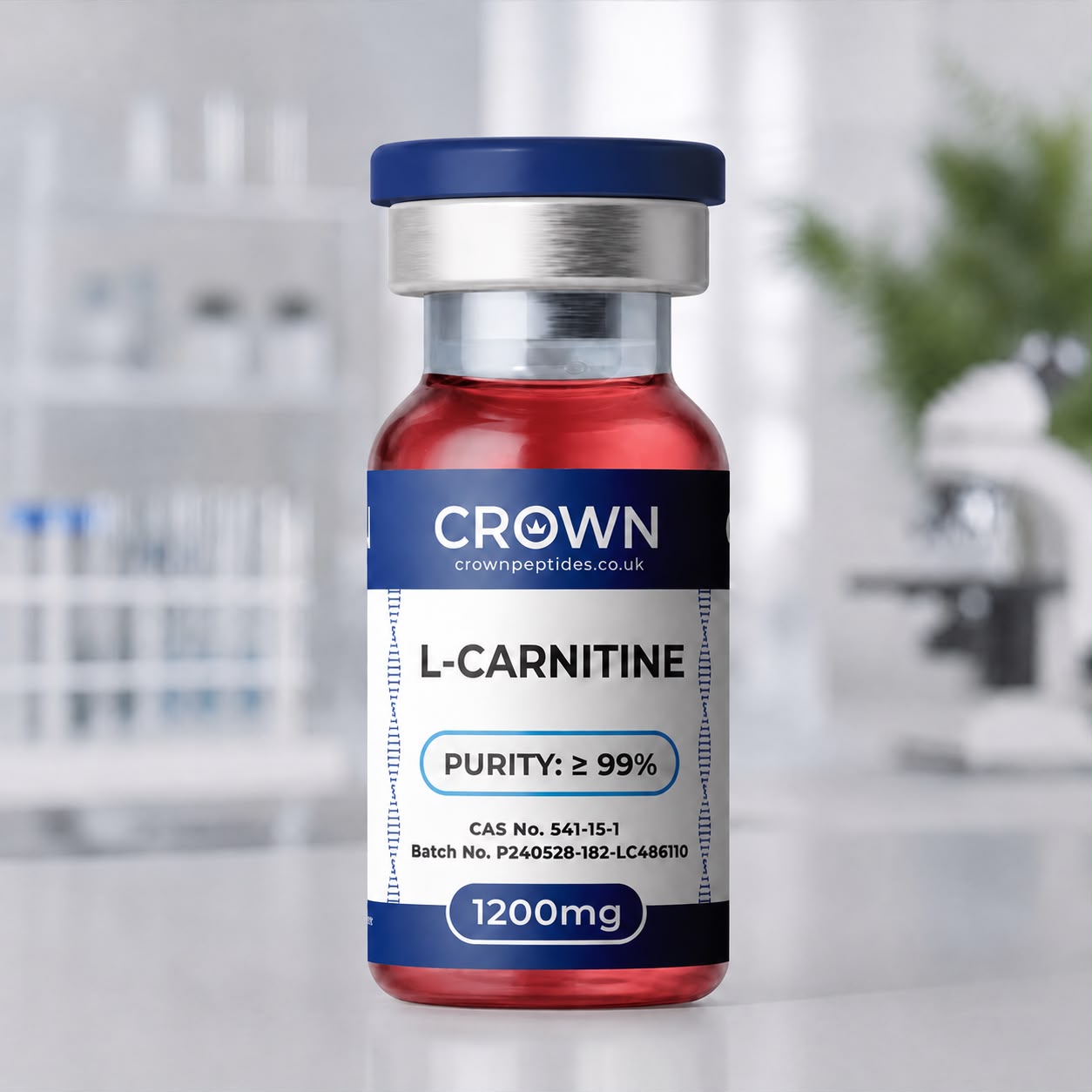
Also known as: L Carnitine, levocarnitine, carnitine.
LC216’s individual components each carry their own research literature: L-Carnitine and the carnitine shuttle in mitochondrial fatty-acid transport, and methionine, choline and inositol as classic lipotropic factors studied for their role in hepatic lipid handling, reviewed extensively in the lipotrope research literature (Learn more). B vitamins including B6, B5 and B12 are studied for their roles as metabolic cofactors. LC216 is studied alongside other metabolic research compounds such as MOTS-c and NAD+.
Long-chain fatty acids are first activated to acyl-CoA in the cytosol, but in that form they cannot pass the inner mitochondrial membrane. Carnitine is the ferry. Carnitine palmitoyltransferase 1 (CPT1), on the outer membrane, swaps the CoA for carnitine to make an acylcarnitine. The carnitine-acylcarnitine translocase (CACT, encoded by SLC25A20) then exchanges each incoming acylcarnitine for a free carnitine heading back out. On the matrix side, CPT2 rebuilds the acyl-CoA for beta-oxidation and frees the carnitine for another trip. Short- and medium-chain fatty acids largely bypass the system.
CPT1 is the control point. It comes in liver (1A), muscle (1B) and brain (1C) forms, and it is held back by malonyl-CoA, the first committed intermediate of fatty-acid synthesis, a link worked out by J. Denis McGarry and Daniel Foster. The logic is neat: a cell busy making fat does not ferry the same fat into mitochondria to break it down. Carnitine itself enters cells through the transporter OCTN2 (SLC22A5), and loss-of-function variants in that gene cause primary systemic carnitine deficiency, a disorder that shows how much tissues depend on the shuttle.
Carnitine does not only carry long fatty chains. Inside the matrix, carnitine acetyltransferase (CrAT) converts acetyl-CoA into acetylcarnitine, a form that can leave the mitochondrion. Deborah Muoio’s group at Duke found that mice lacking CrAT in skeletal muscle handled glucose less well and switched poorly between fuels, and proposed that CrAT lets surplus acetyl groups escape before they inhibit pyruvate dehydrogenase (Muoio et al., Cell Metabolism). In that model, free carnitine acts as a buffer for the mitochondrial acetyl-CoA pool rather than simply a transporter.
The same chemistry makes acylcarnitines superb diagnostic markers. Because each fatty acid travels as a carnitine ester of a particular chain length, a blockage at one oxidation step shows up as a pile-up of one species. Tandem mass spectrometry of acylcarnitines underpins newborn screening for fatty-acid oxidation disorders; an excess of octanoylcarnitine (C8), for example, points to medium-chain acyl-CoA dehydrogenase deficiency. Research labs use the same profiles to see where fuel is backing up in cells and tissues.
The word “lipotropic” grew out of 1930s Toronto, where Charles Best, co-discoverer of insulin, and colleagues found that choline stopped the livers of depancreatised dogs from filling with fat. Methionine and inositol joined the list as nutrients that hasten fat removal from the liver or limit its deposition there, largely by supporting phospholipid synthesis through methylation reactions.
The mechanism is now well mapped. The liver packages triglyceride for export inside VLDL particles, and those particles need a phosphatidylcholine coat. Choline supplies that headgroup directly; methionine supplies it indirectly, because SAM-driven methylation can convert phosphatidylethanolamine into phosphatidylcholine. Inositol is the building block of phosphatidylinositol and its signalling derivatives. The idea still shapes modern research: a diet deficient in methionine and choline is one of the most widely used ways to induce steatohepatitis in mice, offering a direct experimental mirror of what the lipotropes supply.
The components of LC216 meet in a single metabolic network. Methionine is converted to SAM, the main methyl donor in cells, and after donating its methyl group it becomes homocysteine. Methylcobalamin is the cofactor methionine synthase uses to turn homocysteine back into methionine with a methyl group from folate, while choline, via betaine, offers a second recycling route.
Carnitine synthesis draws on the same pool. Lysine residues within proteins are trimethylated using SAM, and the trimethyllysine liberated by protein turnover is converted to carnitine in four steps; one of them, an aldolase reaction, depends on pyridoxal phosphate, the active form of vitamin B6. The final step occurs mainly in liver, kidney and brain. Arginine ties in through creatine synthesis, which ends with a SAM-dependent methylation, and through nitric oxide synthase, which uses it as substrate. Dexpanthenol, a precursor of pantothenic acid, completes the picture, since pantothenate is needed to build the coenzyme A that CPT1 trades for carnitine.
Compound-level reference data. Batch-specific results appear on the Certificate of Analysis.
Work out concentration with the peptide calculatorResearchers working with LC216 may also be interested in MOTS-c, NAD+, 5-Amino-1MQ, SS-31 and Methylene Blue — other compounds studied in cellular metabolism and mitochondrial-energy research.
LC216, also sold as Lipo-B or LC-216, is a ready-made aqueous research solution that combines L-Carnitine with L-Arginine, L-Methionine, Inositol, Choline and three B vitamins. The number matches the label: the eight components add up to 216mg per vial. It is designed for work on fatty-acid transport, lipotropic liver biochemistry and vitamin cofactor pathways in one preparation.
L-Carnitine gives the product its name, but by weight the larger shares belong to Inositol and Choline at 50mg each, followed by L-Methionine, Vitamin B6 and Vitamin B5 at 25mg each. L-Arginine matches carnitine at 20mg, and Vitamin B12 (as methylcobalamin) makes up the final 1mg. Researchers looking for a single-compound carnitine material should bear that ratio in mind when designing controls.
The label describes an effect first seen in animals: these nutrients help clear fat from the liver or stop it accumulating. Choline and methionine both feed the production of phosphatidylcholine, which the liver needs to wrap triglyceride into exportable lipoprotein particles, and inositol is the base of the phosphatidylinositol family of membrane lipids.
Not quite. Vitamin B5 is pantothenic acid; dexpanthenol is its alcohol counterpart, which is oxidised to pantothenic acid in biological systems. Pantothenate is the starting material for coenzyme A, the very carrier that CPT1 exchanges for carnitine at the outer mitochondrial membrane.
Cyanocobalamin is a manufactured, very stable form of B12 that must be converted before cells can use it. Methylcobalamin is one of the two natural coenzyme forms, the one that methionine synthase uses directly when it regenerates methionine from homocysteine. That makes it a logical partner for the methionine and choline in this formulation.
Methyl groups and fuel handling are the common thread. Methionine, choline and B12 keep the SAM methyl-donor cycle turning, B6 and SAM are both needed to make carnitine, carnitine and the coenzyme A built from B5 move fatty acids into mitochondria, and arginine feeds creatine and nitric oxide pathways. Each piece has its own literature, but together they cover one connected stretch of metabolism.
It acts as a temporary handle. CPT1 attaches long-chain fatty acids to carnitine as acylcarnitines, the CACT translocase carries them across the inner membrane in exchange for free carnitine, and CPT2 hands the fatty acid back to coenzyme A in the matrix. Without carnitine, long-chain fats stay stranded in the cytosol.
Carnitine has one chiral centre, so it exists as two mirror-image forms. Animal cells make, transport and use only the L-form, which is the version found in meat and the one the shuttle enzymes recognise. D-carnitine is not part of normal metabolism, so research material should be the single L-isomer, which is what LC216 contains.
It was isolated from meat extract in 1905 and named after the Latin carnis, meaning flesh. Its structure was settled in 1927. Decades later, insect nutritionists found that yellow mealworms needed an unknown growth factor they called vitamin BT, after Tenebrio; in 1952 it turned out to be carnitine.
Mammals build it from two amino acids. Lysine side chains in proteins receive three methyl groups from SAM, which comes from methionine, and the trimethyllysine freed when those proteins are degraded passes through four enzymatic steps, one needing pyridoxal phosphate from vitamin B6. In humans the last step happens mainly in liver, kidney and brain, and other tissues import carnitine through the OCTN2 transporter.
They share the molecule, but the regulatory status is different. Levocarnitine is licensed in the US as Carnitor for primary systemic carnitine deficiency and for secondary deficiency caused by certain inborn errors of metabolism. LC216 is a multi-component laboratory formulation and is not that medicine or any licensed product.
Both carry a trimethylamine group that intestinal bacteria can cleave off as trimethylamine (TMA), which the liver oxidises to TMAO. A 2013 Nature Medicine study showed that dietary L-carnitine raised TMAO and accelerated atherosclerosis in mice, an effect that disappeared when the gut microbiota was suppressed. LC216 holds both of these TMA precursors in a single solution.
Through SAM. Methionine is the raw material for S-adenosylmethionine, and 5-Amino-1MQ blocks NNMT, an enzyme that uses up SAM when it methylates nicotinamide. One raises the supply side of the methyl pool and the other trims a major drain, so labs mapping SAM:SAH balance sometimes consider both.
The weak point is the methylcobalamin. Its cobalt–methyl bond breaks when exposed to light, converting it to hydroxocobalamin, and stability studies using HPLC have reported a half-life of around an hour under strong light. Keeping the vial in its carton at 2–8°C, as the storage section advises, protects the B12 content most of all.
Because this is a mixture, small batch-to-batch differences in any of eight components could blur comparisons over time. Ordering a five- or ten-vial pack keeps a whole study on one lot with one Certificate of Analysis, while the single 216mg vial suits a pilot experiment or a first look at the formulation.
Every batch is published openly — identity, purity and batch number, with no account needed.
Supplied for laboratory research purposes only — not for human consumption or for medical, veterinary or diagnostic use.
Each batch undergoes internal analytical verification using chromatographic and spectrometric methods prior to lyophilisation.
• HPLC Analysis
• Mass Spectrometry Confirmation
• Batch Traceability
By purchasing this product you confirm that you are a qualified researcher and that this compound will be used exclusively for laboratory research purposes.
This product is not intended for diagnostic or therapeutic use.
Any human or medical use is strictly prohibited.
Store in a cool, dry, secure and sterile environment away from any unauthorised persons or children.
Disclaimer: All products are sold strictly for laboratory research purposes only. Not for human or veterinary use, consumption, therapeutic, or diagnostic application. None of our products are medicines, and none are presented as such. By purchasing, you confirm you are a qualified professional and legally permitted to handle these materials in compliance with all applicable laws and regulations. Misuse, resale for unauthorised purposes, or unlawful application is strictly prohibited. Crown Peptides UK disclaims all liability for improper use, handling, or regulatory non-compliance.