Register today and get 10% off your first orderRegister for 10% off your first orderRegister now
Crown Peptides
SAVE20%

Research Peptides

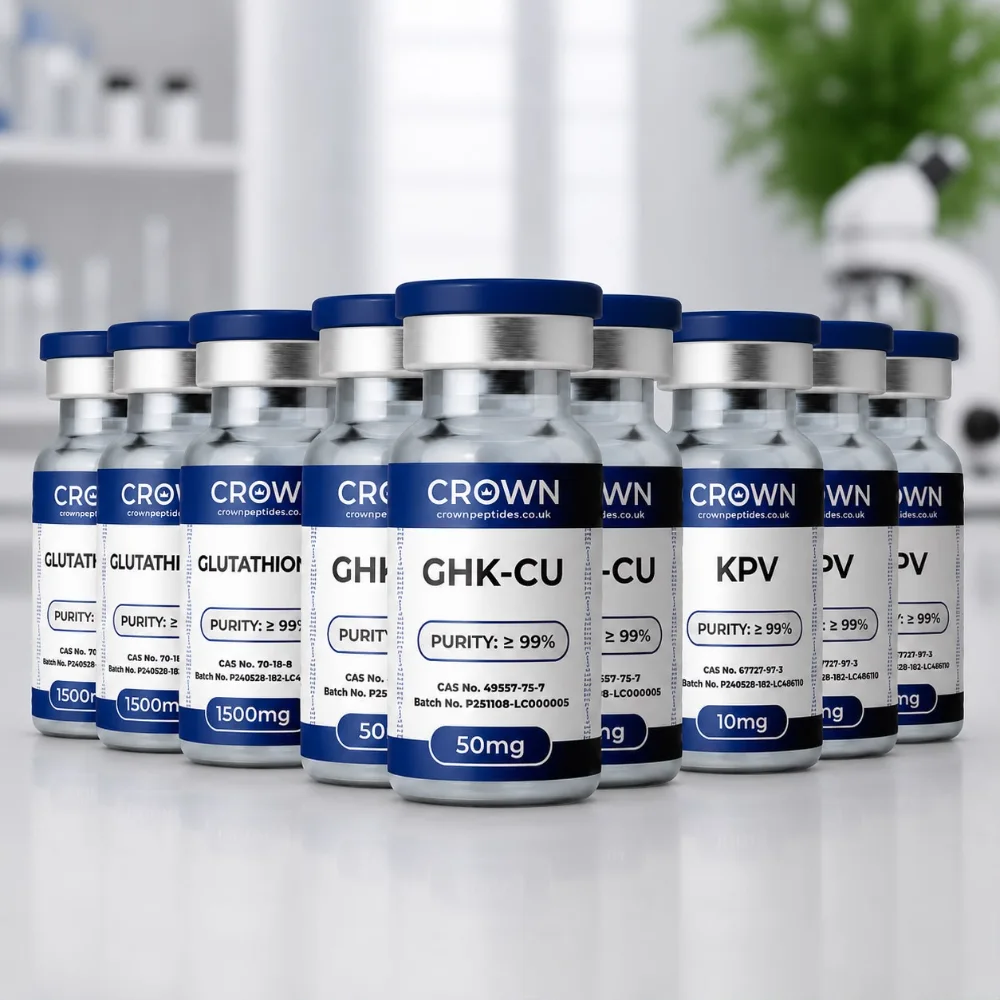
Dermal & Cellular Research Bundle x 9 Vials (GHK-Cu 50mg / KPV 10mg / Glutathione 1500mg)

Three complementary research peptides studied in skin, collagen and antioxidant research. Save 20% compared with buying the nine vials individually, with every batch independently tested and dispatched from the UK.

Original price was: £296.91.£237.53Current price is: £237.53.

In stock

Batch level verified
All Batches TestedEvery batch, no exceptions
HPLC & MS VerifiedFull certificate published
Same Day PostageOrder before 2pm
UK Based CompanyDispatched from the UK
Product Overview

Three complementary research peptides studied in skin, collagen and antioxidant research. Save 20% compared with buying the nine vials individually, with every batch independently tested and dispatched from the UK.

Full Product Specification
Overview

Product Overview

Dermal & Cellular Research Bundle UK is Crown Peptides' 9-vial research bundle bringing together GHK-Cu, KPV and Glutathione, supplied as 3 × GHK-Cu 50mg, 3 × KPV 10mg and 3 × Glutathione 1500mg for laboratory research into tissue remodelling, inflammatory signalling and cellular antioxidant defence.

9 vials3 of each compoundHPLC testedChromatographic purityMS verifiedIdentity confirmedBatch CoADocumentation supplied

Supplied for laboratory research purposes only — not for human consumption or for medical, veterinary or diagnostic use.

Key features

Key Features

  • Studied in research involving collagen, extracellular-matrix and fibroblast biology
  • Studied in research involving inflammatory mediators and skin or barrier models
  • Studied in research involving redox cycling and oxidative-stress models
  • Suited to comparative and combined work across tissue, immune and antioxidant pathways
  • Batch-specific quality documentation available for each vial
Background

About the Dermal & Cellular Research Bundle UK

Skin and tissue research rarely comes down to a single pathway. Matrix remodelling, local inflammation and oxidative stress all feed into one another, and this bundle groups three well-characterised compounds that each map to one of those areas. GHK-Cu is the copper complex of the naturally occurring tripeptide Gly-His-Lys, long studied in collagen and tissue-remodelling models. KPV is the Lys-Pro-Val tripeptide from the C-terminal end of alpha-melanocyte-stimulating hormone, investigated for its anti-inflammatory signalling. Glutathione is the gamma-Glu-Cys-Gly tripeptide at the centre of cellular thiol and antioxidant biochemistry.

Supplied together, they give researchers one consistently documented set of materials for studying how structure, inflammation and redox balance influence each other in cellular and tissue models.

Research

Dermal & Cellular Bundle Research

GHK-Cu: the matrix-building member of the set, best known from early fibroblast work in which the copper tripeptide raised collagen synthesis (Learn more). Its copper chemistry and remodelling research get full treatment on the GHK-Cu page.

KPV: here it supplies the inflammation-signalling dial, with its best-documented findings coming from mouse colitis studies (Learn more) and later work in keratinocytes and other barrier cells. The full background sits on the KPV product page.

Glutathione: the redox member, and one with a direct skin-cell link, since in cultured human skin fibroblasts it guarded the cells against UVB and UVA damage (Learn more). The GSH/GSSG couple and its enzymes are explained on the Glutathione page.

  • Collagen and extracellular-matrix research
  • Inflammatory mediator and barrier models
  • Oxidative-stress and redox-signalling research
  • Fibroblast and skin-cell biology
Structure, signal and redox: three sides of one tissue

In fibroblast and skin-equivalent cultures, the three processes this set covers rarely move on their own. Inflammatory cytokines such as IL-1 and TNF-alpha push fibroblasts to release matrix metalloproteinases that break collagen down, oxidative stress drives the same enzymes and feeds inflammatory signalling in turn, and the matrix sends cues back to the cells embedded in it. The bundle splits that loop into three handles. GHK-Cu is the tool for questions about matrix synthesis and turnover, KPV for asking how much of a change depends on inflammatory signalling, and glutathione for setting or probing the redox state of the culture. Used side by side, they help a study separate cause from consequence: if collagen output falls under a cytokine challenge, is it rescued by restoring matrix signals, by quietening the inflammatory input, or only by correcting redox balance?

Copper meets a thiol: a chemistry check first

Glutathione is a strong reducing agent and a capable copper ligand. In solution its cysteine thiol can reduce copper(II) to copper(I) and bind the reduced metal, forming copper–glutathione complexes while part of the glutathione is oxidised to GSSG. GHK holds its copper very tightly, but whether a large excess of glutathione can strip or reduce some of it under your particular buffer, pH and timing is something to measure rather than assume. Copper cycling with thiols can also generate reactive oxygen species, which would muddy any redox readout. We know of no published work characterising this exact pairing, so three habits are worth adopting: dissolve and store the two separately, add them to cultures as separate additions rather than one pre-mixed stock, and run a cell-free GHK-Cu-plus-glutathione control checked by UV-visible absorbance or LC-MS before interpreting any biology.

A nine-arm layout for a cytokine or UV challenge

A clean starting design uses an untreated control, a challenge-only group (an inflammatory cytokine or a measured UV exposure), each compound alone under challenge, the three pairs, and all three together. Readouts should cover every pathway in every arm: pro-collagen I secretion or hydroxyproline for matrix, MMP-1 and IL-6 or IL-8 for inflammatory tone, and intracellular GSH:GSSG or a ROS-sensitive dye for redox state. An arm that only reports collagen cannot show whether a change travelled through inflammation or oxidation, which is the whole reason for grouping these compounds. Three vials of each suit a pilot, main run and reserve pattern: the first set for single-agent concentration finding, the second for the full factorial experiment, and the third left sealed so a repeat uses material from the same supply.

Molar maths: why glutathione dwarfs the other two

Label weights hide a large molar spread. A 50mg GHK-Cu vial (about 401.9 g/mol as the copper complex) holds roughly 124 micromoles, a 10mg KPV vial (about 342.4 g/mol) close to 29 micromoles, and a 1500mg glutathione vial (about 307.3 g/mol) almost 4.9 millimoles: around 39 times the GHK-Cu and more than 160 times the KPV, molecule for molecule. That reflects use rather than imbalance. Cells keep glutathione in the millimolar range, so experiments that add it to media or buffers work at that scale, whereas the two signalling peptides are tested at far lower concentrations. A vial’s stated mass can include counter-ions and residual water, so check net content on each Certificate of Analysis before calculating molarity.

Specifications

Specifications

Product
Dermal & Cellular Research Bundle
Contents
3 × GHK-Cu 50mg, 3 × KPV 10mg and 3 × Glutathione 1500mg (9 vials in total)
GHK-Cu
Copper-binding tripeptide complex (Gly-His-Lys)
CAS 89030-95-5
KPV
Tripeptide fragment of alpha-melanocyte-stimulating hormone (Lys-Pro-Val)
CAS 67727-97-3
Glutathione
Naturally occurring tripeptide (gamma-Glu-Cys-Gly)
CAS 70-18-8
Classification
Multi-compound research bundle of three tripeptide research compounds
Bundle size
9 vials (3 of each compound)
Form
Research material supplied according to product label
Purity and assay
Batch-specific — refer to the Certificate of Analysis for each compound
Verification
HPLC and Mass Spectrometry where analytically appropriate

Compound-level reference data. Batch-specific results appear on the Certificate of Analysis.

Work out concentration with the peptide calculator
Testing

Purity and Testing

Each compound in the Dermal & Cellular Research Bundle is supplied for controlled laboratory research with its own batch-specific analytical documentation. High-Performance Liquid Chromatography (HPLC) can assess chromatographic purity, while Mass Spectrometry provides molecular information used to support identity verification. That matters in combined work: when three compounds are studied side by side, confirmed identity and purity for each one keeps every result attributable to the right material.

The batch-specific Certificate of Analysis is the definitive source for the exact purity result, identity data and analytical specification of each material supplied.

Storage

Storage Conditions

  • Store each unreconstituted compound according to its product label and batch-specific documentation
  • Prepared research solutions should use validated storage conditions appropriate to the compound and study design
  • Protect from unnecessary heat, direct light and repeated temperature fluctuations
Full storage guide
Related

Related Compounds

Researchers working with this bundle may also be interested in GHK-Cu, KPV, Glutathione, GLOW and KLOW — the individual compounds in this bundle, plus two multi-peptide blends built around GHK-Cu.

Compliance

Research Use Only

  • Laboratory research only
  • Not for human or clinical use
  • Not for human or veterinary consumption
  • Qualified personnel only
Questions

Dermal & Cellular Research Bundle Frequently Asked Questions

About the Dermal & Cellular Research Bundle5 questions
What does the Dermal & Cellular Research Bundle contain?

Nine vials: three of GHK-Cu at 50mg, three of KPV at 10mg and three of Glutathione at 1500mg, each with its own label and batch documentation. All three are tripeptides, though glutathione links its first two residues through an unusual gamma bond.

Why put a copper peptide, an inflammation fragment and an antioxidant in one set?

Matrix damage in skin models is usually driven by inflammation and oxidative stress acting together. Giving a lab one tool for each of those inputs makes it possible to test which one actually controls the matrix outcome, instead of guessing from a single compound.

Is this the same as buying GLOW or KLOW?

Not at all. GLOW and KLOW are single-vial blends at fixed ratios built around GHK-Cu with BPC-157 and TB-500 (KLOW adds KPV). This bundle keeps every compound in its own vial, so each concentration can be set independently, and it adds glutathione, which neither blend contains.

Has anyone published research on GHK-Cu, KPV and glutathione together?

Not as a trio, as far as we can find. GHK-Cu and KPV appear together in commercial blends, but peer-reviewed studies of the combination are lacking, and each compound’s evidence comes from its own separate literature. Single-agent arms therefore carry real weight in any design using this set.

How does the nine-vial price compare with single products?

The bundle costs 20% less than the same nine vials ordered individually, and the whole set arrives in one consignment with documentation for each compound, which simplifies record-keeping for a multi-arm study.

Setting up a skin-cell study3 questions
Which cell systems can test all three compounds?

Primary human dermal fibroblasts are the natural starting point, because all three pathways are active in them. Keratinocyte lines such as HaCaT add the epidermal side, and fibroblast–keratinocyte co-cultures or 3D skin equivalents let matrix, inflammatory and redox readouts be taken from one tissue-like system.

Why does a skin-focused set include KPV, when so much of its literature is about the gut?

KPV’s anti-inflammatory activity was in fact explored in skin before the gut became its main arena. In this bundle its job is narrow: it is the switch that tells you whether a matrix or redox effect depends on inflammatory signalling. Running it with and without a cytokine challenge answers that directly.

Can the blue colour of GHK-Cu affect plate-based assays?

Concentrated GHK-Cu solutions are visibly blue, and colorimetric methods such as Sirius Red collagen staining or MTT viability readings depend on absorbance. At typical working concentrations the effect is usually small, but a compound-only blank in every plate removes the doubt.

Quantities and assay quirks2 questions
Will the glutathione outlast the peptide vials?

Almost certainly. Three 1500mg vials hold about 14.6 millimoles in total, so even experiments run at millimolar concentrations rarely exhaust them, whereas the GHK-Cu and KPV are the vials whose use deserves planning. Weigh out glutathione as needed rather than dissolving a whole vial.

Why might glutathione added to medium not raise levels inside the cells?

Many cell types break extracellular glutathione down at the surface and rebuild it inside, so the amount added is not the amount that ends up in the cytoplasm. Measuring intracellular GSH:GSSG directly in each arm is far more reliable than inferring it from what went into the well.

Read the batch certificate before you order

Every batch is published openly — identity, purity and batch number, with no account needed.

View lab reports

Supplied for laboratory research purposes only — not for human consumption or for medical, veterinary or diagnostic use.

All Batches Purity Tested

Each batch undergoes internal analytical verification using chromatographic and spectrometric methods prior to lyophilisation.

• HPLC Analysis
• Mass Spectrometry Confirmation
• Batch Traceability

For Research Use Only

By purchasing this product you confirm that you are a qualified researcher and that this compound will be used exclusively for laboratory research purposes.

Not for Human Consumption

This product is not intended for diagnostic or therapeutic use.

Any human or medical use is strictly prohibited.

Store Safely at All Times

Store in a cool, dry, secure and sterile environment away from any unauthorised persons or children.

Other Research Peptides

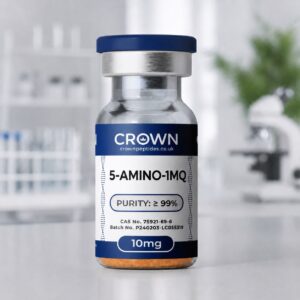
5-Amino-1MQ research compound UK 10mg and 50mg vial - Crown Peptides
≥99% PURITY
HPLC & MS TESTED
5-Amino-1MQ Research Compound
From: £24.99

Buy Now

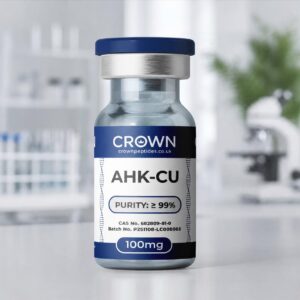
AHK-Cu 100mg research peptide vial – Crown Peptides UK
≥99% PURITY
HPLC & MS TESTED
AHK-Cu Research Peptide
From: £29.99

Buy Now

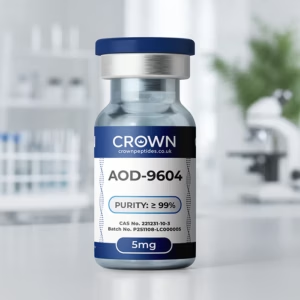
AOD-9604 5mg research peptide vial - Crown Peptides
≥99% PURITY
HPLC & MS TESTED
AOD-9604 Research Peptide
From: £34.99

Buy Now

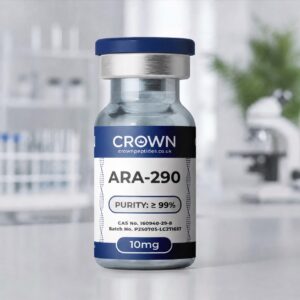
ARA-290 research peptide UK 10mg vial - Crown Peptides
≥99% PURITY
HPLC & MS TESTED
ARA-290 Research Peptide
From: £39.99

Buy Now

SUPPORT Mon to Fri, 9am to 5pmDISPATCH Cut-off 2pmEMAIL info@crownpeptides.co.ukWHATSAPP +44 7301 802654

Disclaimer: All products are sold strictly for laboratory research purposes only. Not for human or veterinary use, consumption, therapeutic, or diagnostic application. None of our products are medicines, and none are presented as such. By purchasing, you confirm you are a qualified professional and legally permitted to handle these materials in compliance with all applicable laws and regulations. Misuse, resale for unauthorised purposes, or unlawful application is strictly prohibited. Crown Peptides UK disclaims all liability for improper use, handling, or regulatory non-compliance.

© 2026 Crown Peptides UK, a trading name of Crown Peptides Ltd (company no. 17068950), Suite Ra01, 195-197 Wood Street, London E17 3NU . All Rights Reserved.