Dihexa Research Peptide
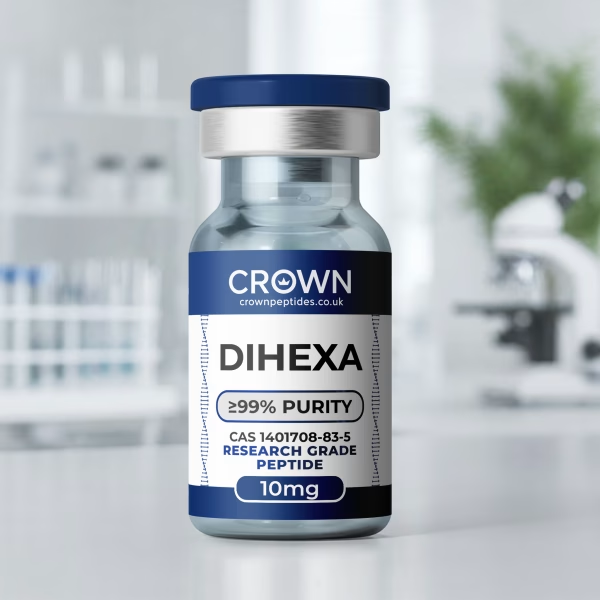
Dihexa research peptide, an angiotensin IV-derived oligopeptide studied in cognitive, synaptic and growth-factor signalling research. Supplied in 10mg and 20mg, HPLC and Mass Spectrometry verified with a batch-specific Certificate of Analysis.
Out of stock
Supplied for laboratory research purposes only — not for human consumption or for medical, veterinary or diagnostic use.
Product Overview
Dihexa UK is Crown Peptides’ angiotensin IV-derived research oligopeptide, supplied in 10mg and 20mg for laboratory research.
- Studied in research involving the brain renin-angiotensin system and the angiotensin IV pathway
- Studied in research involving spatial learning and memory in animal models of cognitive impairment
- Studied in research involving synaptic markers, neuronal counts and dendritic connectivity
- Studied in research involving hepatocyte growth factor signalling and the c-Met receptor
- Batch-specific quality documentation available
About Dihexa UK
Dihexa is a small synthetic oligopeptide built from the active end of angiotensin IV. Angiotensin IV is a six-amino-acid fragment of the renin-angiotensin system, the same system better known for its role in blood pressure, which also has a separate and well-documented presence in the brain. Angiotensin IV itself has been studied in memory research since the 1990s, but it breaks down quickly in the body and does not cross the blood-brain barrier well. Dihexa is the result of work to keep the active part and lose those limitations.
Also known as: PNB-0408, PNB0408, N-hexanoic-Tyr-Ile-(6) aminohexanoic amide, N-(1-oxohexyl)-L-tyrosyl-N-(6-amino-6-oxohexyl)-L-isoleucinamide
Structurally it is a tripeptide-derived molecule capped at both ends: a hexanoic acid group on the N-terminus and a six-carbon aminohexanoic amide on the C-terminus. Those two caps are where the name comes from, and they are what make the molecule stable enough to survive and small and fat-soluble enough to reach the brain. At roughly 505 daltons it is a fraction of the size of a protein-based research tool; for comparison, BPC-157 is about 1.4 kilodaltons and a typical antibody fusion protein is over 70.
That size is the point of difference. Most compounds studied for synaptic connectivity are large growth factors that have to be delivered directly into the brain. Dihexa sits in the neurocognitive research area alongside Semax, Selank and Adamax, and it also appears in ageing and cellular research work alongside Epitalon and Pinealon. A wider overview of the compounds studied in this field is in our guide to peptides researched for the brain.
Dihexa was developed by Joseph Harding and colleagues at Washington State University, and carries the development code PNB-0408. The molecule has since been taken further than most research peptides ever go: a phosphate prodrug of Dihexa, fosgonimeton, was developed by Athira Pharma and entered human clinical trials for neurodegenerative conditions. Very few compounds in this category have reached clinical-stage development at all.
Dihexa Research
Research on angiotensin IV and memory goes back more than three decades, and Dihexa belongs to the generation of analogues built to make that pathway usable in whole-animal work. The published literature covers learning and memory in impairment models, synaptic and neuronal markers, cell protection and signalling.
- Spatial learning and memory in animal models of cognitive impairment
- Neuronal counts and synaptic protein expression
- Inflammatory signalling in the brain
- Growth factor signalling and the c-Met receptor
- Cell protection in sensory and nerve tissue
Where the story starts: making angiotensin IV usable
The design problem Dihexa was built to solve is well documented. Angiotensin IV analogues had shown promise in memory research since the 1990s, but rapid breakdown and poor passage across the gut wall and the blood-brain barrier limited what could be done with them in whole-animal work. The Washington State group established that the activity sat in a short N-terminal core, then capped that core at both ends to give it stability and fat solubility. The result was a molecule that is orally active and crosses the blood-brain barrier, which is what opened the pathway up to the studies below.
An independent Alzheimer’s model study
The most detailed recent work on Dihexa comes from an independent group publishing in Brain Sciences in 2021. They gave Dihexa to APP/PS1 mice, one of the standard genetic models of Alzheimer’s disease. Angiotensin IV levels in brain tissue rose. The animals recovered spatial learning and memory in the Morris water maze. Nissl staining showed higher neuronal counts, and synaptophysin, a protein used as a direct marker of synapse number, was raised. Astrocyte and microglial activation fell, the inflammatory cytokines IL-1β and TNF-α came down and the anti-inflammatory cytokine IL-10 went up. The authors traced the effect to PI3K/AKT signalling: blocking that pathway with wortmannin reversed it. (Learn more)
The wider class, reviewed systematically
A 2018 systematic review in Neuroscience and Biobehavioral Reviews screened 450 articles and took 32 forward. Across that body of work, most angiotensin IV studies reported benefits on memory and learning tasks, in normal animals and in models of cognitive deficit alike. The authors concluded that angiotensin IV and its analogues improved cognition in impairment models. This matters because it places Dihexa inside a pathway with a broad, independently replicated evidence base rather than resting on any single paper. (Learn more)
Cell protection outside the brain
A 2015 study in Frontiers in Cellular Neuroscience used the zebrafish lateral line, a well-established system for studying sensory hair cell damage. Dihexa protected hair cells from aminoglycoside exposure. The same study showed how specific the molecule is: adding a single amino group to the N-terminus reduced the protection, which tells you the structure is doing real work rather than acting non-specifically. (Learn more)
Nerve repair research
A 2021 study examined Dihexa alone and in combination with mesenchymal stem cells and granulocyte colony-stimulating factor in a rat sciatic nerve damage and repair model, looking at recovery of limb function. It is an example of Dihexa being used as a tool in regenerative work rather than purely cognitive work. (Learn more)
Standing in for a growth factor
A 2022 paper in Stem Cell Research and Therapy is worth noting for what it says about potency. Working on generating hepatic cells from human pluripotent stem cells, the authors used Dihexa alongside vitamin C and forskolin and found the combination could substitute for growth factors in driving hepatic specification. A small synthetic molecule standing in for a protein growth factor in a cell-culture protocol is an unusual and well-defined result. (Learn more)
Taken together, Dihexa is an unusually well-travelled research compound for its size: a defined small molecule with a known structure and CAS number, independent replication in a genetic Alzheimer’s model, a systematic review behind the pathway it works on, results in sensory and nerve tissue, and a prodrug that reached human clinical trials. Related compounds studied in the same area include Cerebrolysin and PE-22-28.
Specifications
- Product
- Dihexa
- Classification
- Angiotensin IV-derived synthetic oligopeptide research compound
- Available strengths
- 10mg and 20mg
- Form
- Research material supplied according to product label
- Purity / assay
- batch-specific; refer to Certificate of Analysis
- Verification
- HPLC and Mass Spectrometry where analytically appropriate
- Also known as
- PNB-0408, N-hexanoic-Tyr-Ile-(6) aminohexanoic amide
- Product Name
- Dihexa
- Structure
- hexanoic acid capped tyrosine-isoleucine core with a 6-aminohexanoic amide C-terminus
- Molecular Formula
- C27H44N4O5
- Molecular Weight
- approximately 504.67 g/mol; refer to the batch Certificate of Analysis for the confirmed mass
- CAS Number
- 1401708-83-5
Purity and Testing
Crown Peptides Dihexa is supplied with batch-specific quality documentation. HPLC shows how clean a batch is, while mass spectrometry confirms the molecule’s identity. Dihexa is a small, well-defined molecule of around 505 daltons, so unlike a large glycosylated protein its measured mass can be read against the expected value closely. The Certificate of Analysis should be used as the definitive source for identity, assay, purity and relevant impurity information.
Storage Conditions
- Store unreconstituted material at -20°C ± 5°C in a cool, dry environment
- Prepared research solutions should use validated storage conditions appropriate to the compound and study design
- Protect from unnecessary heat, direct light and repeated temperature fluctuations
Related Compounds
Compounds studied alongside Dihexa in cognitive and neurological research include Semax, Selank, Adamax, Cerebrolysin, PE-22-28, Pinealon and SS-31. The full range is in our neurocognitive research peptides and ageing and cellular research peptides categories.
Dihexa Frequently Asked Questions
About Dihexa8 questions
What is Dihexa?
Dihexa is a small synthetic oligopeptide derived from angiotensin IV, a fragment of the brain renin-angiotensin system. It was designed to keep the memory-related activity of angiotensin IV while being stable enough to survive in the body and small enough to cross the blood-brain barrier. It is used in research on learning, memory, synaptic connectivity and growth factor signalling.
What does the name Dihexa mean?
It describes the chemistry. The molecule carries a six-carbon hexanoic acid group at one end and a six-carbon aminohexanoic amide at the other, so it has two hexa groups. Its full research name, N-hexanoic-Tyr-Ile-(6) aminohexanoic amide, spells the same thing out.
What is angiotensin IV?
Angiotensin IV is a six-amino-acid fragment produced from angiotensin II. The renin-angiotensin system is usually discussed in terms of blood pressure, but it also exists independently inside the brain, where angiotensin IV has been studied since the early 1990s for its effects on learning and memory in animal models.
How does Dihexa work?
The proposed mechanism involves the hepatocyte growth factor system and its receptor c-Met, a pathway tied to the growth and branching of neurons. Independent work in Alzheimer’s model mice has separately traced Dihexa’s effects to PI3K/AKT signalling, a pathway that sits downstream of growth factor receptors and governs cell survival.
Is Dihexa a peptide or a small molecule?
Both descriptions get used. It is built from amino acids like a peptide, but at around 505 daltons and with synthetic caps on both ends it behaves chemically more like a small molecule, which is what allows it to be orally active and to cross into the brain.
What is PNB-0408?
PNB-0408 is Dihexa’s development code, from the period when it was being taken forward for commercial development after the original university work.
What is fosgonimeton?
Fosgonimeton is a phosphate prodrug of Dihexa developed by Athira Pharma. A prodrug is an inactive form that the body converts into the active compound, usually to improve how it is absorbed or delivered. Fosgonimeton was taken into human clinical trials for neurodegenerative conditions, which is further than almost any other compound in this research category has gone.
How is Dihexa different from Semax and Selank?
Semax and Selank come from different origins entirely: Semax from ACTH and Selank from the immune peptide tuftsin. Dihexa comes from the angiotensin pathway. All three are studied in cognitive research, but they are separate molecules working through separate systems, which is why they appear in the literature as distinct lines of investigation rather than alternatives to one another.
Findings in research models3 questions
What did the 2021 Alzheimer’s model study show?
In APP/PS1 mice, Dihexa restored spatial learning and memory in the Morris water maze, raised neuronal counts and synaptophysin expression, reduced glial activation and inflammatory cytokines, and raised the anti-inflammatory cytokine IL-10. Blocking PI3K signalling with wortmannin reversed the anti-inflammatory and anti-apoptotic effects, which identified the pathway involved.
What is synaptophysin and why is it measured?
Synaptophysin is a protein found in the membranes of synaptic vesicles. Because it is present wherever there are synapses, researchers use the amount of it in a tissue sample as a proxy for how many synapses are there. A rise in synaptophysin is one of the standard ways a study demonstrates increased synaptic density.
Has Dihexa been studied outside the brain?
Yes. A 2015 study showed it protected sensory hair cells in the zebrafish lateral line from aminoglycoside damage, a 2021 study used it in a rat sciatic nerve damage and repair model, and a 2022 stem cell study found it could stand in for growth factors when driving human pluripotent stem cells towards hepatic cells.
Buying, testing & storage4 questions
Is Dihexa legal to buy in the UK?
Dihexa is supplied in the UK as a laboratory research material. It is not a licensed medicine and is not sold for human or veterinary use. It is supplied strictly for laboratory research purposes by qualified personnel.
Where can I buy Dihexa in the UK?
Crown Peptides supplies Dihexa in 10mg and 20mg vials from the UK, with HPLC and mass spectrometry verification and a batch-specific Certificate of Analysis published for every batch. Orders placed before 2pm are dispatched the same working day.
What is the difference between the 10mg and 20mg vials?
Only the quantity of material in the vial. Both are the same compound from the same production and testing process, and both come with the same batch documentation. The 20mg vial works out cheaper per milligram, which is why most laboratories running longer studies choose it.
How should Dihexa be stored and handled?
Unreconstituted material should be kept at -20°C ± 5°C in a cool, dry place, away from direct light and repeated temperature swings. Prepared solutions should follow storage conditions validated for the study in question. Our storage information page covers handling in more detail.
Read the batch certificate before you order
Every batch is published openly — identity, purity and batch number, with no account needed.
View lab reports- Laboratory research only
- Not for human or clinical use
- Not for human or veterinary consumption
Supplied for laboratory research purposes only — not for human consumption or for medical, veterinary or diagnostic use.
Other Research Peptides
 Musculoskeletal researchBPC-157 + TB-500 Blend (Wolverine Stack)5mg / 5mg · 2 strengths ›