Research Peptides
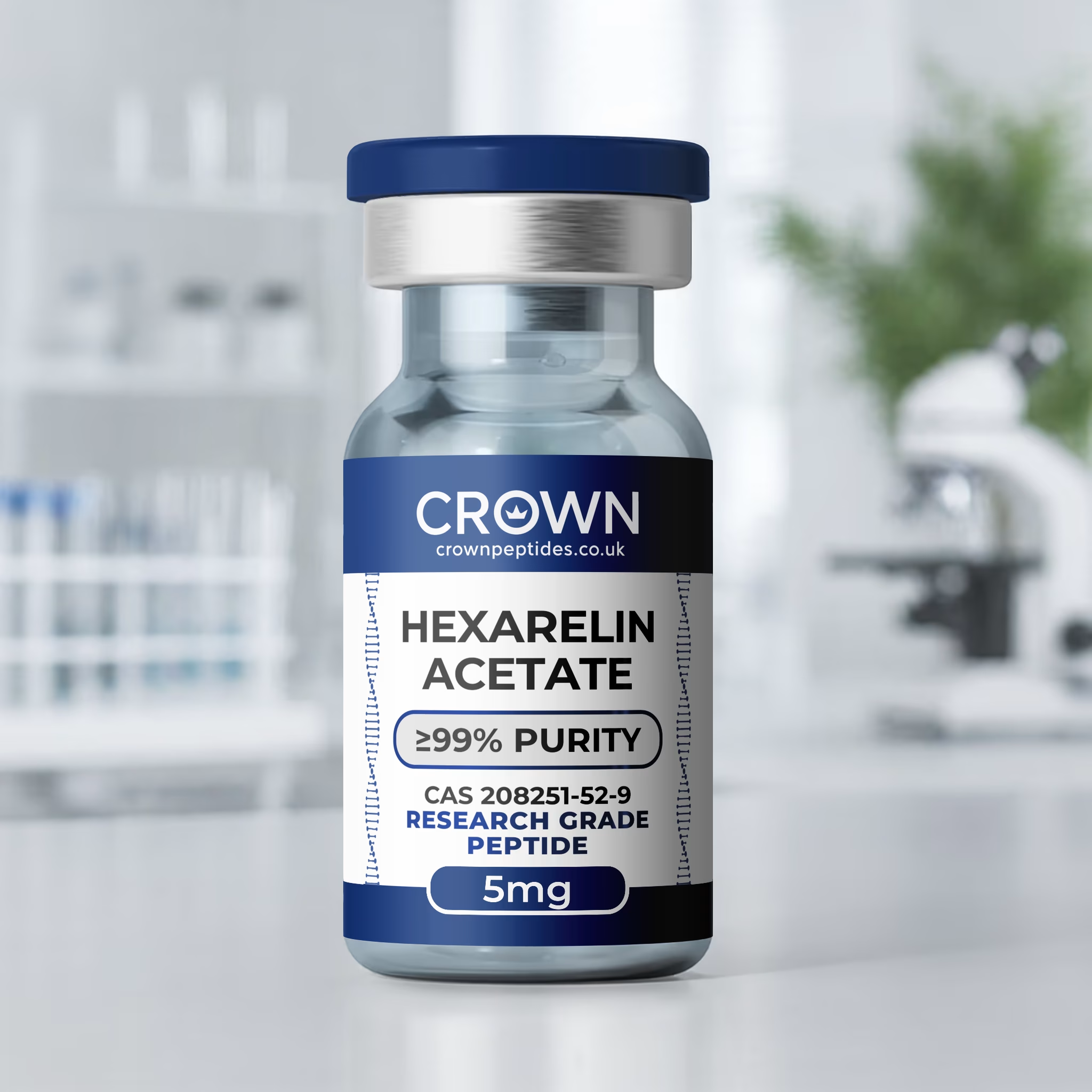
A high-purity research peptide studied in CD36, cardiac and ghrelin receptor research. Coming soon in 5mg, with every batch independently tested and dispatched from the UK.
Hexarelin peptide UK is Crown Peptides’ synthetic growth hormone-releasing hexapeptide research compound, supplied as the acetate salt and coming soon in 5mg for laboratory research.
Supplied for laboratory research purposes only — not for human consumption or for medical, veterinary or diagnostic use.
Hexarelin is a synthetic peptide of six amino acids, His-D-2-methyl-Trp-Ala-Trp-D-Phe-Lys-NH2. It was made in the early 1990s by taking GHRP-6 and adding a single methyl group to its second residue, D-tryptophan, a change intended to make the molecule chemically more stable. Like GHRP-6 and GHRP-2, it belongs to the family of growth hormone-releasing peptides, which act on the ghrelin receptor rather than on the GHRH receptor used by Sermorelin and Tesamorelin.
What sets hexarelin apart in the literature is a second target. In the late 1990s a Montreal group found that it binds a site in the heart that other growth hormone secretagogues did not recognise, and in 2002 they identified that site as CD36, a scavenger receptor found on heart muscle cells, small blood vessels and macrophages. Much of hexarelin’s research since then has focused on the heart and on fat handling in macrophages rather than on the pituitary, which gives it a research profile quite unlike the other growth hormone peptides in the range.
Also known as: hexarelin acetate, examorelin, EP-23905, MF-6003, His-D-2-Me-Trp-Ala-Trp-D-Phe-Lys-NH2
Hexarelin was first described in 1994 by a Milan group, who compared it with GHRP-6 in infant and adult rats. (Learn more) It was soon taken up by cardiovascular researchers, partly because early studies in growth hormone-deficient and older rats suggested a protective effect on the heart that growth hormone alone did not seem to explain. Today its literature overlaps only partly with that of Ipamorelin and the other ghrelin receptor peptides. Researchers studying heart models may also be interested in SS-31, which targets mitochondria in heart cells by a different route.
The 1994 paper set out the design. Replacing D-tryptophan in GHRP-6 with the more stable D-2-methyl-tryptophan gave a hexapeptide that was highly active in conscious ten-day-old rats. In anaesthetised adult rats, given into a vein, hexarelin and GHRP-6 produced growth hormone peaks within ten minutes and were equally effective at every dose tested; given under the skin, hexarelin gave a longer-lasting response and was slightly more effective. (Learn more)
In isolated, perfused rat hearts, hexarelin raised coronary perfusion pressure in a dose-dependent way. Using a light-activated, radiolabelled form of hexarelin, the Montreal group labelled an 84-kilodalton protein in cardiac membranes, with a single class of binding sites and a dissociation constant of about 14.5 nanomolar. Two other potent secretagogues, MK-0677 and EP 51389, did not compete for this site and did not narrow the coronary vessels, which pointed to a receptor separate from the pituitary one. (Learn more)
In 2002 the same group purified the 84-kilodalton protein and found that its starting sequence matched rat CD36, a glycoprotein expressed in heart muscle cells and microvascular endothelial cells. Hexarelin’s effect on coronary perfusion pressure was absent in hearts from CD36-null mice and from spontaneously hypertensive rats that genetically lack CD36, and the size of the response tracked how much CD36 each heart contained. (Learn more)
A 2004 cross-linking study broke the labelled complex into fragments and located the binding site within residues Asn132 to Glu177 of CD36, with methionine 169 as the likely contact point. That region overlaps the stretch of CD36 that binds oxidised LDL, the modified cholesterol particle macrophages take up, which suggested that hexarelin might interfere with that uptake. (Learn more)
To separate direct heart effects from growth hormone release, a 1999 study used rats whose pituitary gland had been removed. Seven days of hexarelin prevented the worsening of ischaemia-reperfusion damage in their explanted hearts, limiting the rise in left ventricular end-diastolic pressure, coronary perfusion pressure and creatine kinase release, and improving recovery of contraction. EP 51389, a secretagogue that does not bind the heart, had no effect. (Learn more)
In rats studied four weeks after coronary artery ligation, two weeks of hexarelin increased stroke volume and cardiac output and lowered peripheral resistance to a similar extent as growth hormone, but without the weight gain growth hormone produced. (Learn more) In 2013 a Japanese group compared hexarelin with an equal molar amount of ghrelin in ghrelin-knockout mice after infarction. Two-week mortality was 6.7% with hexarelin, 14.3% with ghrelin and 50% with vehicle, and hexarelin gave better ejection fraction and pressure measures than ghrelin. (Learn more)
In cultured human THP-1 macrophages, hexarelin increased the cholesterol transporters ABCA1 and ABCG1 and the outflow of cholesterol from the cells, through activation of PPAR-gamma that followed binding to both CD36 and the ghrelin receptor. In apolipoprotein E-null mice on a lipid-rich diet, hexarelin reduced atherosclerotic lesions, and the macrophage response was strongly reduced when one copy of the PPAR-gamma gene was missing. (Learn more)
Taken together, hexarelin is the growth hormone-releasing peptide most closely tied to CD36: the compound used to discover that binding site, with a body of rodent and cell data in heart and macrophage models that is largely independent of its effect on the pituitary.
Compound-level reference data. Batch-specific results appear on the Certificate of Analysis.
Work out concentration with the peptide calculatorCrown Peptides Hexarelin will be supplied with batch-specific quality documentation appropriate to the material. Hexarelin differs from GHRP-6 by a single methyl group, so the two peptides are only 14 daltons apart and can behave very similarly on HPLC. HPLC shows how clean a batch is, while mass spectrometry confirms the methylated chain at about 887 daltons, so researchers know they have hexarelin rather than its parent. The Certificate of Analysis should be used as the definitive source for identity, assay, purity and relevant impurity information.
Researchers working with hexarelin may also be interested in GHRP-6, its parent peptide, as well as GHRP-2, Ipamorelin, CJC-1295 + Ipamorelin Blend, CJC-1295 with DAC and TB-500 — other compounds studied in growth hormone axis, cardiac and tissue research.
Hexarelin is a synthetic six-residue peptide, His-D-2-methyl-Trp-Ala-Trp-D-Phe-Lys-NH2, from the growth hormone-releasing peptide family. It acts on the ghrelin receptor and also binds CD36, a scavenger receptor. In laboratory research it is used mainly in heart and macrophage models, as well as in ghrelin receptor pharmacology.
Examorelin is its International Nonproprietary Name, the official generic name used in regulatory and clinical documents. Hexarelin is the original name, reflecting its six residues. EP-23905 and MF-6003 are development codes used in early studies. All of these names refer to the same peptide, and papers indexed under any of them belong to the same body of work.
By one methyl group. GHRP-6 has D-tryptophan at position two; hexarelin has D-2-methyl-tryptophan, which the 1994 paper describes as chemically more stable. In rats the two gave similar growth hormone responses into a vein, while hexarelin under the skin was longer-lasting. The CD36 heart work was carried out with hexarelin and its derivatives.
Sermorelin, Tesamorelin and CJC-1295 are GHRH analogues acting on the GHRH receptor. GHRP-2, GHRP-6 and Ipamorelin act on the ghrelin receptor, as hexarelin does. Hexarelin is the one chosen when a study concerns CD36, because it is the ligand that site was discovered with, and because its heart and macrophage work does not depend on the pituitary at all.
CD36 is a glycoprotein on the surface of many cell types, including heart muscle cells, the endothelial cells lining small blood vessels, and macrophages. It is called a scavenger receptor because it takes up modified fats such as oxidised LDL, and it also helps cells take in fatty acids. Its role in heart energy use and atherosclerosis makes it a widely studied target.
No. In the 1999 binding study, MK-0677 and EP 51389, both potent growth hormone secretagogues, did not compete for the cardiac site. In the other direction, the Montreal group later developed EP 80317, a related peptide that binds CD36 but has no growth hormone-releasing activity, so the two activities can be separated.
Yes. The ghrelin receptor, GHS-R1a, is the receptor through which growth hormone-releasing peptides release growth hormone from the pituitary. A 2006 macrophage study found that hexarelin’s effects on cholesterol transporters involved binding to both CD36 and GHS-R1a, so it is studied as a ligand with two distinct receptor targets.
They removed growth hormone from the picture. In hypophysectomised rats, which cannot make growth hormone, hexarelin still limited ischaemia-reperfusion damage in explanted hearts, while EP 51389, a secretagogue that does not bind the heart, did not. Later, hexarelin’s effect on coronary pressure was absent in hearts lacking CD36.
In perfused hearts from normal animals, hexarelin raised coronary perfusion pressure in a dose-dependent way. In hearts from CD36-null mice, and from spontaneously hypertensive rats that naturally lack CD36, that response was missing. The strength of the response also matched how much CD36 each heart expressed, linking the effect to CD36.
In ghrelin-knockout mice given equal molar amounts after coronary artery ligation, both peptides lowered two-week mortality compared with vehicle, at 6.7% for hexarelin and 14.3% for ghrelin against 50%. Hexarelin gave better ejection fraction and pressure measures than ghrelin, and both reduced sympathetic nervous activity.
In cultured THP-1 macrophages it increased the cholesterol transporters ABCA1 and ABCG1 and cholesterol outflow through a PPAR-gamma-dependent pathway. In apolipoprotein E-null mice on a lipid-rich diet, it reduced atherosclerotic lesions. The binding site on CD36 overlaps the region that takes up oxidised LDL.
Hexarelin is not a controlled drug under the Misuse of Drugs Act 1971; growth hormone itself appears on the Class C list, but growth hormone-releasing peptides such as hexarelin do not. It is not a licensed medicine in the UK. It is sold in the UK as a research compound for laboratory use only, which is how Crown Peptides supplies it. This is general information, not legal advice.
Hexarelin Acetate is coming soon to Crown Peptides in 5mg vials, available singly or in packs of 3, 5 or 10 with a saving on every vial. Orders ship from the UK, and every batch is independently tested, with its Certificate of Analysis published on this page once stock arrives.
Five milligrams of an 887-dalton peptide is roughly 5.6 micromoles, or about 5.3 micromoles if calculated on the monoacetate salt; the exact peptide content is on the batch’s Certificate of Analysis. The cardiac binding site was measured at a dissociation constant of about 14.5 nanomolar, so one vial covers a good deal of membrane and cell work.
Keep the unreconstituted powder at -20°C ± 5°C, dry and away from light. The sequence contains two tryptophan residues, one of them methylated, and tryptophan is sensitive to light and oxidation, so vials are best kept sealed and dark until use. Prepared solutions should follow storage conditions validated for your study design, and each batch’s Certificate of Analysis documents the material as dispatched.
Every batch is published openly — identity, purity and batch number, with no account needed.
Supplied for laboratory research purposes only — not for human consumption or for medical, veterinary or diagnostic use.
Each batch undergoes internal analytical verification using chromatographic and spectrometric methods prior to lyophilisation.
• HPLC Analysis
• Mass Spectrometry Confirmation
• Batch Traceability
By purchasing this product you confirm that you are a qualified researcher and that this compound will be used exclusively for laboratory research purposes.
This product is not intended for diagnostic or therapeutic use.
Any human or medical use is strictly prohibited.
Store in a cool, dry, secure and sterile environment away from any unauthorised persons or children.
Disclaimer: All products are sold strictly for laboratory research purposes only. Not for human or veterinary use, consumption, therapeutic, or diagnostic application. None of our products are medicines, and none are presented as such. By purchasing, you confirm you are a qualified professional and legally permitted to handle these materials in compliance with all applicable laws and regulations. Misuse, resale for unauthorised purposes, or unlawful application is strictly prohibited. Crown Peptides UK disclaims all liability for improper use, handling, or regulatory non-compliance.