Bronchogen Research Peptide
Bronchogen, the bronchial peptide bioregulator Ala-Glu-Asp-Leu (AEDL), studied in research on bronchial epithelial cells and gene expression.
Out of stock
Supplied for laboratory research purposes only — not for human consumption or for medical, veterinary or diagnostic use.
Product Overview
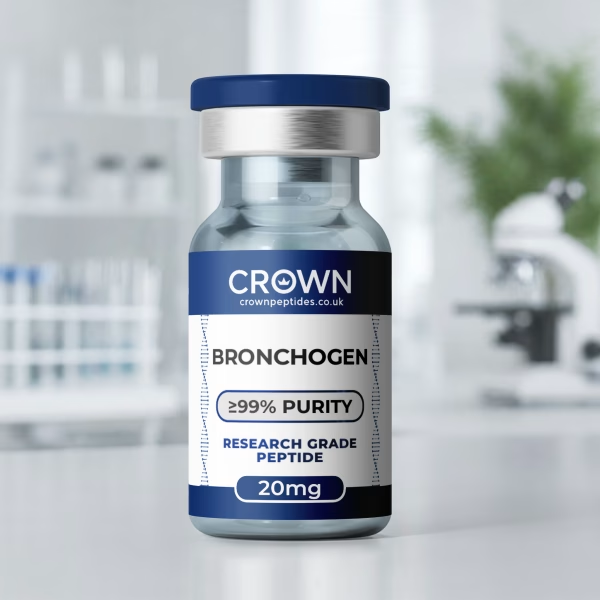
Bronchogen UK is Crown Peptides’ bronchial peptide bioregulator, the tetrapeptide Ala-Glu-Asp-Leu, supplied in 20mg for laboratory research.
- Studied in research involving bronchial epithelial cells and lung tissue
- Studied in research involving bronchial differentiation genes and their expression
- Studied in research involving animal models of chronic obstructive lung disease
- Studied in research involving direct binding to DNA and to histone proteins
- Sequence and batch analysis published for every batch
About Bronchogen UK
Bronchogen is a synthetic peptide of four amino acids, alanine, glutamic acid, aspartic acid and leucine, written in shorthand as AEDL. It is the member of the Khavinson short peptide bioregulator family associated with the airways: specifically with bronchial epithelium, the layer of cells lining the airways, and with lung tissue.
Also known as: AEDL, ADEL, Ala-Glu-Asp-Leu, H-Ala-Glu-Asp-Leu-OH, bronchial peptide bioregulator, lung peptide bioregulator
Of the peptides in this family, Bronchogen has one of the better-developed research records, and it is the one with the most direct evidence for the mechanism the whole family is described by. Where most of these peptides are discussed in terms of DNA binding on the strength of work done on their relatives, AEDL itself has been through the binding experiments. That matters when you are assessing what is actually known about a compound rather than what is claimed for its family.
Three different things are sold under overlapping names, and they are not interchangeable. Bronchogen is the synthetic tetrapeptide AEDL, with a defined formula and mass. Chonluten is a different synthetic peptide entirely, a three-amino-acid sequence (Glu-Asp-Gly), also associated with the airways but a separate molecule with its own separate research. Taxorest is a tissue-extract capsule product, a mixture rather than a single defined sequence. Published research on one is not research on the others, and we do not present it as such here.
Bronchogen sits in the bioregulator research peptides category with the rest of the family we supply, each associated with its own tissue: Epitalon with the pineal gland, Pinealon with brain tissue, Cartalax with cartilage, Vesugen with blood vessels and Thymalin with the thymus.
A note on the sequence. Published papers write this peptide two ways, as AEDL (Ala-Glu-Asp-Leu) and as ADEL (Ala-Asp-Glu-Leu), with the middle two amino acids swapped. The same research group uses both, referring to the same compound. The chemistry we supply, and the form the registry entry and most of the literature describe, is AEDL. We state the sequence on the certificate so there is nothing to infer.
Bronchogen Research
Published work on AEDL runs from 2006 to 2023 and divides into three strands: what it does to bronchial epithelial cells in culture, what happened in animal models of lung disease, and the biophysics of how it interacts with DNA. As with the rest of this family, most of it comes from research networks in St Petersburg, and there is very little work on this compound from groups outside that orbit. We set out below what the papers actually report, including where they disagree with each other.
- Bronchial differentiation genes and protein expression in epithelial cell cultures
- DNA methylation of specific gene promoters
- Airway structure in animal models of lung injury
- Direct binding to DNA and to histone proteins
The main study
A 2014 paper in the journal Lung is the most substantial work on this compound. Working with human bronchial epithelial cell cultures at early, middle and late passages, it found the peptide altered levels of several proteins including Ki-67, a marker of cell division, with the strongest effect in the oldest cultures. It also reported changes in the expression of a group of genes that control how bronchial cells specialise, including NKX2-1 and the secretoglobin genes, and activation of genes for mucins and surfactant protein. The same paper reported evidence of the peptide binding directly to DNA, in the major groove at a specific position on guanine. (Learn more)
The methylation follow-up, including what it did not find
A 2015 study examined whether those gene expression changes were explained by DNA methylation, a chemical mark that controls whether a gene can be read. For two of the genes, methylation changed as the cultures aged and tracked their expression. For three others, it did not change at all and the peptide had no effect on it, and one gene’s promoter was completely unmethylated regardless. We mention the negative half because it is the honest picture: methylation explains part of what this peptide does and not all of it. (Learn more)
Tissue specificity, tested directly
A 2012 study applied three peptides from the family to three different human cell types. Bronchogen acted on the bronchial cells, stimulating two differentiation factors whose expression had dropped in older cultures, while the other two peptides acted on pancreatic cells and fibroblasts respectively. Each worked on its own tissue and not the others, which is the clearest published support for the organ-specific claim made for this family. (Learn more)
Animal models of airway damage
Two studies used rats in which chronic airway disease had been induced by prolonged exposure to nitrogen dioxide. After a month of the tetrapeptide, the structural changes typical of the model were reported to be absent: the goblet-cell overgrowth, the change in cell type lining the airways, the inflammatory infiltration and the emphysema. Ciliated cells were restored, secretory IgA rose, and the cell and cytokine make-up of lung washings normalised. A second study from the same group reported the same pattern with reduced neutrophil-driven inflammation and increased surfactant protein B. Both are histology-based rather than numerically quantified, and both come from the same institution. (Learn more) (Learn more)
DNA binding, where AEDL itself was tested
A 2011 study measured how short peptides bind to short stretches of DNA, and AEDL was one of the peptides tested rather than one of its relatives. It bound preferentially to sequences containing CTG, while the related peptides preferred CAG, and the peptides discriminated between sequences carrying different methylation marks. This is the most specific published mechanistic result for this compound. (Learn more)
And where the literature disagrees with itself
A separate 2011 biophysics study measured the effect of Bronchogen on DNA by precise heat measurement. It found the peptide raised the temperature at which DNA comes apart by 3.1 degrees Celsius over a narrow concentration range, which is strong evidence of binding, but the authors concluded the binding was not specific to particular base pairs. That sits awkwardly alongside the CTG preference above, and anyone citing one should know about the other. A companion study found the peptide unfolded the structure DNA is packaged into, releasing about 15% of the packaged DNA into a more accessible state. (Learn more) (Learn more)
Histones and transport
A 2013 study found AEDL among six short peptides that bind to histone proteins, the spools DNA is wound around, apparently at their tail regions, in a way that depended on the peptide’s own sequence. A 2023 modelling study named AEDL among the short peptides that fit best into the cell transporters that normally carry small peptide fragments into cells. The second of those is computer modelling rather than a measurement, which is worth knowing when it is cited as evidence that the peptide gets into cells. (Learn more) (Learn more)
Taken together, Bronchogen is a defined tetrapeptide with roughly nine on-point published studies, direct DNA-binding data on the molecule itself rather than only on its relatives, consistent findings in bronchial cell cultures, and supportive animal work from a respiratory research institute. There are no human studies. Related compounds in the same family include Vesugen and Epitalon.
Specifications
- Product
- Bronchogen
- Classification
- Short peptide bioregulator, synthetic tetrapeptide
- Sequence
- Ala-Glu-Asp-Leu (AEDL)
- Available strength
- 20mg
- Form
- Lyophilised research material supplied according to product label
- Purity / assay
- batch-specific; refer to Certificate of Analysis
- Verification
- HPLC and Mass Spectrometry
- Also known as
- AEDL, ADEL, Ala-Glu-Asp-Leu
- Product Name
- Bronchogen
- Molecular Formula
- C18H30N4O9
- Molecular Weight
- approximately 446.45 g/mol; refer to the batch Certificate of Analysis for the confirmed mass
Purity and Testing
Because the literature writes this sequence two different ways, the sequence on the certificate is the thing that settles what is in the vial. We state it.
Crown Peptides Bronchogen is supplied with batch-specific quality documentation, published on our lab reports page before the batch goes on sale. At around 446 daltons, mass spectrometry confirms identity precisely, and HPLC shows how clean the preparation is. The Certificate of Analysis should be used as the definitive source for identity, assay, purity and relevant impurity information.
Storage Conditions
- Store unreconstituted material at -20°C ± 5°C in a cool, dry environment
- Prepared research solutions should use validated storage conditions appropriate to the compound and study design
- Protect from unnecessary heat, direct light and repeated temperature fluctuations
Bronchogen Frequently Asked Questions
About Bronchogen6 questions
What is Bronchogen?
Bronchogen is a synthetic peptide of four amino acids, known in shorthand as AEDL. It is the airway member of a group of short peptides, each matched to one organ or tissue, that came out of Russian gerontology research from the 1990s onwards. The tissue it is matched to is the bronchial epithelium, the cell layer lining the airways.
Why do some sources write it as ADEL instead of AEDL?
Both appear in the published literature, from the same research group, referring to the same compound, with the middle two amino acids written in a different order. AEDL is what the registry entry and most of the papers use, and it is what we supply. Rather than guess which a supplier means, check the sequence on their certificate.
Is Bronchogen the same as Chonluten?
No. Chonluten is a three-amino-acid peptide with a different sequence entirely. Both are associated with the airways in this family, which is why they get confused, but they are separate molecules with separate research behind them. Notably, work on inflammatory signalling in this family was done on Chonluten rather than on Bronchogen, so claims about that belong to Chonluten.
Is it the same as Taxorest?
No. Taxorest is a tissue-extract product, a mixture of many polypeptides rather than one defined sequence. Bronchogen is a single synthetic tetrapeptide of known formula and mass. There is no primary research literature on the extract under that name.
How is it thought to work?
The proposal across this family is that peptides this short get into cells and into the nucleus, bind to particular stretches of DNA and to the proteins DNA is packaged around, and so change which genes are read. Bronchogen is better supported here than most of its relatives: the binding experiments were done on AEDL itself and found a preference for sequences containing CTG. Worth adding for completeness, a separate biophysics study using a different method concluded the binding was not specific to particular bases, so the picture is not uniform.
How does it compare with the other bioregulators?
They are different sequences associated with different tissues, studied as a group as often as individually. Vesugen is the vascular one, Pinealon the brain one, Cartalax the cartilage one and Epitalon the pineal one. Bronchogen is the airway one, and it is among the more thoroughly studied of them.
Findings in research models4 questions
What did the bronchial cell culture work show?
In human bronchial epithelial cells grown to early, middle and late passage, the peptide changed levels of several proteins including the cell-division marker Ki-67, with the largest effect in the oldest cultures, and altered expression of a set of genes controlling how bronchial cells specialise. The same study reported direct binding of the peptide to DNA.
What happened in the animal studies?
In rats with airway disease induced by prolonged nitrogen dioxide exposure, a month of the tetrapeptide was reported to reverse the structural damage characteristic of the model, with restored ciliated cells, raised secretory IgA and normalised lung-washing cell counts and cytokine profile. These are histology-based studies from a single respiratory institute rather than quantified trials.
Has Bronchogen been studied in people?
No. There are no published human studies or clinical trials on this compound. The work is cell culture, animal models and biophysics.
How strong is the evidence overall?
Mixed, and worth understanding before you cite it. The DNA-binding data on this specific molecule is a genuine strength that most peptides in this family lack. Against that, almost all the work comes from one research network, two published studies reach different conclusions about whether the binding is sequence-specific, and there are no human studies at all. We would rather set that out than imply more.
Buying, testing & storage4 questions
Is Bronchogen legal to buy in the UK?
Bronchogen is supplied in the UK as a laboratory research material. It is not a licensed medicine and is not sold for human or veterinary use. It is supplied strictly for laboratory research purposes by qualified personnel.
Where can I buy Bronchogen in the UK?
Crown Peptides supplies Bronchogen in 20mg vials from the UK, with HPLC and mass spectrometry verification and a batch-specific Certificate of Analysis published for every batch, stating the sequence. Orders placed before 2pm are dispatched the same working day.
Does Bronchogen have a CAS number?
A registry number is associated with it in the public chemical databases, but it comes from a depositor record rather than an authoritative registry entry, and several suppliers state that no number is assigned. Rather than print a figure we cannot fully stand behind, we identify the material by its sequence and its confirmed mass on the certificate, which is the more reliable identification in any case.
How should Bronchogen be stored and handled?
Unreconstituted material should be kept at -20°C ± 5°C in a cool, dry place, away from direct light and repeated temperature swings. Prepared solutions should follow storage conditions validated for the study in question. Our storage information page covers handling in more detail.
Read the batch certificate before you order
Every batch is published openly — identity, purity and batch number, with no account needed.
View lab reports- Laboratory research only
- Not for human or clinical use
- Not for human or veterinary consumption
Supplied for laboratory research purposes only — not for human consumption or for medical, veterinary or diagnostic use.
Other Research Peptides
 Endocrine researchCJC-1295 + IpamorelinBlend