

Research guide
AHK-Cu Peptide UK Guide: Copper Tripeptide-3 Research
One amino acid separates AHK-Cu from GHK-Cu, and that single substitution redirects a copper peptide from skin remodelling to the base of the hair follicle.
In 2007, a research team took living human hair follicles, kept them alive in culture, and dosed them with a copper-bound tripeptide at concentrations so low they are difficult to picture — one picomolar, which is roughly a single gram dissolved in a billion litres of water.
The follicles grew longer.
That study, published in Archives of Pharmacal Research and indexed on PubMed under PMID 17703734, is the foundation of everything known about AHK-Cu. It established that a three-amino-acid peptide bound to a copper ion could influence hair follicle biology at vanishingly small concentrations, and it remains the reference point nearly two decades later.
AHK-Cu is supplied as a research compound for laboratory use only — it is not a medicine, not approved for human consumption, and not sold for any clinical purpose. What follows is what the research actually shows.
What AHK-Cu Actually Is
AHK-Cu is L-alanyl-L-histidyl-L-lysine bound to a copper(II) ion. Three amino acids — alanine, histidine, lysine — and one metal atom. In cosmetic ingredient nomenclature it is known as copper tripeptide-3.
The copper is not an additive or a stabiliser. It is the functional centre of the molecule. Strip it out and you have a short peptide with little of the activity that makes the compound interesting.
The histidine residue provides the coordination site that binds the copper ion, and the resulting complex behaves quite differently from the bare peptide sequence.
Copper itself is an essential trace element involved in collagen cross-linking, enzymatic activity and wound repair. The difficulty with copper in biological systems is delivery — free copper ions are reactive and poorly tolerated. A peptide carrier solves that problem by holding the ion in a stable, bioavailable complex that cells can interact with.
That is the underlying idea behind every copper peptide: not to introduce copper, but to introduce it in a form that biology recognises.
Where Copper Peptides Came From
The story starts with a question about blood plasma, not hair.
In the 1970s, researchers studying why liver tissue from older donors behaved differently in culture identified a small peptide fraction in human plasma that appeared to restore some youthful characteristics. That fraction turned out to be a tripeptide — glycyl-histidyl-lysine — and it was binding copper.
The finding that made it interesting was the age curve. GHK concentration in human plasma is high in early adulthood and declines substantially with age. A molecule that diminishes as tissue repair capacity diminishes is, at minimum, worth investigating.
What followed was decades of work on copper peptides in skin repair, wound healing and collagen synthesis. GHK-Cu accumulated a substantial literature. It was shown to stimulate dermal fibroblast proliferation, elevate vascular endothelial growth factor production, and reduce secretion of transforming growth factor-beta 1 — a combination associated with repair rather than scarring.
AHK-Cu arrived later, from a different starting point. Rather than being discovered in tissue, it was designed — a deliberate variation on the GHK template, engineered with the follicle environment in mind rather than the broader skin repair pathways where GHK-Cu had already proved itself.
That distinction in origin explains the distinction in evidence. GHK-Cu has breadth because it was found first and studied in everything. AHK-Cu has focus because it was built for one job.
- Classification
- Copper tripeptide research compound
- Available strength
- 100mg
- CAS Number
- 682809-81-0
- Molecular Weight
- approximately 415.9 g/mol
- Molecular Formula
- C15H24CuN6O4
- Sequence
- Ala-His-Lys copper complex (3 amino acids)
The Study That Defined It
The 2007 work by Pyo and colleagues examined AHK-Cu in two systems simultaneously, which is why it carries more weight than a single-assay result.
First, human hair follicle organ culture. Whole follicles were isolated from human scalp tissue and maintained ex vivo. Treated with AHK-Cu across a concentration range of 10⁻¹² to 10⁻⁹ molar, the follicles showed significantly stimulated elongation — they grew.
Second, cultured dermal papilla cells. The dermal papilla is the cluster of specialised cells at the base of the follicle that effectively controls the hair growth cycle. AHK-Cu stimulated proliferation of these cells in vitro.
The researchers then looked at why. Using annexin V and propidium iodide labelling with flow cytometry, they measured apoptosis — programmed cell death — in the dermal papilla cells. AHK-Cu at 10⁻⁹ M reduced the number of apoptotic cells, though that particular reduction did not reach statistical significance.
The molecular markers told a clearer story. The Bcl-2 to Bax ratio was elevated, and cleaved caspase-3 and PARP were reduced.
Those names matter, so here is what they mean in plain terms. Bcl-2 and Bax are opposing proteins: Bcl-2 protects cells from apoptosis, Bax promotes it. A higher ratio means the balance has shifted toward survival. Caspase-3 is an enzyme that executes apoptosis once the decision is made, and PARP is one of its targets — finding less of the cleaved forms of both means fewer cells were going through that process.
The conclusion the authors drew was that AHK-Cu promotes hair follicle growth through two complementary routes: stimulating dermal papilla cell proliferation, and reducing their apoptosis.
The control that makes the result meaningful
One detail elevates this from interesting to convincing. The researchers tested a control tripeptide — L-glutamyl-L-histidyl-L-proline — alongside AHK-Cu.
It had no significant effect.
That matters because it rules out a trivial explanation. The result is not simply “adding any small peptide to follicle culture helps”. The specific sequence and its copper coordination are doing the work.
Why Lysine Turned Out to Matter
Related patent work testing peptide-copper complexes for hair growth found something worth knowing about structure-activity relationships in this family.
Complexes containing hydrophilic residues — the lysine in AHK-Cu — proved more active at stimulating hair growth following topical application than otherwise similar peptides containing hydrophobic residues, such as the phenylalanine in AHF-Cu.
The likely explanation is delivery. A more hydrophilic complex partitions differently through tissue, and for a compound applied topically to reach the follicle, that partitioning is decisive. The molecule that binds best is irrelevant if it never arrives.
For researchers this is a useful reminder that in vitro potency and topical activity are different measurements, and a compound can excel at one while underperforming at the other.
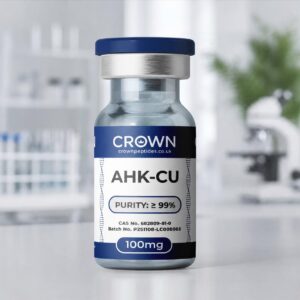
AHK-Cu Research Peptide
HPLC and MS verified · batch certificate published · dispatched from the UK before 2pm
AHK-Cu vs GHK-Cu: The Comparison Everyone Makes
The two copper tripeptides are constantly mentioned together, and the distinction between them is genuinely useful rather than marketing noise.
GHK-Cu — glycyl-L-histidyl-L-lysine-copper, or copper tripeptide-1 — was discovered first and has by far the larger research base. It was originally isolated from human plasma, where its concentration declines with age, and it has been studied extensively in skin repair, collagen synthesis, wound healing and matrix remodelling contexts.
AHK-Cu came later and was developed with follicle biology specifically in mind. Its research base is narrower but more targeted.
Structurally they differ by a single residue: glycine in GHK-Cu, alanine in AHK-Cu. Alanine carries a methyl group where glycine has only hydrogen. That is a small change chemically, and it produces measurably different behaviour — which is itself a good illustration of how sensitive peptide activity is to sequence.
The practical division in research use is that GHK-Cu dominates skin and matrix work, while AHK-Cu is the more specifically studied compound for follicle-focused questions. Both deliver copper; they differ in where the evidence is deepest.
Where a study calls for comparative work across both, GHK-Cu and AHK-Cu are both available as research-grade material.
The Follicle Cycle, and Why Timing Is Everything
Hair follicles do not grow continuously. They cycle, and understanding that cycle explains why dermal papilla cells are the target worth studying.
Anagen is the active growth phase, lasting years in scalp follicles. The follicle is metabolically busy, the dermal papilla is signalling, and the hair shaft lengthens.
Catagen is a brief transitional phase of a few weeks. Growth stops and the lower follicle regresses.
Telogen is the resting phase, lasting months. The follicle is quiescent and the hair is eventually shed.
The proportion of follicles in each phase at any moment determines apparent hair density. Shifting follicles into anagen, or extending time spent there, increases the fraction actively growing.
The dermal papilla governs these transitions. It is the signalling hub — the cluster of mesenchymal cells that instructs the surrounding epithelial cells what to do. Its health and activity effectively set the cycle.
Which is why the 2007 findings matter in the way they do. A compound that increases dermal papilla cell proliferation and reduces their apoptosis is acting on the control system rather than on the hair shaft itself.
Where Wnt signalling fits
Copper peptides have been associated with the Wnt/β-catenin pathway, a signalling cascade central to follicle biology.
Wnt signalling is one of the principal drivers of anagen entry. When the pathway is active, β-catenin accumulates and moves into the nucleus, where it influences transcription of genes involved in follicle development and growth. Suppress the pathway and follicles fail to enter growth phase properly.
The connection between copper peptides and Wnt signalling is an active research area rather than a settled mechanism, and the specific signalling pathway for AHK-Cu is less well characterised than that for GHK-Cu. That gap is worth stating plainly — it is also, for anyone designing research, the interesting part.
Why the Concentrations Are So Small
The active range in the 2007 study — 10⁻¹² to 10⁻⁹ M — is worth pausing on, because it tells you something about the mechanism.
Compounds that work at picomolar and nanomolar concentrations are generally acting through specific high-affinity interactions: receptor binding, signalling modulation, enzyme regulation. Compounds that require micromolar or millimolar concentrations are usually doing something less specific.
AHK-Cu working at picomolar concentrations places it firmly in the first category. It is not acting as a bulk copper source; there is nowhere near enough copper present for that. It is acting as a signal.
This has a practical consequence for laboratory work. Preparing solutions at these concentrations requires serial dilution, and at extreme dilution, peptide adsorption to container surfaces becomes a genuine factor. A meaningful proportion of the compound can end up on the vessel wall rather than in solution. Low-bind labware and careful technique matter more here than in most peptide work.
Handling, Storage and Copper-Specific Considerations
AHK-Cu presents one storage consideration that most peptides do not: the copper itself.
Copper is redox-active. It can cycle between oxidation states, and in doing so it can catalyse oxidative reactions — including reactions that damage the peptide it is bound to. The complex is stable under proper conditions, but it is less forgiving of light and oxygen exposure than an uncomplexed peptide of similar size.
Store lyophilised at −20°C, protected from light, for long-term stability. The characteristic blue colour of copper peptide solutions is a useful visual reference — a distinct colour shift or fading warrants investigation before use.
Bring vials to room temperature before opening. Breaking the seal on a cold vial in humid air condenses moisture directly onto the lyophilised cake, and peptides absorb it readily.
Reconstitute gently. Direct the diluent down the vial wall rather than onto the cake, then swirl. Never shake — foaming creates an air-liquid interface where peptides preferentially denature.
Avoid chelating agents in any buffer system unless their effect is deliberate. EDTA and similar compounds will strip copper from the complex, leaving the bare peptide and a different molecule entirely.
Reconstituted solution should be refrigerated and used within a defined window. Where freezing is necessary, aliquot into single-use volumes first, since freeze-thaw cycling is among the most damaging things that can happen to a peptide in solution.
The peptide calculator handles reconstitution arithmetic, and full guidance is in the storage information guide.
Verifying What Is in the Vial
Copper peptides present a specific analytical question that ordinary peptides do not: is the copper actually bound?
A sample can contain the correct peptide sequence at high purity and still be an incomplete complex. The peptide would pass sequence verification. The compound would not behave as AHK-Cu, because the copper coordination is what makes it active.
Mass spectrometry addresses this directly, since the complexed and uncomplexed forms differ in molecular weight by the mass of the copper ion. The measured weight tells you which you have.
HPLC addresses the separate question of purity — what proportion of the peptide material present is the target sequence rather than deletion sequences or synthesis by-products.
Every batch Crown Peptides supplies carries its own certificate rather than a figure carried forward from an earlier production run. Both tests are run, both are published, and the batch number on the vial matches the batch number on the certificate.
You can read any published certificate through the lab reports library, or scan the QR code on the vial to open that batch’s report directly.
Reading an AHK-Cu Certificate
A few figures on a copper peptide certificate deserve particular attention, and knowing what to look for makes the document genuinely useful rather than decorative.
Molecular weight. The complexed form carries the copper ion, and the measured mass should reflect that. A result matching the bare tripeptide rather than the complex indicates the copper is absent — the sequence would be correct and the compound would still be wrong.
Purity by HPLC. ≥98% is the standard worth holding to for analytical work. The chromatogram shape matters alongside the number: one clean dominant peak suggests well-controlled synthesis, while a cluster of peaks adjacent to the main one often indicates deletion sequences.
Appearance. Copper peptide complexes carry a characteristic blue to blue-violet colour, which is unusual among research peptides and genuinely informative. It comes from the copper coordination itself. A sample that appears white or off-white rather than blue raises an immediate question about whether the complex formed.
Batch number. The number on the certificate should match the number on the vial. Without that link, the figures describe a production run rather than the material in front of you.
Related Compounds Worth Studying Alongside
AHK-Cu sits within a cluster of compounds studied in overlapping skin, follicle and tissue contexts.
The other copper peptide. GHK-Cu is the obvious companion — same metal, same coordination principle, one residue different, and a far larger literature in skin and matrix remodelling. Comparative work across the two is common precisely because the structural difference is so small.
Other dermal research compounds. SNAP-8 approaches skin research through an entirely unrelated mechanism, acting on neurotransmitter release rather than matrix biology. Glutathione is studied for oxidative stress, which intersects with copper peptide work since copper is itself redox-active. The GLOW blend combines several skin-focused compounds, and the skin and cellular research bundle groups them for comparative protocols.
Tissue repair compounds. BPC-157 and TB-500 are studied in tissue repair and angiogenesis contexts that overlap with copper peptide research — GHK-Cu in particular has been examined for effects on vascular endothelial growth factor production, and follicle growth depends heavily on vascular support. The Wolverine Stack combines both.
Inflammatory signalling. KPV is studied in inflammatory contexts, and inflammation is a recognised factor in follicle biology. Thymosin Alpha-1 appears in adjacent immune research.
Melanocortin compounds. Melanotan 1 and Melanotan 2 are studied in pigmentation research, which connects to follicle biology through melanocytes resident in the hair bulb.
Designing Research With AHK-Cu
A few practical points come up repeatedly in protocols using this compound, and most of them stem from the concentration range.
Serial dilution is unavoidable. Reaching picomolar concentrations from a lyophilised vial means several successive dilution steps, and each step compounds any error in the one before. Preparing a concentrated stock, verifying it, then diluting from that stock in controlled steps is more reliable than attempting a single large dilution.
Adsorption losses are real at these concentrations. Peptides bind to glass and polypropylene surfaces. At micromolar concentrations the proportion lost is negligible; at picomolar it can be substantial. Low-bind labware, and pre-rinsing vessels with the solution being used, both reduce the effect meaningfully.
Buffer composition matters more than usual. Anything with chelating activity will compete for the copper ion. Standard laboratory buffers are generally fine, but additives should be checked — and where a buffer must contain a chelator for other reasons, the copper complex should be assumed compromised.
Include a control peptide. The 2007 study’s use of an inactive tripeptide control is worth replicating. It distinguishes sequence-specific activity from any general effect of adding a small peptide to the system, and it is the difference between a suggestive result and a convincing one.
Account for the follicle cycle. In any model involving hair follicles, the phase distribution at the start of the experiment influences the outcome. Follicles already in anagen behave differently from those in telogen, and a result that looks like a treatment effect can sometimes be a sampling artefact.
What the Research Has Not Established
Honesty about the gaps makes the established findings more useful, not less.
The 2007 study was ex vivo and in vitro. Isolated follicles in culture and cultured cells are legitimate models, and they are how a great deal of follicle biology is understood. They are not the same as an intact organism with circulation, immune function and systemic hormonal signalling.
The specific signalling mechanism for AHK-Cu remains less characterised than GHK-Cu’s. The downstream effects have been measured. The precise pathway from copper complex to cellular response is not fully mapped.
The apoptosis reduction observed at 10⁻⁹ M did not reach statistical significance, even though the molecular markers pointed the same direction. The authors reported this plainly, and it should be read plainly.
These are the openings, not the objections. A compound with demonstrated activity and an incompletely characterised mechanism is exactly the kind of thing worth researching.
Read the certificate before you order
Every batch is published openly — identity by mass spectrometry, purity by HPLC, and the batch number printed on the vial you receive.
Open the COA libraryFrequently Asked Questions
What is AHK-Cu?
A copper-binding tripeptide composed of alanine, histidine and lysine, coordinated to a copper(II) ion. It is also known as copper tripeptide-3, and formally as L-alanyl-L-histidyl-L-lysine-Cu²⁺.
What is the difference between AHK-Cu and GHK-Cu?
A single amino acid. GHK-Cu uses glycine in the first position; AHK-Cu uses alanine. GHK-Cu has the larger research base, concentrated in skin repair and matrix remodelling. AHK-Cu was developed with follicle biology in mind and is the more specifically studied of the two in that context.
What did the 2007 study actually find?
AHK-Cu at 10⁻¹² to 10⁻⁹ M stimulated elongation of human hair follicles in organ culture and proliferation of dermal papilla cells in vitro. The Bcl-2 to Bax ratio rose and cleaved caspase-3 and PARP fell, indicating reduced apoptosis. A control tripeptide showed no significant effect.
Why are the active concentrations so low?
Picomolar activity indicates a specific signalling interaction rather than a bulk effect. There is far too little copper present at those concentrations for the compound to be acting simply as a copper source.
Does the copper need to stay bound?
Yes. The copper coordination is the functional centre of the molecule. Chelating agents such as EDTA will strip it, leaving the bare peptide — a different compound with different behaviour.
How should AHK-Cu be stored?
Lyophilised at −20°C, protected from light, for long-term storage. Copper is redox-active, which makes light and oxygen exposure more consequential than for many peptides. Reconstituted solution refrigerated and used within a defined window.
What is copper tripeptide-3?
The cosmetic ingredient name for AHK-Cu. Copper tripeptide-1 is the corresponding name for GHK-Cu.
What purity should AHK-Cu be supplied at?
≥98% for analytical work, confirmed by HPLC, with identity verified by mass spectrometry against a batch-specific certificate. For copper peptides, mass spectrometry carries additional weight because it confirms the copper is actually bound rather than absent.
Is AHK-Cu the same as the ingredient in Tricomin?
Tricomin formulations are built around AHK-Cu as their primary active. The research-grade compound is the same molecule; the difference is formulation, concentration and intended application.
Why does the colour of the solution matter?
Copper coordination produces a characteristic blue to blue-violet colour. It is one of the few peptides where appearance carries real information — a colourless solution where blue is expected suggests the copper is not bound.
Can AHK-Cu and GHK-Cu be used together in research?
They are frequently studied comparatively, since the single-residue difference between them makes for a clean structure-activity comparison. Whether combining them is appropriate depends entirely on the question being asked — for attribution purposes, running them separately is usually cleaner.
A Small Molecule With a Specific Job
Most peptides in research use are generalists in some sense — studied across multiple tissues, multiple mechanisms, multiple questions. AHK-Cu is unusually focused.
Three amino acids, one copper ion, and a research base concentrated almost entirely on one structure: the hair follicle and the dermal papilla cells that control it. The 2007 study established that it works at picomolar concentrations, that the effect is sequence-specific rather than generic, and that it operates by both promoting proliferation and discouraging apoptosis in the cells that matter most.
What remains open is the pathway connecting the copper complex to that cellular response — less characterised than for GHK-Cu, and genuinely worth investigating.
AHK-Cu is available as research-grade material, HPLC and mass spectrometry verified, with the full certificate published against every batch number. Browse the wider research peptide range for related compounds.
Working with AHK-Cu Research Peptide
Batch-tested material, published certificates, and same-day dispatch on orders placed before 2pm.
See AHK-Cu Research Peptide