Register today and get 10% off your first orderRegister for 10% off your first orderRegister now
Crown Peptides
SAVE15%

Research Peptides

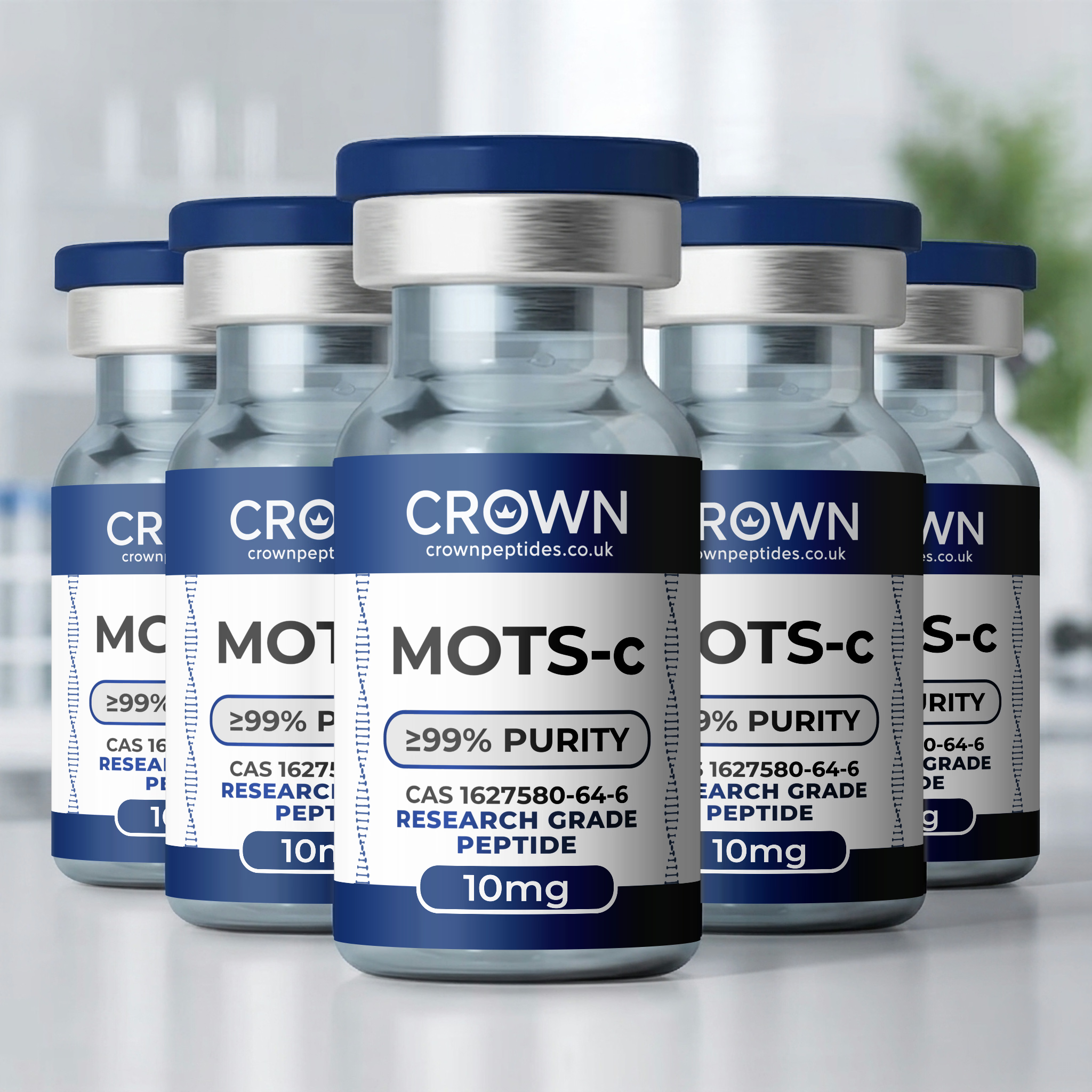
MOTS-c Research Peptide

A high-purity research peptide studied in metabolism and mitochondrial research. Available in 10mg and 40mg, with every batch independently tested and dispatched from the UK.

£106.21£21.24 per vial in this pack
Save 15%
From: £24.99
Your selection:
Order within
for dispatch tomorrow
17Hrs:00Min:59Sec
In stockEstimated deliveryEst. delivery Saturday 24 OctoberSaturday 24 Oct
All Batches TestedEvery batch, no exceptions
HPLC & MS VerifiedFull certificate published
Same Day PostageOrder before 2pm
UK Based CompanyDispatched from the UK
Product Overview

A high-purity research peptide studied in metabolism and mitochondrial research. Available in 10mg and 40mg, with every batch independently tested and dispatched from the UK.

Full Product Specification
Overview

Product Overview

MOTS-c peptide UK is Crown Peptides' mitochondrial-derived 16-amino-acid peptide, available in 10mg and 40mg strengths for laboratory research.

10mg & 40mgAvailable strengthsHPLC testedChromatographic purityMS verifiedIdentity confirmedBatch CoADocumentation supplied

Supplied for laboratory research purposes only — not for human consumption or for medical, veterinary or diagnostic use.

Key features

Key Features

  • Studied in research involving mitochondrial-to-nuclear signalling
  • Studied in research involving cellular energy metabolism
  • Studied in research involving glucose-utilisation pathways
  • Studied in research involving metabolic stress-response research
  • Batch-specific quality documentation available
Background

About MOTS-c Peptide UK

MOTS-c is a 16-amino-acid mitochondrial-derived peptide encoded within the mitochondrial 12S rRNA region. Its discovery contributed to the concept that mitochondrial DNA can generate short bioactive peptides involved in communication between mitochondria and the rest of the cell.

Also known as: MOTS c, MOTSc, mitochondrial open reading frame of the 12S rRNA type-c.

MOTS-c stands for "mitochondrial open reading frame of the 12S rRNA type-c". It was first described in 2015, when researchers identified a short open reading frame inside the mitochondrial genome that encodes a 16-amino-acid peptide with the sequence MRWQEMGYIFYPRKLR.

That discovery placed MOTS-c among the mitochondrial-derived peptides, a small family that also includes humanin. Most proteins are encoded by nuclear DNA, but these peptides are encoded within the mitochondria's own genome, which is why they interest researchers studying how mitochondria communicate with the rest of the cell.

MOTS-c is often studied alongside other mitochondrial and metabolic research compounds such as NAD+ and SS-31, and it is part of the Metabolic Research Bundle. The MOTS-c research guide covers the studies in plain English.

Research

MOTS-c Research

MOTS-c research centres on mitochondrial signalling, metabolic stress adaptation, glucose utilisation, AMPK-related pathways and communication between mitochondria and the nucleus. In the landmark study that first identified the peptide, MOTS-c prevented diet-induced obesity and insulin resistance in mice through AMPK activation in skeletal muscle (Learn more). Its links to cellular energy metabolism connect it with research on NAD+, making it an important tool in mitochondrial-derived peptide research.

  • Mitochondrial-to-nuclear signalling
  • Cellular energy metabolism
  • Glucose-utilisation pathways
  • Metabolic stress-response research
AMPK, the folate cycle and glucose handling

MOTS-c’s best-characterised action runs through AMPK, the enzyme cells use to sense a shortage of energy. The 2015 Cell Metabolism paper that named the peptide, from Changhan Lee and Pinchas Cohen’s group at the University of Southern California, traced an unexpected route. MOTS-c inhibits the folate cycle and the de novo purine synthesis tied to it, which leads to a build-up of AICAR, a natural activator of AMPK. With AMPK switched on, cells reshaped how they used glucose.

Skeletal muscle emerged as the main target tissue. In mice, MOTS-c treatment protected against both age-dependent and high-fat-diet-induced insulin resistance, as well as diet-induced obesity. What makes this so useful to researchers is the direction of travel: a peptide made from the mitochondrial genome adjusting metabolism in the cell around it. That makes MOTS-c a tool for studying how a signal, rather than a nutrient or a coenzyme, can retune energy metabolism in muscle cells and rodent models.

Mitochondrial-to-nuclear signalling under metabolic stress

Most of the instructions passing between mitochondria and the nucleus were long thought to flow one way, because the nucleus encodes nearly all mitochondrial proteins. MOTS-c provided evidence for traffic in the opposite direction. In a 2018 Cell Metabolism study, researchers found that under metabolic stress such as glucose restriction, MOTS-c moved into the nucleus, and that this move depended on AMPK.

Once inside, MOTS-c influenced a broad range of nuclear genes, including many carrying antioxidant response elements, and interacted with stress-responsive transcription factors such as NRF2. The authors proposed that the mitochondrial and nuclear genomes co-evolved to regulate each other. For anyone studying mitonuclear communication, MOTS-c is one of the clearest model molecules available. It also gives researchers a practical handle on the question: because the peptide can be added to cells directly, its effects on nuclear gene expression can be followed under controlled stress conditions such as glucose restriction.

Exercise, skeletal muscle and physical capacity

Exercise has become one of the liveliest areas of MOTS-c research. A 2021 Nature Communications study reported that exercise raised MOTS-c levels in human skeletal muscle and in the circulation. In mice, MOTS-c enhanced physical performance in young (2 months), middle-aged (12 months) and old (22 months) animals, and intermittent treatment started late in life, at 23.5 months, increased physical capacity and measures of healthspan.

At the cellular level, the same study found that MOTS-c regulated nuclear genes linked to metabolism and protein quality control, shaped skeletal-muscle metabolism and helped myoblasts adapt to metabolic stress. Because its effects overlap with the AMPK signalling that exercise itself triggers, MOTS-c is often described in the literature as an “exercise mimetic”, a label drawn from cell and mouse data.

Ageing and a natural variant: MOTS-c K14Q

Some studies have reported that circulating MOTS-c levels fall with age, which is one reason it is investigated in ageing models alongside other mitochondrial research compounds. Human genetics adds a striking extra layer. An East Asian-specific variant in mitochondrial DNA, m.1382A>C, swaps the lysine at position 14 of MOTS-c for glutamine, producing a K14Q form reported to have weaker biological activity.

Because this change occurs naturally, it lets researchers link a single amino acid to measurable traits. In Japanese studies the C allele has been associated with type 2 diabetes risk in men, and a 2022 study tied it to a higher proportion of fast-twitch muscle fibres, with the variant more common in sprint and power athletes than in endurance athletes. A 2024 study of older Korean adults found that men carrying it had greater muscle mass and grip strength. Few peptides offer such a direct bridge between laboratory biology and human population data.

Specifications

Specifications

Product
MOTS-c
Classification
Mitochondrial-derived 16-amino-acid peptide
Available strengths
10mg and 40mg
CAS number
1627580-64-6
Molecular weight
≈ 2174.6 g/mol
Molecular formula
C101H152N28O22S2
Sequence
MRWQEMGYIFYPRKLR
Form
Research material supplied according to product label
Purity and assay
99% (HPLC), batch-specific — refer to Certificate of Analysis
Verification
HPLC and Mass Spectrometry where analytically appropriate

Compound-level reference data. Batch-specific results appear on the Certificate of Analysis.

Work out concentration with the peptide calculator
Testing

Purity and Testing

Crown Peptides MOTS-c is supplied for controlled laboratory research with batch-specific analytical documentation. High-Performance Liquid Chromatography (HPLC) can assess chromatographic purity, while Mass Spectrometry provides molecular information used to support identity verification.

The batch-specific Certificate of Analysis is the definitive source for the exact purity result, identity data and analytical specification of the material supplied.

Storage

Storage Conditions

  • Store unreconstituted material at -20°C ± 5°C in a cool, dry environment
  • Prepared research solutions should use validated storage conditions appropriate to the compound and study design
  • Protect from unnecessary heat, direct light and repeated temperature fluctuations
Full storage guide
Related

Related Compounds

Researchers working with MOTS-c may also be interested in NAD+, SS-31, Epitalon, 5-Amino-1MQ and L-Carnitine — other compounds studied in cellular energy, metabolism and ageing-related research.

Compliance

Research Use Only

  • Laboratory research only
  • Not for human or clinical use
  • Not for human or veterinary consumption
  • Qualified personnel only
Questions

MOTS-c Frequently Asked Questions

About MOTS-c6 questions
What is MOTS-c?

MOTS-c peptide UK from Crown Peptides is a 16-amino-acid mitochondrial-derived peptide encoded within the mitochondrial 12S rRNA region. Its sequence is MRWQEMGYIFYPRKLR, and it is studied as a signalling molecule in energy metabolism. You may also see it written as MOTS c or MOTSc, shorthand for mitochondrial open reading frame of the 12S rRNA type-c.

Who discovered MOTS-c?

It was reported in 2015 by Changhan Lee, working in Pinchas Cohen’s group at the University of Southern California. The team went looking for it after the earlier discovery of humanin, a peptide encoded in the mitochondrial 16S rRNA gene, suggested that mitochondrial DNA might hide other short coding sequences.

Is MOTS-c encoded by nuclear DNA?

No. It comes from a short open reading frame within mitochondrial DNA, tucked inside the gene for 12S ribosomal RNA. Almost every protein in a human cell is encoded in the nucleus, which is what makes MOTS-c and its relatives so unusual.

Why is MOTS-c important in mitochondrial research?

It belongs to the mitochondrial-derived peptides, a small class that provides evidence for mitochondria sending signals to other parts of the cell, including the nucleus, rather than simply producing energy.

Why does so much MOTS-c research focus on skeletal muscle?

The original 2015 study identified skeletal muscle as the peptide’s main target tissue, and muscle is where AMPK-driven glucose handling matters most for whole-body metabolism. Later work added exercise to the picture, showing MOTS-c rising in human muscle after activity and shaping how mouse myoblasts cope with metabolic stress, so energy metabolism, ageing and physical-capacity research all tend to meet in muscle.

Why is MOTS-c sometimes called an exercise mimetic?

Exercise raises MOTS-c in human muscle and blood, and in mice the peptide activates AMPK and improves physical performance, overlapping with the signalling that exercise itself sets off. The nickname comes from that overlap in cell and animal studies.

MOTS-c in metabolic research5 questions
What is the difference between MOTS-c and NAD+?

They work at different levels. MOTS-c is a peptide encoded by mitochondrial DNA and studied as a signalling molecule, while NAD+ is a coenzyme that takes part in energy metabolism inside every cell. See NAD+ vs MOTS-c for the full comparison.

What does the K14Q variant reveal about the MOTS-c sequence?

Position 14 is one of the four positively charged residues in MOTS-c. In the East Asian m.1382A>C variant, that lysine becomes an uncharged glutamine, and the resulting K14Q peptide has been reported to be less biologically active. A single swap at one site changing activity suggests the basic C-terminal stretch, PRKLR, matters to how the peptide works.

Where in the cell does MOTS-c act?

In more than one place, which is part of its appeal. It is made from mitochondrial DNA, acts on the folate cycle and AMPK in the surrounding cytoplasm, and under metabolic stress moves into the nucleus to influence gene expression. It has also been measured in blood, so researchers study it both inside cells and as a circulating factor.

What research models has MOTS-c been used in?

Cultured cells, including skeletal-muscle myoblasts, carry much of the mechanistic work. Mouse studies cover high-fat diets, insulin resistance, ageing and physical performance across young, middle-aged and old animals. Human data are mostly observational: MOTS-c levels in blood and muscle, the response to exercise, and genetic studies of the K14Q variant.

How does MOTS-c fit alongside L-Carnitine and 5-Amino-1MQ?

All three are used in metabolic research, but at different points. L-Carnitine carries fatty acids into mitochondria to be burned, 5-Amino-1MQ is a small molecule that blocks the enzyme NNMT, and MOTS-c is a peptide signal acting through AMPK. Together they let a study look at fuel transport, enzyme activity and signalling side by side.

Testing, handling & strengths2 questions
Why do the two methionines in MOTS-c matter?

MOTS-c has methionines at positions 1 and 6, and methionine is the residue most prone to oxidation. Each oxidised methionine adds 16 Da, so in a mass spectrum oxidation shows up as extra peaks 16 or 32 Da above the expected mass of about 2174.6 g/mol (monoisotopic around 2173.1 Da). With four basic residues plus the free N-terminus, the intact peptide itself usually appears as multiply charged ions, such as the triply charged ion near m/z 725.4 and the quadruply charged ion near m/z 544.3. Each batch’s results are published on the Lab Reports page. The peptide also contains light-sensitive tryptophan.

That is why MOTS-c is supplied as a white lyophilised (freeze-dried) powder in a sealed glass vial, and why unopened vials should be kept at -20°C, away from heat and light. See the storage guide for detail.

Is the 10mg or the 40mg MOTS-c vial better for cell work?

For cell-culture work and pilot experiments, the 10mg vial keeps material fresh and limits how often a vial is opened. Mouse studies and longer exercise or ageing protocols get through more material, which is where the 40mg vial comes into its own. Multi-vial packs of five or ten are also available at a lower price per vial.

Read the batch certificate before you order

Every batch is published openly — identity, purity and batch number, with no account needed.

View lab reports

Supplied for laboratory research purposes only — not for human consumption or for medical, veterinary or diagnostic use.

All Batches TestedEvery batch, no exceptions

Each batch undergoes internal analytical verification using chromatographic and spectrometric methods prior to lyophilisation.

• HPLC Analysis
• Mass Spectrometry Confirmation
• Batch Traceability

For Research Use Only

By purchasing this product you confirm that you are a qualified researcher and that this compound will be used exclusively for laboratory research purposes.

Not for Human Consumption

This product is not intended for diagnostic or therapeutic use.

Any human or medical use is strictly prohibited.

Store Safely at All Times

Store in a cool, dry, secure and sterile environment away from any unauthorised persons or children.

Other Research Peptides

2 strengths5-Amino-1MQ 10mg research compound vial, Crown Peptides UKAgeing research

5-Amino-1MQ Research Compound


From£24.99Strength10mg
Add to basket
Adamax 10mg research peptide vial, Crown Peptides UKNeurocognitive research

Adamax Research Peptide


From£44.99Strength10mg
Add to basket
AHK-Cu 100mg copper peptide vial, Crown Peptides UKAgeing research

AHK-Cu Research Peptide


From£29.99Strength100mg
Add to basket
AICAR 50mg research compound vial, Crown Peptides UKAgeing research

AICAR Research Compound


From£34.99Strength50mg
Add to basket

Further reading

UK research peptides. Every batch HPLC and MS verified, certificate published in full.
SUPPORT Mon to Fri, 9am to 5pmDISPATCH Cut-off 2pmEMAIL Email usWHATSAPP +44 7301 802654

Disclaimer: All products are sold strictly for laboratory research purposes only. Not for human or veterinary use, consumption, therapeutic, or diagnostic application. None of our products are medicines, and none are presented as such. By purchasing, you confirm you are a qualified professional and legally permitted to handle these materials in compliance with all applicable laws and regulations. Misuse, resale for unauthorised purposes, or unlawful application is strictly prohibited. Crown Peptides UK disclaims all liability for improper use, handling, or regulatory non-compliance.

© 2026 Crown Peptides UK, a trading name of Crown Peptides Ltd (company no. 17068950), Suite Ra01, 195-197 Wood Street, London E17 3NU . All Rights Reserved.