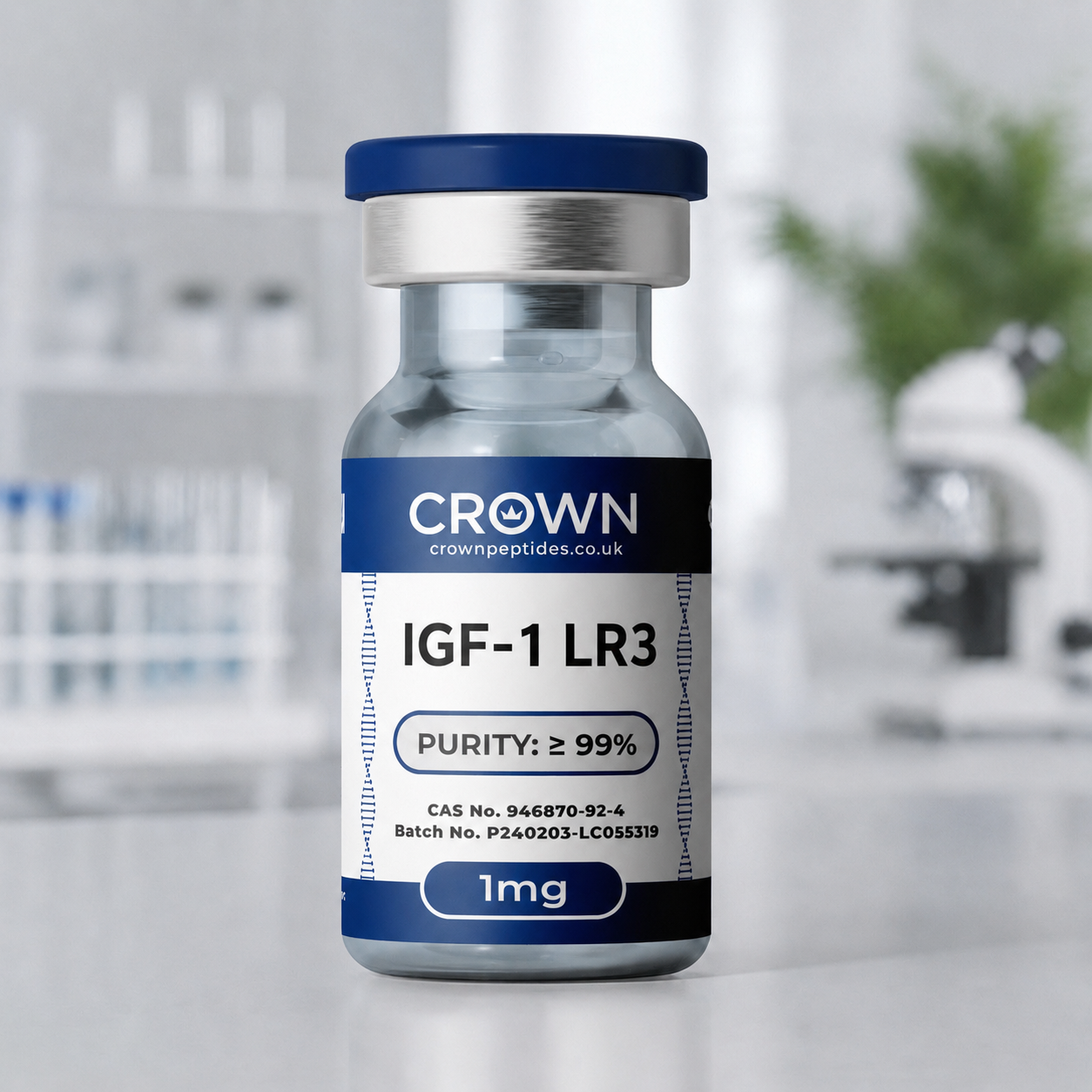
IGF-1 LR3 peptide UK is Crown Peptides’ long R3 analogue of insulin-like growth factor 1, available in 1mg strength for laboratory research.
Key Features
- Long R3 analogue of insulin-like growth factor 1, available in 1mg
- Studied in research involving IGF-1 receptor signalling
- Studied in research involving cell-growth and differentiation models
- Studied in research involving protein-synthesis signalling
- Studied in research involving glucose and nutrient-signalling research
- Batch-specific quality documentation available
About IGF-1 LR3 Peptide UK
IGF-1 LR3 is a modified analogue of insulin-like growth factor 1 containing an extended N-terminus and an arginine substitution. These changes reduce binding to several IGF-binding proteins and create a research profile distinct from native IGF-1.
IGF-1 LR3 Research
IGF-1 LR3 is used in experimental work on IGF-1 receptor signalling, PI3K-AKT and MAPK pathways, cell growth, differentiation, protein-synthesis signalling and nutrient metabolism. The analogue’s reduced interaction with binding proteins (Learn more) makes it useful for studying IGF-receptor biology under conditions that differ from endogenous IGF-1 regulation, alongside related growth-factor research such as [Tesamorelin] and [AOD-9604].
- IGF-1 receptor signalling
- Cell-growth and differentiation models
- Protein-synthesis signalling
- Glucose and nutrient-signalling research
Research context: the IGF-1 LR3 research areas described above reflect laboratory, preclinical or published scientific investigation. They should not be interpreted as established therapeutic effects, medical claims or approved human uses.
Specifications
- Product: IGF-1 LR3
- Classification: Long R3 analogue of insulin-like growth factor 1
- Available strength: 1mg
- Form: Research material supplied according to product label
- Purity / assay: Batch-specific; refer to Certificate of Analysis
- Verification: HPLC and Mass Spectrometry where analytically appropriate
- Intended use: Laboratory research only
Purity and Testing
Crown Peptides IGF-1 LR3 is supplied for controlled laboratory research with batch-specific analytical documentation. High-Performance Liquid Chromatography (HPLC) can assess chromatographic purity, while Mass Spectrometry provides molecular information used to support identity verification.
The batch-specific Certificate of Analysis is the definitive source for the exact purity result, identity data and analytical specification of the material supplied.
Storage Conditions
- Store unreconstituted material according to the product label and batch-specific documentation
- Prepared research solutions should use validated storage conditions appropriate to the compound and study design
- Protect from unnecessary heat, direct light and repeated temperature fluctuations
Research Use Only Disclaimer
- Laboratory research only
- Not for human or clinical use
- Not for human or veterinary consumption
- For handling by appropriately qualified personnel only
Additional Information
- Product Name: IGF-1 LR3
- Classification: Long R3 analogue of insulin-like growth factor 1
- Modified IGF-1 analogue with an N-terminal extension and Arg3 substitution
- Available strength: 1mg
- Large peptide/protein analogue; exact sequence and molecular mass should be matched to the supplier’s batch documentation
IGF-1 LR3 Frequently Asked Questions
What is IGF-1 LR3?
IGF-1 LR3 is a modified long-acting research analogue of insulin-like growth factor 1, supplied by Crown Peptides at 1mg strength.
What does LR3 mean?
The name refers to the extended analogue containing an arginine substitution at position 3 together with an additional N-terminal sequence.
What is IGF-1 LR3 researched for?
Research includes IGF-1 receptor signalling, cell growth, differentiation, protein synthesis and nutrient-related signalling.
Why do researchers distinguish IGF-1 LR3 from native IGF-1?
Its structural modifications alter interactions with IGF-binding proteins, so its experimental behaviour differs from endogenous IGF-1.
How should IGF-1 LR3 identity be confirmed?
Because it is a larger peptide analogue, the batch-specific analytical documentation should be used to confirm exact sequence identity, molecular mass and purity.
Related Compounds
Researchers working with IGF-1 LR3 may also be interested in [Tesamorelin], [AOD-9604], [CJC-1295 with DAC], [GHRP-6] and [MOTS-C] — other compounds studied in growth-factor and metabolic signalling research.