
RESEARCH USE DISCLAIMER
Crown Peptides supplies GHRP-2 as a laboratory research compound only. It is not approved by the FDA, MHRA or EMA for any use, and our products are not intended for human consumption and are not sold, marketed or labelled for the diagnosis, treatment, cure or prevention of any disease.
The short version
- Six residues: D-Ala-D-2-Nal-Ala-Trp-D-Phe-Lys-NH2, acting at the ghrelin receptor.
- The only growth hormone secretagogue ever approved by a national regulator — in Japan, as a diagnostic.
- Stronger growth hormone release than GHRP-6, with markedly less appetite stimulation.
- Still raises cortisol, ACTH and prolactin, which is what Ipamorelin was later built to avoid.
What GHRP-2 Actually Is
GHRP-2 is the only compound in its entire class to have been approved by a national medicines regulator, and almost nobody discussing it online mentions what that approval was actually for. It is a synthetic hexapeptide — D-Ala-D-2-Nal-Ala-Trp-D-Phe-Lys-NH2 — that acts as an agonist at the ghrelin receptor, GHS-R1a, found in the hypothalamus and anterior pituitary. Under the name pralmorelin it is licensed in Japan. Not as a treatment: as a diagnostic test.
That distinction runs through everything else worth knowing about this compound, so it is worth getting right at the outset.
The Japanese Approval, and What It Was For
In October 2004 the Pharmaceuticals and Medical Devices Agency approved pralmorelin, marketed by Kaken Pharmaceutical as GHRP Kaken, for assessing growth hormone deficiency in adults and in children over four. The approval rested on multicentre clinical trials run across 84 Japanese facilities, which demonstrated that the compound reliably separated growth-hormone-deficient patients from healthy controls.
What that approval establishes is narrow but genuine: GHRP-2 produces a growth hormone response that is strong, fast and reproducible enough to build a diagnostic test around. Peak growth hormone arrives within roughly 15 to 30 minutes of administration. For a provocation test, reproducibility is the whole requirement.
What it does not establish is therapeutic benefit. North American rights were sublicensed to Wyeth and the compound never progressed to FDA approval for any indication. Reading the Japanese licence as regulatory endorsement of a therapy is the single most common error made about GHRP-2.
- Classification
- Synthetic hexapeptide growth-hormone secretagogue
- Available strength
- 10mg
- CAS Number
- 158861-67-7
- Molecular Weight
- 817.9 g/mol
- Molecular Formula
- C45H55N9O6
- Sequence
- D-Ala-D-2Nal-Ala-Trp-D-Phe-Lys-NH2 (6 amino acids)
How It Works
GHRP-2 mimics ghrelin. It binds GHS-R1a and triggers growth hormone release through the phospholipase C and calcium signalling route — a different pathway from the GHRH receptor, which works through cAMP and PKA.
That difference is why GHRPs and GHRH analogues are studied together. Because the two receptors converge on the same output by separate signalling routes, combining a secretagogue with a GHRH analogue such as CJC-1295 produces a response greater than either alone. The synergy is a pharmacological consequence of using two doors into the same room.
The distinguishing structural feature is the D-beta-naphthylalanine residue at position two, which is unique to GHRP-2 among the classical hexapeptides and accounts for its particular receptor behaviour.
GHRP-2 Against Its Siblings
The GHRP family is best understood as a sequence of attempts to keep the growth hormone release while shedding everything else that came with it.
GHRP-6 came first and was potent but indiscriminate, with pronounced appetite stimulation. GHRP-2 was the second-generation answer: higher peak growth hormone output per unit dose than GHRP-6, with notably less hunger signalling. Hexarelin pushed acute potency further still, at the cost of the heaviest cortisol and prolactin burden in the family and documented receptor desensitisation with repeated use.
Ipamorelin represents the third generation and a different design philosophy: rather than maximising output, it was built for selectivity, releasing growth hormone without meaningfully raising cortisol, ACTH or prolactin.
So GHRP-2 sits in the middle. Cleaner than GHRP-6, stronger than Ipamorelin, and less selective than either would ideally be. Which end of that trade-off matters depends entirely on what a given study is measuring.
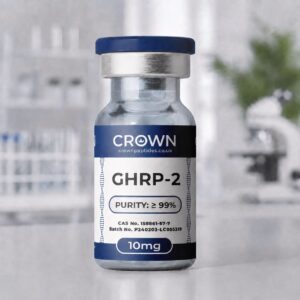
GHRP-2 Research Peptide
HPLC and MS verified · batch certificate published · dispatched from the UK before 2pm
The Cortisol Question
GHRP-2 stimulates ACTH, cortisol and prolactin alongside growth hormone. The elevation is modest — less than hexarelin, less than GHRP-6 — but it is consistent and it is documented in the same Japanese trials that supported the diagnostic approval.
For a single diagnostic dose this is immaterial. For any protocol involving repeated administration it is the central variable, and it is precisely the problem the third-generation secretagogues were engineered to solve. Any research design using GHRP-2 over time needs to account for it rather than treat growth hormone as the only hormone moving.
Current Limitations of the Evidence
By the standards of this field GHRP-2 is unusually well characterised: a regulatory approval, a defined dose-response, and several randomised human studies. Set against pharmaceutical standards, the gaps are real. The longest human studies run six to twelve months, in Japanese paediatric populations. There is no multi-year adult safety data. Therapeutic development effectively stopped after the diagnostic approval, and no active clinical trials are running.
GHRP-2 is also prohibited by the World Anti-Doping Agency at all times, in and out of competition.
Read the certificate before you order
Every batch is published openly — identity by mass spectrometry, purity by HPLC, and the batch number printed on the vial you receive.
Open the COA libraryFrequently Asked Questions
Is GHRP-2 the same as pralmorelin?
Yes. Pralmorelin is the international non-proprietary name for GHRP-2. It also appears under the development codes KP-102 and GPA-748, and in Japan as the brand GHRP Kaken.
How does GHRP-2 differ from GHRP-6?
GHRP-2 produces higher peak growth hormone output with substantially less appetite stimulation. Both act at the same receptor; GHRP-2 is the more selective of the two, though neither matches Ipamorelin on that measure.
Why is GHRP-2 approved in Japan but nowhere else?
The Japanese approval is for diagnostic use in assessing growth hormone deficiency, supported by multicentre trials. Therapeutic development was not pursued elsewhere, and the compound never reached FDA approval.
How is GHRP-2 tested?
Every batch is analysed by HPLC for purity and mass spectrometry for identity, with the certificate published in full and the batch number printed on the vial.
References
- Bowers C. Y., Reynolds G. A., Durham D. et al. Growth hormone-releasing peptide research, foundational work on the GHRP family.
- Pharmaceuticals and Medical Devices Agency approval of pralmorelin (GHRP Kaken), Kaken Pharmaceutical, October 2004.
- Multicentre Japanese clinical trials of pralmorelin for growth hormone deficiency diagnosis, conducted across 84 facilities.
Working with GHRP-2 Research Peptide
Batch-tested material, published certificates, and same-day dispatch on orders placed before 2pm.
See GHRP-2 Research Peptide