
RESEARCH USE DISCLAIMER
Crown Peptides supplies oxytocin acetate as a laboratory research compound only. It is not approved by the FDA, MHRA or EMA for any use in this form, and our products are not intended for human consumption and are not sold, marketed or labelled for the diagnosis, treatment, cure or prevention of any disease.
The short version
- Nine residues: Cys-Tyr-Ile-Gln-Asn-Cys-Pro-Leu-Gly-NH2, with a disulfide bond closing a six-residue ring.
- The first peptide hormone ever synthesised — du Vigneaud, 1953, Nobel Prize two years later.
- Differs from vasopressin by two amino acids, at positions three and eight.
- Social and behavioural findings are extensive but replication has been inconsistent, and the largest autism trial was negative.
The Molecule That Proved Peptides Could Be Built
Oxytocin holds a place in biochemistry that has nothing to do with what it does in the body. In 1953 Vincent du Vigneaud determined its full sequence and then synthesised it from scratch, amino acid by amino acid, demonstrating that the laboratory-made product was indistinguishable from the natural hormone in every biological assay. It was the first time anyone had synthesised a peptide hormone. The Nobel Prize in Chemistry followed in 1955.
Every synthetic peptide in this catalogue exists downstream of that result. Before it, the question of whether these molecules could be constructed rather than extracted was genuinely open.
Structure: A Ring and a Tail
Oxytocin is a nonapeptide — nine residues, Cys-Tyr-Ile-Gln-Asn-Cys-Pro-Leu-Gly, amidated at the C-terminus. The two cysteines at positions one and six are joined by a disulfide bond, which closes the first six residues into a ring and leaves a three-residue tail hanging off it.
That bond is not decorative. Without it the molecule is a floppy linear chain with no biological activity. The ring is what gives oxytocin a defined three-dimensional shape, and shape is what the receptor recognises. At just over 1,000 daltons it sits right at the boundary between small molecule and protein: large enough to hold a conformation, small enough that du Vigneaud could build it by hand.
Its near-twin is vasopressin, also a nonapeptide, differing at only positions three and eight. Two substitutions separate a molecule associated with bonding and parturition from one that governs water retention — a useful reminder of how little structural change it takes to redirect a peptide entirely.
- Classification
- Synthetic cyclic nonapeptide composed of 9 amino acids
- CAS Number
- 6233-83-6
- Molecular Weight
- approximately 1067.24 g/mol
- Molecular Formula
- C45H70N12O14S2
Where It Comes From and What It Binds
Oxytocin is synthesised in magnocellular neurons of the supraoptic and paraventricular nuclei of the hypothalamus. Those neurons project to the posterior pituitary, where the peptide is stored and released into circulation. There is also a separate central route: dendritic release within the hypothalamus itself, and parvocellular projections reaching the amygdala, hippocampus, olfactory bulb, lateral septum, brainstem and spinal cord.
That dual distribution — peripheral hormone and central neuromodulator from the same source — is why the literature splits so widely. It acts at the oxytocin receptor, a G-protein coupled receptor whose expression is modulated by oestrogen, both centrally and peripherally.
What the Research Covers
The peripheral physiology is long settled. Sir Henry Dale showed in 1906 that posterior pituitary extract contained something with uterine-contracting activity, and oxytocin turned out to be it. Uterine contraction and milk ejection are established functions, and oxytocin is an approved medicine for labour induction.
The contested territory is central. Oxytocin has been studied extensively in social and emotional processing — bonding, trust, anxiety, affiliation, interpretation of facial expressions — and in psychiatric contexts including autism, depression and schizophrenia. Intranasal administration has been reported to attenuate cortisol and behavioural responses to psychosocial stress, and work in fear neurocircuitry has examined effects on fear extinction.
Beyond behaviour, there is a substantial metabolic literature covering appetite, obesity and diabetes, plus work in bone, cardiovascular function and pain modulation.
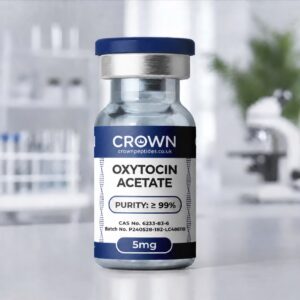
Oxytocin Acetate Research Peptide
HPLC and MS verified · batch certificate published · dispatched from the UK before 2pm
Where the Research Is Heading
Oxytocin is one of the most actively investigated neuropeptides in the field, and the breadth of that interest is the point. Work spans social and emotional processing, stress response, metabolic regulation, bone, cardiovascular function and pain modulation — a range very few single molecules attract.
Much of the attention concerns what oxytocin appears to do centrally. Intranasal administration has been reported to attenuate cortisol and behavioural responses to psychosocial stress, and researchers have examined its influence on fear extinction, affiliation and the interpretation of social cues. These are research findings rather than settled outcomes, and the compound remains investigational for every one of these applications — but the volume and quality of laboratories working on it says something about how promising the underlying biology looks.
Trials continue across psychiatric, metabolic and delivery-focused questions, including work on nose-to-brain routes designed to improve central availability. For researchers, that makes oxytocin an unusually well-supported starting point: a molecule with settled peripheral physiology, an identified receptor, and an open central literature still being written.
Why Acetate
Oxytocin is supplied as the acetate salt, which is standard for peptides of this type. The acetate counter-ion improves stability and handling of the lyophilised material; the peptide itself is unchanged. Quoted masses may refer to either the free peptide or the salt, which is worth checking on any certificate before calculating concentrations.
Read the certificate before you order
Every batch is published openly — identity by mass spectrometry, purity by HPLC, and the batch number printed on the vial you receive.
Open the COA libraryFrequently Asked Questions
How does oxytocin differ from vasopressin?
Two amino acids, at positions three and eight. Both are nonapeptides from the posterior pituitary with the same disulfide-closed ring structure, but the substitutions give them very different activity.
Why is the disulfide bond important?
It closes the first six residues into a ring, giving the molecule a defined conformation. Without it, oxytocin is a linear chain with no biological activity.
What does oxytocin acetate mean?
It is the acetate salt form of the peptide, used for stability. The peptide sequence is identical; only the counter-ion differs.
How is oxytocin tested?
Every batch is analysed by HPLC for purity and mass spectrometry for identity, with the certificate published in full and the batch number printed on the vial.
References
- du Vigneaud V. et al. The synthesis of oxytocin. Journal of the American Chemical Society, 1953.
- Nobel Prize in Chemistry 1955, awarded to Vincent du Vigneaud for the first synthesis of a polypeptide hormone.
- Gimpl G., Fahrenholz F. The oxytocin receptor system: structure, function, and regulation. Physiological Reviews, 2001.
- Ding C., Leow M. K., Magkos F. Oxytocin in metabolic homeostasis: implications for obesity and diabetes management. Obesity Reviews, 2019.
Working with Oxytocin Acetate Research Peptide
Batch-tested material, published certificates, and same-day dispatch on orders placed before 2pm.
See Oxytocin Acetate Research Peptide