PEG-MGF Research Peptide
A high-purity research peptide studied in PEGylation, peptide stability and growth-factor delivery research. Coming soon in 2mg, with every batch independently tested and dispatched from the UK.
Out of stock
Supplied for laboratory research purposes only — not for human consumption or for medical, veterinary or diagnostic use.
Product Overview
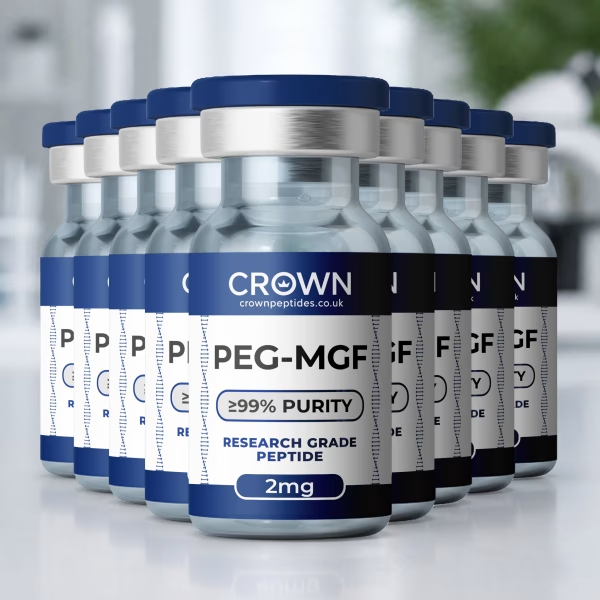
PEG-MGF peptide UK is Crown Peptides’ synthetic PEGylated form of the 24-residue mechano growth factor E-domain peptide, a research compound coming soon in 2mg for laboratory research.
- Studied in research involving PEGylation and peptide half-life extension
- Studied in research involving PEGylated IGF-1, a related product of the same gene
- Studied in research involving sustained and localised delivery of MGF E-domain peptides
- Studied in research involving PEG-linked MGF as a targeting tag in nanoparticle delivery
- Batch-specific quality documentation available
About PEG-MGF Peptide UK
PEG-MGF is the 24-residue MGF peptide, the C-terminal stretch of the E domain of the IGF-1Ec splice variant, with a chain of polyethylene glycol (PEG) attached. PEG is a flexible, water-loving polymer built from repeating ethylene oxide units of 44 daltons each, and joining it to a peptide is called PEGylation. The approach is one of the best-established ways of changing how long a peptide or protein lasts, and it sits alongside other half-life strategies in the growth-axis area, such as the albumin-binding group in CJC-1295 with DAC and the N-terminal modification in Tesamorelin.
Also known as: PEGylated MGF, PEGylated mechano growth factor, pegylated mechano-growth factor, PEG MGF, PEG-mechano growth factor
Unlike plain MGF, PEG-MGF has no single agreed structure. Supplier listings we reviewed in October 2026 describe at least three different products under the same name: one with a short two-unit PEG linker and a mass of about 2,993 daltons, one with a 2 kDa PEG chain and a total mass of about 5,000 daltons, and one stated at about 3,825 daltons. Where a sequence is given, it is usually the 24-residue form ending Glu-Glu-His-Lys. For that reason researchers rely on the batch Certificate of Analysis to know exactly which conjugate they hold. Researchers comparing modified and unmodified IGF-system peptides may also use IGF-1 LR3, which extends the mature hormone’s activity by a different route.
PEG-MGF Research
There are, as yet, no peer-reviewed studies of PEG-MGF as a stand-alone compound: a PubMed search in October 2026 found no paper characterising a PEG-MGF conjugate’s stability, half-life or activity. Its research context comes from three places: PEGylation science in general, which a widely cited review in Nature Reviews Drug Discovery summarises, (Learn more) work on PEGylated IGF-1, and studies of the unmodified MGF E-domain peptide. The findings below are reported for those compounds, not for PEG-MGF. Related compounds include TB-500 and BPC-157.
- PEGylation and peptide half-life extension
- PEGylated IGF-1 (related compound)
- Sustained and localised delivery of MGF E-domain peptides (parent peptide)
- PEG-linked MGF as a nanoparticle targeting tag
What PEGylation is designed to do
Peptide and protein molecules are often broken down by enzymes, filtered quickly by the kidneys and short-lived in circulation. The 2003 review explains how attaching PEG chains increases a molecule’s effective size and shields it from proteolytic enzymes, which is why PEGylation became a standard tool for improving pharmacokinetics. (Learn more) A 24-residue peptide such as MGF, at under 3,000 daltons, is exactly the kind of small molecule this reasoning is usually applied to.
The closest relative with data: PEGylated IGF-1
MGF comes from the IGF-1 gene, and the mature hormone from that gene has been PEGylated and studied in detail. In a first-in-man study of 62 healthy volunteers, Roche’s PEGylated recombinant IGF-1, RO5046013, had a half-life of 140 to 200 hours, exposure rose roughly in proportion to dose, and growth hormone secretion was suppressed far less than with unmodified IGF-1. (Learn more) In mice, a version carrying a 40 kDa PEG chain cleared slowly enough for twice-weekly dosing to hold steady serum levels, and in a photothrombotic stroke model it reduced infarct volume and improved motor function in both young and aged animals. (Learn more) These are findings for PEGylated mature IGF-1, a much larger protein, not for the E-domain peptide.
The trade-off: stability versus activity
PEGylation is not free. A 2018 study notes that adding PEG frequently reduces bioactivity, and showed that IGF-1 carrying a 30 kDa PEG on a protease-sensitive linker bound its binding proteins differently and behaved differently in cell proliferation and uptake tests. When matrix metalloproteinases cut the linker, the wild-type properties returned in full. (Learn more) Whether a PEG chain changes the behaviour of the much smaller MGF peptide has not been measured.
MGF already joined to PEG: a targeting tag
The only published work we found in which the MGF peptide is linked through PEG used it as a tag rather than as the active compound. A McGill University group attached MGF, given as YQPPSTNKNTKSQRRKGSTFEEHK-NH2 with a mass of 2,848 daltons, and the TAT peptide to PEGylated chitosan nanoparticles carrying siRNA. Given intranasally to mice, the particles delivered siRNA to the hippocampus, thalamus, hypothalamus and cerebellar Purkinje cells within four hours. (Learn more)
Other ways researchers have extended MGF
Groups studying the unmodified peptide have tackled the same stability question with delivery systems. Chitosan microspheres released 84.6% of a loaded MGF E-peptide over two weeks, and the released peptide still increased MC3T3-E1 cell proliferation. (Learn more) In a mouse infarction model, the human MGF E-domain peptide was delivered from cell-sized microrods made of poly(ethylene glycol) dimethacrylate hydrogel; the authors reported lower mortality and delayed decompensation. (Learn more) That is a PEG-based gel holding free peptide, not a PEGylated peptide, but it shows the same goal of keeping MGF in place for longer.
Taken together, PEG-MGF is best understood as an exploratory, stability-focused analogue: it combines a peptide with a substantial body of cell and animal research and a chemical modification with decades of pharmaceutical use, but the conjugate itself has not yet been characterised in the published literature.
Specifications
- Product
- PEG-MGF
- Classification
- Synthetic PEGylated IGF-1Ec E-domain peptide research compound
- Available strength
- 2mg (coming soon)
- Form
- Research material supplied according to product label
- Purity / assay
- ≥99% (HPLC), batch-specific; refer to Certificate of Analysis
- Verification
- HPLC and Mass Spectrometry where analytically appropriate
- Also known as
- PEGylated MGF, PEGylated mechano growth factor, PEG MGF
- Product Name
- PEG-MGF
- Structure
- The 24-residue MGF E-domain peptide joined to a polyethylene glycol chain; PEG length, attachment point and total mass vary between manufacturers and no structure has been published in the peer-reviewed literature, so refer to the batch Certificate of Analysis for the confirmed mass
Purity and Testing
Crown Peptides PEG-MGF will be supplied with batch-specific quality documentation appropriate to the material. Because PEG-MGF is sold with PEG chains of different lengths, identity matters as much as purity: HPLC shows how clean a batch is and separates the conjugate from any free, unPEGylated MGF, while mass spectrometry confirms the mass of the material in the vial. A short, defined PEG linker gives a single mass, whereas a longer polymer chain usually appears as a spread of peaks 44 daltons apart, one for each ethylene oxide unit. The Certificate of Analysis should be used as the definitive source for identity, assay, purity and relevant impurity information.
Storage Conditions
- Store unreconstituted material at -20°C ± 5°C in a cool, dry environment
- Prepared research solutions should use validated storage conditions appropriate to the compound and study design
- Protect from unnecessary heat, direct light and repeated temperature fluctuations
Related Compounds
Researchers working with PEG-MGF may also be interested in IGF-1 LR3, CJC-1295 with DAC, Tesamorelin, Sermorelin, TB-500, BPC-157 and AOD-9604 — other modified and growth-axis compounds studied in stability, tissue repair and endocrine research.
PEG-MGF Frequently Asked Questions
About PEG-MGF7 questions
What is PEG-MGF?
PEG-MGF is a synthetic research compound made by attaching a polyethylene glycol chain to MGF, the 24-residue peptide from the end of the IGF-1Ec E domain. It is used in exploratory laboratory work on how PEGylation alters a short growth-factor peptide, and the conjugate itself has not yet been characterised in peer-reviewed studies.
What does PEGylation mean?
PEGylation is the chemical attachment of polyethylene glycol, a chain of repeating ethylene oxide units, to a peptide or protein. The chain attracts a shell of water molecules, making the molecule behave as if it were much larger. It has been used in pharmaceutical research for decades, including on growth hormone and IGF-1.
Why would anyone PEGylate a peptide as short as MGF?
Small peptides are generally cleared quickly by the kidneys and are exposed to protein-cutting enzymes. Adding PEG increases effective size and can shield the chain from those enzymes. MGF, at under 3,000 daltons, is the kind of molecule where those effects are expected to matter most, although they have not been measured for this conjugate.
Why do PEG-MGF molecular weights differ so much between suppliers?
The name does not specify the PEG. Listings reviewed in October 2026 described a two-unit PEG linker giving about 2,993 daltons, a 2 kDa chain giving about 5,000 daltons, and a product stated at about 3,825 daltons. Each is a different molecule, which is why the batch mass spectrometry result matters more for PEG-MGF than almost any other peptide.
Does PEG-MGF have a CAS number?
Not one we could verify. The number 108174-48-7, which appears on some listings, is registered in PubChem to myxoma virus growth factor, a different protein that shares the abbreviation MGF. Another listing gives 1015036-03-4, but we found no public registry record for it. There is no PubChem compound record for PEG-MGF.
How is PEG-MGF different from MGF?
MGF is the unmodified 24-residue peptide, and it is the form used in nearly all published E-domain research on muscle, nerve and heart cells. PEG-MGF is the same peptide with a polyethylene glycol chain added, studied for questions about stability, clearance and delivery. Researchers often run both side by side, with MGF as the documented reference.
How does PEGylation compare with the DAC in CJC-1295 with DAC?
Both aim to make a peptide last longer, by different routes. PEGylation enlarges the molecule with an attached polymer chain. The Drug Affinity Complex in CJC-1295 with DAC is a small reactive group designed to bind albumin, borrowing that protein’s long life in circulation, and the same peptide without it is supplied as CJC-1295 no DAC + Ipamorelin.
Findings in research models4 questions
Has PEG-MGF itself been studied?
Not as a characterised compound. The nearest published work linked the MGF peptide through PEG to chitosan nanoparticles and used it as a targeting tag for intranasal siRNA delivery in mice, rather than testing the conjugate’s own activity. Stability, half-life and receptor data for PEG-MGF have not been reported.
What happened when IGF-1 itself was PEGylated?
In a first-in-man study, Roche’s PEGylated IGF-1 had a half-life of 140 to 200 hours, far longer than the unmodified protein, and suppressed growth hormone secretion much less. In mice it allowed twice-weekly dosing. These results concern the 70-residue mature hormone carrying a large PEG chain, not the E-domain peptide.
Can a PEG chain reduce a peptide’s activity?
Yes, and it often does. A 2018 IGF-1 study found that a 30 kDa PEG changed binding-protein affinity and cell responses, and that cutting the PEG off through a protease-sensitive linker restored the original properties. This is why PEGylated analogues are compared against their unmodified parent in the same assay.
Is a PEG hydrogel the same as PEGylation?
No. In a 2015 mouse infarction study, the MGF E-domain peptide was released from microrods made of poly(ethylene glycol) dimethacrylate gel. The peptide was held inside the material, not chemically joined to PEG. PEGylation, as in PEG-MGF, attaches the polymer to the peptide itself, so the two approaches answer different questions.
Buying, testing & storage4 questions
Is PEG-MGF legal to buy in the UK?
PEG-MGF is not a controlled drug under the Misuse of Drugs Act 1971; the Class C polypeptide hormones listed are somatropin, somatrem, somatotropin and chorionic gonadotrophins. There is no licensed medicine containing PEG-MGF in the UK. It is sold as a research compound for laboratory use only, which is how Crown Peptides supplies it. This is general information, not legal advice.
Where can I buy PEG-MGF in the UK?
PEG-MGF is coming soon to Crown Peptides in 2mg vials, available singly or in packs of 3, 5 or 10 with a saving on every vial. Orders ship from the UK, and every batch is independently tested, with its Certificate of Analysis published on this page once stock arrives.
How far does a 2mg vial go?
It depends on the PEG. At about 3,000 daltons, 2mg is roughly 0.67 micromoles; at about 5,000 daltons it is roughly 0.4 micromoles, and a larger share of the weight is polymer rather than peptide. Use the mass on your batch’s Certificate of Analysis for exact molar calculations. The 5 and 10-vial packs keep a longer project on a single batch.
How should PEG-MGF be stored once it arrives?
Keep the unreconstituted powder at -20°C ± 5°C, dry and away from light. PEG readily absorbs moisture from the air and its chains can slowly oxidise, so vials are best kept sealed and allowed to reach room temperature before opening to avoid condensation. Prepared solutions should follow conditions validated for your study design.
Read the batch certificate before you order
Every batch is published openly — identity, purity and batch number, with no account needed.
View lab reports- Laboratory research only
- Not for human or clinical use
- Not for human or veterinary consumption
Supplied for laboratory research purposes only — not for human consumption or for medical, veterinary or diagnostic use.
Other Research Peptides
 Musculoskeletal researchBPC-157 + TB-500 Blend (Wolverine Stack)5mg / 5mg · 2 strengths ›