DSIP Research Peptide
A high-purity research peptide studied in sleep research.
In stock
Supplied for laboratory research purposes only — not for human consumption or for medical, veterinary or diagnostic use.
Product Overview
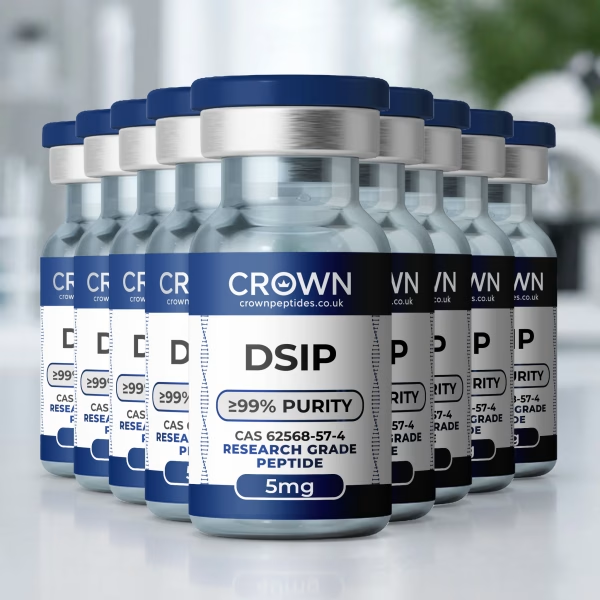
DSIP peptide UK is Crown Peptides' synthetic nonapeptide known as Delta Sleep-Inducing Peptide, available in 5mg and 10mg strengths for laboratory research.
- Studied in research involving sleep and arousal research
- Studied in research involving stress-response pathways
- Studied in research involving neuroendocrine signalling
- Studied in research involving circadian-related experimental models
- Batch-specific quality documentation available
About DSIP Peptide UK
DSIP, or Delta Sleep-Inducing Peptide, is a short synthetic peptide originally isolated in association with sleep-related neurophysiology. It has since been used in experimental research examining sleep-wake regulation, stress responses and neuroendocrine signalling.
Also known as: delta sleep-inducing peptide, DSIP peptide, emideltide.
DSIP Research
DSIP literature spans several areas of neurobiology, including sleep architecture, circadian-related processes, stress-response pathways, pain-related experimental models and endocrine regulation — described in one comprehensive review as a still unresolved riddle spanning decades of neurophysiological research (Learn more). Results across models have been variable, which makes DSIP particularly relevant as an exploratory research compound rather than a peptide with a single established biological function, alongside other neuro-research peptides such as Selank.
- Sleep and arousal research
- Stress-response pathways
- Neuroendocrine signalling
- Circadian-related experimental models
Discovered in sleeping rabbits: where DSIP came from
DSIP has one of the more unusual origin stories in neuropeptide research. A Swiss team led by Marcel Monnier and Guido Schoenenberger went looking for a sleep factor carried in the blood. They electrically stimulated the intralaminar area of the thalamus in rabbits, which produces sleep-like brain activity, and collected a dialysate of the animals’ cerebral venous blood. From that material they isolated a peptide that, when infused into the brains of other rabbits, enhanced slow-wave (delta) and spindle patterns on the EEG.
The team published its sequence in PNAS in 1977: Trp-Ala-Gly-Gly-Asp-Ala-Ser-Gly-Glu (Learn more). They synthesised it alongside five possible breakdown fragments, two altered nonapeptides and a related tripeptide, then tested all nine blind. Only the intact synthetic DSIP produced a specific effect. A follow-up paper in Pflügers Archiv put the mean rise in EEG delta activity at about 35% in both the neocortex and limbic cortex, across 61 rabbits including controls (Learn more).
Sleep-architecture research: delta waves, REM and the EEG
DSIP was defined by what it did to the EEG, the electrical rhythm of the brain. Delta waves are the slow, high-amplitude waves of deep non-REM sleep, often called slow-wave sleep. A 1984 review summarised the first decade of findings: in rodents and humans DSIP mainly promoted slow-wave sleep, while in cats the more prominent change was in REM sleep, and responses followed a U-shaped curve, fading at both low and high concentrations (Learn more).
Human work has been small and mixed. Early double-blind studies by Schneider-Helmert and Schoenenberger reported improved sleep measures in people with disturbed sleep. A later double-blind study of 16 people with chronic insomnia did record higher sleep efficiency and shorter sleep latency, but the authors judged the effects weak and partly explained by changes in the placebo group (Learn more). In animal models the story continues: a rat study under simulated high altitude reported that a phosphorylated form, P-DSIP, increased both non-REM and REM sleep and restored spatial memory.
Stress-response research in rat models
Some of the most consistent DSIP work has little to do with sleep. Russian physiologists, including K. V. Sudakov’s group, sorted rats by open-field behaviour into stress-resistant and stress-susceptible animals, then looked at how DSIP given before stress changed the brain’s response. In one study, DSIP reduced the number of c-Fos-positive cells, a marker of recent neuronal activation, in the paraventricular nucleus of the hypothalamus after immobilisation. That nucleus is the control hub of the hormonal stress axis. Blocking NMDA receptors abolished the effect in stress-susceptible rats, pointing to a glutamate-linked route (Learn more).
Related studies reported fewer ischaemically damaged cortical neurons in rats given DSIP before emotional stress, and shifts in liver antioxidant enzymes and lipid peroxidation under restraint and foot-shock stress. Endocrine work has linked DSIP to lower basal corticotropin (ACTH) levels, and in cultured human K562 cells it reduced the build-up of the stress protein HSP70. It is easy to see why the literature often calls DSIP a “stress-limiting factor”.
A natural peptide with no known gene
For a peptide studied for so long, DSIP keeps some remarkable secrets. Antibody tests have detected DSIP-like material in the hypothalamus, limbic system and pituitary, in the gut and pancreas, in plasma and even in human breast milk. In cerebrospinal fluid, DSIP-like immunoreactivity has been found to rise with age.
Yet no gene or precursor protein that would produce DSIP has been identified, and no dedicated receptor has been confirmed. In their review, Kovalzon and Strekalova argued that some effects credited to DSIP may belong to an as-yet-undiscovered DSIP-like peptide. There is a curious footnote too. The human gene now called TSC22D3, which encodes the glucocorticoid-induced leucine zipper (GILZ), once carried the name DSIPI, short for “DSIP immunoreactor”, because of its link to DSIP antibodies. GILZ is a separate, much larger protein switched on by glucocorticoid stress hormones, a neat echo of DSIP’s own stress-research profile.
Analogues, stability and newer research models
Natural DSIP is short-lived in biological fluids: its in vitro half-life has been put at around 15 minutes, because an aminopeptidase-like enzyme trims it from the tryptophan end. That has inspired a family of analogues. P-DSIP, phosphorylated on the serine at position 7, has been measured alongside DSIP in cerebrospinal fluid and compared with it in rat temperature-regulation studies, where its effects appeared and faded more quickly. DSIP-12, with beta-alanine in place of alanine at position 2, and the shortened fragment DSIP(1–4) have both been studied in rat seizure models, where they increased delta-wave power and reduced seizure severity.
Newer work keeps the peptide in active use. In a rat model of focal stroke, DSIP was associated with faster recovery of motor coordination, although the smaller infarct size did not reach significance (Learn more). A Frontiers in Pharmacology study fused DSIP to a brain-penetrating Tat sequence and reported stronger effects than DSIP alone in a mouse model of chemically induced sleeplessness. For comparative neuropeptide work, DSIP sits naturally beside Selank and Semax.
Specifications
- Product
- DSIP
- Classification
- Synthetic nonapeptide known as Delta Sleep-Inducing Peptide
- Available strengths
- 5mg and 10mg
- Form
- Research material supplied according to product label
- Purity / assay
- 99% (HPLC), batch-specific; refer to Certificate of Analysis
- Verification
- HPLC and Mass Spectrometry where analytically appropriate
- CAS Number
- 62568-57-4
- Molecular formula
- C35H48N10O15
- Molecular weight
- 848.81 g/mol
- Sequence
- Trp-Ala-Gly-Gly-Asp-Ala-Ser-Gly-Glu (WAGGDASGE)
- Peptide length
- 9 amino acids
- Also known as
- delta sleep-inducing peptide, DSIP peptide, emideltide
- Product Name
- DSIP
Purity and Testing
Crown Peptides DSIP is supplied for controlled laboratory research with batch-specific analytical documentation. High-Performance Liquid Chromatography (HPLC) can assess chromatographic purity, while Mass Spectrometry provides molecular information used to support identity verification.
The batch-specific Certificate of Analysis is the definitive source for the exact purity result, identity data and analytical specification of the material supplied.
Storage Conditions
- Store unreconstituted material at -20°C ± 5°C in a cool, dry environment
- Prepared research solutions should use validated storage conditions appropriate to the compound and study design
- Protect from unnecessary heat, direct light and repeated temperature fluctuations
Related Compounds
Researchers working with DSIP may also be interested in Selank, Semax, VIP, Kisspeptin-10 and Sermorelin — other neuroactive and neuroendocrine peptides studied in related signalling research.
DSIP Frequently Asked Questions
About DSIP6 questions
What does DSIP stand for?
Delta Sleep-Inducing Peptide. The name records the first effect ever described for it: a rise in delta-wave activity, the slow brain rhythm of deep sleep, in rabbit EEG studies. Crown Peptides supplies it in 5mg and 10mg strengths.
Why is DSIP also called emideltide?
Emideltide is the International Nonproprietary Name, the formal generic name used in pharmacology databases and regulatory listings, while DSIP, DSIP peptide and delta sleep-inducing peptide are the everyday labels for the same nine-amino-acid molecule. Adding emideltide to literature searches picks up papers and records that never use the abbreviation.
Where was DSIP first discovered?
In rabbits. Swiss researchers induced sleep-like brain activity by electrically stimulating part of the thalamus, then isolated the peptide from the animals’ cerebral venous blood. Its sequence, WAGGDASGE, was published in 1977, and synthetic DSIP reproduced the delta-wave effect in further rabbits.
Why has DSIP research moved beyond sleep?
Because the sleep findings proved inconsistent while other effects kept turning up. Alongside sleep architecture, the literature now covers stress responses, circadian and neuroendocrine signalling, and rat models of seizures, stroke and pain, where DSIP and its analogues have produced some of their clearest results.
Are DSIP research findings consistent across all models?
Far from it. Findings have varied considerably between experimental systems, species and concentrations, including a U-shaped response in early animal work, so the peptide is best described as an exploratory research compound rather than one with a single established effect.
Does the body make DSIP naturally?
DSIP-like material has been detected by antibody methods in the brain, pituitary, gut, plasma and breast milk. Even so, no gene or precursor protein for DSIP has been found, and some researchers think a related, still-unidentified peptide may be responsible for part of that signal.
Sleep & stress research4 questions
What is delta sleep, and why does it matter for DSIP research?
Delta sleep is the deepest stage of non-REM sleep, named after the slow delta waves (roughly 0.5–4 Hz) that dominate the EEG at that point. Because DSIP was identified by its ability to boost those waves, EEG recordings of delta power remain the classic read-out in DSIP sleep studies.
Has DSIP been studied in people?
Only in small studies, mostly in the 1980s and early 1990s. Early double-blind work reported improved sleep measures in people with disturbed sleep, while a later controlled study of 16 people with chronic insomnia found only weak effects. The human data are therefore limited and mixed, and most current research uses animal and cell models.
Why do stress researchers study DSIP?
Rat studies have linked it to calmer activity in the hypothalamic stress hub, lower corticotropin (ACTH) levels and protection of brain and liver tissue markers during experimental stress. Comparing stress-resistant and stress-susceptible rats has made DSIP a useful tool for exploring why individuals differ in how they respond to stress.
How does DSIP differ from Selank?
They come from different families. DSIP is a nine-amino-acid peptide first found in rabbit blood and studied mainly in sleep and stress physiology. Selank is a synthetic seven-amino-acid peptide built on tuftsin, a fragment of an immune protein, and is studied mainly in anxiety-related and immune-signalling models.
Testing & handling4 questions
When does the 10mg DSIP vial make more sense than the 5mg?
Mostly when a project runs long or wide. The 5mg size covers EEG pilot work, short behavioural experiments and method development comfortably. Stress studies comparing several rat groups, or cell work spread across many plates, are where 10mg pays off. Whichever size you pick, it can be bought singly or as a five- or ten-vial bundle, keeping a whole study on one batch.
How does DSIP’s tryptophan help confirm its identity?
The tryptophan at position 1 absorbs at 280 nm as well as in the low-UV range, giving HPLC a clean second detection channel that many small peptides lack. Mass spectrometry completes the picture: the formula C35H48N10O15 gives an average molecular weight of 848.81 g/mol and a monoisotopic mass of about 848.33, so DSIP appears near m/z 849.3 as a singly charged ion and about 425.2 as a doubly charged ion. The batch-specific CoA reports the exact results.
Why are DSIP vials best kept away from light?
Tryptophan is the residue most sensitive to light and oxidation, and in DSIP it sits right at the start of the chain, which is also where breakdown enzymes attack. That is why it pays to keep vials frozen, dry and dark, and to reconstitute only when needed, using a sterile research diluent such as bacteriostatic water.
Is Crown Peptides DSIP the same as P-DSIP?
Ours is the original, unmodified nonapeptide, WAGGDASGE. P-DSIP is a separate analogue phosphorylated on the serine at position 7, which changes its mass and behaviour, so papers on P-DSIP should not be read as data on unmodified DSIP.
Read the batch certificate before you order
Every batch is published openly — identity, purity and batch number, with no account needed.
View lab reports- Laboratory research only
- Not for human or clinical use
- Not for human or veterinary consumption
Supplied for laboratory research purposes only — not for human consumption or for medical, veterinary or diagnostic use.
Other Research Peptides
 Musculoskeletal researchBPC-157 + TB-500 Blend (Wolverine Stack)5mg / 5mg · 2 strengths ›