Semax Research Peptide
A high-purity research peptide studied in cognitive and neuroprotection research.
In stock
Supplied for laboratory research purposes only — not for human consumption or for medical, veterinary or diagnostic use.
Product Overview
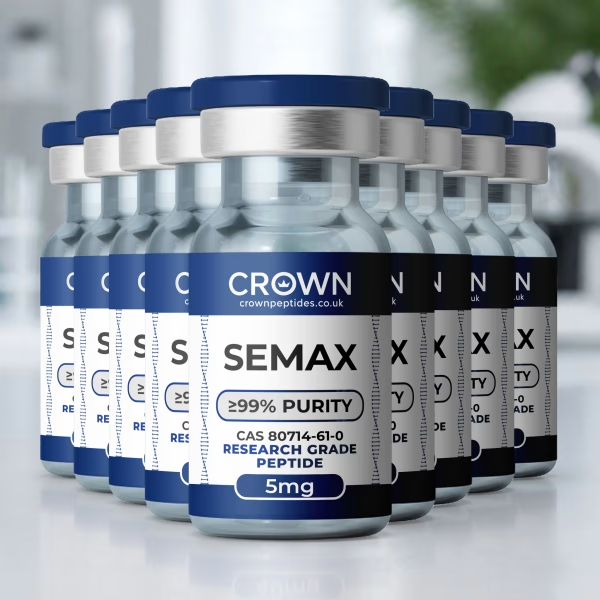
Semax peptide UK is Crown Peptides' synthetic peptide derived from an ACTH fragment, supplied in 5mg and 10mg vials for laboratory research into BDNF signalling, neuronal plasticity and cognition.
- Studied in research involving BDNF and neurotrophic signalling
- Studied in research involving learning and cognition models
- Studied in research involving neuronal plasticity
- Studied in research involving oxidative-stress and neuroprotection models
- Batch-specific quality documentation available
About Semax Peptide UK
Semax is a synthetic peptide developed from the ACTH(4-7) fragment with an added Pro-Gly-Pro sequence. It is studied in neurobiology because its research profile differs substantially from full-length ACTH and centres on neurotrophic, neuronal and stress-response pathways.
Also known as: Semax peptide, Semax acetate, MEHFPGP.
Semax Research
Semax research includes BDNF and other neurotrophic signalling, neuronal plasticity, learning and memory models, oxidative-stress responses and experimental neuroprotection (Learn more). Studies have also examined gene-expression and neurotransmitter changes following peptide exposure, alongside related nootropic and neuro-research peptides such as Selank and DSIP. These areas make Semax a frequently discussed compound in laboratory research on adaptive neuronal signalling.
- BDNF and neurotrophic signalling
- Learning and cognition models
- Neuronal plasticity
- Oxidative-stress and neuroprotection models
A Semax binding site in the basal forebrain
For a peptide studied this widely, one basic question took a long time to answer: does Semax have its own docking point in brain tissue? Using tritium-labelled peptide and cell membranes prepared from the rat basal forebrain, the Moscow group measured binding that was time-dependent, reversible and specific, with a dissociation constant of about 2.4 nM and a maximum capacity close to 33.5 fmol per milligram of protein. Unusually, that binding only occurred when calcium ions were present (Learn more). The same paper found BDNF protein in the basal forebrain climbing within three hours of intranasal application in rats, while the cerebellum stayed unchanged, pointing to a regional effect rather than a brain-wide one.
The basal forebrain houses the cholinergic neurons that supply acetylcholine to the cortex and hippocampus, so it was a logical place to look. In primary cultures from this region, Semax raised survival of cholinergic neurons by roughly 1.5- to 1.7-fold and increased choline acetyltransferase activity at 100 nM, while counts of GABA-releasing neurons and the proliferation of glial cells were unaffected.
The melanocortin question: ACTH relative, uncertain receptor
Semax is routinely grouped with the melanocortins, the family of peptides cut from pro-opiomelanocortin that includes ACTH and alpha-MSH. Yet the five melanocortin receptors (MC1R to MC5R) chiefly recognise a four-residue core, His-Phe-Arg-Trp, found at positions 6 to 9 of ACTH. Semax keeps the His-Phe half of that motif and then switches to Pro-Gly-Pro, so the arginine and tryptophan that classic melanocortin agonists rely on are absent. This is why the calcium-dependent binding site described above draws so much interest: it hints that Semax may act through something other than a textbook melanocortin receptor, though what that site actually is has not been settled.
A head-to-head study in male rats gave a useful benchmark by pairing Semax with Melanotan II, one of the most potent synthetic melanocortin agonists, in a chronic unpredictable stress model. Despite their very different structures, both peptides counteracted several of the same stress markers (Learn more), a result that keeps the receptor debate open.
Permanent ischaemia models: immune, vascular and neurotrophin genes
A large part of the Semax stroke literature uses permanent occlusion of the middle cerebral artery in rats, a model in which blood flow is never restored. A genome-wide study of the ischaemic cortex at 3 and 24 hours found that the genes Semax shifted were dominated by the immune system: by the later time point, immune-response genes made up more than half of all Semax-responsive genes, with immunoglobulin and chemokine genes forming the most notable groups (Learn more). Vascular genes responded too, 24 of them at 3 hours and 12 at 24 hours, linked to endothelial development and migration, smooth-muscle cell migration and the formation of new vessels.
An earlier paper in the same model followed neurotrophin transcripts over three days. Semax lifted Bdnf, TrkA and TrkC at 3 hours, Nt-3 and Ngf at 24 hours, and Ngf again at 72 hours. The bare Pro-Gly-Pro tripeptide also raised several of these transcripts, but its influence was largely non-specific, whereas the Semax response was selective for the ischaemic cortex.
Where Semax is cut, and what the fragments do
Short peptides rarely last long in biological fluids, and Semax research has mapped its breakdown in unusual detail. In rat blood and serum, a bestatin-sensitive aminopeptidase accounted for roughly a third to a half of the degrading activity, clipping methionine and then glutamic acid from the front of the molecule and leaving comparatively stable intermediates (Learn more). Against the remaining enzymes, Semax held up better than its parent fragment ACTH(4-10), and the authors argued that the intermediates persist long enough to share in the effects credited to the intact peptide.
Later work labelled every residue of Semax with tritium so that each fragment could be followed by HPLC. With rat basal forebrain membranes, glial cells and neurons, the main events were loss of Met-Glu from one end and Gly-Pro from the other, producing pentapeptides, although glial and neuronal cultures generated noticeably different fragment patterns.
Copper binding and the N-acetyl Semax comparison
A separate line of chemistry has grown up around the affinity of Semax for metal ions. It binds copper(II) strongly, and at around neutral pH the dominant complex arranges four nitrogen atoms in a flat, square pattern around the metal (Learn more). In SH-SY5Y neuroblastoma and RBE4 endothelial cell lines, Semax reduced copper-induced toxicity. Cell-free studies have since reported that it can pull copper away from amyloid-beta complexes, cutting copper-driven formation of reactive oxygen species and copper-promoted fibril growth in artificial membrane models.
Those results matter for analogue work. N-acetyl Semax, which carries an acetyl cap on its amino terminus, is widely listed online, and it has been compared directly with the parent peptide. The capped version formed a different copper complex, built from three nitrogens, an oxygen and a weak contact from the methionine sulphur, and it failed to protect SH-SY5Y cells from copper toxicity. The authors concluded that the free amino terminus is central to the protective result, even though both forms bound zinc with similar strength.
Specifications
- Product
- Semax
- Classification
- Synthetic peptide derived from an ACTH fragment
- Available form
- 5mg and 10mg vials
- Purity / assay
- 99% (HPLC), batch-specific; refer to Certificate of Analysis
- Verification
- HPLC and Mass Spectrometry where analytically appropriate
- Also known as
- Semax peptide, Semax acetate, MEHFPGP
- Product Name
- Semax
- CAS Number
- 80714-61-0
Purity and Testing
Crown Peptides Semax is supplied for controlled laboratory research with batch-specific analytical documentation. High-Performance Liquid Chromatography (HPLC) can assess chromatographic purity, while Mass Spectrometry provides molecular information used to support identity verification. The batch-specific Certificate of Analysis is the definitive source for the exact purity result, identity data and analytical specification of the material supplied.
Storage Conditions
- Store unreconstituted material at -20°C ± 5°C in a cool, dry environment
- Prepared research solutions should use validated storage conditions appropriate to the compound and study design
- Protect from unnecessary heat, direct light and repeated temperature fluctuations
Related Compounds
Researchers working with Semax may also be interested in Selank, DSIP, VIP, Epitalon and Kisspeptin-10 — other neuro and signalling-research peptides studied in related research areas.
Semax Frequently Asked Questions
About Semax6 questions
What is Semax?
Semax is a seven-residue synthetic peptide, Met-Glu-His-Phe-Pro-Gly-Pro, often shortened to MEHFPGP. Its formula is C37H51N9O10S and its CAS number is 80714-61-0. The opening four residues come from adrenocorticotropic hormone and the final three form a protective tail. Listings also call it Semax peptide or Semax acetate, and it comes from Crown Peptides in 5mg or 10mg vials.
Why do papers call Semax an ACTH(4-10) analogue when it carries only ACTH(4-7)?
Its starting point was ACTH(4-10), Met-Glu-His-Phe-Arg-Trp-Gly, a seven-residue fragment that had shown activity in animal behaviour studies. The designers kept positions 4 to 7 and swapped the last three residues for Pro-Gly-Pro, so the length stayed at seven. The result is a short fragment-derived peptide, not full-length ACTH, which runs to 39 residues.
Does Semax work through melanocortin receptors?
That remains unresolved. Semax lacks the arginine and tryptophan of the His-Phe-Arg-Trp motif that melanocortin receptors read most strongly, and binding studies describe a separate, calcium-dependent site in rat basal forebrain membranes. Papers still class it as a melanocortin derivative because of its ACTH origin and its overlap with Melanotan II in a rat stress study.
Why does the basal forebrain feature so heavily in Semax research?
This region contains the cholinergic neurons that project to the cortex and hippocampus, and it is where specific Semax binding sites were first measured. BDNF protein rose there within hours in rats but not in the cerebellum, and in cultures from the same region Semax supported cholinergic neuron survival and choline acetyltransferase activity.
Has Semax been linked with serotonin or dopamine in rodent studies?
It has. In rodents, Semax raised striatal tissue levels of 5-HIAA, the main serotonin breakdown product, by about 25% after two hours, and extracellular 5-HIAA in the striatum climbed to around 180% of baseline over one to four hours. Dopamine did not change with Semax alone, but given before D-amphetamine it sharply amplified the dopamine release and locomotor activity that amphetamine produced.
Which neurotrophin genes besides Bdnf respond to Semax?
In the permanent-ischaemia rat model, transcripts for nerve growth factor, neurotrophin-3 and the receptors TrkA and TrkC all rose at different time points alongside Bdnf. Earlier work in the intact rat hippocampus had reported rapid induction of Bdnf, Ngf and TrkB, so the response spans several members of the neurotrophin family rather than BDNF alone.
Models and analogues3 questions
Why are immune genes so prominent in Semax stroke studies?
Genome-wide profiling of ischaemic rat cortex showed the immune system accounting for the largest share of Semax-responsive genes, particularly 24 hours after permanent occlusion, with chemokines (signals that steer immune cells into damaged tissue) and immunoglobulin genes leading the list. A later protein study after temporary occlusion found more active CREB, and less MMP-9, c-Fos and active JNK, at 24 hours, consistent with altered inflammation and cell-death signalling.
How did Semax compare with Melanotan II under chronic stress?
Remarkably closely. Given at equal low molar amounts to male rats exposed to unpredictable stressors, both peptides counteracted the drop in sucrose preference, the stalled weight gain, the enlarged adrenal glands and the lower hippocampal BDNF seen in stressed controls. Neither shifted forced swim test scores. Because Melanotan II is a strong melanocortin agonist and Semax is not a classic one, the overlap has prompted questions about shared downstream pathways.
What is N-acetyl Semax, and how does it behave differently?
It is Semax with an acetyl group capping the amino-terminal methionine, a form that some suppliers also amidate at the other end. In a published comparison, the acetylated peptide held copper through a different arrangement of atoms and lost the protection against copper toxicity that unmodified Semax showed in SH-SY5Y cells. Crown Peptides Semax is the uncapped heptapeptide.
Working with Semax3 questions
What happens to Semax in serum and in cell cultures?
It is trimmed from both ends. Aminopeptidases in rat serum remove methionine first and glutamic acid next, and experiments with brain cells and membranes also showed Gly-Pro being cut from the tail, leaving five-residue fragments. Researchers needing intact peptide over long incubations often confirm stability by HPLC, as the basal forebrain culture study did, and bestatin can help reveal how much aminopeptidase activity a serum-containing system carries.
Why can a Semax mass reading come out 16 units heavy?
Semax opens with methionine, whose sulphur atom readily picks up oxygen to become methionine sulphoxide. That adds 16 daltons, so an oxidised molecule gives a protonated ion near m/z 830 instead of the expected 814.4 (monoisotopic mass about 813.35). A small sulphoxide peak is a recognised sign of air exposure, which is one reason dry, cold, tightly sealed storage suits this peptide.
Is it better to stock Semax as 5mg vials or 10mg vials?
That depends on how quickly a prepared solution will be used. The 5mg vial fits pilot work, binding assays and short culture runs where unused material would otherwise sit waiting, while the 10mg vial means fewer reconstitutions across longer animal or transcriptomic studies. Either strength can be bought singly, and boxes of 5 or 10 lower the price of each vial.
Read the batch certificate before you order
Every batch is published openly — identity, purity and batch number, with no account needed.
View lab reports- Laboratory research only
- Not for human or clinical use
- Not for human or veterinary consumption
Supplied for laboratory research purposes only — not for human consumption or for medical, veterinary or diagnostic use.
Other Research Peptides
 Musculoskeletal researchBPC-157 + TB-500 Blend (Wolverine Stack)5mg / 5mg · 2 strengths ›