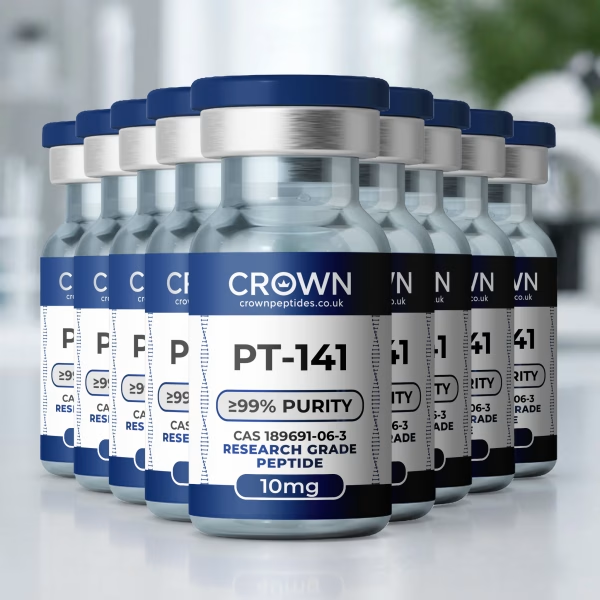
PT-141 Research Peptide
A high-purity research peptide studied in sexual-motivation (melanocortin) research.
In stock
Supplied for laboratory research purposes only — not for human consumption or for medical, veterinary or diagnostic use.
Product Overview
PT-141 peptide UK is Crown Peptides' synthetic cyclic melanocortin peptide (bremelanotide), supplied in 10mg vials for laboratory research into melanocortin receptor pharmacology and central nervous system signalling.
- Studied in research involving melanocortin receptor pharmacology
- Studied in research involving MC3R/MC4R-related signalling
- Studied in research involving central nervous system research
- Studied in research involving behavioural neurobiology models
- Batch-specific quality documentation available
About PT-141 Peptide UK
PT-141, also known as bremelanotide, is a synthetic cyclic melanocortin peptide derived from melanocortin research. Unlike pigmentation-focused analogues, much of its mechanistic research centres on central melanocortin receptor pathways.
Also known as: PT 141, PT141, bremelanotide.
PT-141 Research
PT-141 is studied in melanocortin receptor pharmacology, particularly pathways involving MC3R and MC4R in the central nervous system (Learn more). Experimental models examine neural signalling, autonomic responses and behavioural neurobiology associated with melanocortin-system activation, alongside related melanocortin-research peptides such as Melanotan-1 and Melanotan-2. Its research profile demonstrates how related melanocortin peptides can produce different biological responses depending on receptor preference and tissue context.
- Melanocortin receptor pharmacology
- MC3R/MC4R-related signalling
- Central nervous system research
- Behavioural neurobiology models
A ranked agonist: PT-141 across five melanocortin receptors
PT-141 is often described simply as an MC4R agonist, but the pharmacology is broader. The US prescribing information for bremelanotide lists it as a non-selective agonist with a potency order of MC1R, then MC4R, MC3R, MC5R and, weakest by far, MC2R. All five are G-protein-coupled receptors that raise cyclic AMP when activated, so a cAMP readout in cells expressing a single cloned receptor is the standard way to compare them.
Which receptor matters depends on where the tissue is. MC4R is concentrated in hypothalamic regions including the medial preoptic area and the paraventricular nucleus, and it is the subtype regarded as most relevant to PT-141’s central actions. MC1R sits mainly on melanocytes, and its activation explains why focal skin darkening was recorded as an adverse event in clinical studies. MC3R, also expressed in the brain, has drawn far less attention in PT-141 work, so its contribution remains an open question.
From nasal spray to licensed medicine: Palatin’s path
PT-141 was developed by Palatin Technologies of Cranbury, New Jersey, and early papers from the company described activity at MC3R and MC4R in rats and non-human primates. The first clinical programme used a nasal formulation, partnered with King Pharmaceuticals. In August 2007 the US FDA raised concerns that the compound increased blood pressure in some trial participants, and in May 2008 Palatin halted that programme as King withdrew.
Development later restarted with an injectable formulation. Two Phase 3 studies, numbered 301 and 302, enrolled premenopausal women, and in January 2017 AMAG Pharmaceuticals licensed North American rights. After approval under the brand name Vyleesi, AMAG and Palatin ended their agreement in 2020, returning the product to Palatin, which sold it to Cosette Pharmaceuticals in December 2023. The licensed product is a regulated finished medicine; Crown Peptides PT-141 is freeze-dried research material with the same peptide sequence.
Blood pressure: the cardiovascular signal in trials
Blood pressure shaped the PT-141 story more than any other safety measure. The Vyleesi label reports maximum rises of about 6 mmHg systolic and 3 mmHg diastolic, peaking two to four hours after treatment and usually back to baseline within 12 hours, with heart rate falling by up to 5 beats per minute. Uncontrolled hypertension and known cardiovascular disease are listed as contraindications.
A 2022 review of the whole development programme, covering roughly 3,500 participants in 43 completed studies, described the ambulatory monitoring results as small and transient but statistically significant (Learn more). Those findings fit a wider picture in which central MC4R signalling helps set sympathetic tone, which is why PT-141 data are often discussed alongside human MC4R genetics.
Mapping PT-141’s hypothalamic targets in rats
Early animal work tracked where PT-141 acts in the brain. When given systemically to rats, it increased c-Fos immunoreactivity, a marker of recently activated neurons, in the hypothalamus. Later studies at Concordia University in Montreal, run with Palatin scientists, used ovariectomised, hormone-primed female rats in a paced-mating arena where the female controls the timing of contact (Learn more).
In that model PT-141 increased one class of appetitive behaviour, solicitations, while lordosis and pacing were unchanged and there was no general increase in movement. The same pattern appeared when the peptide was infused into the lateral ventricles or directly into the medial preoptic area, but not the ventromedial hypothalamus. Combined with c-Fos mapping in hypothalamic and limbic regions, the authors proposed that presynaptic MC4Rs on dopamine terminals in the medial preoptic area are a key site of action, a hypothesis that keeps this region at the centre of melanocortin behavioural neuroscience.
Specifications
- Product
- PT-141
- Classification
- Synthetic cyclic melanocortin peptide also known as bremelanotide
- Available form
- 10mg vials
- Purity / assay
- 99% (HPLC), batch-specific; refer to Certificate of Analysis
- Verification
- HPLC and Mass Spectrometry where analytically appropriate
- Also known as
- Bremelanotide
- CAS Number
- 189691-06-3
- Molecular formula
- C50H68N14O10
- Molecular weight
- 1025.2 Da
- Sequence
- Ac-Nle-Asp-His-D-Phe-Arg-Trp-Lys-OH (cyclic, Asp2-Lys7 bridge)
- Peptide length
- 7 amino acids
- Product Name
- PT-141
- Alternative name
- Bremelanotide
Purity and Testing
Crown Peptides PT-141 is supplied for controlled laboratory research with batch-specific analytical documentation. High-Performance Liquid Chromatography (HPLC) can assess chromatographic purity, while Mass Spectrometry provides molecular information used to support identity verification. The batch-specific Certificate of Analysis is the definitive source for the exact purity result, identity data and analytical specification of the material supplied.
Storage Conditions
- Store unreconstituted material at -20°C ± 5°C in a cool, dry environment
- Prepared research solutions should use validated storage conditions appropriate to the compound and study design
- Protect from unnecessary heat, direct light and repeated temperature fluctuations
Related Compounds
Researchers working with PT-141 may also be interested in Melanotan-1, Melanotan-2, Kisspeptin-10, GHK-Cu and KPV — other melanocortin and receptor-signalling peptides studied in related research areas.
PT-141 Frequently Asked Questions
About PT-1416 questions
What is PT-141?
PT-141 is bremelanotide, a seven-residue cyclic peptide with the sequence Ac-Nle-cyclo[Asp-His-D-Phe-Arg-Trp-Lys]-OH, cyclised through a side-chain amide joining Asp-2 to Lys-7. It is a synthetic melanocortin receptor agonist, written variously as PT 141 or PT141, and Crown Peptides supplies it as 10mg of freeze-dried powder per vial.
How much of alpha-MSH survives in PT-141?
PT-141 corresponds to residues 4 to 10 of the 13-residue hormone, with four of those seven positions changed. Methionine 4 becomes norleucine, glutamic acid 5 becomes aspartic acid, phenylalanine 7 is swapped for its D-form, and glycine 10 becomes the lysine that anchors the ring. His-6, Arg-8 and Trp-9 are untouched, preserving the core receptor-recognition motif shared by every melanocortin.
Which company developed PT-141?
Palatin Technologies, a New Jersey biotech, carried the compound from its early rat and primate studies through to its US approval as Vyleesi, using PT-141 as its development code before the generic name bremelanotide was assigned. Along the way it worked with two partners: King Pharmaceuticals on the original nasal programme, and later AMAG Pharmaceuticals for North American commercial rights.
Why did the first PT-141 clinical programme stop?
Blood pressure was the sticking point. In 2007 the FDA flagged increases in some participants and suggested a narrower patient group than the companies had planned, and the following year Palatin ended that programme. The molecule itself was not abandoned; development resumed with a reformulated product and closer blood-pressure monitoring.
Who owns the Vyleesi brand today?
Cosette Pharmaceuticals has held it since buying the product from Palatin in December 2023. Palatin had licensed it to AMAG in 2017 and taken it back in 2020. That ownership applies to the finished, regulated medicine; a Crown Peptides vial shares the bremelanotide sequence but is research-grade material sold for laboratory work.
How does PT-141 differ from Melanotan-1?
Melanotan-1 keeps the whole 13-residue alpha-MSH chain in a straight line with two substitutions, and it is used mainly as an MC1R tool in pigment-cell work. PT-141 is roughly half the length, locked into a lactam ring and studied for its central MC4R actions. The two share the norleucine and D-phenylalanine changes, which is why both resist enzymes better than the natural hormone.
Receptors & models4 questions
Which melanocortin receptor does PT-141 activate most potently?
Somewhat unexpectedly, MC1R. The official potency ranking puts MC1R first, with MC4R second, even though MC4R is the receptor linked to PT-141’s brain effects. Research designs therefore need to consider MC1R-expressing cells and tissues as possible off-target responders, especially in skin or immune-cell experiments.
Why do rat studies of PT-141 focus on the medial preoptic area?
Infusion experiments narrowed it down. Effects seen after systemic treatment were reproduced by delivery straight into the medial preoptic area, yet not by delivery into the nearby ventromedial hypothalamus, so the preoptic region became the leading candidate site. It is also rich in MC4R and in dopamine terminals, giving a plausible mechanism to test.
What do people with MC4R mutations reveal about the blood-pressure findings?
A Cambridge study published in 2009 compared overweight people carrying loss-of-function MC4R mutations with equally overweight controls. Hypertension affected 24% of the mutation carriers against 53% of controls, and in a separate arm an experimental MC4R agonist raised blood pressure over a week of treatment (Learn more). Together these results suggest that MC4R signalling itself pushes pressure upwards, rather than this being a quirk of one compound.
Does every MC4R agonist raise blood pressure?
Not uniformly, and that is what makes the area interesting. In a short inpatient study of RM-493, the agonist later named setmelanotide, researchers reported no adverse effect on heart rate or blood pressure. Differences in receptor selectivity, signalling bias or exposure pattern are all being explored as explanations, and PT-141 serves as a useful comparison compound.
Identity & ordering2 questions
Why does PT-141 often appear near m/z 513 in a mass spectrum?
Electrospray tends to load two protons onto it, helped by its arginine and histidine, so the doubly charged ion at about m/z 513.3 is often the strongest signal, beside the singly charged ion near 1025.5. One impurity worth knowing sits 18 Da heavier: an uncyclised linear chain still carrying the water lost when the ring closes, which shows up at about 1042.5 for the singly charged form.
With only a 10mg fill on offer, how do the pack options work?
A single vial covers a pilot receptor panel, since melanocortin agonists act at low concentrations in cAMP assays. The five-vial and ten-vial boxes are for longer projects such as antagonist comparisons or repeated behavioural cohorts, where keeping every experiment on one production lot simplifies the analysis and the cost per vial drops.
Read the batch certificate before you order
Every batch is published openly — identity, purity and batch number, with no account needed.
View lab reports- Laboratory research only
- Not for human or clinical use
- Not for human or veterinary consumption
Supplied for laboratory research purposes only — not for human consumption or for medical, veterinary or diagnostic use.
Other Research Peptides
 Musculoskeletal researchBPC-157 + TB-500 Blend (Wolverine Stack)5mg / 5mg · 2 strengths ›