ARA-290 Research Peptide
A high-purity research peptide studied in tissue-protection and inflammation research.
In stock
Supplied for laboratory research purposes only — not for human consumption or for medical, veterinary or diagnostic use.
Product Overview
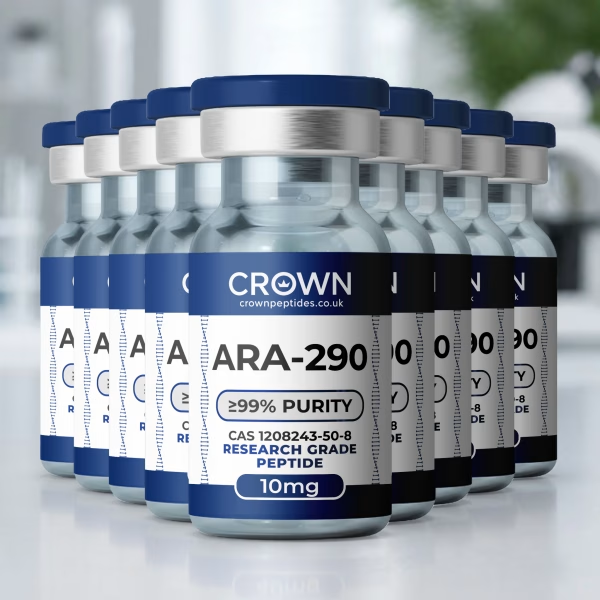
ARA-290 research peptide UK is Crown Peptides' synthetic erythropoietin-derived 11-amino-acid peptide, also known as cibinetide, available in 10mg strength for laboratory research.
- Studied in research involving innate repair receptor signalling
- Studied in research involving inflammatory and cytokine pathways
- Studied in research involving cellular stress and tissue-response models
- Studied in research involving peripheral nerve and microvascular research
- Batch-specific quality documentation available
About ARA-290 Research Peptide UK
ARA-290, also known as cibinetide, is an 11-amino-acid synthetic peptide derived from a region of erythropoietin. It was designed to investigate tissue-protective signalling without reproducing erythropoietin's red-blood-cell-stimulating activity. Research interest centres on signalling through the heteromeric innate repair receptor and the cellular responses associated with that pathway.
Also known as: ARA 290, ARA290, cibinetide.
ARA-290 Research
ARA-290 has been investigated in models of inflammatory signalling, cellular stress and tissue response. A major research theme is the innate repair receptor, a receptor complex associated with tissue-protective signalling (Learn more). Published studies have also looked at peripheral nerve biology, small-fibre and microvascular models, cytokine responses and mechanisms involved in cellular responses after stress or injury, alongside related peptide research such as SS-31 and MOTS-c.
- Innate repair receptor signalling
- Inflammatory and cytokine pathways
- Cellular stress and tissue-response models
- Peripheral nerve and microvascular research
Helix B: the protective face of erythropoietin
Erythropoietin is famous as the kidney hormone that drives red-cell production, yet laboratory work also showed that erythropoietin made locally inside tissues helps them withstand injury. Separating those two jobs was the challenge. In a 2008 paper in PNAS, Michael Brines, Anthony Cerami and colleagues traced the protective activity to helix B (residues 58–82), one of the hormone’s four helices and the one that points out into the surrounding fluid when erythropoietin sits on its classic receptor. Helix B by itself protected neurons in culture and showed tissue-protective activity in rodent models of stroke, diabetic retinal oedema and peripheral nerve trauma.
The team then shrank it further. An 11-residue peptide assembled from the amino acids along that water-facing surface kept the protective signal in rodent stroke and kidney ischaemia–reperfusion models, and also accelerated wound closure and improved performance in cognitive tasks in rodents. Crucially, neither helix B nor the short peptide stimulated red-cell formation in vitro or in vivo. With a pyroglutamate ring closing its N-terminus, that peptide is ARA-290, later given the international non-proprietary name cibinetide.
The innate repair receptor: EPOR partnered with CD131
Red-cell production runs through a homodimer, two erythropoietin receptors (EPOR) paired together on bone-marrow progenitor cells. The tissue-protective effect is attributed to a different pairing, in which EPOR teams up with CD131, the beta common receptor better known as the shared signalling chain of the IL-3, IL-5 and GM-CSF receptors. Researchers call this heterocomplex the innate repair receptor, and ARA-290 was designed to engage it while leaving the homodimer alone.
Some of the clearest genetic evidence comes from neuropathic pain models. After spared nerve injury, ARA-290 relieved touch- and cold-evoked allodynia in rats for as long as 15 weeks, and it was active in normal mice, yet it produced no effect at all in mice lacking the beta common receptor (Swartjes and colleagues, Anesthesiology, 2011). A follow-up rat study connected the long-lasting effect with a damped-down response from spinal microglia, the immune cells of the spinal cord.
Sarcoidosis small-fibre trials: endpoints met and missed
Sarcoidosis-associated small fibre neuropathy has been the main clinical research setting. A double-blind pilot in 22 patients (Heij and colleagues, Molecular Medicine, 2012) compared four weeks of ARA-290 with placebo. The Small Fiber Neuropathy Screening List score and the SF-36 pain and physical-functioning scores improved more with ARA-290, but Brief Pain Inventory and fatigue scores improved equally in both arms.
The larger phase 2b study (Culver and colleagues, Investigative Ophthalmology & Visual Science, 2017) randomised 64 people to one of three cibinetide levels or placebo for 28 days. Its primary endpoint, change in corneal nerve fibre area, reached significance in the middle group (P = 0.012), with smaller changes in the lowest and highest groups. Skin-biopsy counts of GAP-43-positive nerve fibres also rose in the middle group. Pain scores fell in every arm, placebo included; in people with moderate-to-severe pain the placebo-corrected drop was described as clinically meaningful but was not statistically significant (P = 0.157).
Diabetes studies: corneal nerves, metabolism and the retina
A phase 2 study in type 2 diabetes with painful neuropathy (Brines and colleagues, Molecular Medicine, 2015) gave ARA-290 or placebo daily for 28 days and followed participants for a further month. The ARA-290 group showed improved HbA1c and lipid profiles across the 56-day observation window and a significant improvement on the PainDetect neuropathy questionnaire. Corneal nerve fibre density was below that of healthy controls at baseline, and among participants with the lowest density it rose significantly with ARA-290 while staying flat on placebo.
Not every eye endpoint moved. A small phase 2 study in diabetic macular oedema (Lois and colleagues, Journal of Clinical Medicine, 2020) recruited nine patients, eight of whom completed 12 weeks. There was no mean improvement in visual acuity, central retinal thickness, retinal sensitivity or tear production, the four primary endpoints, although the composite visual-function questionnaire score improved slightly and no anti-cibinetide antibodies were detected.
Specifications
- Product
- ARA-290
- Classification
- Synthetic erythropoietin-derived 11-amino-acid peptide, also known as cibinetide
- Available strength
- 10mg
- Form
- Research material supplied according to product label
- Purity / assay
- 99% (HPLC), batch-specific; refer to Certificate of Analysis
- Verification
- HPLC and Mass Spectrometry where analytically appropriate
- CAS Number
- 1208243-50-8
- Molecular formula
- C51H84N16O21
- Molecular weight
- 1257.32 g/mol
- Sequence
- pGlu-Glu-Gln-Leu-Glu-Arg-Ala-Leu-Asn-Ser-Ser
- Peptide length
- 11 amino acids
- Also known as
- ARA 290, ARA290, cibinetide
- Product Name
- ARA-290
- Alternative name
- Cibinetide
Purity and Testing
Crown Peptides ARA-290 is supplied for controlled laboratory research with batch-specific analytical documentation. High-Performance Liquid Chromatography (HPLC) can assess chromatographic purity, while Mass Spectrometry provides molecular information used to support identity verification.
The batch-specific Certificate of Analysis is the definitive source for the exact purity result, identity data and analytical specification of the material supplied.
Storage Conditions
- Store unreconstituted material at -20°C ± 5°C in a cool, dry environment
- Prepared research solutions should use validated storage conditions appropriate to the compound and study design
- Protect from unnecessary heat, direct light and repeated temperature fluctuations
ARA-290 Frequently Asked Questions
About ARA-2907 questions
What is ARA-290?
ARA-290 is an 11-amino-acid synthetic peptide (pGlu-Glu-Gln-Leu-Glu-Arg-Ala-Leu-Asn-Ser-Ser) modelled on the outward-facing surface of helix B in erythropoietin. Its international non-proprietary name is cibinetide, and it is also written ARA 290 or ARA290. Crown Peptides supplies it as 10mg vials for laboratory work on the innate repair receptor.
Why does ARA-290 leave red-blood-cell production alone?
The red-cell signal depends on erythropoietin bringing two of its receptors together into a homodimer, and helix B is not part of that docking surface; it faces away into the surrounding fluid. A peptide copying helix B’s exposed face therefore has no way of assembling the homodimer. In the original 2008 experiments, neither helix B nor the 11-residue peptide raised red-cell formation in cell assays or in animals.
What is the innate repair receptor?
It is the name given to a receptor complex made of one erythropoietin receptor chain and CD131, the beta common receptor. That pairing, rather than the classic two-chain erythropoietin receptor, is linked with erythropoietin’s tissue-protective signalling, and it is the main target studied in ARA-290 papers on inflammation, cellular stress and nerve injury.
Is ARA-290 a straight cut from the erythropoietin chain?
Not quite. Its residues were chosen because they line one side of helix B, the side exposed to water. On a helix, neighbours on the same face sit several positions apart in the chain, so ARA-290 reproduces a surface pattern rather than a continuous run of erythropoietin’s sequence. The pyroglutamate at the start is a further change not found at that position in the hormone.
Which company took ARA-290 into clinical studies?
The peptide came out of work led by Michael Brines and Anthony Cerami, published in PNAS in 2008 with collaborators in several countries. Clinical development was taken forward by Araim Pharmaceuticals, and the ARA prefix in the code name is shared with that company.
Why does cibinetide hold an orphan designation in Europe?
In October 2013 the European Commission granted cibinetide orphan designation EU/3/13/1191 for sarcoidosis, a rare inflammatory disease, now sponsored by Araim Pharmaceuticals Europe Limited. An orphan designation recognises a medicine in development for a rare condition; it is not a marketing authorisation, and cibinetide has not been approved as a medicine. Crown Peptides ARA-290 is research material only.
Why is ARA-290 grouped with SS-31 and MOTS-c?
All three appear in cellular-stress research, but they work at different addresses. SS-31 concentrates on cardiolipin at the inner mitochondrial membrane, MOTS-c is a mitochondria-encoded signalling peptide, and ARA-290 acts from outside the cell through a surface receptor. That spread lets a lab compare receptor-driven protection with mitochondrial approaches in the same injury model.
Clinical and animal findings4 questions
Why do ARA-290 trials photograph corneal nerves?
The cornea is packed with fine sensory fibres of the same small-calibre type that degenerates in small fibre neuropathy, and corneal confocal microscopy can image them without taking a biopsy. That makes fibre area or density a repeatable, objective readout, which is why the sarcoidosis phase 2b study chose corneal nerve fibre area as its primary endpoint and the type 2 diabetes study tracked corneal fibre density.
Did ARA-290 change pain scores in the sarcoidosis trials?
The picture is mixed. In the 22-patient pilot, the SF-36 pain dimension improved more than with placebo, while the Brief Pain Inventory improved by a similar amount in both groups. In the 64-person phase 2b study, pain fell in all arms; the placebo-corrected reduction in participants with moderate-to-severe pain did not reach statistical significance, even though the nerve-fibre endpoint did.
What happened when ARA-290 was tested in mice lacking CD131?
Nothing measurable, and that was the point. In the spared nerve injury model, ARA-290 eased allodynia in rats and normal mice, but mice missing the beta common receptor showed no response. The authors concluded that the beta common receptor is needed for the effect, which supports the innate repair receptor as ARA-290’s route of action.
Did the diabetic macular oedema study reach its endpoints?
None of its four primary endpoints improved on average: visual acuity, central retinal thickness, retinal sensitivity and tear production. Only nine patients were recruited, with eight finishing 12 weeks, so the study was small. A modest gain in the composite visual-function questionnaire score and individual responders were reported, and no serious adverse reactions or anti-cibinetide antibodies were seen.
Identity and ordering2 questions
Why can’t Edman sequencing read ARA-290 from its first residue?
Edman chemistry needs a free amino group at the N-terminus, and ARA-290 has none: its first residue is pyroglutamate, a glutamate folded back into a five-membered lactam ring. Identity is therefore confirmed by mass spectrometry against the calculated 1257.32 g/mol for C51H84N16O21, ideally with fragmentation to check residue order, while HPLC gives the purity figure on the batch certificate.
Is there a reason to buy ARA-290 ten vials at a time?
ARA-290 comes in one 10mg strength, sold on its own, by the five or by the ten. The larger boxes suit projects that follow animals or cultures over several weeks, as the 28-day clinical designs did, or that run several injury models side by side. Keeping a whole project on one batch also means every result traces back to the same certificate.
Read the batch certificate before you order
Every batch is published openly — identity, purity and batch number, with no account needed.
View lab reports- Laboratory research only
- Not for human or clinical use
- Not for human or veterinary consumption
Supplied for laboratory research purposes only — not for human consumption or for medical, veterinary or diagnostic use.
Other Research Peptides



 Musculoskeletal researchBPC-157 + TB-500 Blend (Wolverine Stack)5mg / 5mg · 2 strengths ›