Epitalon Research Peptide
A high-purity research peptide studied in ageing and telomere research.
In stock
Supplied for laboratory research purposes only — not for human consumption or for medical, veterinary or diagnostic use.
Product Overview
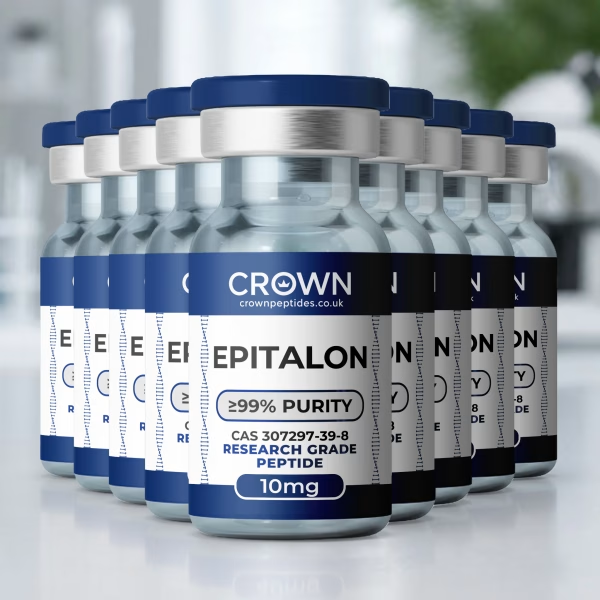
Epitalon peptide UK is Crown Peptides' synthetic tetrapeptide, also known as Epithalon, available in 10mg and 50mg strengths for laboratory research.
- Studied in research involving telomere and telomerase-associated research
- Studied in research involving cellular ageing and senescence models
- Studied in research involving oxidative-stress pathways
- Studied in research involving circadian and pineal-related research
- Batch-specific quality documentation available
About Epitalon Peptide UK
Epitalon is a synthetic tetrapeptide composed of four amino acids and is commonly discussed in research on cellular ageing and pineal-associated biology. Its small size and defined sequence make it suitable for controlled studies examining peptide interactions with cellular regulatory pathways.
Also known as: Epithalon, Epithalone, AEDG peptide, Ala-Glu-Asp-Gly.
Epitalon has the sequence Ala-Glu-Asp-Gly (AEDG). It was developed by Professor Vladimir Khavinson's group at the St Petersburg Institute of Bioregulation and Gerontology, as a synthetic version of the active part of epithalamin, an extract of the pineal gland.
At only four amino acids, Epitalon is one of the smallest peptides studied in ageing research. Its short, defined sequence makes it straightforward to synthesise and to verify by HPLC and mass spectrometry, which suits laboratories that need a well-characterised research compound.
It is often studied alongside NAD+ in ageing research, and alongside Pinealon, another short peptide from the same research group. The Epitalon research guide and Epitalon vs NAD+ cover the detail.
Epitalon Research
Epitalon research has explored telomere and telomerase-associated biology (Learn more), cellular senescence, oxidative stress, gene-expression changes and circadian-related processes. Some of this literature originates from ageing models and pineal-peptide research alongside other ageing-related compounds such as NAD+. These findings remain highly model-dependent and should be presented as experimental observations rather than established anti-ageing effects.
- Telomere and telomerase-associated research
- Cellular ageing and senescence models
- Oxidative-stress pathways
- Circadian and pineal-related research
Telomerase and telomere research: the core of the Epitalon story
Telomeres are the protective caps on the ends of chromosomes, and in most adult cells they shorten a little with every division. Telomerase is the enzyme that can rebuild them, but in ordinary somatic cells its catalytic subunit, hTERT, is largely switched off. That is why one result from Khavinson’s group attracted so much attention: adding Epitalon to cultures of telomerase-negative human fetal fibroblasts was reported to induce expression of the catalytic subunit, measurable telomerase activity and telomere elongation (Learn more).
Two decades later, an independent team at Brunel University London revisited the question with modern quantitative methods. Working with normal epithelial cells and fibroblasts alongside two breast cancer cell lines (21NT and BT474), they reported concentration-dependent telomere lengthening in the normal cells, driven by higher hTERT expression and telomerase activity. The cancer lines also showed lengthening, but mainly through a separate route called ALT (alternative lengthening of telomeres), with only a minor ALT increase in normal cells (Learn more). That split between normal and cancer cells is a key open question for telomere studies.
From pineal extract to melatonin rhythm research
Epitalon began as a question about the pineal gland. Khavinson’s team had been working with epithalamin, a polypeptide extract of bovine pineal tissue, and Epitalon was synthesised to match the amino-acid composition of that extract. According to a recent review, it was later identified in the pineal polypeptide complex itself (Learn more).
The pineal gland is the body’s main source of melatonin, the hormone that tracks the light–dark cycle, so melatonin has been a natural focus. In female rhesus monkeys, Epitalon was reported to stimulate evening melatonin production in older animals and to normalise the daily rhythm of cortisol (Learn more). The same review lists a direct influence on melatonin synthesis among the compound’s documented effects, alongside changes in enzyme activity and interleukin-2 signalling. For researchers interested in how ageing interacts with circadian timing, this pineal–melatonin connection is what sets Epitalon apart from most other peptides in ageing research.
Lifelong ageing studies in laboratory mice
Epitalon is one of relatively few short peptides to have been followed across the whole lifespan of laboratory animals. In a study by Anisimov, Khavinson and colleagues in Biogerontology, female Swiss-derived SHR mice were followed from young adulthood until natural death. Epitalon did not change food intake, body weight or mean lifespan. It did slow the age-related decline in oestrous cycling, reduce chromosome aberrations by 17.1%, increase maximum lifespan by 12.3% and coincide with a six-fold lower incidence of leukaemia compared with controls (Learn more).
Other work from the same research circle has reported fewer chromosome aberrations in senescence-accelerated mice and fewer spontaneous tumours in C3H/He mice. Tracking several markers over a lifetime, rather than one end point, is why these studies are so often cited.
Gene expression and the bioregulator hypothesis
Khavinson’s group describes Epitalon as a “peptide bioregulator”: a short peptide proposed to act inside the cell nucleus rather than at a surface receptor. Their systematic review argues that peptides of two to seven amino acids can enter the nucleus and interact with histone proteins and DNA, including sequences in gene promoters.
In human gingival mesenchymal stem cells, Epitalon was reported to increase production of the neuronal differentiation markers Nestin, GAP43, beta-tubulin III and doublecortin, with mRNA for these genes rising 1.6 to 1.8-fold (Learn more). Molecular modelling in the same paper suggested AEDG binds preferentially to the linker histones H1/3 and H1/6 at sites that contact DNA, offering one possible epigenetic route. Earlier work on cultured lymphocytes from elderly donors reported loosening of tightly packed heterochromatin. The same bioregulator idea runs through research on Pinealon, a three-amino-acid peptide from the same group, which makes the two a natural pair for comparative studies.
Antioxidant research and newer cell models
Epitalon’s research footprint now reaches well beyond telomeres. Several studies have reported increased activity of antioxidant enzymes such as superoxide dismutase and glutathione peroxidase in experimental models. A recent study used human retinal pigment epithelial cells (ARPE-19) exposed to high glucose, a laboratory model of diabetic retinopathy. High glucose slowed wound closure, raised reactive oxygen species and pushed the cells towards a scar-like, fibrotic state; Epitalon restored the delayed wound healing by countering that shift (Learn more). The retina is a recurring theme, as Khavinson’s group has long linked AEDG to retinal as well as pineal tissue.
For laboratories building a broader ageing programme, Epitalon pairs well with NAD+, which approaches ageing through cellular energy metabolism rather than telomeres and pineal signalling. Our Epitalon vs NAD+ article compares the two side by side.
Specifications
- Product
- Epitalon
- Classification
- Synthetic tetrapeptide also known as Epithalon
- Available strengths
- 10mg and 50mg
- Form
- Research material supplied according to product label
- Purity / assay
- 99% (HPLC), batch-specific; refer to Certificate of Analysis
- Verification
- HPLC and Mass Spectrometry where analytically appropriate
- Molecular formula
- C14H22N4O9
- Molecular weight
- 390.35 g/mol
- Sequence
- Ala-Glu-Asp-Gly (AEDG)
- Also known as
- Epithalon, Epithalone, AEDG peptide
- Appearance
- White lyophilised (freeze-dried) powder in a sealed glass vial
- Product Name
- Epitalon
- CAS Number
- 307297-39-8
- Peptide length
- 4 amino acids
Purity and Testing
Crown Peptides Epitalon is supplied for controlled laboratory research with batch-specific analytical documentation. High-Performance Liquid Chromatography (HPLC) can assess chromatographic purity, while Mass Spectrometry provides molecular information used to support identity verification.
The batch-specific Certificate of Analysis is the definitive source for the exact purity result, identity data and analytical specification of the material supplied.
Storage Conditions
- Store unreconstituted material at -20°C ± 5°C in a cool, dry environment
- Prepared research solutions should use validated storage conditions appropriate to the compound and study design
- Protect from unnecessary heat, direct light and repeated temperature fluctuations
Related Compounds
Researchers working with Epitalon may also be interested in NAD+, MOTS-c, SS-31, 5-Amino-1MQ and GHK-Cu — other compounds studied in cellular ageing and mitochondrial-related research.
Epitalon Frequently Asked Questions
About Epitalon6 questions
What is Epitalon?
Epitalon is a synthetic tetrapeptide with the sequence Ala-Glu-Asp-Gly (AEDG), designed from the amino-acid make-up of epithalamin, a bovine pineal extract. Papers spell it several ways, including Epithalon, Epithalone and simply AEDG peptide. Crown Peptides supplies it as a white freeze-dried powder in 10mg and 50mg vials for telomere, pineal and cellular-ageing research.
What is the sequence of Epitalon?
AEDG in single-letter code: alanine, glutamic acid, aspartic acid and glycine. Two of the four residues, glutamic acid and aspartic acid, carry acidic side chains, which makes this a very polar little molecule.
Where does the name Epitalon come from?
It is taken from epithalamin, the pineal extract it was modelled on. The pineal gland sits in a region of the brain called the epithalamus, which gives both names their root.
Is Epitalon the same as epithalamin?
Not quite. Epithalamin is a mixture of polypeptides extracted from bovine pineal glands, while Epitalon is one defined four-amino-acid molecule made by chemical synthesis. As a single pure compound, it can be characterised far more precisely than any tissue extract.
Who developed Epitalon?
Professor Vladimir Khavinson and colleagues at the St Petersburg Institute of Bioregulation and Gerontology, within a long-running programme on short regulatory peptides. Independent teams, including one at Brunel University London, have added to that work more recently.
Why is Epitalon studied in ageing research?
It touches several hallmarks of ageing at once. Experimental work has examined telomere and telomerase biology, cellular senescence, oxidative stress, gene-expression changes and pineal melatonin rhythms in ageing models, giving researchers several measurable end points from one small molecule.
Research context4 questions
What is the difference between Epitalon and Pinealon?
Both are short “bioregulator” peptides from the same research group. Epitalon is a four-amino-acid peptide linked to pineal and cellular-ageing research, while Pinealon is a three-amino-acid peptide studied mainly in neuronal research.
How does Epitalon compare with DSIP?
They often get mentioned together because both appear in sleep and circadian discussions, but they come from quite different places. Epitalon is a four-amino-acid peptide modelled on a pineal extract, and its research centres on melatonin rhythms, telomerase and ageing models. DSIP (delta sleep-inducing peptide) is a nine-amino-acid peptide first isolated from rabbit blood and studied mainly for its effects on brain-wave patterns during sleep and on stress responses. Put simply, Epitalon is an ageing-research peptide with a circadian angle; DSIP is a sleep-research peptide.
Has Epitalon been studied in cancer cell lines as well as normal cells?
It has, and the comparison turned out to be revealing. In the Brunel University London study, normal fibroblasts and epithelial cells lengthened their telomeres mainly by switching on hTERT and telomerase, whereas two breast cancer cell lines relied largely on the alternative ALT pathway. Studies that include both cell types can therefore separate the two mechanisms.
Why is Epitalon often researched alongside NAD+?
The two look at ageing from different directions. NAD+ is central to cellular energy metabolism and the enzymes that depend on it, while Epitalon is studied for telomerase, gene expression and pineal signalling. The Epitalon vs NAD+ article covers how the two compare.
Choosing a strength & testing3 questions
Is the 50mg Epitalon vial worth it over the 10mg?
That depends on how long your study runs. For pilot work, method development or a short run of cell cultures, the 10mg vial keeps material fresh and waste low. Lifelong or multi-week ageing models and large plate-based screens get more from the 50mg vial, because the whole project can draw on one batch. Either strength can be ordered on its own or in multi-vial bundles of five and ten.
Why does Epitalon’s lack of aromatic residues matter for HPLC and mass spectrometry?
Epitalon contains no tryptophan, tyrosine or phenylalanine, so it barely absorbs at 280 nm. HPLC detection relies instead on the peptide bonds themselves, which absorb strongly in the low-UV range around 214–220 nm, and the purity figure reflects the share of that signal in the Epitalon peak. Mass spectrometry then confirms identity: the formula C14H22N4O9 gives an average molecular weight of 390.35 g/mol and a monoisotopic mass of about 390.14, so the protonated molecule appears near m/z 391.1, while impurities missing a residue sit at clearly different masses. Batch results are on the Lab Reports page.
How does Epitalon’s acidic sequence affect handling in the lab?
With glutamic and aspartic acid side by side, Epitalon carries a net negative charge at neutral pH and dissolves readily in aqueous solutions; bacteriostatic water is a common laboratory choice. It also contains none of the residues most prone to oxidation, such as methionine, cysteine or tryptophan, which helps the freeze-dried powder stay stable at -20°C.
Read the batch certificate before you order
Every batch is published openly — identity, purity and batch number, with no account needed.
View lab reports- Laboratory research only
- Not for human or clinical use
- Not for human or veterinary consumption
Supplied for laboratory research purposes only — not for human consumption or for medical, veterinary or diagnostic use.
Other Research Peptides
 Musculoskeletal researchBPC-157 + TB-500 Blend (Wolverine Stack)5mg / 5mg · 2 strengths ›