LL-37 Research Peptide
A high-purity research peptide studied in immune and antimicrobial research.
In stock
Supplied for laboratory research purposes only — not for human consumption or for medical, veterinary or diagnostic use.
Product Overview
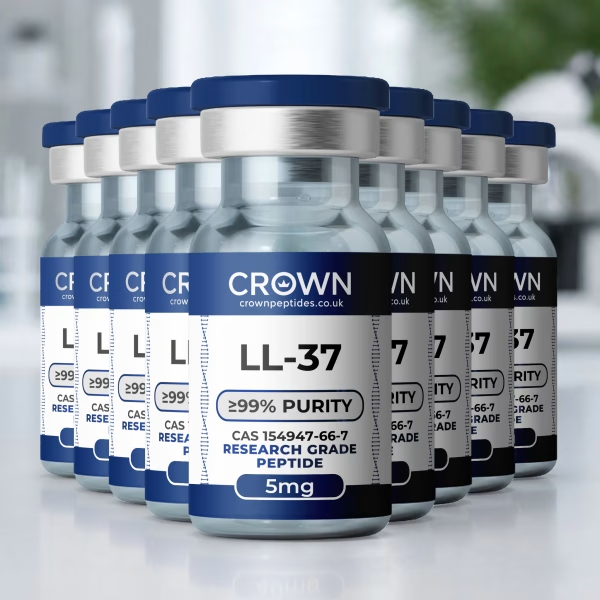
LL-37 peptide UK is Crown Peptides' human cathelicidin-derived 37-amino-acid antimicrobial peptide, available in 5mg strength for laboratory research.
- Studied in research involving antimicrobial peptide activity
- Studied in research involving biofilm and membrane-interaction research
- Studied in research involving innate immune signalling
- Studied in research involving host-defence and inflammatory pathways
- Batch-specific quality documentation available
About LL-37 Peptide UK
LL-37 is a 37-amino-acid cationic peptide generated from the human cathelicidin precursor hCAP18. It is an important research molecule in innate immunity because it combines direct antimicrobial activity with effects on host-cell signalling.
Also known as: LL 37, LL37, cathelicidin LL-37.
LL-37 Research
LL-37 has been extensively investigated in antimicrobial assays, biofilm models, membrane interactions, innate immune signalling, inflammatory responses and wound-related research, with pleiotropic activity documented across this literature (Learn more). Its amphipathic cationic structure allows interaction with microbial membranes, while separate research examines chemotactic, immune-modulatory and epithelial signalling functions, alongside related host-defence and barrier-research peptides such as KPV.
- Antimicrobial peptide activity
- Biofilm and membrane-interaction research
- Innate immune signalling
- Host-defence and inflammatory pathways
From hCAP18 to LL-37: one precursor, several fragments
Humans carry a single cathelicidin gene, CAMP, and its product is hCAP18: an 18 kDa protein with a cathelin-like domain at the front and the 37-residue LL-37 sequence at the back, stored inactive in the peroxidase-negative granules of neutrophils. Sørensen and colleagues (Blood, 2001) found that the precursor stays intact inside the phagolysosome and is only cut once it has been released from the cell, and that proteinase 3, one of the three serine proteases of the azurophil granules, is the enzyme solely responsible.
Skin handles the precursor differently. Yamasaki and colleagues (FASEB Journal, 2006) showed that kallikrein 5 and kallikrein 7, proteases of the outer skin layer, activate hCAP18 and then trim LL-37 into shorter peptides with activities of their own.
Helix, charge and the bacterial membrane
LL-37 carries eleven lysines and arginines against five aspartates and glutamates, a net charge of about +6 at neutral pH, and its hydrophobic and charged residues fall on opposite sides once it folds. Fold is the key word. In pure water at low concentration the peptide is largely disordered; anions such as bicarbonate and sulphate push it into an alpha-helix, and the degree of helicity tracked its antibacterial activity against Gram-positive and Gram-negative bacteria (Johansson and colleagues, Journal of Biological Chemistry, 1998). Shortened versions missing the first four or eight residues needed more anion to fold and were weaker against E. coli.
Membrane studies by Oren and colleagues (Biochemical Journal, 1999) added more detail. LL-37 sits in balance between single molecules and oligomers even at very low concentrations, and it resisted protease breakdown both in solution and when bound to membranes. On bacteria-like membranes its behaviour fitted a detergent-like “carpet” mechanism, and infrared work placed the helix almost flat along mammalian-type membrane surfaces rather than spanning them as a channel. It is cytotoxic to normal eukaryotic cells as well as to bacteria in culture, which is why viability controls feature so heavily in this literature.
Beyond killing: chemotaxis, receptors and self-DNA
Much of the current interest in LL-37 concerns host cells rather than microbes. De Yang and colleagues (Journal of Experimental Medicine, 2000) showed that it attracts human neutrophils, monocytes and T cells by acting on formyl peptide receptor-like 1 (FPRL1, now FPR2), giving it a recruiting role in innate and adaptive immunity.
Whether that host-directed side really matters in a living animal was settled with genetics. Nizet and colleagues (Nature, 2001) deleted the mouse cathelicidin gene and found the animals markedly more vulnerable to necrotic skin infection by group A Streptococcus, confirming cathelicidins as a genuine component of innate defence rather than an in-vitro curiosity. Human genetics points the same way: patients with Kostmann syndrome, a severe congenital neutropenia, were found to lack the peptide in plasma and saliva. Two further strands, the complexes LL-37 forms with the body’s own DNA and the over-processing seen in rosacea skin, are covered in the questions below.
Wound edges, leg ulcers and two clinical trials
Heilborn and colleagues (Journal of Investigative Dermatology, 2003) found that hCAP18 levels in human skin climb after wounding, peaking around 48 hours and falling back once the wound closes, yet the peptide was missing from the epithelium at the edge of chronic ulcers. In organ-cultured human skin, antibodies raised against LL-37 held back re-epithelialisation in a concentration-dependent way, pointing to a part for the peptide in the migrating wound edge.
That led to topical studies in hard-to-heal venous leg ulcers. A first-in-human trial in 34 participants (Grönberg and colleagues, Wound Repair and Regeneration, 2014) compared three LL-37 concentrations with placebo over four weeks: healing-rate constants were roughly six- and threefold higher in the two lower-concentration groups, significant only for the lowest, while the highest showed no difference from placebo. The follow-up phase IIb HEAL LL-37 trial in 148 patients (Mahlapuu and colleagues, 2021) found no significant improvement in the full study population; a post hoc analysis suggested better healing in the subgroup with wounds of at least 10 cm², a finding that would need confirming in a dedicated study.
Specifications
- Product
- LL-37
- Classification
- Human cathelicidin-derived 37-amino-acid antimicrobial peptide
- Available strength
- 5mg
- Form
- Research material supplied according to product label
- Purity / assay
- 99% (HPLC), batch-specific; refer to Certificate of Analysis
- Verification
- HPLC and Mass Spectrometry where analytically appropriate
- Molecular formula
- C205H340N60O53
- Molecular weight
- 4493.3 g/mol
- Sequence
- LLGDFFRKSKEKIGKEFKRIVQRIKDFLRNLVPRTES
- Peptide length
- 37 amino acids
- Also known as
- LL 37, LL37, cathelicidin LL-37
- Product Name
- LL-37
- CAS Number
- 154947-66-7
Purity and Testing
Crown Peptides LL-37 is supplied for controlled laboratory research with batch-specific analytical documentation. High-Performance Liquid Chromatography (HPLC) can assess chromatographic purity, while Mass Spectrometry provides molecular information used to support identity verification.
The batch-specific Certificate of Analysis is the definitive source for the exact purity result, identity data and analytical specification of the material supplied.
Storage Conditions
- Store unreconstituted material at -20°C ± 5°C in a cool, dry environment
- Prepared research solutions should use validated storage conditions appropriate to the compound and study design
- Protect from unnecessary heat, direct light and repeated temperature fluctuations
Related Compounds
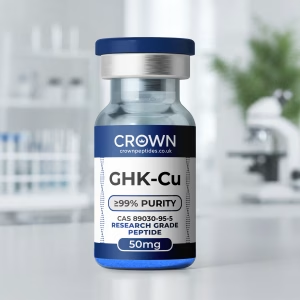
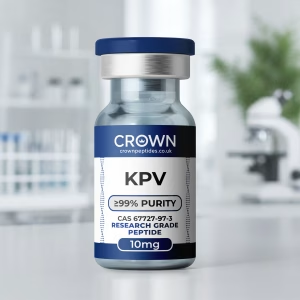
Researchers working with LL-37 may also be interested in KPV, BPC-157, Thymosin Alpha-1, VIP and GHK-Cu — other compounds studied in host-defence, immune and barrier-related research.
LL-37 Frequently Asked Questions
About LL-376 questions
What is LL-37?
LL-37 is the 37-residue cationic peptide cut from hCAP18, the only cathelicidin protein humans make. It is studied both as a membrane-active antimicrobial and as a signal that steers immune and epithelial cells. You will also see it written LL 37, LL37 or cathelicidin LL-37; Crown Peptides supplies it in 5mg vials.
What do the letters and the number in LL-37 stand for?
The name is a literal description of the peptide. It begins with two leucines (single-letter code L) and runs to 37 amino acids, ending in serine. Shorter skin fragments follow the same habit, giving names such as KR-20 and RK-31.
How does LL-37 get released from hCAP18?
By enzymatic cutting after secretion. In neutrophils the precursor is stored whole and is split by proteinase 3 once it leaves the cell, freeing LL-37 from the cathelin-like domain. In skin, kallikrein 5 and kallikrein 7 do the activating and can trim LL-37 further into smaller peptides with their own activity profiles.
Do other animals have more cathelicidins than humans?
Many do. Cattle and pigs carry several cathelicidin genes, and their precursors are activated by neutrophil elastase rather than proteinase 3. Humans rely on one gene with no backup, which is part of why LL-37 draws such concentrated attention.
What links vitamin D to LL-37?
The promoter of the CAMP gene contains a vitamin D response element. When the active hormone 1,25-dihydroxyvitamin D3 binds its receptor, cathelicidin expression rises in keratinocytes, monocytes and neutrophils, and bacterial LPS added to that effect in neutrophils. Vitamin D status is therefore worth recording in any system where cathelicidin output is measured.
Why do mouse studies often use CRAMP instead of LL-37?
CRAMP is the mouse’s own cathelicidin, encoded by the Cnlp gene and about 67% identical to LL-37. Knockout mice lacking it made it possible to test cathelicidin function in a living animal. The two are not interchangeable in every assay, though: in the Pseudomonas biofilm work, CRAMP did not reproduce LL-37’s effect at sub-inhibitory concentrations.
Membranes, biofilms and immunity7 questions
Why does LL-37 need to fold before it acts on bacteria?
Its activity depends on forming an amphipathic alpha-helix, with charged and greasy residues on opposite faces. In plain water the peptide is mostly unstructured, and ions such as bicarbonate or sulphate, or contact with a membrane, drive the fold. The more helical the peptide became in those experiments, the stronger its antibacterial activity.
What did LL-37 do to Pseudomonas biofilms below its killing concentration?
It blocked their formation. Overhage and colleagues (Infection and Immunity, 2008) saw inhibition of Pseudomonas aeruginosa biofilms at 0.5 µg/mL, far below the 64 µg/mL needed to inhibit growth. The peptide reduced bacterial attachment, stimulated twitching motility and altered the Las and Rhl quorum-sensing systems, and it also affected biofilms that had already formed.
Which receptor does LL-37 use to recruit immune cells?
Formyl peptide receptor-like 1, now usually called FPR2. LL-37 drew neutrophils, monocytes and T cells towards it, and raised calcium signalling both in monocytes and in cells engineered to carry FPRL1; cross-desensitisation by a known FPRL1 agonist confirmed the route.
Why does LL-37 keep appearing in psoriasis research?
Because of what it does with the body’s own DNA. Lande and colleagues (Nature, 2007) reported that LL-37 condenses self-DNA into aggregates that plasmacytoid dendritic cells take up and hold in early endosomes, where toll-like receptor 9 is triggered and type I interferon follows. Free self-DNA does not normally provoke that response, so the peptide was identified as the factor breaking innate tolerance in psoriatic skin.
Can having too much processed cathelicidin matter as well as too little?
Rosacea research suggests so. Affected facial skin carried unusually high cathelicidin levels and a different mix of cut fragments, alongside raised stratum corneum tryptic enzyme activity, and putting those rosacea-type peptides into mouse skin increased inflammation (Yamasaki and colleagues, Nature Medicine, 2007).
What does severe congenital neutropenia tell us about LL-37?
In an observation study of six patients with Kostmann syndrome (Pütsep and colleagues, The Lancet, 2002), neutrophils were short of the LL-37 precursor and of alpha-defensins, with none detectable in plasma or saliva, while lactoferrin and oxidative burst were normal. All had severe periodontal disease apart from one patient whose bone-marrow transplant had restored near-normal levels.
What happened when LL-37 was applied to venous leg ulcers?
Two topical studies give a cautious picture. The 34-participant first-in-human trial reported faster healing at the two lower concentrations, significant only for the lowest, and nothing at the highest. The 148-patient phase IIb trial found no significant benefit across the whole group; only a post hoc look at wounds of at least 10 cm² suggested an advantage, which remains a hypothesis rather than a result.
Analysis, handling and supply3 questions
How do the five arginines affect an LL-37 mass spectrum?
They make it busy. With five arginines and six lysines, LL-37 picks up several protons at once in electrospray ionisation, so a single sample shows a family of multiply charged ions rather than one clean peak, and the software has to work back to the neutral mass near 4493 g/mol. Its strongly basic character is also why reversed-phase runs normally include an acidic ion-pairing agent.
Is LL-37 unusually tough for a 37-residue peptide?
In solution, yes: it resisted proteolytic breakdown in the Oren membrane study both free and membrane-bound, and the N-terminal residues contributed to that resistance. That resistance is to enzymes, not to heat or light, so the freeze-dried powder still belongs at the temperature given in the storage section above. Because the fold responds to buffer ions, keeping solution conditions consistent between experiments matters as much as the cold chain.
How is the 5mg LL-37 vial supplied?
There is one strength, 5mg, available either on its own or bundled five and ten vials to a box. Concentration series across many wells use material quickly, and LL-37 is also the usual reference comparator when newer antimicrobial peptides are benchmarked, so the larger boxes suit anything past a pilot run.
Read the batch certificate before you order
Every batch is published openly — identity, purity and batch number, with no account needed.
View lab reports- Laboratory research only
- Not for human or clinical use
- Not for human or veterinary consumption
Supplied for laboratory research purposes only — not for human consumption or for medical, veterinary or diagnostic use.
Other Research Peptides
 Musculoskeletal researchBPC-157 + TB-500 Blend (Wolverine Stack)5mg / 5mg · 2 strengths ›