

Research guide
LL-37: The Only Peptide of Its Kind the Human Body Actually Makes
LL-37 is the only cathelicidin the human body produces. Thirty-seven residues, a membrane-disrupting mechanism, and research spanning immunity, wound models and cancer.
Of all the antimicrobial peptide families identified across the animal kingdom, humans carry exactly one cathelicidin. Just one. Every other mammal studied carries multiple cathelicidin genes, some species dozens, but humans rely entirely on a single peptide — LL-37 — to fill this entire branch of the innate immune system’s antimicrobial arsenal.
That singular reliance has made LL-37 one of the most extensively studied host defense peptides in the research literature, and for good reason: a molecule this central to human innate immunity, carrying no genetic backup within its own peptide family, rewards close scientific attention.
LL-37 is sold by Crown Peptides for laboratory research use only and is not approved for human consumption.
The Body’s Only Cathelicidin
LL-37 takes its name from its structure: 37 amino acids, beginning with two leucine residues. It’s derived from a larger precursor protein called hCAP-18, which is cleaved to release the mature, biologically active LL-37 peptide. It’s stored within neutrophil granules — the specialised immune cells that form the first line of cellular defence against infection — and is also secreted directly by keratinocytes (skin cells) and mucosal epithelial cells, positioning it at exactly the barrier surfaces where the body first encounters potential pathogens.
Cathelicidins as a broader peptide family are defined by a conserved “cathelin” domain present in their precursor form, a structural signature shared across the many cathelicidin genes found in other mammalian species. Humans being restricted to just this one variant is itself a research point of interest — it means LL-37 alone has to accomplish, within human biology, the range of antimicrobial and immunomodulatory functions that other species distribute across several distinct cathelicidin peptides.
Why Only One Cathelicidin Is a Notable Research Fact
It’s worth dwelling on the comparative biology point raised at the outset, because it shapes how researchers interpret LL-37’s importance. Mice carry a single cathelicidin too — CRAMP, the murine homologue frequently used as a research stand-in for LL-37 in animal studies — but many other mammalian species carry considerably larger cathelicidin gene families. Cattle and pigs, for instance, express multiple distinct cathelicidin peptides, each potentially specialised for somewhat different antimicrobial or immunomodulatory roles.
Humans having just the one gives LL-37 an outsized functional burden within human innate immunity compared with the more distributed cathelicidin systems seen elsewhere in the mammalian world. That single-gene reliance is part of why deficits in LL-37 production or function are associated with increased susceptibility to certain infections and skin conditions in the clinical literature — there’s no backup cathelicidin gene to compensate if this one system underperforms.
- Classification
- Human cathelicidin-derived 37-amino-acid antimicrobial peptide
- Available strength
- 5mg
- CAS Number
- 154947-66-7
- Molecular Weight
- 4493.3 g/mol
- Molecular Formula
- C205H340N60O53
- Sequence
- LLGDFFRKSKEKIGKEFKRIVQRIKDFLRNLVPRTES
How LL-37 Physically Destroys Bacteria
LL-37’s core antimicrobial mechanism rests on a straightforward biophysical principle: electrostatic attraction. LL-37 carries a strong cationic (positive) charge, and bacterial cell membranes are characteristically negatively charged, unlike mammalian cell membranes, which are zwitterionic — carrying both positive and negative charges in a way that produces net neutrality. That charge difference creates a selective vulnerability: LL-37 is drawn preferentially toward bacterial membranes, largely bypassing the host’s own cells.
Once LL-37 reaches a bacterial membrane, it inserts itself into the lipid bilayer and disrupts its structural integrity, ultimately compromising the membrane’s ability to maintain the ion gradients and barrier function bacteria depend on to survive. Beyond this direct membrane-disruption mechanism, research has documented LL-37 interfering with internal bacterial processes as well, giving the peptide multiple, layered routes to antimicrobial activity across a genuinely broad spectrum of bacteria, fungi, and viruses.
The Scavenger Receptor Connection
Beyond direct membrane disruption, research has documented that cathelicidin peptides including LL-37 exert broader immunomodulatory effects specifically through interactions with scavenger receptors — a class of cell-surface receptors expressed on macrophages and other innate immune cells, traditionally studied for their role in clearing modified lipoproteins and cellular debris but increasingly recognised as important players in pathogen recognition and immune signalling more broadly.
This scavenger receptor pathway represents yet another distinct mechanism through which LL-37 shapes immune cell behaviour, separate from its direct antimicrobial killing activity and separate from its chemotactic recruitment function discussed below. Taken together, these multiple, parallel mechanisms are why researchers increasingly describe LL-37 not simply as an antimicrobial peptide but as a genuine immunomodulator — a molecule that shapes how the immune system behaves, well beyond directly killing pathogens itself.
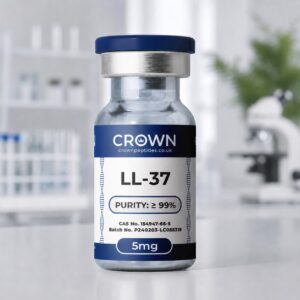
LL-37 Research Peptide
HPLC and MS verified · batch certificate published · dispatched from the UK before 2pm
Endotoxin Neutralisation: A Second Line of Defence
Beyond directly killing pathogens, LL-37 performs a second, distinct immunological function: binding and inactivating bacterial endotoxins, particularly lipopolysaccharide (LPS), the potent inflammatory trigger found in the outer membrane of gram-negative bacteria. Left unchecked, LPS can drive a dangerously excessive inflammatory response — the kind implicated in septic shock — so a peptide capable of neutralising it represents a genuinely distinct protective mechanism, separate from directly killing the bacteria producing it.
Research has specifically documented LL-37 inhibiting LPS/ATP-induced pyroptosis — an inflammatory form of programmed cell death — in macrophages, through what researchers describe as a dual mechanism. That finding illustrates how LL-37’s endotoxin-neutralising role connects directly to broader immune cell survival and inflammatory regulation, rather than functioning as an isolated, narrow biochemical curiosity.
The COVID-19 Research Connection
LL-37’s endotoxin-neutralising and inflammatory-regulation roles drew focused research attention during the COVID-19 pandemic, given how central excessive inflammatory responses became to severe disease outcomes. Research proposed that upregulating LL-37 expression might help prevent the severe inflammatory responses characteristic of serious COVID-19 cases, while also potentially reducing microthrombosis — the small blood clots increasingly recognised as a significant complication in severe cases.
That research direction connected several threads of LL-37’s known biology into a single, timely research question: its documented ability to neutralise inflammatory triggers, its nucleic-acid sensing and interferon-inducing properties relevant to antiviral defence, and its established role in vascular biology all converged as plausible mechanisms worth investigating in the specific context of a novel viral respiratory illness with a pronounced inflammatory and clotting complication profile.
Chemotaxis: Recruiting the Rest of the Immune System
LL-37’s immunomodulatory role extends into chemotaxis — the process by which chemical signals attract immune cells to a specific site. Research has documented LL-37 recruiting neutrophils, monocytes, and T cells directly to sites of infection, with effective concentrations for this chemotactic and cytokine-modulating activity typically studied in the range of 0.1 to 5 micrograms per millilitre.
That recruitment function is mediated partly through LL-37’s activation of G protein-coupled receptors, including formyl peptide receptor 2 (FPR2, also known as FPRL1) — a receptor expressed across multiple immune cell types that, once engaged, triggers directed cellular migration toward the LL-37 signal source. This chemotactic role positions LL-37 as something considerably more sophisticated than a simple antimicrobial agent: it’s an active immune system coordinator, directly shaping which cells arrive at an infection site and when.
Vitamin D and LL-37 Gene Regulation
One of the more distinctive regulatory details in LL-37’s research literature concerns its connection to vitamin D. The gene encoding LL-37’s precursor, hCAP-18, contains a vitamin D response element, meaning its expression is directly upregulated by active vitamin D signalling. That regulatory link has made LL-37 a frequent subject of interest in research examining vitamin D’s role in innate immune function more broadly, since it offers a concrete, well-characterised molecular mechanism connecting vitamin D status to a specific antimicrobial output rather than a vaguer, less mechanistically defined immune benefit.
This gene-regulatory connection is a useful example of how LL-37 research intersects with broader nutritional immunology research: understanding exactly which downstream antimicrobial and immunomodulatory pathways vitamin D influences gives researchers a considerably more precise framework than treating vitamin D’s immune effects as a single, undifferentiated phenomenon.
Nucleic Acid Sensing: A More Recently Understood Mechanism
One of the more actively developing threads in LL-37 research concerns its interaction with nucleic acids. Research indicates LL-37 enables extracellular nucleic acids to enter the cytosol of immune cells, effectively acting as a delivery vehicle. More recent research, from 2025, found that LL-37 binds double-stranded RNA and is taken up into cells together with that dsRNA via Toll-like receptors, triggering intracellular RNA sensors to induce inflammatory cytokines, including interferon-beta.
That nucleic-acid-delivery mechanism gives LL-37 a documented role in antiviral innate immune sensing specifically — recognising viral genetic material and triggering an appropriate inflammatory and interferon-mediated antiviral response. It’s a mechanistically distinct function from LL-37’s direct antimicrobial membrane-disruption activity, and one that has attracted growing research attention given how central interferon responses are to effective antiviral immunity.
Skin Biology: A Site of Constant LL-37 Activity
Skin represents a particularly active site of LL-37 research, given the peptide’s constitutive secretion by keratinocytes and its induction following injury or infection. Healthy, intact skin maintains a baseline level of LL-37 expression as part of its ongoing barrier defence function, with expression increasing further in response to injury, inflammation, or infection — a responsive, dynamically regulated system rather than a static, fixed level of protection.
That dynamic regulation has made LL-37 a frequent subject in dermatological research examining conditions where skin barrier function or antimicrobial defence is disrupted. Both insufficient and excessive LL-37 activity have been linked to distinct skin conditions in the research literature — underscoring that, as with many potent immune signalling molecules, the relationship between LL-37 levels and healthy skin function follows more of a balanced, optimal-range pattern than a simple “more is always better” relationship.
Wound Healing: Angiogenesis and Epithelial Repair
LL-37’s research profile extends well beyond direct immune defence into tissue repair specifically. Research has documented LL-37 promoting wound healing through keratinocyte migration and angiogenesis — the formation of new blood vessels essential for delivering oxygen and nutrients to healing tissue. An early foundational study specifically identified an angiogenic role for LL-37, and subsequent research using CRAMP-deficient mice — CRAMP being the murine cathelicidin homologue — found decreased vascularisation during wound repair, directly confirming that cathelicidin-mediated angiogenesis plays a functionally important role in cutaneous wound neovascularisation.
Separate research using a rabbit hind-limb model documented LL-37 inducing both angiogenesis and arteriogenesis — the formation and remodelling of larger arterial vessels, not just smaller capillaries. In vivo research specifically in diabetic mice, a model chosen because diabetic wound healing is a well-documented clinical challenge involving impaired vascularisation, found that adenoviral delivery of LL-37 significantly improved re-epithelialisation and granulation tissue formation — the two hallmark processes of effective wound closure.
Fibroblast Function and the Broader Repair Programme
Beyond keratinocyte migration and angiogenesis, LL-37’s wound-healing research also documents enhanced fibroblast function — fibroblasts being the cell type responsible for producing collagen and other extracellular matrix components that give healing tissue its structural integrity. A complete wound-healing research picture requires this three-part combination: new blood vessel formation to supply oxygen and nutrients, epithelial cell migration to close the wound surface, and fibroblast-driven matrix production to rebuild structural tissue underneath.
LL-37’s documented involvement across all three of these processes simultaneously — rather than influencing just one isolated step in the repair sequence — is a significant part of why it’s regarded as such a comprehensive wound-healing research compound, engaging multiple distinct cell populations and repair processes that would otherwise need to be independently coordinated for effective tissue regeneration to occur.
Novel Delivery Systems in Recent Research
Because LL-37 as a free peptide can be susceptible to degradation and may carry cytotoxicity concerns at higher concentrations, researchers have explored engineered delivery systems to improve its wound-healing research profile specifically. Recent research examined self-assembling PEG-PPS polymer nanomicelles combined with LL-37, finding that this delivery approach improved the oxidative microenvironment of chronic wounds and promoted angiogenesis more effectively than the free peptide alone, with diabetic wounds treated using this LL-37 nanomicelle formulation showing accelerated, higher-quality healing in vivo.
That kind of delivery-system innovation reflects a recurring pattern across peptide research more broadly: a molecule’s fundamental biological activity and the practical challenge of delivering it effectively to a target tissue are often two entirely separate research problems, each requiring its own dedicated line of investigation to fully resolve.
Cancer Research: An Emerging Application
LL-37 and structurally related peptide mimics have drawn research interest as potential anticancer agents, an application that traces back to the same membrane-selectivity principle underlying its antimicrobial activity. Many cancer cell membranes carry an altered charge profile compared with healthy cells, sharing some characteristics with the negatively charged bacterial membranes LL-37 is naturally drawn toward — a property researchers have investigated as a potential basis for selective cancer cell targeting.
This anticancer research thread remains considerably earlier-stage than LL-37’s antimicrobial and wound-healing literature, but it illustrates the same broader theme found throughout this compound’s research profile: a single, well-characterised core mechanism — selective membrane interaction driven by charge — generating research applications across genuinely distinct fields once researchers recognise how that fundamental property might apply beyond its original antimicrobial context.
Structural Flexibility and the Alpha-Helical Conformation
LL-37’s functional versatility connects to a structural property worth understanding: the peptide adopts an amphipathic alpha-helical conformation when it encounters a lipid membrane environment, meaning the helix arranges its amino acid side chains so that hydrophobic (water-repelling) and hydrophilic (water-attracting) residues cluster on opposite faces of the helix. That amphipathic arrangement is what allows the peptide to embed itself partially within a lipid bilayer while maintaining favourable interactions with the surrounding aqueous environment simultaneously.
In aqueous solution without a nearby membrane, LL-37 exists in a more disordered, less structured conformation — meaning its functional alpha-helical structure is itself context-dependent, forming specifically upon membrane contact rather than existing as a fixed, permanent structural feature. That structural flexibility is a recurring theme across many host defense peptides, and it’s part of what allows a single small molecule like LL-37 to interact effectively with the genuinely diverse range of membrane types and biological contexts its research literature spans.
Dosage in Research Settings
LL-37’s research base is concentrated in in vitro antimicrobial and topical wound-model studies rather than systemic human dosing trials, and researchers have specifically documented that both deficient and excessive concentrations within a wound environment affect outcomes differently — concentration matters in both directions, not just as a simple more-is-better relationship. That concentration-dependent profile is itself an important research design consideration rather than a detail to skip past.
Because LL-37’s clinical translation has been genuinely limited by low proteolytic stability, cytotoxicity at higher concentrations, and rapid degradation by proteases in biological fluids, published dosing figures are specific to individual study designs rather than a single settled research concentration, and none of them constitute a human administration guideline.
Reported Benefits in the Research Data
LL-37’s documented research activity spans antimicrobial, antiviral, antifungal, antiparasitic, and anti-biofilm effects against a broad range of Gram-positive and Gram-negative pathogens, alongside wound-healing effects that have made it a specific research candidate for polymicrobial infected wounds. As the only cathelicidin the human body produces, it also draws research interest simply for what it reveals about the body’s own innate antimicrobial defence system.
Side Effects and Research Limitations
LL-37’s own research literature is unusually direct about its limitations: cytotoxicity at higher concentrations, low stability in biological fluids, and rapid proteolytic degradation are all documented barriers to its clinical translation, which is exactly why so much current research effort focuses on modified LL-37 analogues designed to improve on the native peptide’s stability and safety profile rather than using the unmodified sequence directly.
Manufactured to Research Standard
LL-37’s 37-amino-acid length and cationic charge profile make purity verification especially important, given how sensitive its biological activity is to structural integrity.
Crown Peptides tests every batch of LL-37 for HPLC purity and mass spectrometry identity confirmation, with a batch-specific certificate of analysis provided for every order.
Storage follows the standard protocol used across the peptide range: supplied as a lyophilised powder, stable when kept cold and shielded from light and moisture, with reconstituted solution requiring refrigeration and use within the recommended window.
LL-37 Compared With Other Research Peptides
LL-37’s dual antimicrobial-and-repair profile places it in interesting company alongside other compounds in Crown Peptides’ research catalogue. BPC-157 and TB-500, both extensively studied for tissue repair and wound healing, work through mechanisms distinct from LL-37’s membrane-disruption and immune-recruitment activity — offering researchers complementary rather than overlapping angles into wound repair biology. GHK-Cu, studied for collagen synthesis and gene-expression modulation in skin tissue, represents yet another mechanistically distinct route into related dermatological research territory.
- Structure: 37 amino acids, derived from precursor protein hCAP-18; the only human cathelicidin.
- Core mechanism: electrostatic disruption of negatively charged bacterial membranes.
- Immune roles: LPS/endotoxin neutralisation, chemotaxis via FPR2, dsRNA sensing and interferon induction.
- Wound healing: promotes keratinocyte migration, angiogenesis, and arteriogenesis.
- Emerging research: anticancer membrane-selectivity applications, engineered nanomicelle delivery systems.
Why Membrane-Selectivity Mechanisms Draw Sustained Research Interest
It’s worth stepping back to appreciate why LL-37’s core mechanism — selective, charge-based membrane targeting — has proven so durable a research subject across such varied applications. Conventional antibiotics typically target specific bacterial biochemical processes, like cell wall synthesis or protein production machinery, which creates a very specific, exploitable vulnerability for bacteria to develop resistance against through targeted mutation.
A membrane-disruption mechanism based on broad physical and electrostatic properties, by contrast, is considerably harder for bacteria to develop resistance against, since it would require wholesale restructuring of the bacterial membrane’s fundamental charge characteristics rather than a single point mutation in one targeted protein. That resistance-resilience property is a major reason antimicrobial peptides like LL-37 continue to draw sustained research interest in an era where conventional antibiotic resistance has become an increasingly pressing global research and public health concern.
Frequently Asked Questions:
What is LL-37 Peptide Used For?
LL-37 is an antimicrobial peptide used in research to study its broad-spectrum ability to destroy bacteria, fungi, and viral pathogens, as well as its role in modulating the innate immune system. It is also investigated for its involvement in wound healing, tissue regeneration, and inflammation regulation.
Does LL-37 Need to Be Refrigerated?
Yes, once reconstituted with bacteriostatic water, LL-37 must be stored in the refrigerator between 36°F and 46°F to maintain its structural stability and potency. Unopened lyophilized powder can also be stored in the refrigerator or freezer for long-term preservation, protected from direct light and heat.
Does LL-37 Have Documented Antiviral Research Applications?
A 2025 study found LL-37 binds double-stranded RNA and is taken up into cells together with it via Toll-like receptors, triggering intracellular RNA sensors to induce antiviral cytokines including interferon-beta.
How Is LL-37 Expression Connected to Vitamin D?
The gene encoding LL-37’s precursor, hCAP-18, contains a vitamin D response element, meaning active vitamin D signalling directly upregulates its expression — a concrete molecular mechanism linking vitamin D status to innate antimicrobial defence.
Why Is LL-37’s Mechanism of Interest Given Rising Antibiotic Resistance?
Because it relies on broad electrostatic and physical membrane disruption rather than targeting one specific bacterial protein, it’s considerably harder for bacteria to develop resistance against compared with many conventional antibiotics.
Concentration-Dependent Effects Worth Understanding
A nuance that runs throughout LL-37’s research literature, and that’s worth making explicit rather than leaving implied, is how strongly concentration-dependent many of its effects are. At the relatively low concentrations typically associated with chemotaxis and cytokine modulation — the 0.1 to 5 microgram-per-millilitre range referenced earlier — LL-37 functions predominantly as an immune signalling and recruitment molecule. At higher concentrations, its direct membrane-disrupting antimicrobial activity becomes more prominent, and research has also documented cytotoxicity concerns toward host cells at sufficiently elevated concentrations.
That concentration-dependent behaviour is precisely why the delivery-system research discussed earlier — nanomicelle formulations designed to control local concentration and release kinetics — carries such practical research significance. A peptide whose beneficial and potentially harmful effects both scale with concentration, but at different thresholds, is exactly the kind of molecule where controlled, engineered delivery approaches offer genuine research value beyond simply administering the free peptide directly.
Read the certificate before you order
Every batch is published openly — identity by mass spectrometry, purity by HPLC, and the batch number printed on the vial you receive.
Open the COA libraryThe Bottom Line
LL-37’s research profile reflects the weight of responsibility that comes with being humanity’s only cathelicidin: direct antimicrobial killing, endotoxin neutralisation, immune cell recruitment, antiviral nucleic acid sensing, and tissue repair through angiogenesis, all documented within one 37-amino-acid peptide. Few host defense molecules carry a research footprint this broad, and it’s precisely that breadth that keeps LL-37 among the most actively studied antimicrobial peptides in the current literature.
References
- Duplantier AJ, van Hoek ML. The Human Cathelicidin Antimicrobial Peptide LL-37 as a Potential Treatment for Polymicrobial Infected Wounds. Front Immunol. 2013;4:143. https://pubmed.ncbi.nlm.nih.gov/23840194/
Working with LL-37 Research Peptide
Batch-tested material, published certificates, and same-day dispatch on orders placed before 2pm.
See LL-37 Research Peptide